gluten-free
We planted two blueberry bushes earlier this year, but we weren't sure whether or not they would bear fruit straight away. Fortunately they did, although the fruit doesn't all ripen at once, so I'm picking 100-150g every five days or so. I've also found out that I really prefer cooked blueberries to raw, so I've made blueberry sauce for some cheesecake pots, and added some to baked rhubarb.
I decided to put the latest pickings into a cake, but had to find a recipe using a small amount. I also had some lemons that needed using, so a blueberry and lemon cake seemed in order. I soon found this Sainsbury's recipe for a lemon and blueberry polenta cake, which only used 100g of fruit. I had to adapt the recipe a little, using vanilla yogurt instead of natural. As I was using a yogurt with a separate topping of toasted oat flakes (about a tablespoonful), I sprinkled them on top of the cake too.
This was a deliciously light cake, although I think it could have taken another 50g of fruit, as the blueberries were very thinly spread. The zest of another lemon would have improved the flavour from my point of view but I do like a tart lemon cake - others might appreciate the subtlety of a milder flavour.
It's also nice to add another gluten-free cake to my repertoire.
Showing posts with label blueberries. Show all posts
Saturday, 5 August 2017
Friday, 29 July 2016
Apple and Berry Crumble Cake
I've still got blackberries from last year, and also found a small container of frozen blueberries while assessing the space in the freezer, prior to this year's gooseberry harvest. I'd also got a couple of Bramley apples to use up, so something using all three seemed a good idea.
This recipe, for an Apple and Berry Crumble Cake, which I found on the Good to Know site, was quick to put together, as part of the base mixture was put aside for the crumble topping, rather than needing to make two separate mixtures. I used 300g total weight of mixed blackberries and blueberries as I had less than 100g of blueberries in my little pot in the freezer. I didn't bother thawing the berries ahead of use, either! In place of the mixed nuts in the topping, I used toasted chopped hazelnuts, but apart from these minor changes, I followed the recipe exactly. I didn't need to cover the cake while it was baking - even after the full cooking time it was only lightly browned.
I was worried that the combination of Bramley apples and frozen fruit would make the cake too wet but this wasn't the case, if anything the crumble topping was too dry and powdery. I think this would have made the cake quite unpleasant to eat on it's own, but it was fine as a dessert with vanilla yogurt. The fruit didn't have any extra sugar added to it, so it made a nice sharp layer between the sponge and the crumble.
This recipe, for an Apple and Berry Crumble Cake, which I found on the Good to Know site, was quick to put together, as part of the base mixture was put aside for the crumble topping, rather than needing to make two separate mixtures. I used 300g total weight of mixed blackberries and blueberries as I had less than 100g of blueberries in my little pot in the freezer. I didn't bother thawing the berries ahead of use, either! In place of the mixed nuts in the topping, I used toasted chopped hazelnuts, but apart from these minor changes, I followed the recipe exactly. I didn't need to cover the cake while it was baking - even after the full cooking time it was only lightly browned.
I was worried that the combination of Bramley apples and frozen fruit would make the cake too wet but this wasn't the case, if anything the crumble topping was too dry and powdery. I think this would have made the cake quite unpleasant to eat on it's own, but it was fine as a dessert with vanilla yogurt. The fruit didn't have any extra sugar added to it, so it made a nice sharp layer between the sponge and the crumble.
Labels:
apple,
blackberries,
blueberries,
cake,
cinnamon,
crumble,
dessert
Saturday, 25 July 2015
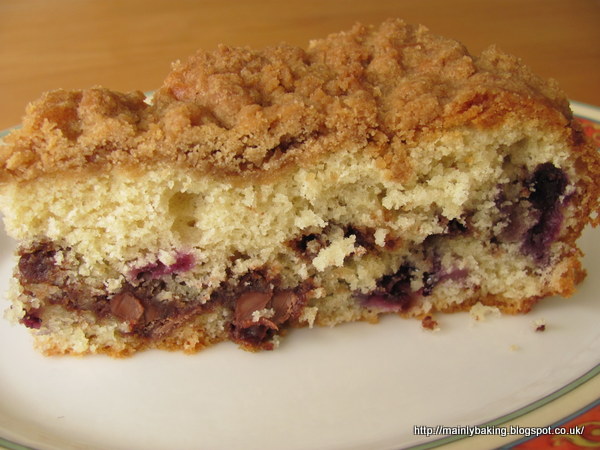
Blueberry Streusel Cake with Chocolate-Orange Chips
I was unsure about whether I should look for a chocolate recipe to which I could add blueberries, or a blueberry recipe to which I could add chocolate, but after much recipe research I chose the latter. As many blueberry recipes contain an element of citrus, I decided to add orange flavoured milk chocolate to a blueberry coffee/streusel cake. I thought that the sweetness of milk chocolate would compliment the tartness of the blueberries better than plain chocolate, which can be bitter. What surprised me was how little orange-flavoured chocolate there is in the shops - in the end I had to buy a Terry's Chocolate Orange to get reasonably priced chocolate without added ingredients such as almonds.
The only downside to the cake is that the fruit and chocolate pieces both sank, which surprised me a little as it was quite a stiff cake batter. However, it was also a shallow cake, so everything sinking didn't spoil things too much - you can see in the top photo that the fruit and chocolate filed more than half the depth of the cake in places. As I said before, I enjoyed the flavour of the blueberries and orange-chocolate together much more than I expected, and the crispness of the streusel topping made a good contrast to the soft juicy fruit.
We Should Cocoa (rules here) is the brainchild of Choclette, who usually hosts alternate months of the challenge, with guest hosts filling in the gaps. The idea of the challenge is to use chocolate in some form, alongside an added ingredient chosen by the host.Wednesday, 1 July 2015
Baking with Coconut Flour: 1 - Blueberry Coconut Cake
Coconut flour seems to be a fashionable ingredient at the moment. It is popular with those eating a Paleo diet, as they avoid any type of grain, so have considerable difficulties when it comes to needing flour for baking. It is also gluten-free, but it's cost would probably rule it out as the sole alternative to grains containing gluten for most coeliacs. Those on a Paleo diet are usually doing so because they fear modern diets are harming our health. I'm sceptical about these sort of claims, and think the new breed of 'well-being' bloggers and cooks could do more harm than good if others follow their restrictive diets, but it's not a point I want to argue about here.
I was asked to try coconut flour by Nuts.com, and was interested in taking up their challenge to try it in my baking because I've already tried, and liked, coconut oil and sugar. It was the gluten-free aspect of the flour that most interested me, as I do need to bake gluten-free goodies occasionally.
When I looked into coconut flour more closely, it seemed a very interesting product - lower in carbohydrates, higher in fibre and protein than wheat flour, as well as being gluten-free, and containing several important vitamins and minerals. This appears to make it a more nourishing ingredient to use than wheat flour, although, because it is extremely absorbent, much less of it is needed when baking, compared to flours from grains and pulses.
This absorbency presents problems when baking, as coconut flour can't be substituted weight for weight for other flours - less than half is typically needed in most recipes. Additionally, recipes advise increasing the number of eggs used (doubling the usual number seems popular), although some use oils and syrups instead of solid fats and sugars, as well as extra liquid. The main advice is to initially use recipes specifically written for coconut flour, rather than trying to adapt your own favourite recipes, until you are more familiar with how it works. This is fine, if you can find a trusted source of recipes - they aren't exactly mainstream; Paleo recipes often use ingredients that I just wouldn't want to put in my baking! Coconut flour is also extremely expensive compared to wheat flour - I paid £6.99 for 500g of Tiana coconut flour in Holland and Barrett - so I didn't want too many failures when trying recipes, even if the recipe uses only 50g! It is, however cheaper than ground nuts, which I tend to use a lot, and in larger quantities, in gluten-free baking.
The first recipe which appealed to me was a blueberry and coconut cake from the Great British Chefs website, devised by Victoria Glass. I liked the look of this because it didn't seem too extreme - it used basic white sugar, a reasonable number of eggs (I found one chocolate cake recipe which used 12!) and made a product which looked comparable to 'normal' cakes, even though it was both gluten- and dairy-free. I tried not to deviate too far from the recipe, although I did add a little vanilla extract, and only had 150g of blueberries.
This cake worked out very well - it was moist but surprisingly light, and tasted strongly of coconut, which wasn't surprising in a cake containing coconut three ways - flour, oil and desiccated. The texture of the cake wasn't any different to cakes made with grain flours, so I don't think anyone would notice that it was made with such an unusual ingredient. Despite the number of eggs used, I didn't find the flavour or texture 'over-eggy' which is a complaint about some coconut flour recipes.
The very fact that the cake was so coconutty made me want to try the flour in a recipe where the coconut flavour isn't really needed, such as a chocolate cake or brownies. The search for a suitable recipe for one of those is ongoing - the recipes I've found so far are either too 'paleo' or add other coconut products to make sure there's a strong coconut flavour.
I don't think coconut flour is likely to become one of my 'everyday' baking ingredients, but I can see that it will be useful for gluten-free baking, and that it might appeal to those who feel guilty about eating cakes and other baked goods, and want to make them a little more nutritious.
If you are interested in trying coconut flour, here's a few links to nutritional and baking guides that I found useful. Note that I'm not endorsing any health claims written therein - I don't have the expertise to either agree with or challenge them - you'll have to make up your own mind!
Retailers:
Nuts.com
Tiana-coconut.com
Sukrin Coconut Flour
Blogs:
All Day I Dream About Food
Nourished Kitchen
Elana's Pantry
Disclaimer - Although Nuts.com asked me to try coconut flour, I have received nothing from them as an inducement to either endorse their product, or give a favourable review of coconut flour in general. All opinions expressed are my own.
I was asked to try coconut flour by Nuts.com, and was interested in taking up their challenge to try it in my baking because I've already tried, and liked, coconut oil and sugar. It was the gluten-free aspect of the flour that most interested me, as I do need to bake gluten-free goodies occasionally.
When I looked into coconut flour more closely, it seemed a very interesting product - lower in carbohydrates, higher in fibre and protein than wheat flour, as well as being gluten-free, and containing several important vitamins and minerals. This appears to make it a more nourishing ingredient to use than wheat flour, although, because it is extremely absorbent, much less of it is needed when baking, compared to flours from grains and pulses.
This absorbency presents problems when baking, as coconut flour can't be substituted weight for weight for other flours - less than half is typically needed in most recipes. Additionally, recipes advise increasing the number of eggs used (doubling the usual number seems popular), although some use oils and syrups instead of solid fats and sugars, as well as extra liquid. The main advice is to initially use recipes specifically written for coconut flour, rather than trying to adapt your own favourite recipes, until you are more familiar with how it works. This is fine, if you can find a trusted source of recipes - they aren't exactly mainstream; Paleo recipes often use ingredients that I just wouldn't want to put in my baking! Coconut flour is also extremely expensive compared to wheat flour - I paid £6.99 for 500g of Tiana coconut flour in Holland and Barrett - so I didn't want too many failures when trying recipes, even if the recipe uses only 50g! It is, however cheaper than ground nuts, which I tend to use a lot, and in larger quantities, in gluten-free baking.
The first recipe which appealed to me was a blueberry and coconut cake from the Great British Chefs website, devised by Victoria Glass. I liked the look of this because it didn't seem too extreme - it used basic white sugar, a reasonable number of eggs (I found one chocolate cake recipe which used 12!) and made a product which looked comparable to 'normal' cakes, even though it was both gluten- and dairy-free. I tried not to deviate too far from the recipe, although I did add a little vanilla extract, and only had 150g of blueberries.
This cake worked out very well - it was moist but surprisingly light, and tasted strongly of coconut, which wasn't surprising in a cake containing coconut three ways - flour, oil and desiccated. The texture of the cake wasn't any different to cakes made with grain flours, so I don't think anyone would notice that it was made with such an unusual ingredient. Despite the number of eggs used, I didn't find the flavour or texture 'over-eggy' which is a complaint about some coconut flour recipes.
The very fact that the cake was so coconutty made me want to try the flour in a recipe where the coconut flavour isn't really needed, such as a chocolate cake or brownies. The search for a suitable recipe for one of those is ongoing - the recipes I've found so far are either too 'paleo' or add other coconut products to make sure there's a strong coconut flavour.
I don't think coconut flour is likely to become one of my 'everyday' baking ingredients, but I can see that it will be useful for gluten-free baking, and that it might appeal to those who feel guilty about eating cakes and other baked goods, and want to make them a little more nutritious.
If you are interested in trying coconut flour, here's a few links to nutritional and baking guides that I found useful. Note that I'm not endorsing any health claims written therein - I don't have the expertise to either agree with or challenge them - you'll have to make up your own mind!
Retailers:
Nuts.com
Tiana-coconut.com
Sukrin Coconut Flour
Blogs:
All Day I Dream About Food
Nourished Kitchen
Elana's Pantry
Disclaimer - Although Nuts.com asked me to try coconut flour, I have received nothing from them as an inducement to either endorse their product, or give a favourable review of coconut flour in general. All opinions expressed are my own.
Labels:
blueberries,
cake,
coconut,
coconut flour,
coconut oil,
dairy-free,
gluten-free
Wednesday, 14 January 2015
Lemon Blueberry Ricotta Cake
I can't remember now, why I chose this recipe; I think it was probably to use up the rest of the ricotta cheese that I'd bought for my Christmas Day dessert. The only change I made to the recipe was that my punnet of blueberries weighed 170g, and I used them all. I didn't have a loaf tin of the required dimensions, so I baked the cake in my 30cm long loaf tin. Although it is long, it has the cross section of a small 1lb tin, so gives a lot of dainty slices from one loaf.
I was in two minds about this cake - it tasted great but I thought the texture was too moist and dense. It didn't have the light crumb that you expect from a cake of this type. I think it would have made a better dessert than a tea table treat, served with a blueberry coulis and some cream. It did make a refreshing change to all the Christmas treats still lying around though!
Tuesday, 1 July 2014
Blueberry Jam and Rye Crumble Bars
This recipe, published in the Telegraph less than two weeks ago is a good example of acting quickly. I didn't have raspberry or gooseberry jam, as recommended, but I did have a blueberry conserve with extra fruit, which I was sure would have a similar tartness.
This all worked very well to produce a delicious crumble bar - Hubs described it as a portable fruit crumble, which is his favourite hot dessert, so I think he liked it! The jam was very fruity and still quite runny even after baking - I thought it might set more solidly after 45 minutes in the oven, but it kept it's soft-set consistency. This lead to the bars being quite fragile, so I think that next time I will make them in a slightly smaller tin (20cm square instead of 23cm) so that a thicker base will make them a little sturdier and easier to handle. Otherwise, no complaints!
Monday, 26 May 2014
Blueberry and Orange Bread and Butter Pudding
This recipe will make 4 generous portions, or 6 portions for those with more delicate appetites!
Ingredients
25g butter, melted
5 - 6 slices bread from a large loaf, not too thinly sliced (optional - remove crusts).
120g orange curd - approximately
zest of 1 orange, finely grated
300mls semi-skimmed milk
2 eggs
120g frozen or fresh blueberries. (If using frozen, don't thaw before assembling the pudding)
3 tablespoons Demerara sugar for sprinkling on top (optional)
Use a little of the melted butter to grease a 2 litre baking dish.
Make sandwiches using the bread and a generous amount of orange curd, and cut into small triangles.
Arrange half of the small sandwiches over the bottom of the baking dish and sprinkle over the blueberries and orange zest.
Arrange the rest of the sandwiches evenly on top, with some of the points sticking up, if possible.
Drizzle over the remaining melted butter and leave for about 10 minutes to allow the butter to soak in and set.
Beat the eggs and milk together and pour over the bread, pressing down with the back of a spoon to submerge the bread initially.
Allow to stand at room temperature for about 40 minutes, then sprinkle over the sugar and bake at 180C for 30-40 minutes, until the pudding is gold and crispy on top and the custard is set.
Best served warm rather than straight out of the oven, so allow to stand for about 20 minutes.
I used frozen blueberries, which didn't all burst when cooked; this looked good as there wasn't a lot of fruit juice spoiling the colour of the custard. The orange curd gave a strong flavour which was freshened by the orange zest. Using fresh fruit instead of dried made the pudding seem lighter and more suitable for summer.
Tuesday, 12 November 2013
Blueberry Almond Bars
These tasty fruit-topped bars, made using this recipe from Dan Lepard, are a good way of stretching a little fruit to feed several people.
The recipe, although simple enough to follow, is quite time consuming and uses a lot of equipment - a saucepan for each of the two upper layers plus a bowl for the base, as well as mixing and weighing utensils.
The results were delicious, but rather fragile. The base was quite crumbly and the almond topping stayed soft and sticky. Although this gave some lovely contrasts of texture, it made the bars difficult to cut and handle, and they needed eating with a fork.
The almond layer was very sweet and tasted of caramel, but this sweetness was offset by the tartness of the fruit and the plainness of the bottom layer, which was a cross between a shortbread and a cake.
The recipe, although simple enough to follow, is quite time consuming and uses a lot of equipment - a saucepan for each of the two upper layers plus a bowl for the base, as well as mixing and weighing utensils.
The results were delicious, but rather fragile. The base was quite crumbly and the almond topping stayed soft and sticky. Although this gave some lovely contrasts of texture, it made the bars difficult to cut and handle, and they needed eating with a fork.
Sunday, 23 June 2013
Blueberry, Hazelnut and Lime Cake
Sometimes I wonder whether my shopping habits are really as thrifty as I think they are. Why buy five limes in a pack when I only need two? Because a multi-pack is 5p per unit cheaper than buying limes individually, of course! But then I'm left with the business of making sure the three remaining limes get used up before they are too soft and squishy to use.
This recipe was a good example of getting rid of the leftovers. When searching the back of the freezer for something or other, I came across a very sad looking pack of blueberries which had been there far too long. I used my favourite quick-mix, oil-based, cake recipe, replacing the lemon zest with that of lime, the almonds with hazelnuts, and sprinkling the punnet of blueberries, still frozen, over the top. The 'drizzle' of citrus juice and sugar was left off altogether.
The resulting cake was a very good combination of flavours. The blueberries were, surprisingly, still quite juicy when cooked, so gave little tart bursts of flavour when eaten. I'm always pleased with the texture of this cake, which is moist and tender, and as this isn't a very sweet cake and doesn't contain much fat, it's feels almost healthy to eat some!
Monday, 26 March 2012
Blueberry Traybake with Lemon Streusel
I didn't really follow the recipe at all, except as a guide to quantities, but this cake was inspired by this recipe on the King Arthur Flour website. I just loved the idea of candied lemon pieces in the Streusel topping, and blueberries and lemon are a classic combination.
To keep the cake low(ish) in saturated fat, I used my standard recipe for a yogurt and oil cake, although I did keep the butter in the streusel topping. I read on one of the blogs featuring the same cake that there was an awful lot of streusel crumbs, so I reduced it to a half quantitiy, then wished I hadn't, as it didn't cover the blueberries well enough and the cake rose around the little lumps of streusel. I also made the streusel by my favoured method of melting the butter and mixing it with the other ingredients - this ensures the streusel isn't powdery at all.
Cake - 200g plain flour
2 teaspoons baking powder
115g sunflower oil
3 eggs
1 teaspoon vanilla extract
Method
Pre-heat oven to 180C and line a 12 x 8" (30 x 20cm) shallow baking tin with parchment.
Make the streusel by mixing the melted butter into the other ingredients and leaving to cool. It will be one big lump at this stage, but will crumble nicely when it's cool.
Make the cake by mixing the flour, baking powder and sugar in a large bowl. In a smaller bowl, whisk the yogurt, sunflower oil, eggs and vanilla together until emulsified, then mix into the flour. Don't overmix - just stir briskly until there are no signs of dry flour.
Transfer the batter to the baking tin, then scatter the frozen blueberries evenly over the surface.
Crumble the streusel topping evenly over the surface, then bake for 35-40 minutes, or until a test probe comes out clean. Cool in the tin
To keep the cake low(ish) in saturated fat, I used my standard recipe for a yogurt and oil cake, although I did keep the butter in the streusel topping. I read on one of the blogs featuring the same cake that there was an awful lot of streusel crumbs, so I reduced it to a half quantitiy, then wished I hadn't, as it didn't cover the blueberries well enough and the cake rose around the little lumps of streusel. I also made the streusel by my favoured method of melting the butter and mixing it with the other ingredients - this ensures the streusel isn't powdery at all.
This was a really good cake, and it would also make a tasty dessert if served still warm. It was very moist from the blueberry juice and the little pockets of crunchy lemon streusel gave a lovely contrast in flavour and texture. What started off as a potential problem - not enough streusel - ended up being a positive feature of the cake! It was also just the right size for the four of us to eat in two days - one problem with fresh fruit cakes is that they don't keep long, especially in the sort of unexpectedly hot weather we're having at the moment.
Ingredients
Streusel - 75g plain flour
50g light muscovado sugar (or demerara for more crunch)
2 tablespoons finely chopped candied lemon peel
a few drops lemon extract
grated zest of half a lemon
75g butter, meltedCake - 200g plain flour
2 teaspoons baking powder
200g caster sugar
250g low fat natural yogurt115g sunflower oil
3 eggs
1 teaspoon vanilla extract
200g frozen blueberries
Method
Pre-heat oven to 180C and line a 12 x 8" (30 x 20cm) shallow baking tin with parchment.
Make the streusel by mixing the melted butter into the other ingredients and leaving to cool. It will be one big lump at this stage, but will crumble nicely when it's cool.
Make the cake by mixing the flour, baking powder and sugar in a large bowl. In a smaller bowl, whisk the yogurt, sunflower oil, eggs and vanilla together until emulsified, then mix into the flour. Don't overmix - just stir briskly until there are no signs of dry flour.
Transfer the batter to the baking tin, then scatter the frozen blueberries evenly over the surface.
Crumble the streusel topping evenly over the surface, then bake for 35-40 minutes, or until a test probe comes out clean. Cool in the tin
Labels:
blueberries,
cake,
candied peel,
dessert,
lemon,
low saturated fat
Sunday, 11 September 2011
Orange and Blueberry Muffins
You know that me and muffins don't get along, so I surprised even myself when I decided to make these muffins, from Dom at Belleau Kitchen, as soon as I saw the recipe. This is a recipe that Dom's mum picked up from the chef when she was at the Peregrine Inn in Yosemite, California - she's a determined lady when she wants a recipe, apparently!
Surprise number two was that the recipe worked really well, although I didn't do it full justice, as I couldn't find any nuts to make the topping. That was surprise number three - that I'd let the baking store cupboard run down - not like me at all!
Unlike Dom, I did have some rolled oats that I could use, so apart from the topping and reducing the salt a little, I followed the recipe exactly, although the muffins took 20 minutes to bake with my oven set to 180C fan. This was a big recipe - I made 22 muffins, although the last two didn't have their fair share of blueberries - the fruit I bought was quite large (especially compared to frozen blueberries) so I wished I'd added a few extra. I sprinkled demerara sugar on the top of the muffins before baking, to give a textural contrast, but I really think they needed the topping given in the recipe, as the flavour was pleasant, but a little bland, without it.
As I said, the recipe worked very well to give light muffins with a close crumb. The oats really weren't evident in the texture, which was another surprise! The flavour was quite delicate, but would have been improved by the walnuts and cinnamon in the intended topping. I think this is a muffin recipe which could easily be varied by using different fruit juices, spices and added fruit - apple and blackberry springs to mind. As it's one of the most successful muffin recipes I've tried, and it fits into my 'low saturated fat' baking scheme, I'm sure I'll be using it again, so thanks to Dom and his intrepid mother for sharing the recipe!
I'm not going to copy out the recipe - you can visit Belleau Kitchen for that, from the link above - but as an aide memoire I'm going to list the metric weights/volumes of ingredients I used (or should have) after converting from cups:
Surprise number two was that the recipe worked really well, although I didn't do it full justice, as I couldn't find any nuts to make the topping. That was surprise number three - that I'd let the baking store cupboard run down - not like me at all!
Unlike Dom, I did have some rolled oats that I could use, so apart from the topping and reducing the salt a little, I followed the recipe exactly, although the muffins took 20 minutes to bake with my oven set to 180C fan. This was a big recipe - I made 22 muffins, although the last two didn't have their fair share of blueberries - the fruit I bought was quite large (especially compared to frozen blueberries) so I wished I'd added a few extra. I sprinkled demerara sugar on the top of the muffins before baking, to give a textural contrast, but I really think they needed the topping given in the recipe, as the flavour was pleasant, but a little bland, without it.
As I said, the recipe worked very well to give light muffins with a close crumb. The oats really weren't evident in the texture, which was another surprise! The flavour was quite delicate, but would have been improved by the walnuts and cinnamon in the intended topping. I think this is a muffin recipe which could easily be varied by using different fruit juices, spices and added fruit - apple and blackberry springs to mind. As it's one of the most successful muffin recipes I've tried, and it fits into my 'low saturated fat' baking scheme, I'm sure I'll be using it again, so thanks to Dom and his intrepid mother for sharing the recipe!
I'm not going to copy out the recipe - you can visit Belleau Kitchen for that, from the link above - but as an aide memoire I'm going to list the metric weights/volumes of ingredients I used (or should have) after converting from cups:
- 100g rolled oats
- 250ml orange juice
- 375g plain flour
- 200g caster sugar
- 4 teaspoons baking powder
- 1/2 teaspoon salt (reduced from original recipe)
- 250ml sunflower oil
- 3 beaten eggs
- 225g blueberries
- finely grated zest of medium orange
- 70g sugar for topping
- 50g finely chopped nuts for topping
- 1 teaspoon cinnamon for topping
Labels:
blueberries,
cupcakes and muffins,
low saturated fat,
orange
Thursday, 13 January 2011
Blueberry and Apple Loaf
This was a better attempt at baking without butter, but although the flavour was vey good, the texture still wasn't quite right - it was quite dense and flabby, rather than moist and crumbly. I think this may be because I used a Greek style yougurt, which, ironically, has higher fat levels than most full-fat natural yogurts.
On the recommendation of a poster on one of the messageboards I visit, I tried this recipe from Smitten Kitchen, although I didn't use the lemon juice syrup drizzle, as CT doen't like flavours which are too sharp. I only had 150g blueberries, which was about 1 cupful, so I added a small Cox eating apple, peeled and chopped into pieces about the same size as the blueberries. The moisture from the apples may also have contributed to making the texture denser than I'd hoped it would be. I think my loaf tin has different dimensions to the one recommended in the recipe - shorter and deeper - as the cake took 75 minutes to cook properly.
Although I wasn't completely satisfied with the texture, I think this is a recipe worth repeating. Smitten Kitchen suggests several possible variations, and I'd be interested in trying a loaf without fresh fruit - possibly with chocolate chips or nuts, using a lower fat yogurt or perhaps buttermilk.
On the recommendation of a poster on one of the messageboards I visit, I tried this recipe from Smitten Kitchen, although I didn't use the lemon juice syrup drizzle, as CT doen't like flavours which are too sharp. I only had 150g blueberries, which was about 1 cupful, so I added a small Cox eating apple, peeled and chopped into pieces about the same size as the blueberries. The moisture from the apples may also have contributed to making the texture denser than I'd hoped it would be. I think my loaf tin has different dimensions to the one recommended in the recipe - shorter and deeper - as the cake took 75 minutes to cook properly.
Although I wasn't completely satisfied with the texture, I think this is a recipe worth repeating. Smitten Kitchen suggests several possible variations, and I'd be interested in trying a loaf without fresh fruit - possibly with chocolate chips or nuts, using a lower fat yogurt or perhaps buttermilk.
Thursday, 9 December 2010
Pear and Blueberry Cupcakes with Hazelnut Crumb Topping
These are big cupcakes, bursting out of muffin cases! This recipe came about as a result of having only 80g of blueberries left over from another recipe. Not enough for blueberry muffins, or any other sort of cake where blueberries were the main feature, but with added flavours there should be enough to taste.
I quite liked the pairing of pears with blueberries, in a cake I made a while ago, so decided to repeat that combination, adding some hazelnuts to a crumble topping for added crunch and flavour.
Ingredients
100g caster sugar2 large eggs
150g SR flour
50g full-fat Greek style yogurt
1 pear, peeled cored and chopped into small pieces
80g blueberries
for the topping:
55g salted butter
70g plain flour
50g demerara sugar
25g finely chopped toasted hazelnuts
Method
First make the topping by melting the butter in a small bowl(microwave) or pan(hob), then stirring in the other ingredients. This gives a soft dough, which you will be able to crumble, once it is cool.Preheat the oven to 180C and put muffin cases into a 12-hole muffin pan
To make the cupcake batter, put all the ingredients, except the pears and blueberries, into a bowl and beat until well mixed and smooth. Fold in the chopped pears.
Distribute the batter evenly between the muffin cases, filling each one to just over halfway. I got 9 cakes out of this amount of batter. Divide the blueberries between the cupcakes, sprinkling them on the surface and pressing down lightly with the back of a spoon to flatten the mixture and embed the blueberries.
Use your fingers to crumble the topping dough over the cupcakes, as equally and evenly as possible.
Bake for 25-30 minutes, until firm and golden brown. A probe will come out clean. Cool in the pan for a few minutes then move the cupcakes to a wire rack to finish cooling.This recipe worked very well - the pear stayed evenly distributed throughout the batter, and putting the blueberries between the batter and the topping meant they didn't sink, and also gave some colour to the cupcakes. The crumble topping worked well, as it always does, adding a contrast in texture and some extra flavour to the cake. I've previously only used this recipe with added chocolate, and without it the cupcakes weren't quite sweet enough. In future I'll add an extra 25g sugar to the batter.
Labels:
blueberries,
crumble,
cupcakes and muffins,
hazelnuts,
pears
Subscribe to:
Posts (Atom)