Showing posts with label coconut flour. Show all posts

Wednesday, 21 October 2015

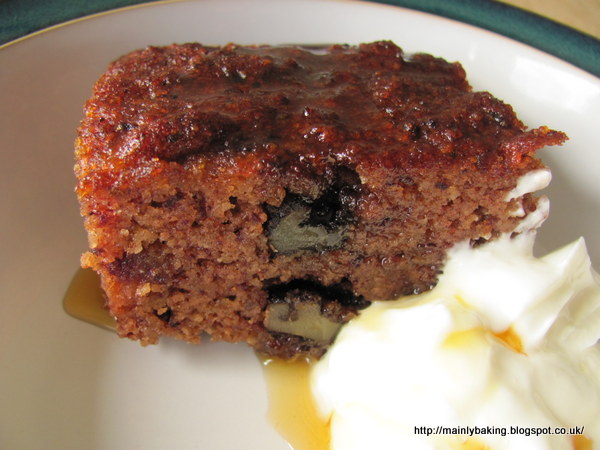
Date and Walnut Sponge Pudding

Dairy-free and gluten-free

The recipe I adapted for this gluten- and dairy-free  dessert calls itself a healthier version of a sticky toffee pudding. It comes from the Hemsley sisters who are well known for healthy eating recipes and I found it on the Vogue website. That's not a website that I would think to look at for recipes but it came up in a Google search for recipes using coconut flour.

While I'm all for healthy eating, that wasn't the aspect of the recipe that really interested me. What I wanted was a gluten-free recipe that could be adapted to be dairy-free as well. In this recipe the flour is replaced by ground almonds and coconut flour. The recipe also cuts out added refined sugar, relying on just the dates for natural sweetness. I wasn't convinced this would be sweet enough for those more used to normal puddings, so I added 75g of light muscovado sugar. I replaced the butter with coconut oil and added 75g chopped walnuts for texture and flavour (and also so that this dessert could be my contribution to this month's AlphaBakes challenge).

Ingredients
250g dried dates, roughly chopped*
1 1/4 teaspoons bicarbonate of soda
200ml boiling water
100g coconut oil
75g light muscovado sugar
3 eggs (mine happened to be large)
200g ground almonds
pinch of ground cloves
20g coconut flour
75g walnut pieces

* I used a semi-dry date which was still quite moist and sticky. I cut each date crossways into three pieces with scissors - this ensures there are no pits left in any of them.

Method
(I don't have a large food processor, so adapted the method in the original recipe to use a hand (stick) blender.)
Soak the dates in the boiling water and bicarbonate of soda for 10 minutes. While still warm, use a hand blender to purée the dates, and their liquid, with the coconut oil. If you can leave a few pieces of dates in the mixture it gives more texture to the pudding, so don't blend too much.
Transfer the date mixture to a large bowl and stir in the sugar, then beat in the eggs, one at a time.
Stir in the ground almonds and cloves, then sift over the coconut flour and fold in quickly. Lastly, fold in the walnut pieces.
Transfer to a baking dish (I used one roughly 20cm square), greased with coconut oil, and bake at 170C for around 45 minutes, until firm. You might need to cover the pudding towards the end of the cooking time, if it's getting too dark.
Cut into portions to serve while still warm - it should serve 8-12 people depending on appetite.

The resulting dessert was delicious but not really dark and sticky enough to call itself a 'sticky toffee' pudding in my opinion, so I've just called it a sponge pudding. It was surprisingly light, considering it was just raised by the bicarbonate of soda. Adding 75g of sugar seemed to make the pudding just about right to me, in terms of sweetness, so I'm not sure how enjoyable the original version would have been. However, it's certainly worth a try if so-called 'sugar-free' baking appeals to you - but remember that dried fruit such as dates contain a lot of natural sugar, so you're not cutting out all sugar!

Adding the walnuts, and leaving some pieces of dates in the blended mixture made the texture of the pudding more interesting - the walnuts added crunch and the pieces of dates added bursts of sweet caramel flavour. If you don't like nuts, adding some plumped up raisins or sultanas would keep some textural variations - I would soak them in orange juice or something similar, so that they didn't absorb too much moisture from the cake batter, as coconut flour needs all the moisture it can get to avoid making things really dry and stodgy. I didn't make the suggested sauce to serve with the dessert, as I needed to stay dairy-free, but it was very good with a little maple syrup poured over it, and served with natural yogurt.


AlphaBakes is a monthly challenge hosted by Caroline, at Caroline Makes, and Ros, at The More Than Occasional Baker. The idea of the challenge is to use a randomly chosen letter of the alphabet as the first letter of a prominent ingredient, or a word in the name of the dish made. This month, Caroline is the host, the letter is W, and I used Walnuts.

Friday, 7 August 2015

Baking with Coconut Flour: 3 - More Brownies

Although I was pleased enough with the previous batch of brownies I made with coconut flour, they were a little on the cakey side, rather than dense and chewy. The brownies I usually make are dense and chewy - my definition of a perfect brownie - so I wanted to see if I could adapt that recipe to use coconut flour.

My usual recipe contains both melted chocolate and cocoa for great depth of flavour, and butter. I decided to make my trial recipe dairy-free, as well as using the gluten-free coconut flour. To achieve this I used coconut oil rather than a vegetable oil. Although it is a more saturated fat, I like the results of using coconut oil better than using vegetable oils - it's similar to the results when baking with butter.

I was working mainly on instinct, combined with my limited experience of cooking with coconut flour, as well as what I'd read about baking with coconut flour. This is how I changed the recipe:

Original:                                                                   Coconut flour recipe:
140g plain chocolate (around 70%)                            140g plain chocolate
140g butter                                                                100g coconut oil
300g light muscovado sugar                                       300g light muscovado sugar
2 teaspoons vanilla extract                                        2 teaspoons vanilla extract
3 large eggs                                                               4 large eggs
160g plain flour                                                         40g coconut flour
3 tablespoons cocoa                                                  3 tablespoons cocoa

(If it's important that the recipe is completely dairy-free, then remember to check the ingredients in the chocolate that you choose.)

In both cases the method was the same - melt the chocolate and fat together, stir in the sugar and vanilla extract, then beat the eggs in, one at a time. Sift in the flour and cocoa, and fold into the wet mixture. Spread into a 8 x 8" square tin, lined with baking parchment, and bake at 180C. The original recipe takes 30-35 minutes to bake, depending on how gooey you like your brownies, but the coconut flour brownies were cooked in 25 minutes.  Cut into bars or squares while still warm but cool completely before removing from tin.

I was really pleased with these  brownies. Using melted chocolate and more sugar made the brownies moister and more chewy (less cakey) than the first recipe, as I'd hoped, although they were still quite light. I think this lightness is a feature of any baking with coconut flour as you need so little compared with wheat flour. The use of coconut oil, as well as coconut flour, added a touch more coconut to the flavour, but nothing too overwhelming.

What made it more pleasing to adapt my own recipe successfully was that only a few days previously I'd tried an online recipe for chocolate chip bars with coconut flour and had produced something so disastrous that it had to be thrown away - and things have to be really awful before I bin them, as I'm reluctant to waste food if it's at all edible!

Tuesday, 21 July 2015

Baking with Coconut Flour: 2 - Brownies

As I mentioned in my first post about baking with coconut flour, it's quite difficult to find basic recipes that are similar to wheat flour recipes. Although coconut flour can be used for it's gluten-free properties it's more commonly used by those on a 'paleo' diet, who have given up all forms of grains, as well as dairy and processed foods (often including refined cane and beet sugar). This means that anyone on a 'paleo' diet who still wants to bake has to come up with viable alternatives to most people's baking staples such as flour, butter and sugar, which makes it hard to find recipes where just the wheat flour has been substituted with coconut flour. It's made more difficult because recipes using coconut flour need a higher proportion of liquid, as the flour is very absorbent; this is often solved by using more eggs, but liquid fats and sweeteners are often used too.

Still, the internet is a vast place, and I eventually found a recipe for chocolate brownies (on Bob's Red Mill site) that didn't stray too far from the sort of recipe I would usually use. It used a mixture of vegetable oil and butter, ordinary sugar and cocoa and chocolate chips for the chocolate hit. A 20 x 20cm (8 x8") tray of brownies only used 60g of coconut flour compared to 100-160g of flour in other recipes I've used. The recipe also used 4 eggs, compared to the 2-3 usually used in the same sized tray. I left out the optional nuts, as I wanted to get the full effect of the coconut flour flavour when used with chocolate.

The recipe was really quick and easy to make, as everything could be mixed with a spoon in one big bowl. As the recipe used cocoa, then stirred in chocolate chips, there wasn't even any chocolate to melt.  I baked in a 20 x 20cm tray as I like deep brownies. Here's the ingredients, converted to metric weights: 75g softened butter, 75mls (5 tablespoons) sunflower oil, 200g light muscovado sugar, 4 eggs, 60g coconut flour, 50g cocoa, 175g plain chocolate, roughly chopped (or chocolate chips).

I was quite pleased with how these brownies came out. They were more cake-like in texture than the perfect brownie - moist but light and a little crumbly, rather than dense and chewy  - but had a good chocolate flavour. I thought that I could taste the coconut flour when the brownies were freshly made, but that seemed to fade over the next few days. I'm not sure whether someone who disliked coconut would notice the flavour or not! This recipe is definitely worth making again when gluten-free baking is needed, although I'd also like to try a recipe with melted chocolate, to try and get a more chewy brownie.

Wednesday, 1 July 2015

Baking with Coconut Flour: 1 - Blueberry Coconut Cake

Coconut flour seems to be a fashionable ingredient at the moment. It is popular with those eating a Paleo diet, as they avoid any type of grain, so have considerable difficulties when it comes to needing flour for baking. It is also gluten-free, but it's cost would probably rule it out as the sole alternative to grains containing gluten for most coeliacs. Those on a Paleo diet are usually doing so because they fear modern diets are harming our health. I'm sceptical about these sort of claims, and think the new breed of 'well-being' bloggers and cooks could do more harm than good if others follow their restrictive diets, but it's not a point I want to argue about here.

I was asked to try coconut flour by Nuts.com, and was interested in taking up their challenge to try it in my baking because I've already tried, and liked, coconut oil and sugar. It was the gluten-free aspect of the flour that most interested me, as I do need to bake gluten-free goodies occasionally.

When I looked into coconut flour more closely, it seemed a very interesting product - lower in carbohydrates, higher in fibre and protein than wheat flour, as well as being gluten-free, and containing several important vitamins and minerals. This appears to make it a more nourishing ingredient to use than wheat flour, although, because it is extremely absorbent, much less of it is needed when baking, compared to flours from grains and pulses.

This absorbency presents problems when baking, as coconut flour can't be substituted weight for weight for other flours - less than half is typically needed in most recipes. Additionally, recipes advise increasing the number of eggs used (doubling the usual number seems popular), although some use oils and syrups instead of solid fats and sugars, as well as extra liquid. The main advice is to initially use recipes specifically written for coconut flour, rather than trying to adapt your own favourite recipes, until you are more familiar with how it works. This is fine, if you can find a trusted source of recipes - they aren't exactly mainstream; Paleo recipes often use ingredients that I just wouldn't want to put in my baking! Coconut flour is also extremely expensive compared to wheat flour - I paid £6.99 for 500g of Tiana coconut flour in Holland and Barrett - so I didn't want too many failures when trying recipes, even if the recipe uses only 50g! It is, however cheaper than ground nuts, which I tend to use a lot, and in larger quantities, in gluten-free baking.

The first recipe which appealed to me was a blueberry and coconut cake from the Great British Chefs website, devised by Victoria Glass. I liked the look of this because it didn't seem too extreme - it used basic white sugar, a reasonable number of eggs (I found one chocolate cake recipe which used 12!) and made a product which looked comparable to 'normal' cakes, even though it was both gluten- and dairy-free. I tried not to deviate too far from the recipe, although I did add a little vanilla extract, and only had 150g of blueberries.

This cake worked out very well - it was  moist but surprisingly light, and tasted strongly of coconut, which wasn't surprising in a cake containing coconut three ways - flour, oil and desiccated. The texture of the cake wasn't any different to cakes made with grain flours, so I don't think anyone would notice that it was made with such an unusual ingredient. Despite the number of eggs used, I didn't find the flavour or texture 'over-eggy' which is a complaint about some coconut flour recipes.

The very fact that the cake was so coconutty made me want to try the flour  in a recipe where the coconut flavour isn't really needed, such as a chocolate cake or brownies. The search for a suitable recipe for one of those is ongoing - the recipes I've found so far are either too 'paleo' or add other coconut products to make sure there's a strong coconut flavour.

I don't think coconut flour is likely to become one of my 'everyday' baking ingredients, but I can see that it will be useful for gluten-free baking, and that it might appeal to those who feel guilty about eating cakes and other baked goods, and want to make them a little more nutritious.

If you are interested in trying coconut flour, here's a few links to nutritional and baking guides that I found useful. Note that I'm not endorsing any health claims written therein - I don't have the expertise to either agree with or challenge them - you'll have to make up your own mind!

Retailers:
Nuts.com
Tiana-coconut.com
Sukrin Coconut Flour

Blogs:
All Day I Dream About Food
Nourished Kitchen
Elana's Pantry

Disclaimer  - Although Nuts.com asked me to try coconut flour, I have received nothing from them as an inducement to either endorse their product, or give a favourable review of coconut flour in general. All opinions expressed are my own.