Showing posts with label onion. Show all posts

Wednesday, 2 December 2015

Muaddas

This dish of rice and brown lentils, with fried onions, is found in most Middle Eastern countries, most often called mujadara (and other spelling variations). I think the proportions of rice and lentils varies from place to place, and also how well the onions are fried - some recipes garnish with crispy onions.

I have one book of traditional Middle Eastern recipes - The Complete Middle East Cookbook, by Tess Mallos - and her section on recipes from the Gulf States calls this dish Muaddas. The recipe uses 1 part lentils to 4 parts rice, plus a large onion. I scaled down the recipe to serve two, so probably used a little more onion than in the recipe. The idea is to fry the onions until just beginning to colour, stir in the raw long-grain rice and lentils then add double the amount of water and some salt, and cook until the water is absorbed and the grains cooked - the recipe suggests about 45 minutes. Because I was using basmati rice, which cooks much faster than the lentils, I part-cooked them first, which reduced the cooking time to 20 minutes.

I served a vaguely Middle Eastern vegetable casserole with the Muaddas, flavoured with the spice mix Baharat, garlic, ginger and chilli. Muaddas made a nice change from plain rice, but it wasn't anything special - I expected the fried onions to add more flavour.

I made this dish for the season finale of the Formula 1 Foods challenge on Caroline Makes, as I needed a recipe from the United Arab Emirates to celebrate the last race taking place in Abu Dhabi. I would have liked to find a dessert or sweetmeat to make, but many traditional recipes from that part of the world rely on yeast doughs and/or deep frying, neither of which I wanted to tackle. I am pleased that I've stuck with this challenge until the end - I think I missed out a couple of rounds when totally lacking in inspiration, but produced something most of the time!


Saturday, 10 October 2015

A Russian-inspired Meal

Kartoshnik
This weekend's challenge for Formula 1 Foods, over at Caroline Makes, is to produce food inspired by the cuisine or culture of Russia, to coincide with the Russian leg of the Formula 1 Grand Prix. I wanted to cook something which would fit in with my meal plans and not be too fiddly, or involve the expense of buying special ingredients, and I was pretty sure that I could find something in Russian traditional cooking to fit the bill. In the end, after discounting cakes with 15 layers, recipes which used whole jars of honey, and anything based on yeast dough,  I found two suitable recipes, both of which used simple everyday ingredients and methods. One was a savoury potato and cheese dish called Kartoshnik and the other was Sharlotka, sliced apples cooked in a sweetened egg-rich batter to make a cake or pudding. I decided to cook them both and have a meal inspired by Russia.

Kartoshnik
To be honest, I have my doubts that Kartoshnik is a traditional Russian dish. It's mentioned frequently on recipe websites, but there only seems to be one recipe in circulation. Usually traditional dishes get tweaked by generations of cooks, or regional variations in ingredients, so just one recipe, with no variations, suggests an invention by one cook, which has just spread by online repetition. However, it was surprisingly tasty, so if it hasn't been eaten  by past generations of Russians, it deserves to be enjoyed by those in the future.

Kartoshnik is a dish meant to accompany a meat dish, but in view of the amount of eggs and cheese used, I decided to treat it as a vegetarian main meal. Cooked mashed potato is mixed with eggs, onion, cheese and a little cream, with some baking powder added to lighten the mixture. When baked it becomes something like a quiche filling, both in taste and texture, so it was quite good as a main course. According to the recipe it is traditionally served with sour cream and chopped green(spring) onions, but I served mine with cabbage cooked with onions, apples and caraway seeds, which felt quite Eastern European to me.

Following this online recipe, I mixed 4 eggs, 75g grated Cheddar cheese, 75g mature Gouda cheese (in place of swiss cheese), 80mls double cream, a grated small onion, 1 teaspoon salt, 3 teaspoons baking powder, then stirred in 450g cooked and mashed potatoes (weighed after peeling). This mixture was spread into a 9" square greased baking dish and baked at 200C(fan) for about 30 minutes until golden brown and set. As the dish was removed from the oven, I brushed the top with a knob of melted butter, rather than serve with the larger amount of butter suggested.

Sharlotka
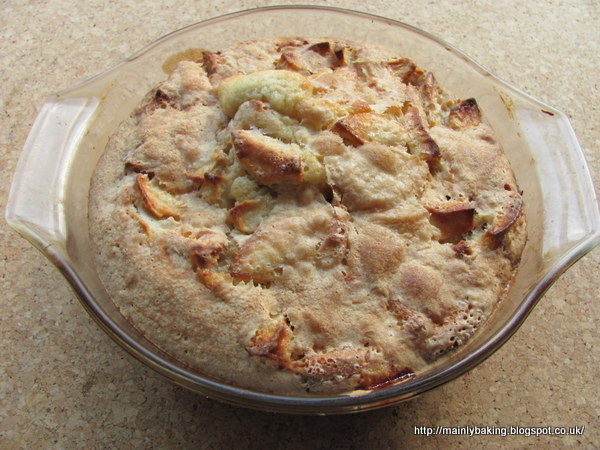
For dessert, I followed this recipe for Sharlotka, which baked the batter in a pudding dish. This wasn't entirely successful, as the depth of my baking dish meant that the dish took over an hour to cook properly. With the benefit of hindsight, it would have been better to use a larger, shallower cake tin, and serve the Sharlotka as a cake. Considering that the batter ingredients were just plain flour, sugar and eggs (with a 1/4 teaspoon baking powder, as suggested by some other recipes I looked at), I had no idea what the texture of the cake was going to be like. A sponge? a clafouti? a pancake? In fact, it was most like a dense sponge in texture, quite sweet but very plain and a good carrier for the sharp eating apples used in the recipe. When first baked, it had a crisp sugary crust, but this softened with time. I served the cooled cake with vanilla yogurt.

Although both these dishes are quite high in carbohydrates, neither of them seemed very heavy, so it didn't seem too much to serve them both as part of the same meal. The leftovers from the Kartoshnik were eaten with a chilli the following day, and suited that quite well too.


Saturday, 16 May 2015

Cheddar and Jalapeno Cornbread,

made with Quark.

I love the AlphaBakes challenge, where we are asked to cook something using a randomly chosen letter of the alphabet, as either the starting letter of a principle ingredient (eg B for bacon), or as part of the name of the dish (eg B for Battenburg Cake). Admittedly, some letters of the alphabet prove more difficult than others, but that's all part of the fun.

Last time the letter Q came around I made a cake using quinoa, which had a fairly unpleasant texture and didn't go on my list of things worth making again; this time I intended to play it safer with a quiche. Except every time I suggested quiche for dinner, my husband vetoed the idea, so I had to think again. Quark seemed the next best idea, and while searching for recipes I came across this cornbread recipe from The Fabulous Baker Brothers.

This is a luxury version of cornbread, compared to recipes I've tried before. It contains lots of cheese, sweetcorn kernels, onion and jalapeno peppers for flavour, and uses quark instead of the sour cream or buttermilk more usually found in cornbread recipes.

This was a straightforward recipe to follow, but my batter was very dry and I needed to add a few tablespoons of milk to give a stiff dropping consistency. The cooked cornbread was quite dry and crumbly, so it wouldn't have hurt to make the batter a little sloppier. The cornbread also took a lot longer to cook than the 40 minutes the recipe suggested - I think mine was in the oven for a touch over an hour!

We both really liked this - it was very cheesey, and well spiced with the jalapenos, which I had chopped quite finely. Most cornbread recipes contain a proportion of wheat flour, which I think lightens the sponge texture; this one was all cornmeal, and also contained coarsely puréed sweetcorn kernels, so it was quite dense. It definitely needed more liquid in the batter though, to reduce the crumbliness a little.

We ate the cornbread, still warm, with a spicy ratatouille. The following night we ate it with a pork and bean chilli, but after two meals I'd only used half the cornbread, so I had to freeze the rest. I hope it doesn't become even more crumbly in the freezer.

This cornbread also fits the brief for Dom's Simply Eggcellent challenge over at Belleau Kitchen. This month he wanted our savoury recipes using eggs. While eggs are not the principle ingredient of a cornbread, it's almost impossible to make any sort of cake without eggs, so I think it's OK to submit this recipe.


AlphaBakes is co-hosted by Ros, at The More Than Occasional Baker and Caroline, at Caroline Makes. This month's challenge, using the letter Q, is hosted by Ros, who will be posting a round-up of entries at the end of the month.

Thursday, 14 May 2015

Cauliflower Cake (Yotam Ottolenghi's recipe)

I noticed that there is a bloggers' celebration of cauliflower taking place, co-hosted by Karen at Lavender and Lovage and Choclette at Tin and Thyme.

I love cauliflower as it's extremely versatile and always tasty, however it's cooked. One of my favourite ways to eat it is gently fried with whole spice seeds, such as nigella, black mustard and cumin, and a few flakes of dried chilli. It then makes a delicious accompaniment, alongside rice or bread, to a curry.

Then there's cauliflower cheese, to which I often add pasta, to make a cross between cauliflower and macaroni cheese. And along with numerous others, I'm a fan of cauliflower 'rice' to reduce carbohydrate intake, although I do prefer to mix it with some Basmati rice, so that it will still absorb sauces.

The Cool Cauliflower Recipe Collection: Linky Party and Blog HopHowever, the recipe I want to add to this collection of cauliflower recipes is Yotam Ottolenghi's recipe for Cauliflower Cake. This is a delicious, well flavoured cake which is like a frittata. The addition of flour makes it lighter, yet sturdier, than a traditional frittata. The cake is flavoured with cheese, rosemary, onion, basil and sesame and kalonji seeds and can be eaten both hot and cold, which makes it ideal for picnics and parties.

I made and wrote about it back in September 2014, but rather than edit that post for the cauliflower link-up party, I thought it better to write a new post.


Monday, 28 July 2014

Courgette and Bacon Gratin


If there's one over-riding reason why I don't post many savoury recipes, it's because I don't often follow a recipe when I make something for dinner. Obviously there's a general template to follow to produce something like a lasagne, or a sausage pie, and I'm often inspired by recipes I've read, but I don't make things exactly the same every time, and I don't often take note of the quantities I use, particularly when I add things to adjust the flavour and seasoning as I go along. Generally, cooking of this sort is a lot more forgiving than baking cakes, where more precision is usually needed.

I did take a bit more notice while I was making this gratin, partly because Hubs has accused me of thwarting his efforts to lose weight by making too many cakes and desserts, so I might have less to post unless I write about my savoury cooking. As I say, I took a bit more notice, but it's still a fairly loose recipe - a little more or less of anything would probably have worked just as well, and it could easily be made a vegetarian recipe by leaving out the bacon and choosing a vegetarian-compatible cheese. I used this recipe by Ina Garten as inspiration.

Ingredients (to serve 2)
1 tablespoon sunflower oil
half an onion, finely chopped
100g smoked bacon or pancetta pieces
3 medium courgettes - around 500g - cut into 0.5cm slices
1 clove garlic, crushed
12 sage leaves, finely shredded
1 tablespoon plain flour
milk, as necessary - roughly 200mls
salt and pepper to taste
50g fresh white breadcrumbs
50g grated parmesan cheese
1 tablespoon pine nuts

Method
Heat the oil on a medium heat, in a large frying pan, and fry the bacon pieces and onion until the bacon is beginning to brown. Lower the heat a little and add the courgettes and garlic, and continue frying, turning occasionally, until the courgettes are beginning to soften.

Add the sage leaves, then stir in the flour and cook for 2 minutes. Add the milk gradually, allowing the sauce to thicken between additions. There will be more liquid coming out of the courgettes as the gratin bakes in the oven, so you want a very thick coating sauce at this stage, otherwise there will be too much thin sauce at the end of cooking. Season to taste - I didn't need any extra salt because of the bacon. Put this mixture into an ovenproof dish.

Mix together the breadcrumbs, parmesan cheese and pine nuts, and scatter in an even layer over the courgette mixture. Bake at 180C for 45 minutes, or until the topping is crisp and golden and the courgettes are really soft.

We  really enjoyed this accompanied by a mixture of runner beans and mange tout peas. Hubs doesn't really like completely vegetarian meals, so adding the bacon made it tastier for him. I was also trying to keep this meal relatively low in carbohydrates; for a more filling dish cooked pasta or potatoes could be added, but then I think the sauce would need to be a little thinner, as pasta goes on absorbing moisture during baking.

Looking at the photographs, I feel I ought to explain the idiosyncrasy of cutting mange tout peas in half. Hubs is basically lazy, so eats with just a fork where possible (although just a spoon is even better!). Mange tout peas sometimes have a long stringy bit along one side - if you haven't got a knife handy, this can make them unpleasant to eat whole, as well as difficult to fit into your mouth!