Showing posts with label mincemeat. Show all posts

Wednesday, 7 April 2021

Mincemeat and Marzipan Teabread

I can't say that I haven't eaten anything sweet for the last 10 weeks, but less activity during winter lockdown, coupled with a bit of over-eating around the New Year has meant I've been struggling with my weight again. It's easier not to bake and buy the occasional treat than to have home-made cakes and other goodies tempting me all the time.

However, Easter is a time of celebration, and even though the cold weather meant I wouldn't be meeting my children, I still felt we all deserved a treat. I delivered cake and Easter Eggs to them both, and put most of what I kept for myself into the freezer, to be rationed out.

I shared this Mincemeat and Marzipan Teabread with my daughter; the flavour of the spiced fruit in the mincemeat, together with marzipan, is reminiscent of the traditional Simnel Cake. The flavour obviously depends on the mincemeat ingredients.


Ingredients:

200g SR flour
100g cold butter, cut into small cubes
85g light muscovado sugar
110g marzipan, cut into small cubes
3 eggs* 
300g mincemeat
6 crushed brown sugar cubes to sprinkle on top, or a couple of tablespoons of demerara sugar

*the eggs were mixed sizes - medium or smaller; 2 large eggs are usually enough, if the mincemeat isn't too dry

Method
Line a 2lb loaf tin with parchment, pre-heat oven to 180C (fan 160C).
In a large bowl, rub the butter into the flour, then stir in the  muscovado sugar and marzipan cubes.
In a small bowl, lightly beat the eggs, then mix in the mincemeat to loosen it.
When the mincemeat is well distributed into the eggs, add this mixture to the flour mix and stir until evenly combined.
Transfer to the loaf tin and sprinkle generously with sugar.
Bake for 60-75 minutes**, or until a probe comes out clean. You may need to cover the top with foil towards the end of the baking time, if it's browning too much.
Cool in the tin for 10 minutes, then transfer to a wire rack to finish cooling.

** the cooking time depends on how sloppy the cake batter is - a stiff batter will cook faster than a very loose one

Thursday, 15 October 2020

'Hodge Podge' Shortbread Squares......

 ...... or, clearing the store cupboard!

One of the reasons I keep returning to this recipe, besides how delicious it is, is that it is so quick to make, and doesn't require any fresh ingredients such as eggs or milk. The filling is very adaptable, as witnessed by the filling I used this time, in an attempt to use some of the remnants of my baking supplies, lingering in jars and packets. 

I followed the recipe here, including adding chopped toasted hazelnuts to the topping. This time the filling was:

the last of a jar of mincemeat - 200g
the scrapings from a jar of ginger curd* - 50g
currants - 50g
two balls of stem ginger, finely chopped
2 tablespoons of syrup from the stem ginger jar

*the ginger curd was lemon curd with added fresh ginger, but it didn't taste strongly of either lemon or ginger, although it was tart. It was a disappointment, flavourwise, but I wasn't going to waste it if I could find a use for it.

Adding the other ingredients to the mincemeat toned down it's spiciness and sweetness, but I still didn't get as much of the ginger flavour as I'd hoped for. That didn't stop the shortbread squares being as good as usual though! The crumbly shortbread, subtly spiced filling and crunchy hazelnuts in the topping all blended together well. 

Monday, 6 April 2020

Fruited Banana Loaf (2)

"If it ain't broke, don't fix it" is a refrain often heard, and this time I decided to take heed. Through some unexpected changes in plans (mostly involving social distancing) I once again found myself with too many bananas. Up until recently this has happened about once every 5 years, but this year, twice so far!

So I used Mary Berry's tasty, quick recipe again; this time I added the scrapings from a jar of mincemeat (roughly 70g) and 50g sultanas. Using the mincemeat meant that I didn't need to use the 2 tablespoons of milk in the recipe - there was enough moisture in the mincemeat - but otherwise I followed the recipe and made the whole batter, including the extra additions, as an all-in-one mix.

Once again, this was delicious. The mincemeat added a little spiciness to the show, but the banana still came  across as the dominant flavour.

This time I didn't freeze any of the loaf, and I was really surprised at how well it kept - the last slice was almost a week old, and as good as the first.

Wednesday, 26 February 2020

Mincemeat Loaf Cakes

It seems quite a long time since I tried a new recipe; I have a lot of favourites that I keep returning to at the moment, either because they are reliable (if I'm baking for someone else), or I know they freeze well.

I knew I wanted to make a mincemeat cake to use some of the Christmas excess,  so decided this might be the time to try a new recipe. Mary Berry's recipe appealed because it made two small loaves and she says they freeze well.

It's a straightforward recipe to follow - it's an all-in-one mixture, so you just need to make sure you have well softened butter before you start. I didn't have currants, so used dried cranberries instead, and topped the cakes with flaked almonds rather than split nuts.

The cake batter was very stiff, and with the benefit of hindsight, now that I've cut the cakes, I think I should have added a couple of tablespoons of milk to loosen it a little. The cakes were a little dry and crumbly, and didn't compare favourably, in that respect, to the recipe I usually use. They rose well during cooking, in terms of increased volume, but there was a definite dip in the middle of each one. I think I might have been guilty of not mixing well enough, as the batter was so stiff.

As always with this  sort of cake, the final flavour relies heavily on any added ingredients in the mincemeat. I used a Waitrose brand with their 'Christmas 2019 special' ingredients of plum, honey and ginger. Even after being diluted into the cake mixture, the plum flavour (provided by prunes and plum juice) was still evident.

I think this is a recipe to use again, as it uses mincemeat leftovers, rather than a whole jar, but I'll be more careful next time, and make sure the batter has a 'dropping' consistency, and is well mixed.

Saturday, 28 December 2019

Festive Desserts

I made two desserts for the Christmas period, as something chocolate is obligatory, but my daughter had also asked for a repeat of Dan Lepard's Mont Blanc Layer Cake.

The Mont Blanc Layer Cake recipe, based on meringue, is far too big for just three of us, particularly as it doesn't keep well, so I made a meringue roulade with only 3 egg whites, filled it with a half quantity of the chestnut and ricotta cream and drizzled melted chocolate over the top.

We decided, on trying the dessert, that although it was delicious, we all preferred the crisper meringue of the original recipe, which gives a better textural contrast with the chestnut cream than the soft meringue of the roulade.

For  the chocolate dessert, I made a half-sized quantity of Delia Smith's Chocolate Truffle Torte, which fitted nicely into a 7" (18cm) shallow cake tin. The only departure from the recipe was to use Amaretto liqueur instead of rum.

My daughter also contributed a batch of mince pies, which has become a tradition now. She uses this Mary Berry recipe, which adds dried apricots to the mincemeat and tops the tarts with grated marzipan.

Monday, 2 December 2019

Shortbread Squares (Again!) with Mincemeat and Hazelnuts

I make these shortbread squares so often these days that I feel guilty about writing a blog post about them again!

However they are so delicious and so quick to make that reminding you about them in the run-up to Christmas is probably doing you a favour. Don't bother with pastry and individual mince pies, especially if you're feeding a crowd - make these instead!

The basic shortbread recipe, and general idea, comes from Sue Lawrence's book 'On Baking'. Over time I have experimented with many fillings based on jam, mincemeat and dried fruits.  This time the filling was mincemeat mixed with apricot jam, and I also added chopped toasted hazelnuts to the portion of dough put aside for the topping.

Dough Ingredients:
170g SR flour
170g semolina
170g butter
85g caster sugar
30g finely chopped toasted hazelnuts

Filling:
250g mincemeat and 100g apricot jam, mixed together well (or use all mincemeat).

Method
Preheat the oven to 190C and line a 20cm (8") square baking tin with parchment.
Mix the flour and semolina in a large mixing bowl.
Melt the butter and sugar together gently, until the sugar has dissolved, and add to the flour mixture. Stir until well combined.
Take 2/3 of the dough and press firmly and evenly into the base of the baking tin.
Spread the filling over the base, leaving a small margin around the edges.
Mix the chopped hazelnuts into the remaining dough and crumble the mixture over the filling layer. Press down lightly with the palm of the hand.
Bake for 25 minutes, by which time the shortbread should be a light golden brown in colour.

Cut into pieces of the desired size (I make 16 squares) as soon as the tray is removed from the oven, but don't try to take the pieces out of the baking tin until they are completely cold - they are too fragile while warm, and will break up.

The shortbread layers of these squares are perfect - crisp but a little crumbly, and they just melt in the mouth. Curiously,  adding apricot jam seemed to reduce the sweetness of the mincemeat - it must just be down to the natural tartness of apricots because the sugar content of jam and mincemeat are very similar.


Saturday, 20 April 2019

Easter Shortbread Squares

Another outing for my favourite 'biscuit bar' recipe - what could be better than a crisp, melt-in-the-mouth shortbread filled with a luscious fruity filling? The original recipe is from Sue Lawrence's book 'On Baking' and has a date and ginger filling. I stick to her recipe for the shortbread layers but have experimented with many different fillings.

This time I was aiming to get the flavours of  the traditional Simnel cake (marzipan, dried fruit, spices) into the little shortbread squares. As I was using some mincemeat left over from Christmas to get the fruit and spice into the filling I added the tang of citrus flavours (in the form of marmalade) to brighten the flavour and make it feel fresher and more Spring-like. For the final step, I grated marzipan into the topping.

Ingredients
170g SR flour
170g semolina
170g butter
85g caster sugar

250g mincemeat
100g marmalade (I used three-fruit marmalade for a sharper flavour)

100g white marzipan

Method
Preheat the oven to 190C/170C fan. Line a 20cm (8") square tin with parchment.
Weigh the flour and semolina into a large bowl. Mix the mincemeat and marmalade in a small bowl.
Put the butter and sugar in a small saucepan and heat gently until the butter has melted and the sugar dissolved.
Pour this mixture onto the flour mixture and mix well to combine.
Put 2/3 of the dough into the prepared baking tin and spread evenly. Press down firmly as you level the mixture and smooth the surface.
Spread the mincemeat mixture over the dough, leaving a small margin around the edges.
Break up the remaining portion of dough into crumbs, still in the bowl, and coarsely grate the marzipan into the bowl. Gently mix the marzipan and dough crumbs together, then sprinkle them evenly over the filling. Press the topping down very lightly.
Bake for 25 minutes until golden brown. Rest for 5 minutes, then cut into 16 squares while still hot. Cool completely in the tin - they will fall apart if you try to move them while still hot.

Mixing marmalade and mincemeat for the filling worked really well. The marmalade added the fresh zing that I wanted and also muted the level of the spicing in the mincemeat, so that it didn't taste as if I was eating a Christmas mince pie. The marzipan flavour in the topping didn't come through as strongly as I had hoped for, but I'm not sure how I could remedy that. Introducing almond extract would be difficult in this particular recipe, without flavouring all of the shortbread dough. Altogether it was an harmonious blend of flavours and textures.

Friday, 1 February 2019

Mincemeat and Orange Cake

With this cake I surprised myself by finishing off my mincemeat before the end of January; it's not unusual for me to be baking with the remnants from a jar at Easter. I've used this recipe before, adding my own touches to the ingredients, as you can see here.

As I had two jars of mincemeat open, one of which had orange flavour notes, I added the zest of an orange to the cake, and soaked the rather wizened sultanas I was using in the juice of the orange for a couple of hours, before draining off the excess. I was lucky that there was just about 400g of mincemeat when the contents of both jars were combined. I also added a sprinkling of demerara sugar as a topping, before baking.

I cooked the cake in a smaller tin - 20cm in diameter - as I prefer a deeper cake, but this didn't affect the cooking time, it was still done in 75 minutes.

It looks, in the photo as if the fruit sank, but that's just the randomness of that particular slice - it was  much more evenly distributed in reality! Adding the orange definitely perked up the cake - the usual spiciness and tartness of mincemeat is muted when it's spread though cake batter, giving a much more gentle flavour.

Friday, 18 January 2019

Mincemeat Shortbread Bars

There's always mincemeat to use up after Christmas, but even with an opened jar in the fridge, I couldn't resist a 'reduced to clear' jar of Bitter Orange and Juniper Mincemeat in Waitrose. So I rolled out my favourite shortbread slice recipe yet again! I've made mincemeat versions of this with various embellishments - marzipan or chopped hazelnuts in the topping, cranberry sauce mixed with the mincemeat - but decided that this time I'd use the mincemeat just as it was, to allow the orange and juniper flavours to shine through. I used about 300g of mincemeat for the filling, but it wouldn't have hurt to add a bit more.

Although the recipe was as good as usual, with crisp, melt in the mouth shortbread layers, I was a little disappointed that the advertised flavours of the mincemeat - bitter orange and juniper - weren't really very strong at all. It didn't seem much different to the basic mincemeat I'd used for my mincepies at Christmas, and in the past I've added better orange flavour by adding freshly grated orange zest to mincemeat.

Friday, 2 March 2018

Mincemeat and Marzipan Shortbread Squares

Another variation on my favourite filled shortbread traybake, using one of my favourite seasonal flavour combinations - mincemeat and marzipan. This recipe is so quick to put together that it could easily be made instead of mincepies at any time over the festive season, but I made it to use up the Christmas leftovers.

The original recipe, from Sue Lawrence's 'On Baking' used dates, currants and ginger in the filling, but I've made several versions in the past, keeping the shortbread part of the recipe the same and varying the filling. The butter and sugar in the recipe are melted together before being added to flour and semolina, and the resulting crumbly dough is just scattered and then pressed into the baking tin. Using prepared mincemeat, rather than cooking the filling, means the whole recipe can be assembled and into the oven in about 5 minutes - much faster than messing around with pastry, or even traditional shortbread.


Ingredients
170g SR flour
170g semolina
170g butter
85g caster sugar
300g mincemeat
100g marzipan, cut into cubes of half a cm

Method
Preheat oven to 180C/160C fan. Line a 20cm (8") square baking tin with parchment.
Weigh the flour and semolina into a large bowl.
In a small pan, melt the butter and sugar over a low heat, just enough to dissolve the sugar. Add to the flour mix and stir together until evenly combined.
Scatter 2/3 of the dough over the base of the tin and press down firmly to give an even layer. Smooth the surface, using fingers or a spatula.
Spread the mincemeat over the dough, leaving a margin of 1cm around the edges. Sprinkle over the cubes of marzipan.
Cover with the remaining dough mixture - the easiest way to do this is to crumble the shortbread over the surface, using fingers, then press down lightly with the palm of your hand.
Bake for 25 minutes, or until golden brown. Cut into squares as soon as the tin is removed from the oven, but cool completely before lifting the shortbread from the tin.

The shortbread was crisp and buttery, but not too sweet, which meant that even with commercial mincemeat and marzipan added, the squares were not over-sweet. My mincemeat contained cranberries which also added to the flavour.

Friday, 21 April 2017

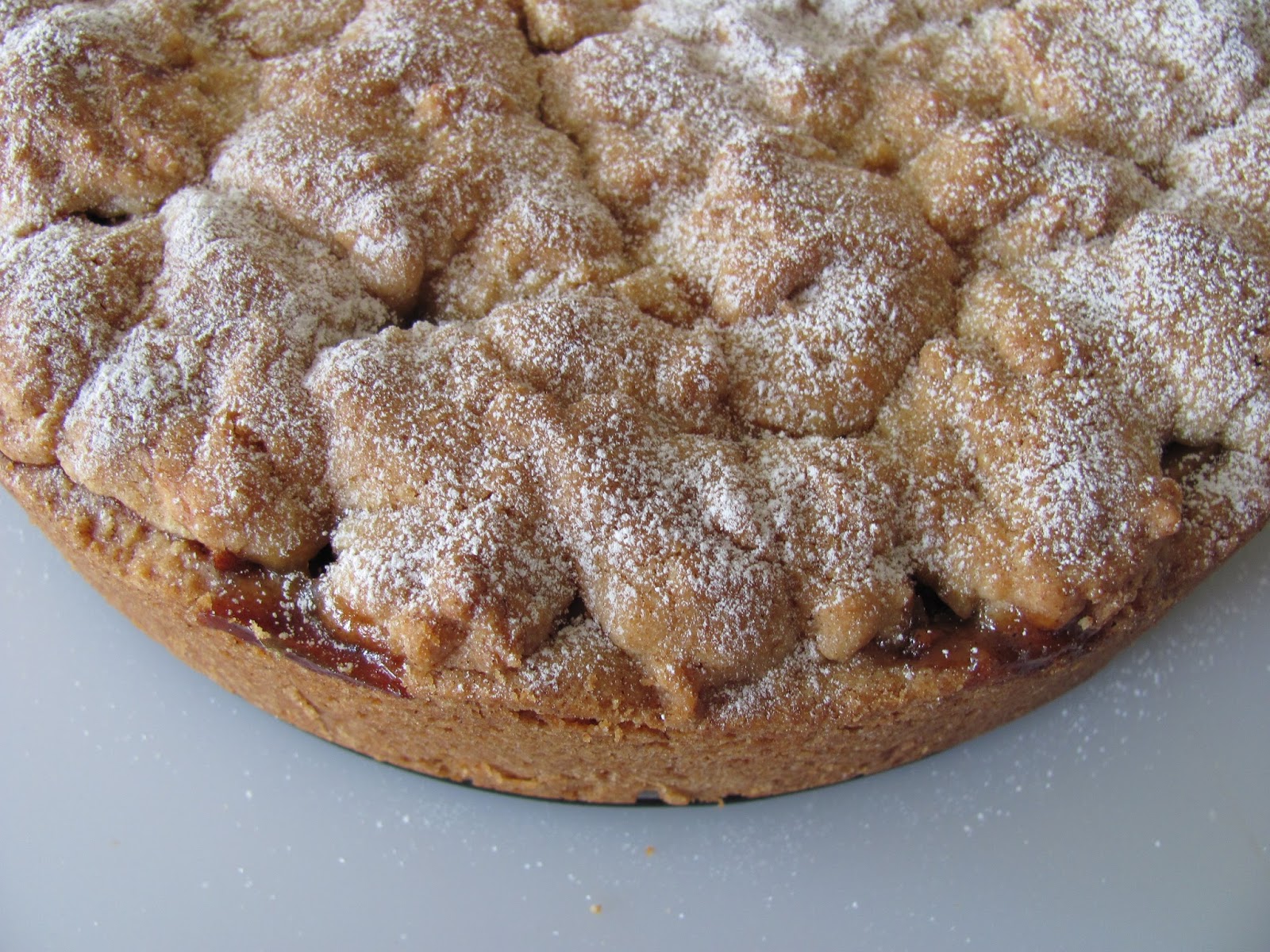
Mincemeat and Apple Cake

Another outing for the cake I often make when I want a dessert with fresh fruit, but can't be bothered to fuss around with pastry. Because I hadn't checked supplies and found myself short of flour, I used a proportion of spelt flour in the recipe this time - it seemed to make the cake a little more crumbly.

Anything with mincemeat in it smells wonderful when it is baking; in this case the flavour was pretty good too. Adding the apples and orange zest cut back on the sweetness of the filling a little without changing the flavour much, as the mincemeat had it's own citrus notes. The dough has a texture somewhere between pastry and scone - what I imagine the old-fashioned American shortbread cakes to be like.

I'm pleased to say that this cake used the last of my winter mincemeat stocks!

Ingredients
150g butter
150g caster sugar
1 large egg
*100g SR flour
*200g white spelt flour
*1 teaspoon baking powder
250g mincemeat
2 eating apples, peeled, cored and chopped into small pieces
grated zest of 1 orange

* you can use 300g SR flour, in which case you won't need the baking powder

Method
Preheat oven to 180C. Grease and base-line a 20cm (8") springform cake tin.
Melt the butter in a large bowl in the microwave - it doesn't need to be very hot, just liquid. Stir in the sugar, then beat in the egg.
Add both flours and the baking powder and mix to a soft dough. Put 2/3 of the dough into the baking tin and spread out into an even layer with your fingers, building up a little wall around the sides of the tin.
Mix together the mincemeat, chopped apples and orange zest and spread onto the cake base.
Crumble the remaining dough evenly over the filling and press down lightly, spreading the dough as you do - it should more or less cover the top, but any small gaps will fill as the dough rises and spreads during baking.
Bake for 50-60 minutes until the top is firm and golden. Cool for about 15 minutes, then run a knife between the cake and the tin, in case any fruit juices have leaked from the cake and are sticking to the sides of the tin - this can sometimes happen with mincemeat.
Dust with icing sugar before serving, either warm or at room temperature. This cake can be quite fragile, so I always leave it on the springform base.

Sunday, 26 March 2017

Mincemeat Flapjacks

I'd planned to make mincemeat shortbread from Sue Lawrence's book 'On Baking', but we were suffering from an unscheduled cut in our water supply, which meant I couldn't do anything which was going to make my hands really sticky - such as rubbing fat into flour, or handling biscuit dough. Luckily I found a recipe for mincemeat flapjacks a bit further on in the book, and decided I could make the recipe without touching any of the ingredients in a way which would need me to wash my hands. Just a quick wipe with a hand sanitiser afterwards and all was well. The flapjacks were made in one saucepan too, which minimised the washing up - useful when you can't actually wash-up at all!

Ingredients
225g mincemeat
170g butter
285g golden syrup
the grated zest of 1 orange
425g porridge oats

Method
Pre-heat oven to 180C and line a baking tin roughly 20 x 30cm (8 x 12") with baking parchment, using one piece big enough to come up the sides of the tin too.
Melt the mincemeat, butter and golden syrup together in a large pan, over a low heat, stirring often.
When the butter has melted remove the pan from the heat and add the orange zest and oats. Mix everything together thoroughly.
Transfer the oat mixture to the baking tin and spread evenly, pressing down firmly. Bake for 25-30 minutes until golden brown.
Mark into pieces while still warm, but cool completely before removing from tin.

The smell while these flapjacks were baking was fantastic, and they tasted pretty good too. There wasn't a large amount of mincemeat in the recipe but it was enough to give quite a strong flavour. The mincemeat I used was quite citrussy, so it was complemented by the added orange zest. My usual flapjack recipe uses more sugar than golden syrup, whereas this recipe uses mainly golden syrup plus the sugar in the mincemeat. The end result was very similar, as these flapjacks were also nice and chewy - they were perhaps just a little softer than those I usually make.


Sunday, 12 February 2017

Mincemeat and Marzipan Tea Loaf

This is a great cake recipe for using Christmas leftovers, but also good enough to buy mincemeat and marzipan especially to make it (as long as you could find a use for the leftovers!). I was using brandy marzipan, brought from the 'reduced to clear' shelf, and a standard nut-free mincemeat.

The recipe comes from Good Food, although it isn't on their website. I originally found it in one of their cookbooks - 101 Cakes and Bakes - and there are plenty of blogs which have given the recipe. I wrote out the recipe when I first used it, six years ago (here's the link!) so there's not much point is writing it again. This time I needed to add a couple of tablespoons of milk to loosen the cake batter - it was a very stiff mincemeat - and it needed a few minutes longer baking time as a result. I also increased the marzipan from 85g to 110g, as I suggested in the linked post, although I kept the pieces small as I read on one blog that large pieces of marzipan had sunk to the bottom of the cake during baking. This time I sprinkled a handful of flaked almonds on top before baking.

The mincemeat I used was quite basic, so the almond flavour of the marzipan was the strongest element of the cake. I think adding a little more spice, or even the grated zest of an orange, would have been an improvement, but it's difficult to know in advance how the mincemeat will influence the flavour of the cake. My husband thought it tasted like Stollen, so he really liked it!


Saturday, 7 January 2017

Mincemeat and Cranberry Shortbread Squares

Another outing for the traybake recipe that I consider one of the best I've tried. It's from Sue Lawrence's book 'On Baking'. I regard the dough for this recipe as perfect because it is light and crisp, keeps well and is easily made. The same dough is used for the base and the topping too which is an extra bonus. I haven't tried it with a fresh fruit filling yet, but it's worked really well with the variations of dried fruit fillings that I've tried.

This time I made the filling with a mix of two different mincemeats (it's too long an explanation as to why I had two jars open), and the remains of a small jar of cranberry sauce which had been opened for the Christmas turkey. Because one of the mincemeats was quite sloppy, and I wasn't sure how the cranberry sauce would react to heat, I added half a teaspoon of ground rice to thicken any excess liquid.

Ingredients
Filling:
270g mincemeat
80g cranberry sauce
1/2 teaspoon ground rice

Shortbread dough:
170g SR flour
170g semolina
170g butter
85g caster sugar

Method
Preheat the oven to 190C and line a 8"(20cm) square shallow baking tin with baking parchment, bringing the parchment up the sides of the tin too.
Mix the filling ingredients together.
In a small pan, melt the butter and sugar together, stirring to dissolve the sugar.
Pour the warmed mixture onto the flour and semolina, in a large bowl, and mix in thoroughly with a fork.
Once all the ingredients are well blended, put 2/3 of the crumbly dough into the baking tin. Spread evenly and press down firmly.
Spread  the filling over the base, leaving a small margin around the edges. Crumble the rest of the dough over the top - you don't need to get full coverage, a few gaps are attractive - and press down lightly.
Bake for 25 - 30 minutes until the top is becoming golden brown around the edges.
Mark into squares or fingers while still warm, but cool completely before removing from tin - the squares are very fragile while warm.

Obviously, the flavour of these squares will depend to some extent on the mincemeat used (whether it had alcohol, nuts, lots of spice, unusual ingredients etc). I found that the taste of the cranberry sauce dominated my mincemeat, which made the squares quite tart and fruity.

This recipe is a really quick way of getting something very similar to mincepies, with a lot less work! Leave out the cranberry sauce if you don't have any and increase the mincemeat, or try adding marmalade instead.

Friday, 23 December 2016

Mincemeat Frangipane Tart

gluten- and dairy-free

The highlight of this recipe, for me, was making a really good gluten- and dairy-free pastry. I'd read that it wasn't easy, so it felt quite an achievement  to come up with a recipe which worked well first time (and was repeatable - I made this dessert twice!). After looking at many recipes and reading about gluten-free pastry, I based this recipe on my usual wheatflour sweet shortcrust pastry recipe, but added both a little xanthan gum for strength and baking powder for lightness. I'd read that gluten-free pastry needs more liquid than wheatflour pastry, so I made the dough wetter than usual.

There are reservations about this apparent success though - the pastry dough was very sticky and hard to handle, and I'm not sure I would have had as much success in other situations, for instance if the pastry needed baking blind, or if I was trying to make a pastry top crust too. This may have only worked because the filling was put straight onto raw chilled pastry, and the mincemeat and frangipane layers completely filled the pastry case, holding the sides in place until the pastry had set during baking and leaving no chance of any collapse. Obviously I need to try out the pastry in other situations before declaring it a total success.

Ingredients:
Sweet shortcrust pastry:
200g Dove's gluten-free plain flour
1/8 teaspoon xanthan gum
1/4 teaspoon baking powder
100g hard dairy-free baking fat (eg Stork)
50g icing sugar
1 large egg
2 tablespoons water

250g mincemeat (check it's gluten- and dairy-free, if this is important)

Frangipane:
100g caster sugar
100g ground almonds
100g dairy-free baking spread
1 tablespoon ground rice
2 large eggs
a few drops almond extract
flaked almonds for topping

Method
Sift the flour and icing sugar into a bowl and add the xanthan gum and baking powder.
Cut the baking fat into small cubes and add to the bowl. I find that Stork is not as hard as cold butter, so can usually be used straight from the fridge.
Rub or cut the fat into the flour mixture until the mixture resembles breadcrumbs, then mix in the egg and water to make a smooth sticky dough. Only knead enough to incorporate everything into an even dough. Put the ball of dough onto a large piece of clingfilm, wrap loosely and flatten the dough into a 3cm thick disc. Chill for 20 minutes.
Unwrap the dough, but leave it in the centre of the clingfilm, then cover with another large piece of film. Roll out the dough evenly, between the pieces of film, until it is about 30cm (12") in diameter and will fit into a shallow fluted flan tin, about 23cm (9") in diameter.
Remove the top piece of clingfilm carefully - the dough will still be sticky - and invert the circle of dough into the flan tin, so that the bottom piece of film is now on top. While this piece of clingfilm is still in place, ease the dough into place in the corners and flutes of the tin. Chill the pastry case again.
Remove the pastry case from the fridge, gently ease off the clingfilm and trim the dough around the top of the tin to give a neat edge. Any small holes can now be patched with small pieces of the dough trimmings, if necessary - just smooth a small piece into place with your finger.
Pre-heat the oven to 180C, and put a baking tray onto a middle shelf to heat.
Spread the mincemeat into the base of the pastry case.
Put all the ingredients for the frangipane, except the flaked almonds, into a bowl and beat until the mixture is smooth. This is easily done with a spoon, but you can use a hand-held mixer too, if you prefer.
Pour the frangipane over the mincemeat to fill the pastry case, and sprinkle with flaked almonds. Put onto the baking tray and cook for 40-45 minutes until frangipane is firm and golden brown.
Cool in the tin.

I was really pleased with this. I've made frangipane mincemeat tarts before, but never a gluten-and dairy-free version. I doubt anyone would be able to tell the difference as the strong flavours of mincemeat (I used a gluten-free variety with added cranberries) and almonds covers any deficiencies through not using butter in the pastry. The pastry was light and crisp too, and kept well over the three days it took to eat the tart.

I think this will be my last post before Christmas, so I'm fortunate it's a festive one. I'm not planning to cook anything new over the Christmas period, just old favourites. It's also hard to get photographs in the chaos of cooking and the bad light at this time of year, so I'll be back soon with something new.

Season's Greetings to you all!

Tuesday, 1 March 2016

Mincemeat Squares

I thought it was about time to use the last of an opened jar of mincemeat, still sitting in the fridge. Hopefully, there will be warmer weather soon, and thoughts will turn to lighter flavours rather than the spices and dried fruits we like so much in winter.

Once the jar was scraped out, I managed to get 200g of mincemeat, so added 25g of dried cranberries to give the amount needed for this Delia Smith recipe.

Even though I made the recipe in a slightly smaller 20cm (8") square baking tin, the  mincemeat squares were very thin. I was hoping for something like a flapjack, but these were really more like biscuits; because they were so thin they really crisped up in the hot oven. (I have a feeling I've used other versions of this recipe before, and have thought the same thing.)

The recipe was very quick and easy to put together and baked quickly too - I think from getting the scales out, to taking the baked squares out of the oven only took 35 minutes. The only changes I made to the recipe was to use half wholemeal flour and half spelt flour, and butter instead of the vegetable margarine that Delia specifies. I also heated the mincemeat in the microwave for a few seconds - just enough to take the chill off,  as it had been in the fridge - this made it easier to spread over the bottom layer of dough.

Friday, 22 January 2016

Mincemeat, Prune and Orange Cake

The writer of the blog where I found this recipe calls it a 'Lazy Girl Cake' but at this time of year I'd also call it a cheapskate's cake, as you can often find mincemeat being sold off cheaply to get rid of seasonal stock. I found double-sized jars (820g) in Waitrose for only 60p!

Phil at As Strong as Soup directed me to the recipe here, on the English version of C'est Moi Qui L'ai Fait! but I also found it on this site, which claims that it originates in a National Trust recipe book. Whatever it's origins, I adapted the recipe a little, for my own tastes, using chopped prunes instead of sultanas and adding the zest of an orange to compliment the fact that there were quite a lot of citrus-y ingredients in the mincemeat.

Ingredients
150g softened butter
150g soft brown sugar
2 large eggs
225g SR flour
75g ready to eat prunes chopped into small pieces
400-410g mincemeat (1 standard sized jar)
the zest of an orange, finely grated

Method
Pre-heat the oven to 160C and prepare a 20cm(8") or 23cm(9") loose-based cake tin.
Put the butter, sugar, eggs, orange zest and half the flour into a mixing bowl, and beat until well blended, and light and fluffy - easiest with a hand-held electric mixer.
Fold in the rest of the flour, the mincemeat and the chopped prunes.
Transfer the batter to the baking tin, and bake until a test probe comes out clean - it will be roughly 90 minutes for the 20cm cake and 75 minutes for the larger cake which will be more shallow.
Cool in the tin for 20 minutes, then transfer to a wire rack.

This is a gently flavoured cake - the usual spiciness of mincemeat is diluted by the cake batter, and adding orange zest increases the citrus notes. Obviously, the flavour will vary depending on the mincemeat used - mine didn't contain nuts or alcohol! The prunes were the biggest pieces of fruit so stood out in both the appearance and taste of the cake. Again, this is a factor that can be varied to taste - I considered dried apricots and cranberries before going with the prunes.

This is such a simple way to make a well-flavoured light fruit cake that I'm sure I'll be using it throughout the year - I've got quite a bit of cheap mincemeat to use now!


Friday, 1 January 2016

Festive Fruit Pie

Most of the Christmas leftovers have been dealt with by now. The last slice of ham, a few chunks of turkey and half a dozen chestnuts, together with a few mushrooms, in a mustard-y cream and white wine sauce, made a very tasty pie. What hasn't been eaten has been packed into the freezer, hopefully to make pies and curries over the next few weeks, and not just forgotten about. However, I am also determined not to leave too many half-used jars and packets of seasonal ingredients lurking about, as by springtime I'm past the point of wanting to eat things like mincepies and cranberry sauce.

Allow me a slight digression here - have you noticed that cream cheese is sold in 280g packs now, and not 300g? Luckily I was using a modern cheesecake recipe which took account of that, but many of my older recipes use multiples of 300g, so leftovers are inevitable, even if buying smaller packs, which are proportionally more expensive, to make up the weight.

Even so, as a result of scaling down a cream cheese frosting recipe, I was left with around half a pack of cream cheese and happened to read this recipe at Belleau Kitchen for a delicious sounding pastry using cream cheese, orange zest and ground almonds. It seemed perfect for the 'leftovers' fruit pie that I had decided to make. I made a slight adaptation to the recipe - I reduced the sugar to 50g and used icing sugar (which I think is incorporated more easily into pastry), and also used the zest of a small orange instead of a clementine, but otherwise I followed Dom's recipe, which originates from Dan Lepard's 'Short and Sweet'.

I used 2/3 of the pastry to line a deep pie dish, and the remainder to make a lattice for the top. I assembled the lattice on a sheet of baking parchment, and chilled it, along with the pie case, for about 20 minutes, before putting the pie together for baking.

For the filling I mixed together:
200g of mincemeat
roughly 125g of a good quality cranberry sauce (over 50% fruit)
two eating apples, peeled and cored and cut into small dice
80g of ready-to-eat dried dates, snipped into small pieces
1 teaspoon of ground rice to absorb excess fruit juices

I put the filling into the unbaked pie case, and placed the pre-made lattice on top. The excess pastry around the top of the pie case was folded over the edges of the lattice to seal the base and lattice together. The top was brushed with beaten egg white and sprinkled with caster sugar and the pie was baked at 180C for about 40 minutes until golden brown.

Both elements of this pie were very good! The pastry was very short and crumbly, but very easy to work with, and probably would have been even more delicious with a blander pie filling. The orange zest could be tasted in the pastry when eaten alone, but it was overwhelmed by the spices and other flavours in the mincemeat mixture. The pie filling still tasted predominantly of mincemeat but the addition of tart cranberries and apples cut through the usual sweetness and added a greater depth of flavour. The overall spice level of the mincemeat was reduced too, allowing the combination of dried and fresh fruits to dominate. Altogether, a successful experiment - the pastry is wonderful (thanks Dom!) it's worth buying cream cheese specially for it, and the filling mixture reduced my stock of opened jars while tasting much better than such a haphazard mixture might have done!

Saturday, 26 December 2015

Chocolate Orange Cheesecake

Although I love a traditional Christmas Pudding, the rest of the family are not so keen - especially the younger generation. For many years our tradition has been something with chocolate for dessert on Christmas Day. This dessert, from the 2015 Christmas (November) issue of Good Food magazine (the only issue I buy now), fit the bill, although the chocolate was very much in a minor role to the deliciously creamy baked orange cheesecake.

This recipe for Chocolate Orange Cheesecake was simple to make. I don't have a large food processor, so made the base by hand - crushing the biscuits with a rolling pin and mixing in the melted butter - and mixed the ingredients for the filling with a hand-held electric mixer, on slow speed. I chopped the chocolate for the topping in a mini-processor - much simpler and faster than grating. The only issue I had was leakage of the very sloppy cheesecake mixture out of my springform tin - I think it's time for a new one, hopefully with a tighter leak-proof fit between sides and base. Fortunately the wrapping of foil which was designed to stop the waterbath water seeping in also contained the mess, and the heat of the waterbath set the cheesecake quickly around the edges to prevent too much loss.

Although no-one wanted to eat much  dessert after Christmas Day dinner, CT and I both tried a small piece. I expected the topping to be difficult to cut, but the chocolate rubble had stayed as such, and hadn't set into a hard layer, as melted chocolate spread on top would have done. An excellent idea which I will remember for the future! In fact it was the base which was hard to get through - after serving two small slices, I realised I hadn't actually cut through the base at all, but had lifted the cheesecake off the biscuit layer! After that was sorted, subsequent slices were easier to serve!

As a baked cheesecake, this was deliciously soft and creamy - only just set, but just right! The orange flavour of the zest and liqueur in the cheesecake mixture shone through, highlighted by the orange flavoured milk chocolate in the topping. Adding a proportion of almondy milk chocolate to the topping added extra crunch and flavour, and the base was thin and crisp. All round, an excellent dessert, and one I will use again.

I promised to mention FB's mincepies in my post. It was her first attempt at making pastry, and an excellent attempt it was too! She used this Mary Berry recipe which added orange zest to the pastry, chopped dried apricots to the mincemeat and topped the pies with grated marzipan. They were really good - tasty adaptations to bought mincemeat to make the pies extra special. My thanks go to her for taking on some of the Christmas cooking.

The use of many eggs in this cheesecake means I can enter it into Belleau Kitchen's Simply Excellent link-up for December. Dom's theme this month is Anything Goes, so I'm expecting to see a lot of Christmas desserts!


Chocolate in the base and topping also makes this cheesecake eligible for this month's We Should Cocoa event, a blog cooking challenge originated by Choclette at Tin and Thyme and hosted this month by Munchies and Munchkins, who has chosen the theme of Christmas.

Wednesday, 23 December 2015

Apple and Mincemeat Cake

This is just the right sort of cake to make in the run up to the festive season. Although it's not the sort of rich or fancy cake that will be eaten around Christmas and New Year, the flavours are good enough to put you in the festive mood, without feeling you are over-indulging too early. It's also a really simple cake to make and one I often fall back on when I'm lacking in imagination or time, especially as my husband always comments on how good it is.

The filling in the middle can be adapted to suit the seasons and the recipe also works really well with fresh fruit, as long as it doesn't exude too much juice during cooking (although even that can be overcome by cooking and draining the fruit first). For a taste of Christmas I used a mixture of mincemeat, dried pears and fresh apples - adding apples cuts through the sweetness of the mincemeat. Using the dried pears was a waste of good ingredients, however, as their flavour was overwhelmed by the mincemeat.

Ingredients
200g mincemeat
2-3 eating apples (peeled cored and diced into pieces about the size of sultanas)
4 dried pear halves (snipped into similar sized pieces with scissors)
150g butter
150g caster sugar
1 large egg, beaten
300g SR flour
2 tablespoons chopped toasted hazelnuts
icing sugar for dusting

Method
Grease and base line a 20cm(8") springform tin. Preheat oven to 180C.

Mix the diced apples and dried pears into the mincemeat and set aside - the acidity of the mincemeat should stop the apples from discolouring.

Melt the butter (I find it easiest to do this in a large mixing bowl, in the microwave, then the dough can be mixed in the same bowl). The butter doesn't need to be hot, just completely liquid. Stir in the  caster sugar, then the beaten egg, then mix in the flour to make a soft spreadable dough.

Take roughly 2/3 of the dough and spread it evenly over the base of the cake tin. Push the dough up the sides of the cake tin a little way (about 2cm), to make a wall to contain the filling. This wall doesn't need to be any thicker than rolled out pastry for a pie - it just holds in any fruit juices.
Spread the mincemeat mixture evenly over the dough base.

Use the remaining dough to top the cake. (The easiest way is to flatten small pieces of dough with your fingers and put them on top of the cake filling, fitting them together as closely as possible but getting an even covering too. It doesn't matter about small gaps as the dough spreads and fills in the holes during baking. I usually start at the edge of the cake and work inwards - the dough is pliable enough to spread easily.)

Sprinkle over the chopped hazelnuts, then bake for 50-60 minutes until firm and golden brown.
Cool in the tin, then dust with a little icing sugar before serving.

This was my last baking session before starting on the Christmas desserts tomorrow, so I'll wish you all

MERRY CHRISTMAS
and
A HAPPY AND HEALTHY 2016!