Showing posts with label currants. Show all posts

Thursday, 15 October 2020

'Hodge Podge' Shortbread Squares......

 ...... or, clearing the store cupboard!

One of the reasons I keep returning to this recipe, besides how delicious it is, is that it is so quick to make, and doesn't require any fresh ingredients such as eggs or milk. The filling is very adaptable, as witnessed by the filling I used this time, in an attempt to use some of the remnants of my baking supplies, lingering in jars and packets. 

I followed the recipe here, including adding chopped toasted hazelnuts to the topping. This time the filling was:

the last of a jar of mincemeat - 200g
the scrapings from a jar of ginger curd* - 50g
currants - 50g
two balls of stem ginger, finely chopped
2 tablespoons of syrup from the stem ginger jar

*the ginger curd was lemon curd with added fresh ginger, but it didn't taste strongly of either lemon or ginger, although it was tart. It was a disappointment, flavourwise, but I wasn't going to waste it if I could find a use for it.

Adding the other ingredients to the mincemeat toned down it's spiciness and sweetness, but I still didn't get as much of the ginger flavour as I'd hoped for. That didn't stop the shortbread squares being as good as usual though! The crumbly shortbread, subtly spiced filling and crunchy hazelnuts in the topping all blended together well. 

Friday, 2 October 2020

Garibaldi Biscuits, with a flavour twist

I don't often fiddle about with biscuits, although I have become a fan of tray-bake cookies, where the dough is baked in a tray and cut into bars after baking. However, this recipe,  for Garibaldi biscuits, from last year's GBBO winner, David Atherton, intrigued me because of the flavours used - barberries, hazelnuts and fennel seeds, in addition to the usual currants.

I followed the recipe exactly, but as I didn't need any extra milk for the dough, I brushed the biscuits with water before sprinkling on the final dusting of caster sugar. Saved me opening a carton of milk just to use a splash of it.

Overall the recipe, and the results, were disappointing. I found it really difficult to handle the dough once it had been rolled to a rectangle of the correct size - it was almost paper thin at that point. Once the filling ingredients had been added, it was impossible to roll out the rectangle to the correct size a second time, because the amount of the filling just wouldn't allow the dough to be rolled out far enough. I managed to get it large enough to cut out 12 biscuits, but they didn't look anywhere near as neat as in the photo accompanying the recipe, as I couldn't cut through the filling layer cleanly.

After baking, the biscuits proved a huge let down, apart from the flavour - I really loved the combination of the tart barberries, the crunchy hazelnuts and the aniseed warmth from the fennel seeds. However, the biscuit dough was brittle, and again, the amount of filling created a problem in that, in places, the layers separated because there was too much filling for the top and bottom layers of dough to make contact when rolled out. This was necessary to hold everything together.

After this disappointment I checked other recipes online. The ever reliable Delia Smith uses a very similar dough - a bit more sugar and more milk instead of egg - but less than half the filling. I think this would enable all the currants/filling ingredients to become properly embedded in the dough. 

David Atherton seems to specialise in 'healthy' recipes, judging by those published in The Guardian newspaper, so I can see why he reduced the sugar in the dough, added the egg and increased the amount of filling, but for me the change in proportions between the filling and the biscuit dough spoiled the recipe instead of enhancing it.

I won't be trying this recipe again, but now that I've tried barberries for the first time, I'll be using them again in my baking. I think they'd make a lovely addition to Christmas mincemeat.

Monday, 30 May 2016

Date and Ginger Shortbread Squares

After trying many different recipes for layered bars with a filling of jam or softened dried fruit, I think I've at last found the perfect recipe for the dough layers. This recipe for Date and Ginger Squares, from Sue Lawrence's book 'On Baking' uses an easy shortbread dough made from equal parts of SR flour and semolina, which makes a really crisp, but melt-in-the-mouth biscuit. I adapted the recipe slightly by adding a little lemon zest to the filling, and adding the stem ginger in pieces, rather than blending it with the rest of the filling.

Filling - 175g dates, roughly chopped to check there are no stones left in
60g currants
1 tablespoon of ginger syrup from a jar of stem ginger
1 tablespoon honey
1 tablespoon lemon juice
zest of half a lemon
good pinch of ground cinnamon
3 tablespoons water
2 balls of stem ginger, finely chopped

Dough - 175g SR flour
175g semolina
175g butter
85g caster sugar

For the filling, place all the ingredients except the stem ginger into a small pan and simmer together, for about 10 minutes, until all the liquid is absorbed and the dates soft. Purée with a stick blender or in a food processor, then stir in the chopped stem ginger.

For the shortbread dough, melt the butter and sugar together on a gentle heat until the sugar has dissolved, then  tip it over the flour and semolina, and combine well. The mixture will be crumbly, not a smooth dough. Put 2/3 of this mixture into a 8" square shallow baking tin lined with baking parchment, spread evenly and press down firmly.

Spread the filling over the base, leaving a small margin around the edges. Crumble the rest of the  shortbread mixture over the filling, then press down lightly with the palm of your hand. There may still be a few gaps where the filling shows through, but this is fine!

Bake at 190C for 25 minutes, until the shortbread is golden brown. Cut into 16 squares as soon as the  tin comes out of the oven, but cool completely in the tin before trying to move the squares - they will be too fragile while still warm.

Although the biscuit dough for these squares was perfect, and the filling was very tasty, these squares didn't really live up to the name of 'Date and Ginger'. There certainly wasn't enough ginger in the recipe and I'm not sure the currants added anything to the taste experience. Next time I will try several things to increase the ginger flavour - more stem ginger, some ground ginger as well as cinnamon, and more ginger syrup instead of honey. I will also leave out the currants and increase the amount of dates.

I'll also be using the shortbread recipe in other types of bars - it would be interesting to see how the crisp biscuit stands up to using fresh fruit in the filling, which often produces a 'soggy bottom' result.

Friday, 15 November 2013

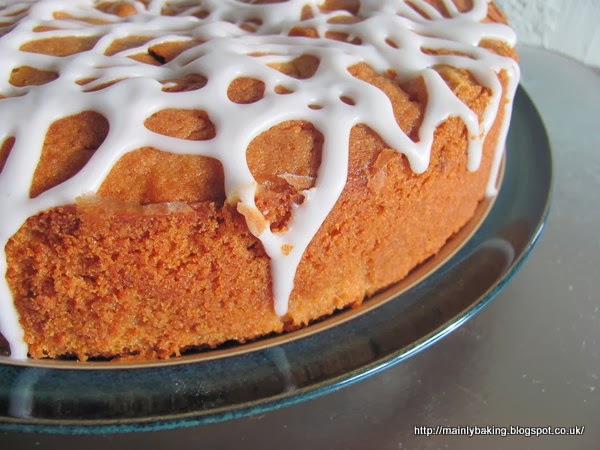
Apple Cake with an 'Eccles' filling

Despite the Good Food website taking liberties with the name of this cake, I really don't think I can bear to call it an Eccles Cake. The term Eccles Cake conjures up only one thing - a puff pastry  shell completely encasing a spicy currant filling; it's one of those traditional, iconic British things, like Bakewell Tarts, Cornish Pasties and Melton Mowbray Pork Pies, that shouldn't be messed with.

However, despite my misgivings over the name, this recipe made an exceedingly good cake - two layers of apple-studded cake enclosing a spicy
layer of dried fruits (sultanas, currants and candied peel). The cake layers were moist, but tender and light, and tasting slightly of caramel due to the use of brown sugar. The apple pieces kept their shape during cooking, adding to the range of textures in the whole cake. The dried fruit layer was spicy, sweet and buttery, with the flavour of the ground cloves and candied peel really standing out. Having said that, I know that many people do not like these particular flavours, but I think the cake would be just as good without them - perhaps adding something like cranberries instead of the peel, to keep the weight of filling correct.

The only changes I made to the cake recipe was to use sultanas instead of raisins, and to bake the cake in a 23cm tin rather than a 20cm one - the comments on the website, about the cake, suggested a larger tin would make a better proportioned cake - and I think I agree with them. The use of sultanas was purely to take advantage of what was in the storecupboard, but I did buy the currants especially for the recipe - currants are essential for a real Eccles Cake filling. I simplified the decoration by just using a drizzle of lemon glacé icing, although I have to confess that this was partly due to not reading the recipe properly, and having neither sugar cubes to crush nor an extra lemon to take zest from!.

I am entering this recipe into this month's Tea Time Treats baking challenge. The remit this month, in the run-up to Christmas, is to use dried fruits when producing something suitable for the tea table. This cake fits the bill quite nicely, as it is full of seasonal flavours and ingredients, and I think it would make a lovely Christmas cake for anyone not completely sold on the idea of a traditional fruit cake. 

Tea Time Treats is hosted alternately by Karen at Lavender and Lovage, and Kate at What Kate Baked - Karen is hosting this month and, as usual, will present a round-up post at the end of the month.