Showing posts with label mixed dried fruit. Show all posts

Friday, 23 November 2018

Cookie Bars

I've been really busy lately, helping my son clean and redecorate his new flat before he moved in. I made these cookie bars in a quiet moment - probably waiting for paint to dry before I could do anything else. I found this recipe, which originally came from Fig Jam and Lime Cordial blog, a while back, and it's really useful for cookies in a hurry.

Because I didn't want to add to my store cupboard of cooking ingredients, I bought a 120g pack of ready-mixed 'add-in' morsels marketed by Whitworth's. It was a mix of 35%  cranberries infused with cherry juice, 25% dark chocolate, 20% cherry infused apple and 20% raisins, called Dark Choc Cherry mix 'n' bake. I added 30g chopped roasted hazelnuts to add a bit more flavour and crunch. I used these in place of the chocolate and the orange zest in the recipe.

Although it was quick and easy to use a pre-packed mix of chocolate and fruit, infusing cranberries and apple pieces with cherry juice didn't give the same intense flavour that using dried cherries would have done, and there wasn't really enough chocolate in the cookie bars to satisfy a chocoholic! Not a bad idea for a speedy bake, though, particularly if you don't want to accumulate lots of opened bags of dried fruit and nuts.

Monday, 10 October 2016

Apple and Orange Fruit Loaf

When I'm short of inspiration, I sometimes look back over my blog posts to find cakes I thought were worth making again. I first tried this recipe back in October 2012, so it's taken me a while to get back to it, but it was worth making again!

When I originally made this Orange Frosted Apple Cake, I left out the nuts and just used an orange glacé icing on top. This time I made a few more changes: I used spelt flour instead of wholemeal, sunflower oil rather than rapeseed, walnuts instead of pecans, and a mix of dried vine fruits, berries and cherries. Instead of frosting the cooked cake, I sprinkled some crushed raw sugar cubes over the batter before baking to give a crunchy topping - I find the extra fat and sugar in frostings unnecessary in many cases, unless the cake is for a special occasion.

The grated apple and yogurt used in the cake add moistness, and mean that less fat - in this case, sunflower oil - can be used. Adding the apple also cuts down on the sugar needed, so this is a relatively healthy cake, especially without the frosting! The apple doesn't add much to the flavour of the cake, so in this case the walnuts and spices were the predominant flavours, with a subtle orange background note.

I really don't know why I waited so long to make this cake again, as it's a really good light fruit cake and can be varied according to which dried fruits and nuts are available.

Thursday, 11 August 2016

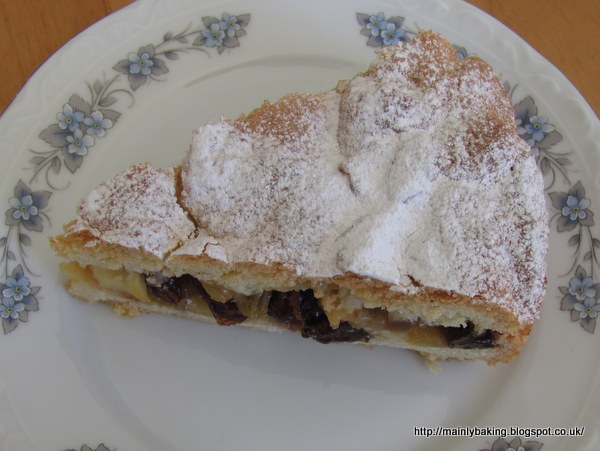
Apple and Orange Cake

In the absence of any better ideas, and with no inspiration to be found in any of my books, I fell back on this family favourite. The recipe makes a shortcake style dough which sandwiches a layer of fresh and/or dried fruits. Almost any fruit can be used, although fruit which releases a lot of juice during cooking is best cooked and drained first. This time the filling was three sliced eating apples, 100g mixed dried fruit (including raisins and cherries), 100g thick-cut orange marmalade and the zest of a large orange.

The dough is made by melting 150g butter and mixing in 150g caster sugar and 1 large egg. When everything is blended together tip in 300g SR flour and mix to a soft dough. Spread 2/3 of the dough into the base of an 8"(20cm) springform cake tin - just spread it out with your fingers, trying to get an even thickness. If you think the filling might release a lot of juice, you can build up a small wall of dough around the edge of the tin, but this isn't necessary with this particular filling as the dried fruit absorbs any juices from the apples. Mix all the ingredients for the filling together and spread out on the dough. The remaining dough makes the topping - break it into small pieces and drop on top of the fruit, then flatten the pieces to cover as much of the fruit as possible. There may well be small gaps but the dough spreads while baking, so most of these will fill up, and any gaps look quite attractive, anyway! There's a bit more detail on making this cake, with some explanatory photos, here.

Bake for 50 - 60 minutes at 180C until the cake is golden brown and feels firm. Cool in the tin for at least 15 minutes before removing the sides of the springform tin. Dust with icing sugar before serving, if liked. The cake can be served warm as a dessert, or at room temperature as a cake.

Adding the orange elements - marmalade and orange zest - gave this cake a light refreshing flavour and made the mixture of apples and dried fruit more suitable for a summer cake.

Friday, 17 June 2016

Berry and Cherry Cake

This was a hastily thrown together cake, using what was available in my storecupboard, just to make sure there was something in the cake tin, to get us through to the weekend. I used a pack of mixed dried fruit  -  cranberries, flame raisins, golden raisins, inca berries, tart cherries, bing cherries and blueberries - and added the last of a tub of candied peel and a few drops of lemon extract for a light citrus note.

Ingredients
225g SR flour
110g butter
85g caster sugar
100g mixed dried fruit
2 tablespoons candied peel, finely chopped
1 teaspoon vanilla extract
few drops lemon extract,
1 egg
milk to mix - about 100mls
2 tablespoons demerara sugar for topping (optional)

Method
Preheat the oven to 175C and line a small (1lb/450g) loaf tin.
Rub the butter into the flour, then stir in the sugar, dried fruit and candied peel.
Add the egg, vanilla and lemon extracts and 3 tablespoons of milk. Mix to a smooth batter, adding more milk, as necessary, to give a dropping consistency.
Transfer the batter to the loaf tin, level the top and sprinkle with demerara sugar, if using.
Bake for about 60 minutes, until a test probe comes out clean and dry.
Cool on a wire rack

Because this is a rubbed-in cake, rather than starting with a creamed mixture of fat and sugar, there isn't a really fine crumb, and small holes can often be seen, but for a quickly put together fruit cake, I think this is acceptable. The unusual combination of dried fruits in the mixture, together with the background citrus flavour, made a really tasty cake.

Wednesday, 26 June 2013

Hazelnut and Courgette Fruitcakes

This recipe contains ingredients better suited to Autumn - courgettes, apples, hazelnuts, spices and dried fruit - but I was looking for something to use up excess courgettes without using citrus flavours, which have dominated my baking recently.

The recipe comes from the revamped Good Food site, and all I did differently was to bake the mixture in two 1lb loaf tins, rather than a 8" round cake tin. I also squeezed out some of the moisture from the grated courgette and apple. For the dried fruit, I used a mixture containing raisins, apricots, pineapple and papaya. After tasting, I realised the tropical fruits were a mistake and I should have stuck to fruits more in keeping with the other flavours from more temperate regions  - dried pears, peaches or cranberries would have been better additions to vine fruits and apricots.

The cake was very moist and quite dark in colour - I think it might have been better made with white caster sugar rather than  light muscovado, as more of the colour from the courgettes might have shown through. As it was there were only occasional flecks of green to be seen.

Although the cake, as I made it, wasn't quite to my taste, with a little tweaking and a better choice of dried fruit, I'm sure it would make a good cake for colder afternoons in front of the fire.

Thursday, 21 February 2013

AlphaBakes - E is for..........?

Well, how many ingredients used in baking begin with E? Apart from eggs, which were more or less ruled out by Ros, the host of this month's AlphaBakes challenge, unless they were the main ingredient, I could only come up with elderflowers, which are not in season at the moment.

Scanning through the indexes (or indices) of all my baking books didn't get me much further. The very small 'E' sections were filled with titles such as 'easy....,' 'express....', 'everyday....' and 'extra....', which didn't really fit the brief either. Then I saw 'Eccles cakes'! Although I discarded these on the basis of being too time consuming and fiddly at the moment, especially if I made my own pastry, the word Eccles rang the bells of my memory. A Jamie Oliver recipe for Ecclefechan Tart, named after a place in Scotland, had received a lot of notice a couple of years ago, and I'd filed away the idea of it as 'interesting', in my mind. Now was the golden opportunity!

I needed some online research into the dish, as I didn't have a recipe, even in my books by Scottish cooks, such as Sue Lawrence. Along the way I discarded the Jamie Oliver recipe, as it used cream, unlike most other recipes. I wanted this to be a 'store cupboard' recipe, if I liked it, so that I could easily make it at any time. I did, however, keep his idea of baking one large tart rather than individual tartlets, and of  blind-baking the pastry case prior to adding the filling. In the end, I went with a slight adaptation of this recipe from The Great British Baking Club, although all the recipes are very similar.

I used a mix of dried fruit, including sultanas, blueberries, glacé cherries and a dried berry mix which included cranberries, more cherries and strawberries. Any large fruits were chopped smaller so that all the pieces were about the same size. I also added 35g flaked almonds, as these were the only nuts I had in stock. To freshen the flavour, I added the grated zest of a tangerine.

This amount of filling just fitted the 23cm shortcrust pastry case I had made, and I topped off with a decorative lattice made from the pastry offcuts. This large tart needed baking for about 30 minutes at 190C to set the filling.

I expected this to taste like a mincepie, but it was completely different. The lack of spices made the fruit taste much fresher, and the egg, sugar and butter mixture had set to a very sweet, soft paste. Although it was very sweet, I really liked the flavour and will certainly be making this again as a winter dessert. Serving it with creme fraiche would offset the richness a little.


As well as it fitting the brief for this month's AlphaBakes challenge, I am also entering this Ecclefechan Tart into the Tea Time Treats February challenge, the theme of which is puddings. If the word pudding is taken in it's wider sense, as a dessert course, then a pastry based tart is surely a suitable entry?

AlphaBakes (rules here) is a challenge to bake something based on a randomly chosen letter of the alphabet. The letter can be used for either the name of the bake or one of the main ingredients. It is hosted alternately by Ros from The More Than Occasional Baker, and Caroline from Caroline Makes. Ros is this month's host, and will be doing a round-up of entries at the end of the month.

Tea Time Treats (rules here) challenges participants to produce something suitable for the tea table. It is hosted by Karen from Lavender and Lovage and Kate from What Kate Baked. This month the theme of Perfect Puddings has been chosen by Kate, who will gather all the entries into a round-up post at the end of the month.

Monday, 14 January 2013

Caraway and Vinegar Fruit Cake


In his Guardian column this weekend, Dan Lepard gave two recipes for cakes raised with vinegar and bicarbonate of soda. Although I've never really noticed vinegar cakes before, both recipes sounded really interesting. I chose the first recipe, as I'd baked with dates in my recent Date and Maple Brownies. Dan suggests that this Caraway and Vinegar Currant Cake is quite adaptable, so I took him at his word, and replaced the currants (not tolerated in this house) with a mix of sultanas, dried cranberries and chopped ready-to-eat dried apricots. I kept the caraway seeds in the recipe, as I quite like the flavour, but it could be replaced with any other spice - I know it's an acquired taste.

I followed the recipe exactly, except I only used 225 mls of the suggested 275mls milk - I kept back 50 mls, as Dan used that inexact term  'about' 275mls. The batter was very sloppy, so I decided not to add the reserved milk.

As we are not eating large quantities of cake at the moment, I divided the batter between two small loaf tins, so that half could go into the freezer. The batter completely filled my loaf tins, so if you make this, make sure you use a really deep baking tin. I was worried about overflow, but the cakes rose gently, and the outer edges were set before the centre showed signs of rising - I think most of the rise occurred in the last 15 minutes of the baking time, which was the same for these loaves as suggested in the recipe.

This was a really well flavoured cake, with a soft-textured, moist crumb not usually seen in fruit cakes - Dan says this is down to the use of vinegar, whose acidity 'mellows the starch'. The crumb is a little 'holey'; and uneven,  but this doesn't detract from the flavour.

The mix of fruits I used worked well too, with the sweetness of the sultanas and apricots balanced by the tarter cranberries. The fruit stayed evenly distributed throughout the cake, and although there wasn't the quantity to call this a rich fruit cake, there were plenty of pieces of fruit in each slice. The caraway wasn't overwhelming, but it was noticeable, so it's best to substitute if you don't like the flavour.

Tuesday, 18 December 2012

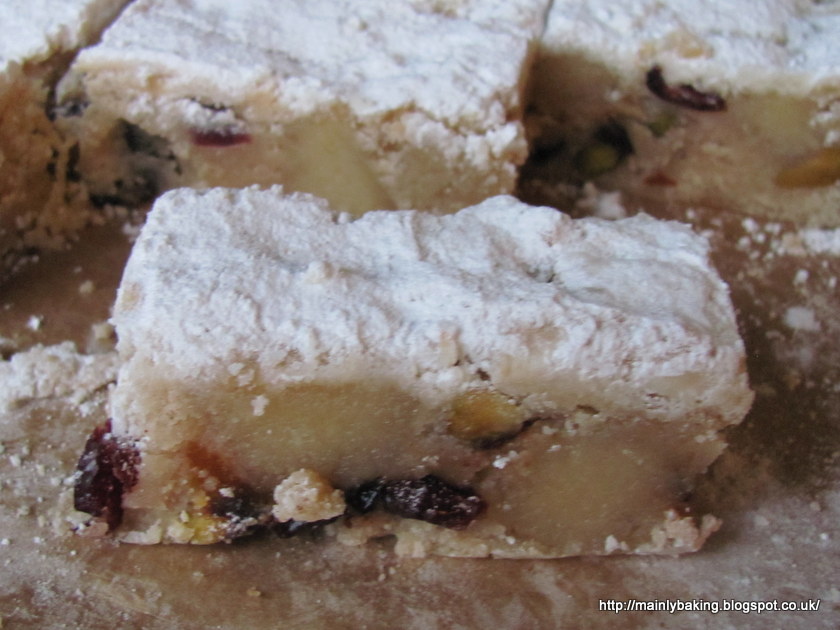
Cherry Stollen Bars

This is the start of my seasonal baking, although it was made for Hub's birthday treat. I like this recipe so much that I'll probably make another batch for New Year, when we have family visiting. I like these bars because they are packed with marzipan, and they achieve the 'stollen' effect without using yeast. Not only does yeast baking take so much time, my yeast doughs are notoriously unreliable - a recipe which works once may not work the next time I try it!

The recipe for these Stollen Bars comes from Dan Lepard, and featured in last year's Christmas cooking supplement in the Guardian Weekend magazine. When I made them last year, I followed the recipe exactly and thought the result was perfect! This time I varied the fruit content and cut down on the nuts a little, mostly because of what I had available in the store cupboard, but also because I wanted to try the recipe with cherries and cranberries. I used only 50g of pistachios and 150g of mixed dried fruit, including cherries, cranberries, chopped apricots and sultanas. There were more cherries by weight than any of the other fruit - a mix of regular and sour - which is why I've called these Cherry Stollen Bars. I used a generous coating of butter - about 25g was enough - and kept adding icing sugar until no more butter soaked through. Hubs thought it would be better with less icing sugar!

Although the result was just as tasty as before (I had been worrried that stronger tasting fruit would overwhelm the pistachio and orange flavour, which didn't happen), and looked really festive, I wasn't as happy with the bake. I'm not sure if the tray of dough was slightly under-baked or if the marzipan  lumps melted round the edge and made the dough too moist. I used marzipan with a slightly lower almond content than my usual brand, so that might have accounted for the difference. Whatever it was, it left the bars  moister in the centre than previously - more cake-like than bread-like - which I didn't like quite as much (although I am being really picky and self-critical here!).

As well as being a good seasonal bake, these Stollen Bars fit into this month's AlphaBakes Challenge. This month the challenge, set by Ros from the More Than Occasional Baker, is to bake something where the name, or principle ingredient, begins with the letter 'S'. I expect, given the time of year, that stollen will feature heavily in the offerings, but that's fine by me, as it's one of my favorite christmas cakes. Ros co-hosts this baking challenge with Caroline, from Caroline Makes - each month a new letter of the alphabet is chosen randomly.

Sunday, 25 November 2012

Hermit Bars

This is a recipe from one of my most looked-at books, called The Ultimate Cookie Book. I've had the recipe bookmarked to cook for years but have never made it because CT didn't really like dried fruit in cakes or cookies. Now that I'm not cooking regularly for CT, I can branch out into different areas, although FB comes with her own set of things she doesn't like or won't eat!

These bars certainly look like the illustration in the book; they are basically a lot of dried fruit and nuts held together by a small amount of very moist, heavily spiced, cake batter. The moisture comes from the addition of a huge amount of black treacle! However, when they took more than twice as long to cook as the recipe suggested, I checked other recipes online and found that Hermit Bars (or Hermit cookies) are usually made from a stiff cookie dough which is either baked in one block, like biscotti dough, and sliced after baking, or made as individual cookies.

The main difference I could see between my recipe and the ones online was the amount of flour - nearly all the other ingredients were present in similar proportions. I think they would have been nicer as more solid, chewy cookies, rather than very moist, somewhat soggy, cake bars. The spice and treacle flavour was very strong and overwhelmed the mix of dried fruit I used - apricots, cranberries and raisins - which made me realise why raisins alone were used in the recipe, mainly for texture. The overall flavour and texture was like eating slices of a very moist cold Christmas Pudding - not really exciting, even if you like Christmas Pudding! Interesting, but not to be repeated, I think!

Sunday, 30 September 2012

Condensed Milk Flapjacks

AKA, on the Carnation website, as Cherry Berry Fruit Bars

I recently noticed a part-used can of condensed milk lurking at the back of the fridge. It's a real bore picking recipes which use part of a can, because a) you don't want to bake another recipe using it too soon after the first and b) you can never find a recipe which uses the exact amount you have left over!

Searching for something which used about 2/3 of a can, I came across this recipe on the Carnation web-site. The whole recipe uses a full can, but I figured if I cut it down in size I could get away with what I had. Calculations of baking tin sizes made me realise I couldn't get away with 2/3 of all the ingredients, but could use 4/5 of everything in a 8" sqaure tin. This left me a little short of condensed milk, so I added an extra heaped tablespoon of golden syrup to compensate.

This recipe was absolutely packed with dried fruit and seeds. My usual flapjack recipe uses much less, and I've always wondered how much more it would take, and still hold together. Judging by this I could add a lot more to offset the butter and sugars! I used dried fruit from a pack of Cherries and Berries, rather than just cherries and cranberries, but  other than that I used dried apricots, sunflower seeds and pumpkin seeds, as suggested.

The condensed milk gave a lovely gooey, chewy texture to the flapjacks and combined with the brown sugar and syrup to give a toffee flavour, but I felt the amount of fruit and seeds overwhelmed all of this. I actually prefer a flapjack recipe with less add-ins and more of the flavour of oats and golden syrup. So although this was a delicious fruit-loaded bar, I don't think it will replace my usual recipe when I want flapjacks.

Wednesday, 11 July 2012

Hazelnut and Red Berry Brownies

I think I need to write this post to prove I'm still alive! Hubs and I were away the first week of the month, and I left a batch of brownies in the cake tin for the 'lodgers' - FB and CT. Since we've been back, we have been very busy, but I did manage to cook another batch of brownies from my favorite recipe.

This time I used sunflower oil instead of olive oil - I think using olive oil is an expensive waste, as the flavour of it is lost in the chocolate flavour. Instead of adding 100g of mixed chopped chocolate, I added 50g finely chopped hazelnuts and 50g of dried red fruit, from a mix called Berries and Cherries, roughly chopping the large pieces of fruit.

Adding dried fruit to brownies is unusual for me, but the result was better than I expected, as I think the fruit complimented the hazelnuts well! As usual, the brownies were moist and chewy, and richer than usual as I used a small proportion of 85% chocolate in the melted chocolate - about 1/3.

Now I really need to get thinking about this month's baking challenges, as I've lost almost half the month already!

Thursday, 17 May 2012

Marzipan, White Chocolate and Red Berry Cake

It seems a long time since I last wrote a blog post. I have been baking, but nothing new - things are a little hectic at the moment, and I haven't had time to look for new recipes, or even bake anything more complicated than easy one-bowl recipes which cook quickly, such as these brownies.

This cake is one such simple bake, although it takes a little longer than brownies to bake. The basic recipe, a Lighter Lemon Drizzle Cake, from Good Food is proving very versatile and open to adaptation.

This time I left out the lemon in the cake and omitted the the soaking syrup altogether, and added 50g each of chopped white marzipan, white chocolate and a red berry mix (cherries, cranberries, strawberries and blueberries), which was roughly chopped to avoid large pieces of fruit.

The result was a delicately flavoured cake, with the marzipan and the fruit being the highlight flavours, and the white chocolate giving a hint of vanilla. The ground almonds and polenta give a firm, moist texture.

Saturday, 5 May 2012

Chocolate Hazelnut Cake with Dried Fruit

This is a sturdy everyday sort of chocolate cake, which you can make more or less luxurious by varying the quantity of add-ins, and by choosing dried fruit and nuts to suit your budget. I wasn't feeling very extravagent, so only added 50g of chopped chocolate and 50g of sweetened dried fruit (cherries, cranberries, strawberries and blueberries), but the cake would easily have taken double this amount. More common dried fruit, such as sultanas and raisins, would make the cake cheaper.

I loosely based the cake on this Good Food recipe for a 'lighter' lemon drizzle cake. I kept the quantities of grains, sugar, eggs, oil and yogurt the same, but instead of using 175g flour, 50g polenta and 50g ground almonds, I used 200g flour, 25g cocoa and 50g coarsely ground hazelnuts. Any trace of lemon was omitted, as well as the final soaking syrup. The chopped chocolate and dried fruit was stirred into the final batter. I whizzed the fruit a little in the mini-chopper, after grinding the nuts, to cut up any large pieces of fruit - the strawberries were quite large.

This wasn't a very rich chocolate cake, as befits an 'everyday' cake, but it was well-flavoured and moist and it was nice to chew on the juicy pieces of fruit, which aren't often added to chocolate cake. As I said earlier, adding more fruit and chocolate would make a more luxurious cake.

Friday, 6 April 2012

Hot Cross Buns

Yet again, I've been touched by whatever jinx it is that makes my yeast baking fail! 

These Hot X Buns, from the recent Dan Lepard recipe published in the Guardian were full of flavour. However, the buns themselves were dense, heavy and dry - and I know that is not how Dan meant them to be.

I used 250g of a mix of cherries, berries and sultanas and 50g chopped dried apricots, but I missed the citrus tang that you get from mixed peel. The only change I made was to divide the dough into 15, rather than 12 buns, although I forgot to make the paste crosses correspondingly smaller!

I don't know where I went wrong - I bought new yeast, in case the yeast used in my last failed attempt was too old, I was careful not to get the liquid too warm, I measured all the ingredients carefully, I followed the instructions exactly. I set the batch of rolls in a warm place to double in size, and hardly anything happened! After 90 minutes, they had nowhere near doubled in size and weren't getting any larger, so I went ahead and put on the crosses, and baked, then glazed, them.

I think this is the last attempt at yeast baking. Failure is not just discouraging, it's flippin' expensive!

I am still going to enter these into this month's challenge over at Tea Time Treats - although the recipe didn't work well for me, I'd certainly recommend it to anyone more confident in their baking skills, as the flavour in the buns was excellent!

Tea Time Treats is a monthly baking and blogging challenge hosted jointly by Karen at Lavender and Lovage, and Kate at What Kate Baked. The full rules can be found here. This month the event is hosted by Kate and the theme is baking for an Easter Tea.