Showing posts with label pastry. Show all posts

Saturday, 16 January 2021

Cranberry and Hazelnut Frangipane Tart

Just before Christmas, I bought a jar of Christmas Cranberry Curd; just after Christmas I bought another - 'reduced to clear' so that the supermarket could get rid of unsold Christmas stock. I didn't have a clear idea of what to do with them at the time, but the idea of using some in a Bakewell tart type of thing slowly took shape. So, in my first baking session since Christmas, that's what I made.

I didn't have enough ground almonds, but I did have ground hazelnuts which needed using. I thought the hazelnut flavour might be better with cranberry, as it's much stronger than the flavour of almonds (in fact, you really need to add almond extract if you want a strong almond flavour in anything).

I also had some Trex cooking fat in the fridge, which needed using up too. I've never used Trex in baking (it was bought to make a lining paste for bundt tins) but it was past it's BBE date, so needed to be used. I did taste it to make sure it wasn't rancid, and it was fine. I substituted 1/4 of the butter in the pastry with Trex and just that amount was enough to make the pastry shorter than usual. The pastry dough seemed a little more difficult to work with, but it was worth it for the result, and didn't seem to affect the flavour greatly.

Ingredients

  • Shallow 24cm tart/flan tin lined with chilled raw shortcrust pastry - no need to bake blind.*
  • 200g of cranberry curd (lemon curd or a jam of your choice can be used instead)
  • Frangipane - 100g softened butter, 100g caster sugar, 2 large eggs, 50g ground roasted hazelnuts, 25g ground almonds, 25g flour (I used SR flour, but think plain flour, or more nuts would be better **).
  • 2 tablespoon of chopped roasted hazelnuts.

Method

Spread the cranberry curd over the base of the pastry case and return to the fridge while the frangipane is made.
Pre-heat oven to 200C/180C fan-assisted. Put a baking sheet in to heat up.
Make the frangipane by putting all the ingredients, except the chopped hazelnuts, into a bowl and beating until the mixture is light and fluffy and no specks of butter can be seen. Spread carefully over into the pastry case - I spoon small amounts of batter around the edge of the case then spread it inwards, so as not to move the curd or jam towards the edges of the pastry case, where it might erupt out of  any gaps between the frangipane and pastry. 
Use a teaspoon or a damp finger to try and seal the frangipane batter against the pastry sides, level the surface, then sprinkle over the chopped hazelnuts.
Transfer the tart to the heated baking sheet and bake at 200C for 10 minutes. Reduce the heat to 170C and bake for roughly another 25 minutes, until the frangipane isn't wobbling, and is golden brown in colour.

* I made shortcrust pastry using 300g flour, 150g butter and Trex and water to mix to a dough. I wanted some pastry for something else, so made more than necessary for one tart case. I'm guessing starting with 200g flour would be enough for just the tart case, and you could make a sweet shortcrust (adding sugar and egg) if preferred.

** The tart puffed up while baking, which I expected, as I'd added some SR flour, but it didn't sink evenly when it cooled, leaving a puffy rim around the edge of the tart and a fragile crust on the frangipane. This hasn't happened to me before, but I'm now rethinking the use of SR flour in frangipane. I'll try plain flour next time, but all ground nuts can be used too; I like a little flour as it makes the frangipane lighter and more cakey than when just nuts are used, but that's a personal preference.

This tart was absolutely delicious. The tartness of the cranberry curd stood up well to the flavour of the hazelnuts. My only disappointment was that the curd seemed to be absorbed into the bottom of the frangipane mixture, so that there wasn't a well defined layer of curd left after baking, as there usually is with jam. When I checked the curd ingredients, I noticed that it contained agar as a gelling agent, which gave it a strange gloopy consistency, but may also explain the way it behaved in the tart, when heated. Fortunately, this didn't affect the flavour, only the looks.

Monday, 13 January 2020

Lemon Curd 'Bakewell' Bars

I've recently started to donate baked goods to a monthly Coffee Morning run by the Friends of my local library. Not only is it giving me a much needed excuse to bake, but it's helping a good cause too. This month I made some date shortbread squares and these lemon and almond bars - similar to a Bakewell tart, but with lemon curd instead of raspberry jam.

Because the tart was going to be cut into individual portions before being put out for sale, I made it in a narrow rectangular tart tin, measuring 36 x 11.5cm. That way it could be cut into bars which would be easier to eat with fingers than a wedge from a round tart. Having a border of pastry on both short edges looked quite attractive too.


After lining the tart tin with sweet shortcrust pastry, I spread about 200g of lemon curd over the base - there's no need to blind-bake the pastry for this recipe. I used this BBC Good Food recipe for the frangipane mixture. It was exactly the right amount to fill the tart! The only changes I made to the recipe was to only use the zest of 1 lemon, and to add a few drops of almond extract, as I wanted the frangipane to taste more of almonds than lemon.

I baked the tart for 15 minutes at 200C, then lowered the temperature to 180C and continued baking until the frangipane was cooked to a golden brown colour - about another 25 minutes. When cool, I cut into bars about 3cm wide, although I discarded the first centimetre at each end, with the extra pastry (cook's treat!).


Saturday, 28 December 2019

Festive Desserts

I made two desserts for the Christmas period, as something chocolate is obligatory, but my daughter had also asked for a repeat of Dan Lepard's Mont Blanc Layer Cake.

The Mont Blanc Layer Cake recipe, based on meringue, is far too big for just three of us, particularly as it doesn't keep well, so I made a meringue roulade with only 3 egg whites, filled it with a half quantity of the chestnut and ricotta cream and drizzled melted chocolate over the top.

We decided, on trying the dessert, that although it was delicious, we all preferred the crisper meringue of the original recipe, which gives a better textural contrast with the chestnut cream than the soft meringue of the roulade.

For  the chocolate dessert, I made a half-sized quantity of Delia Smith's Chocolate Truffle Torte, which fitted nicely into a 7" (18cm) shallow cake tin. The only departure from the recipe was to use Amaretto liqueur instead of rum.

My daughter also contributed a batch of mince pies, which has become a tradition now. She uses this Mary Berry recipe, which adds dried apricots to the mincemeat and tops the tarts with grated marzipan.

Tuesday, 1 October 2019

Autumn Fruit Frangipane Tarts

It's a measure of how little baking I do these days, that it's over three weeks since I last posted. When I do bake anything, however small, half of it usually ends up in the freezer, meaning there's always cake there if needed, but as a result I don't need to bake as often. My waistline doesn't need cake every day, either!

When making this tart I realised that I hadn't made any pastry since the festive baking at the end of 2018 - an indication that calorific desserts are also becoming something for special occasions; I usually just have fresh fruit and yogurt!

These Autumn Fruit Frangipane Tarts had plum jam in the base and fresh blackberries and pieces of eating apple embedded in the frangipane mixture. I made two small tarts instead of one big one, as I was taking one to my local Cake Club. The frangipane comes from this Jamie Oliver recipe, but I made half as much again, after seeing the amount the original ingredients gave.

I made sweet shortcrust pastry to this recipe, but this made enough for the two tart cases with quite a lot leftover: 300g plain flour, 1/2 teaspoon baking powder, 150g butter, 50g icing sugar, 1 medium egg, water as necessary to bind. If you reduce the quantities you could use just an egg yolk instead of a whole egg.

Once the pastry is mixed, rest in the fridge for 20 minutes, then roll out as thinly as possible to line 2 x  20cm (8") tart tins (or one 23cm tin if you're following the recipe). Refrigerate again while you make the filling - there's no need to blind bake with a frangipane.

Preheat the oven to 180C (160 fan) and put a baking sheet in to heat up too.

Put all the frangipane ingredients into a bowl and beat until well combined. I added just a few drops of almond extract, to give a better flavour, instead of the lemon zest in the recipe. Then prepare the fruit.

(I used one large eating apple, which I peeled and chopped into quite thin pieces, about 1cm square, and put into acidulated water so that the pieces didn't turn brown. I also used fresh blackberries, as I was worried that frozen would release too much juice and spoil the colour of the frangipane - I didn't weigh the amount I used but the quantity give in Jamie's recipe sounds about right.)

Spread a couple of tablespoons of plum jam (or whatever red jam you prefer) into the base of each pastry case. Divide the frangipane mixture between the two tarts, working from the edge inwards, and trying to get a good seal between the frangipane and the pastry, so that the jam doesn't boil out around the edge. Spread evenly and then dot the drained and dried apple pieces and blackberries over the surface, pressing down gently to embed them in the frangipane. Sprinkle over a handful of flaked almonds, then a little extra caster sugar.

Transfer to the heated baking sheet and bake for about 45 minutes until the frangipane is a good golden colour and feels firm. Cool on a wire rack.

I decorated the tart which I was taking to Cake Club with a drizzle of glacé icing, but it's not really necessary, and the icing soon dissolved where it was in contact with the pieces of fruit, so didn't really give the desired effect by the time it was eaten.

Adding fruit to a frangipane tart is a tasty bonus, although in this case the plum jam had a stronger flavour than the apples and blackberries - I should have looked for a blackberry jam, I think.

My tart looks darker than most frangipane because I was using almonds which had been ground with the skins still on; the jury is still out on whether this really gives a good look.

Saturday, 29 December 2018

Lemon Curd and Hazelnut Tart

This was one of my Christmas desserts - not very festive, but I'd just made 2 large jars of lemon curd with some excess lemons, and needed to find ways of using it. I used this recipe for my curd, but this time added the zest of all 5 lemons. Lemon curd makes a tasty dessert, swirled into natural yogurt and topped with a sprinkle of plain granola, but it takes a long time to get through a whole jar that way, let alone two. This recipe used around 200g - I didn't weigh it, just spooned out about half a jar.

I made a sweet shortcrust pastry, using 200g plain flour, 1/4 teaspoon baking powder, a pinch of salt, 100g of butter, 50g of icing sugar, an egg and enough water to make a soft dough. After resting in the fridge I lined a shallow fluted flan tin with the pastry (the recipe won't use all the pastry, if you can roll it out really thinly - I made mince pies with the leftovers). I spooned 200g lemon curd onto the raw pastry, spread it evenly and refrigerated again while I made the hazelnut frangipane. I did this by putting 100g softened butter,
100g caster sugar, 50g SR flour, 50g ground roasted hazelnuts, half a teaspoon of vanilla extract and two eggs into a bowl and beating until well combined. The frangipane was spread gently over the lemon curd, working from the edges inwards, and being careful to get the batter to seal against the pastry edges, to minimise the chance of any lemon curd bubbling out. I sprinkled a handful of finely chopped roasted hazelnuts over the frangipane, then decorated the top with a few pastry shapes cut out from the excess pastry - they're supposed to be snowflakes but look more like stars. The tart was baked, on a pre-heated baking sheet, at 200C for 15 minutes, then the heat was lowered to 170C and baking continued until the frangipane was golden and firm - about another 20 minutes. The frangipane rose quite a lot while cooking, but thankfully sank back to give a level surface as it cooled - I think perhaps SR flour was unnecessary, but it does give a lighter texture to the tart.

The combination of lemon and hazelnuts was delicious, and the frangipane had the lightness of a sponge rather than being stodgy, as is sometimes the case when no raising agent, or all nuts, rather than a mixture of nuts and flour is used. I chose to use hazelnuts as they have a much stronger flavour than almonds, and because I thought they would work better with the tanginess of the lemon curd. I think the lemon curd would have overwhelmed the nut flavour if almonds were used, but this way the hazelnut flavour won.

Tuesday, 21 August 2018

Chocolate Hazelnut Tart

- for the final We Should Cocoa

We Should Cocoa, a monthly link-up for chocolate recipes started 8 years ago, when Tin & Thyme was still Chocolate Log Blog, and Choclette shared her hosting duties with Chele at Chocolate Teapot. Amazingly, I have been participating since the first link-up, although not very regularly recently. According to my records, I've contributed to 65 out of a possible 95 events. This month will be the 96th We Should Cocoa - and Choclette has decided to call a halt.

For many years the link-up had a theme, so I decided to check on the first, in August 2010. It turned out to be raspberries. I made Chocolate Frangipane Tartlettes with chocolate pastry and raspberry jam in the base - a kind of chocolate bakewell tart. At the same time, I made some similar tartlettes, with Nutella in the base, which we preferred. I thought it would be a fitting end to these events to base my entry on the first thing I made, so decided to go with a tart with Nutella in the base and a hazelnut frangipane on top. I also added more chocolate to the filling, so that the final tart had both the chocolate and hazelnut flavours of the Nutella ramped up.

Ingredients
Pastry
150g plain flour
100g butter
25g icing sugar
25g cocoa
1 egg yolk
cold water to mix

Filling
110g softened butter
110g caster sugar
1 egg + 1 egg white
1 tablespoon plain flour
110g ground hazelnuts
150g chocolate hazelnut spread
25g plain chocolate (I used 100% cacao) grated*

to finish - 40g plain chocolate (about 70%)

* 100% cacao is very hard, and when grated on a fine microplane grater, 25g goes a long way. If you are using  70% plain chocolate, or a coarse grater, you might need as much as 50g to get enough grated chocolate to cover the base.


Method
Make the pastry by sifting the icing sugar and cocoa into the flour, then rub in the butter until the mixture resembles breadcrumbs. Add the egg yolk and enough cold water to make a soft but not sticky dough, kneading briefly. Shape the dough into a disc, wrap in clingfilm and refrigerate for 15 minutes. Roll out the dough thinly and  line a 20cm (8") tart tin. Refrigerate again while you make the filling.
Pre-heat the oven to 200C. Put a baking sheet into the oven while it is heating.
Cream the butter and caster sugar until light and fluffy, then slowly beat in the egg, egg white and flour. Fold in the ground hazelnuts.
Warm the chocolate spread slightly (just a few seconds in the microwave, or in a bowl over hot water) and spread over the base of the pastry case, then sprinkle over the grated chocolate. Spoon the hazelnut frangipane filling into the pastry case and spread evenly.
Put the tart onto the preheated baking sheet and bake for 10 minutes, then lower the heat to 180C and bake for a further 25 minutes until the frangipane is set and golden in colour. Cool in the tin.
Finish the tart by melting the 40g of plain chocolate and drizzling it over the cool tart - I put the chocolate into a small plastic bag, then put that into a mug of hot water (seal the bag first, of course). When the chocolate has melted, snip off one corner of the bag to allow the chocolate to dribble out.

This tart was delicious! The extra dark chocolate in the base cut through the sweetness of the chocolate hazelnut spread, and the hazelnut flavour of the frangipane came through strongly. The only thing wrong was that the frangipane appeared to have separated a little as it cooked, leaving a pale set custard-y layer at the bottom. Although this didn't affect the flavour, it did affect the appearance; I have no idea what went wrong.

So, it's the end of an era! I'm sending this recipe to the very last We Should Cocoa link-up. Although I don't bake as much now as I did 8 years ago, I can thank WSC for stretching both my skills and my imagination. Over the years I've used ingredients that I would never have thought to pair with chocolate (some more successfully than others, I must admit) and tackled more complex recipes than I would usually handle. I believe Chocolette intends to keep the WSC archive, and has a Pinterest board, so we can still look there for inspiration.

Thank you for 8 years of fun, Choclette!


Tuesday, 17 July 2018

Chocolate Tart - free from gluten and lactose

I've used this recipe before, when I needed a gluten- and lactose-free chocolate tart. I really liked it the first time I made it, and didn't want to play around finding a different recipe, as we were are in the middle of a heat-wave and having too much cake/dessert around isn't good for me at all, especially with no-one to help me eat it!

I find gluten- and dairy-free pastry shrinks more than usual when baked blind, but the recipe I use makes a sweet shortcrust pastry case which doesn't stick to the baking tin, doesn't seem to suffer from soggy bottoms and has a good 'short' texture which doesn't become too hard, which seems a good trade-off to me. The dough starts out stickier, and needs careful handling - you can find the details here. Instead of adding the tart filling to a raw pastry case, as in that particular recipe, the pastry case is baked blind once the clingfilm is removed.

When baking blind, the only thing I do differently, compared to regular shortcrust pastry, is to dry out the pastry case for a little longer than usual, at a lower temperature. I initially bake the case, lined with baking parchment and filled with baking beans, at 200C for about 12-15 minutes, then turn the oven down to 160C, remove the parchment and beans and return the empty pastry case to the oven for about 20 minutes.

The filling for this tart is dense and fudgy, but as you don't add much extra sugar, it allows the flavour of the chocolate to dominate, so you need to choose a chocolate that you are happy  to eat on its own. The addition of the coffee is to further bring out the chocolate flavour, but I can't see any reason why other flavours couldn't be used too, such as orange zest. And, of course, if you don't need dairy/lactose-free, make it with butter and regular double cream.

As you can see, I served this tart with raspberries and there was also raspberry coulis and cream available.

Friday, 6 April 2018

Pistachio and Marzipan Palmiers

I have to admit that this was more of an assembly job than a real baking session, but these puff pastry biscuits were a lovely treat over the Easter weekend. I also have to admit that I chose the recipe to use the last of the Christmas marzipan, which had been stored, well wrapped, in the fridge since I made these Mincemeat and Marzipan Squares a month ago.

The recipe was in this feature on Easter baking, in the Guardian newspaper. There are a few points to note when it comes to assembly - the nut mixture needs to be firmly embedded into the pastry (I found it best to press down with the rolling pin rather than roll), and I felt that a longer chilling time would have made the roll of dough easier to cut. Unfortunately I didn't have more time at that stage as I needed the oven for the joint of lamb we were having for dinner. I baked the palmiers at 180C fan (200C conventional) as the temperature given in the recipe seemed a bit low for cooking puff pastry in a conventional oven. The palmiers still took the full 20 minutes to bake to a light golden colour, so my decision to raise the oven temperature seemed correct.

These are best eaten the day they are baked; the pastry wasn't quite so crisp the next day. Comparing my photos to the illustration with the recipe, it looks as though I should have processed the nuts and marzipan to a finer texture, but I liked the crunch of some larger pieces of nuts.

Saturday, 1 April 2017

Goat's Cheese Soufflé Tart

This is the second time I've written about this recipe, for a Goat's Cheese Soufflé Tart, which is given extra flavour with a layer of onion chutney in the base, but the first was several years ago, so it was definitely time revisit the recipe!

I had a lot of cheese left after a meal with friends, including a large piece of soft goat's cheese, which wasn't going to keep for long. I was in two minds as to which kind of tart to make - this recipe or a more conventional leek and goat's cheese quiche with an egg and cream custard filling. In the end, I decided to make this soufflé-style tart again, as it was such a success the first time.

It's a little more fiddly to make than a traditional quiche, but from my previous experience, more likely to be successful, as the semi-solid, meringue-like, soufflé filling prevents any possibility of a soggy pastry bottom when the tart is cooked. I made my own pastry from 200g plain flour, 100g butter, 25g grated parmesan cheese plus water to mix, and used it to line a 22cm (9") deep fluted flan tin, which was then baked blind. I then followed the recipe closely for the soufflé filling, except for using finely chopped rosemary instead of thyme.

Once again, this was a resounding success! The onion chutney I had chosen was flavoured with a little chilli, nigella seeds and cumin, so added an extra piquancy to the layer between the pastry and goat's cheese filling. The souffléed filling was moist and creamy - completely different to the custard filling of a conventional quiche - and the pastry was light and crisp. The goat's cheese which was crumbled over the surface of the tart didn't brown much during cooking, so the tart looked pale and interesting rather than well-cooked, but this didn't affect the flavour. My goat's cheese was quite strongly flavoured and this came through well in the tart.

Monday, 20 March 2017

Chocolate Tart

gluten- and lactose-free

I have a favourite recipe for a baked filling for a chocolate tart, which is naturally gluten-free, but unfortunately it didn't work well when I tried to make it lactose-free too. Using a vegetable fat instead of butter and lactose-free cream instead of creme fraiche lead to the filling separating during baking to give a thin layer of egg custard on the base with a thicker chocolate layer on top. It was still edible and quite tasty but not really good enough to serve to guests.

Searching through my file of recipes cut from magazines, I eventually found a recipe for a filling for a chocolate tart which looked suitable. It contained a much smaller amount of butter than the previously tried recipe and cream rather than creme fraiche, so I hoped it would adapt better to lactose-free alternatives.

Ingredients
23cm (9") pre-baked shortcrust pastry case (gluten and dairy-free, if necessary)
50g hard vegetable fat (eg Stork)
250g 70% dark chocolate, dairy-free
3 large eggs, separated
50g caster sugar
6 tablespoons lactose-free double cream
1 tablespoon finely ground fresh coffee

Method
Pre-heat oven to 200C.
Melt the butter and chocolate together in a bowl, over a pan of simmering water. Cool slightly.
Whisk egg whites to very soft peak stage.
Whisk yolks and sugar in a large bowl, until just combined and slightly frothy. Stir in the coffee and cream.
Pour in the cooled chocolate mixture, and fold in gently, along with the egg whites.
Spoon the chocolate mixture into the pastry case, and level using a hot, wet palette knife to give a smooth surface.
Bake for 12-15 minutes, until the edges are firm and the centre is just set.
Cool to room temperature before serving.

This recipe worked perfectly. The chocolate filling was dense and fudgy, but not too sweet. Although I don't need either gluten-, dairy- or lactose-free baking for family cooking it is nice to have 'free-from' alternatives when needed for guests. Now that I'm happy with the gluten-and dairy-free pastry recipe I use, a chocolate tart is a useful addition to my repertoire.


Friday, 3 March 2017

Coconut Tart

gluten- and dairy-free

The main aim of this baking session was to see how well my recipe for gluten-and dairy-free pastry behaved during blind-baking (see this post for details of the pastry). It shrank rather more than I'd expect from using my usual pastry techniques, and browned slightly too much during the drying out period. My main fear was that, as the pastry is so soft and pliable, the edges would collapse during baking, but I pressed the baking parchment quite firmly against the pastry wall and made sure the baking beans went well up the sides. The over-browning can be easily rectified by lowering the oven temperature during the drying out phase, so overall I was pleased with the result.

When it came to a filling, I wanted something different to the tarts I've baked recently, so that ruled out chocolate, lemon and frangipane. I've got a recipe book called The Book of Old Tarts, and came across a recipe for Cumbrian Tart in there - a coconut macaroon-type mixture on top of raspberry jam. I don't know how authentically Cumbrian this recipe is, as I couldn't find any online references, but  it sounded tasty, and was simple to make.

I didn't have raspberry jam, and although I was briefly tempted by the leftovers of a jar of mincemeat, I decided that marmalade would probably give a good sharp contrast to the sweet coconut topping - and it did!

Ingredients
1 shallow pre-baked 23cm(9") pastry case (gluten and dairy-free if necessary)
200g marmalade (I used fine shred orange and tangarine)
2 tablespoons golden syrup
25g caster sugar
55g butter (or hard baking fat, eg Stork, if dairy-free)
140g desiccated coconut
1 egg

Method
Pre-heat oven to 190C.
Spread the marmalade in the base of the pastry case.
Warm the golden syrup, sugar and butter together, in a small pan, until the sugar has dissolved.
Remove from the heat and mix in the coconut and egg.
Spread the coconut mixture over the marmalade, making sure to seal the edges where the filling joins the pastry.
Bake for 30 minutes until golden brown (mine was cooked to dark brown in 23 minutes).

If you search for coconut tart recipes, there are several similar recipes, but they often use a lot more sugar and fat in the filling, and more complicated methods of preparation. The simplicity of this recipe, together with quite low levels of sugar, meant that the flavour of the coconut dominated, and the filling, while nice and chewy, wasn't too sweet and contrasted nicely with the crisp pastry.

The second time I made the recipe I used a seedless raspberry jam in the base, and also reduced the oven temperature, from 200C to 180C, while drying out the pastry case for 10 minutes after blind baking.

I preferred the marmalade version which I thought gave the coconut filling a tropical twist as well as a certain tartness, but my husband preferred the more traditional raspberry. I found the raspberry version too sweet, although the contrasting colour does  make the tart look more interesting.

Tuesday, 31 January 2017

Lemon Tart

I've not been having much luck with lemon recipes recently; after the Spelt, Lemon and Maple Drizzle Cake, which failed twice, I had another technical failure with a Lemon Tart.

I chose this particular Lemon Tart recipe, from Good Food, to see if reducing the fat levels still made an acceptably tasty dessert - this recipe claims to be half the fat of a classic tart.

I liked the reduced fat pastry, which was unexpected, and really loved both the flavour and texture of the filling, which was light and silky smooth and just about sharp enough for my tastes. However, my tart cracked like crazy paving as it cooled. I don't think it was overcooked, as it was still wobbly in the centre, but I did leave it in the oven, with the door slightly open, to cool, so that might have been the problem, although slow cooling is usually advised to avoid cracks. The cracks didn't really spoil the tart from the point of view of eating it, but I usually only make desserts like this on special occasions, and wouldn't want to serve this to guests.

Sunday, 1 January 2017

Chocolate Tart

This is an early Jamie Oliver recipe, from The Naked Chef, which I think was published in 1999. It's fairly heavy on sugar, but doesn't taste too sweet because of the large amount of cocoa in the chocolate filling. Adding golden syrup helps the filling bake to a rich fudgy texture, similar to a very rich brownie.

You need a pre-baked shortcrust pastry tart shell, a maximum of 25cm(10") in diameter. I make my own sweet shortcrust pastry and use a 23cm (9") fluted shallow tart tin, but a bought pastry case is OK too.

Filling Ingredients
140g unsalted butter
150g dark chocolate (70% cocoa solids)
8 tablespoons cocoa
pinch salt
4 large eggs
200g caster sugar
3 tablespoons golden syrup
3 heaped tablespoons sour cream/creme fraiche

Preheat oven to 150C or 130C fan
Melt the butter, chocolate, cocoa and salt together in a bowl over a pan of simmering water. Stir to mix thoroughly. Remove from heat.
In a separate large bowl, mix the eggs and sugar until thick and creamy, then stir in the golden syrup and cream.
Stir the chocolate mixture into the egg mixture until well blended, then carefully pour the batter into the pastry case, filling the case as full as possible.

(If you've used a case which is less than 25cm in diameter you will have some chocolate mixture left over, but this can be poured into two or three shallow ramekins and baked alongside the tart.)

Bake for 35 - 45 minutes until the mixture feels firm in the centre. My 23cm tart cooked in 35 minutes, but the recipe suggests a bit longer for the bigger size.
Cool for at least 45 minutes before serving. I serve at room temperature, dusted with icing sugar. There's no need to refrigerate any leftovers.


Friday, 23 December 2016

Mincemeat Frangipane Tart

gluten- and dairy-free

The highlight of this recipe, for me, was making a really good gluten- and dairy-free pastry. I'd read that it wasn't easy, so it felt quite an achievement  to come up with a recipe which worked well first time (and was repeatable - I made this dessert twice!). After looking at many recipes and reading about gluten-free pastry, I based this recipe on my usual wheatflour sweet shortcrust pastry recipe, but added both a little xanthan gum for strength and baking powder for lightness. I'd read that gluten-free pastry needs more liquid than wheatflour pastry, so I made the dough wetter than usual.

There are reservations about this apparent success though - the pastry dough was very sticky and hard to handle, and I'm not sure I would have had as much success in other situations, for instance if the pastry needed baking blind, or if I was trying to make a pastry top crust too. This may have only worked because the filling was put straight onto raw chilled pastry, and the mincemeat and frangipane layers completely filled the pastry case, holding the sides in place until the pastry had set during baking and leaving no chance of any collapse. Obviously I need to try out the pastry in other situations before declaring it a total success.

Ingredients:
Sweet shortcrust pastry:
200g Dove's gluten-free plain flour
1/8 teaspoon xanthan gum
1/4 teaspoon baking powder
100g hard dairy-free baking fat (eg Stork)
50g icing sugar
1 large egg
2 tablespoons water

250g mincemeat (check it's gluten- and dairy-free, if this is important)

Frangipane:
100g caster sugar
100g ground almonds
100g dairy-free baking spread
1 tablespoon ground rice
2 large eggs
a few drops almond extract
flaked almonds for topping

Method
Sift the flour and icing sugar into a bowl and add the xanthan gum and baking powder.
Cut the baking fat into small cubes and add to the bowl. I find that Stork is not as hard as cold butter, so can usually be used straight from the fridge.
Rub or cut the fat into the flour mixture until the mixture resembles breadcrumbs, then mix in the egg and water to make a smooth sticky dough. Only knead enough to incorporate everything into an even dough. Put the ball of dough onto a large piece of clingfilm, wrap loosely and flatten the dough into a 3cm thick disc. Chill for 20 minutes.
Unwrap the dough, but leave it in the centre of the clingfilm, then cover with another large piece of film. Roll out the dough evenly, between the pieces of film, until it is about 30cm (12") in diameter and will fit into a shallow fluted flan tin, about 23cm (9") in diameter.
Remove the top piece of clingfilm carefully - the dough will still be sticky - and invert the circle of dough into the flan tin, so that the bottom piece of film is now on top. While this piece of clingfilm is still in place, ease the dough into place in the corners and flutes of the tin. Chill the pastry case again.
Remove the pastry case from the fridge, gently ease off the clingfilm and trim the dough around the top of the tin to give a neat edge. Any small holes can now be patched with small pieces of the dough trimmings, if necessary - just smooth a small piece into place with your finger.
Pre-heat the oven to 180C, and put a baking tray onto a middle shelf to heat.
Spread the mincemeat into the base of the pastry case.
Put all the ingredients for the frangipane, except the flaked almonds, into a bowl and beat until the mixture is smooth. This is easily done with a spoon, but you can use a hand-held mixer too, if you prefer.
Pour the frangipane over the mincemeat to fill the pastry case, and sprinkle with flaked almonds. Put onto the baking tray and cook for 40-45 minutes until frangipane is firm and golden brown.
Cool in the tin.

I was really pleased with this. I've made frangipane mincemeat tarts before, but never a gluten-and dairy-free version. I doubt anyone would be able to tell the difference as the strong flavours of mincemeat (I used a gluten-free variety with added cranberries) and almonds covers any deficiencies through not using butter in the pastry. The pastry was light and crisp too, and kept well over the three days it took to eat the tart.

I think this will be my last post before Christmas, so I'm fortunate it's a festive one. I'm not planning to cook anything new over the Christmas period, just old favourites. It's also hard to get photographs in the chaos of cooking and the bad light at this time of year, so I'll be back soon with something new.

Season's Greetings to you all!

Sunday, 3 April 2016

Cherry Pithiviers

I've wanted to make this recipe since I saw Rick Stein make it on his French Odyssey TV series, and that was back in 2005. It wasn't until I was planning my Easter cooking, and around the same time noticed large jars of reasonably priced Morello cherries in Aldi, that a plan fell into place. Rick's recipe uses fresh cherries, but they aren't in season yet and I couldn't see any reason why preserved cherries wouldn't work.

This is more of an assembly job than an exercise in cookery skills - ready made puff pastry, a jar of cherries, a simple frangipane paste - but there are still obstacles to perfection. I fell at the last hurdle, and made a mess of the traditional pithiviers markings on top of the pie, but overall I was really pleased with how the dessert turned out.

I used ready-rolled sheets of all-butter puff pastry, which was all that was available when I was shopping. This made assembly even easier - one sheet was rolled slightly thinner so that I could cut a 29cm disc, and the second sheet was just the right size to cut out a 25cm disc for the base.

While the pastry discs chilled for 20 minutes, I made a frangipane paste from 125g softened butter, 125g caster sugar,  1 medium egg and 1 medium egg yolk, 125g ground almonds, 15g plain flour and 2 tablespoons kirsch. Into this I mixed 225g very well-drained Morello cherries, without stones.

The pastry base was placed on a baking sheet covered with baking parchment, and the cherry frangipane mixture was heaped on and spread out to leave a 2.5 cm border of pastry. This border was brushed with an egg wash made from an egg yolk and a teaspoon of water, then the top layer of pastry was carefully placed on top. At this point it's necessary to exclude as much air as possible, seal the two layers of pastry together then crimp around the edges of the pie - a little tricky, and the top pastry may need trimming if it has stretched during handling. Once this assembly was complete, the pie was chilled again for 20 minutes.

After chilling, the pie was brushed with egg wash and the traditional arcing cuts were put on top. It's important to egg wash first, then mark with the tip of a sharp knife. If you cut first, the egg wash will seal up the cuts and they won't open during baking to give the markings you need. It's also important just to mark the surface of the pastry and not cut right through. (I just couldn't get the cuts right - after the second cut I could see I was already going wrong, so I just did the best I could, filling any large gaps with odd short cuts. Rick Stein says in his book that he couldn't do it correctly either!)

Finally, cut a small hole in the centre of the pie and place in a 220C oven for 15-20 minutes, until the pastry has risen and turned golden. After this time reduce the temperature to 180C and cook for another 40 minutes, covering loosely with foil if it's getting too dark. (The published recipe is a bit unclear at this point - it says bake for 40 minutes, but doesn't say whether this is a total of 40 minutes from the start of baking, or whether it's 40 minutes after the initial 20. I checked a few blog recipes and they all gave an extra 40 minutes (a total of about an hour) so I did that too.) You can test the frangipane with a probe, if you like and if it's dry, remove the pie from the oven sooner, but I didn't find the probe test very helpful.

Traditionally, pithiviers are sprinkled lightly with icing sugar (you only need a teaspoonful), then returned to a 220C oven for a few minutes to caramelise the sugar and give a glazed look. I had something else in the oven and couldn't turn up the heat, so flashed the sugared pithiviers under a hot grill to glaze it.

This is best eaten warm or at room temperature, on the day it's made. I kept mine for three days, and although it still tasted good, the pastry didn't stay as crisp as when freshly baked. This was a really delicious version of the traditional pithiviers, which only uses frangipane paste. Cherries pair really well with almonds, and the soft frangipane and crisp pastry gave a good combination of textures. It was really odd to see the pastry puff up so much around the edge of the pie, so that the domed raw pie came out of the oven as a flat disc. I was happy using preserved cherries - I wonder now how much liquid would have come out of raw cherries, and if that would have made the frangipane too sloppy?


Wednesday, 27 January 2016

Sesame and Ginger Oat Biscuits

 - made from pastry scraps!

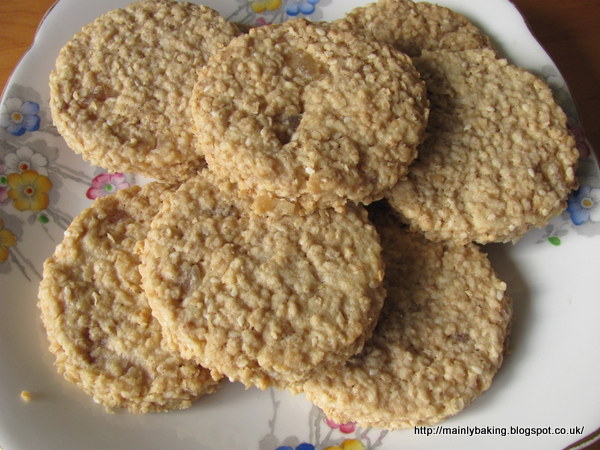
I've used this recipe before, when I've had a substantial amount of leftover shortcrust pastry. Last time I reduced the sugar in the original recipe and made savoury oat biscuits, this time I left in the suggested amount of sugar, added some sesame seeds and some crystallised ginger and made some fairly plain, not too sweet, biscuits which provided welcome relief from the excesses of rich food over the Christmas period.


It's more of a baking tip than a recipe - you weigh your pastry leftovers, then add the same weight of rolled oats and half that weight of butter and sugar. I started with 180g of shortcrust pastry, so added 180g of oats, 90g butter and 90g of soft brown sugar. I also added 2 tablespoons of sesame seeds and 50g of finely chopped crystallised ginger.

After leaving the bowl of ingredients for half an hour or so, for the pastry and butter to soften, everything is kneaded together either by hand or in a food processor. The dough is then rolled out to about 5mm thick and cut into shapes of your choice. These take about 15 minutes to bake at 180C - they need to be firm but not coloured too darkly.

The recipe I used, plus some other suggestions for using up leftover pastry, can be found on this link to the Guardian 'Readers' Recipe Swap'.

Sunday, 17 January 2016

Honey Nut Tart

I think this tart must be very similar to a Pecan Pie; it uses sugars, butter and eggs to make the filling, but here the pecans are replaced by hazelnuts and walnuts, and the syrup (corn or maple) used in most recipes is replaced by honey - you could call it an Anglicised version of the classic American dessert.

I saw the recipe in the latest National Trust newsletter, following an article about all that the National Trust is doing to help the plight of the honeybee, including supporting the National Pollinator Strategy. I can't find the recipe (Sissinghurst Honey, Walnut and Cobnut Tart) online, except as a .pdf file, but it's very simple  - the first thing you need is a 9" (22 - 23cm) shallow sweetened shortcrust pastry flan case, baked blind. For the filling, scatter 100g each of roughly chopped toasted hazelnuts (or fresh cobnuts. in season) and walnut pieces over the pastry case then pour over the sticky filling. This is made by melting 85g of butter, then stirring in
100g of set honey. This mixture is blended with 4 medium-sized beaten eggs and 175g of light brown sugar (the recipe used demerara, which I didn't have). When the mixture feels smooth and the sugar has dissolved, pour over the nuts to fill the pastry case as much as possible (I had a little of the filling left over). Bake for 30 - 40 minutes at 190C, until the filling is firm. I found the filling baked in 25 minutes, so it might be an idea to use a slightly lower temperature than that used to bake the pastry case - I suspect a misprint in the recipe! Serve at room temperature.

This was a gloriously indulgent, sweet and sticky tart, with the flavours of both nuts still identifiable. I was a little disappointed that the honey was lost amongst all the sweetness and nuttiness, but perhaps that was down to my choice of honey. A really strongly flavoured one might have stood up better, although I'm always wary of recipes which use a lot of sugar as well as honey - there's often not enough honey to give a strong flavour.

Friday, 1 January 2016

Festive Fruit Pie

Most of the Christmas leftovers have been dealt with by now. The last slice of ham, a few chunks of turkey and half a dozen chestnuts, together with a few mushrooms, in a mustard-y cream and white wine sauce, made a very tasty pie. What hasn't been eaten has been packed into the freezer, hopefully to make pies and curries over the next few weeks, and not just forgotten about. However, I am also determined not to leave too many half-used jars and packets of seasonal ingredients lurking about, as by springtime I'm past the point of wanting to eat things like mincepies and cranberry sauce.

Allow me a slight digression here - have you noticed that cream cheese is sold in 280g packs now, and not 300g? Luckily I was using a modern cheesecake recipe which took account of that, but many of my older recipes use multiples of 300g, so leftovers are inevitable, even if buying smaller packs, which are proportionally more expensive, to make up the weight.

Even so, as a result of scaling down a cream cheese frosting recipe, I was left with around half a pack of cream cheese and happened to read this recipe at Belleau Kitchen for a delicious sounding pastry using cream cheese, orange zest and ground almonds. It seemed perfect for the 'leftovers' fruit pie that I had decided to make. I made a slight adaptation to the recipe - I reduced the sugar to 50g and used icing sugar (which I think is incorporated more easily into pastry), and also used the zest of a small orange instead of a clementine, but otherwise I followed Dom's recipe, which originates from Dan Lepard's 'Short and Sweet'.

I used 2/3 of the pastry to line a deep pie dish, and the remainder to make a lattice for the top. I assembled the lattice on a sheet of baking parchment, and chilled it, along with the pie case, for about 20 minutes, before putting the pie together for baking.

For the filling I mixed together:
200g of mincemeat
roughly 125g of a good quality cranberry sauce (over 50% fruit)
two eating apples, peeled and cored and cut into small dice
80g of ready-to-eat dried dates, snipped into small pieces
1 teaspoon of ground rice to absorb excess fruit juices

I put the filling into the unbaked pie case, and placed the pre-made lattice on top. The excess pastry around the top of the pie case was folded over the edges of the lattice to seal the base and lattice together. The top was brushed with beaten egg white and sprinkled with caster sugar and the pie was baked at 180C for about 40 minutes until golden brown.

Both elements of this pie were very good! The pastry was very short and crumbly, but very easy to work with, and probably would have been even more delicious with a blander pie filling. The orange zest could be tasted in the pastry when eaten alone, but it was overwhelmed by the spices and other flavours in the mincemeat mixture. The pie filling still tasted predominantly of mincemeat but the addition of tart cranberries and apples cut through the usual sweetness and added a greater depth of flavour. The overall spice level of the mincemeat was reduced too, allowing the combination of dried and fresh fruits to dominate. Altogether, a successful experiment - the pastry is wonderful (thanks Dom!) it's worth buying cream cheese specially for it, and the filling mixture reduced my stock of opened jars while tasting much better than such a haphazard mixture might have done!

Saturday, 26 December 2015

Chocolate Orange Cheesecake

Although I love a traditional Christmas Pudding, the rest of the family are not so keen - especially the younger generation. For many years our tradition has been something with chocolate for dessert on Christmas Day. This dessert, from the 2015 Christmas (November) issue of Good Food magazine (the only issue I buy now), fit the bill, although the chocolate was very much in a minor role to the deliciously creamy baked orange cheesecake.

This recipe for Chocolate Orange Cheesecake was simple to make. I don't have a large food processor, so made the base by hand - crushing the biscuits with a rolling pin and mixing in the melted butter - and mixed the ingredients for the filling with a hand-held electric mixer, on slow speed. I chopped the chocolate for the topping in a mini-processor - much simpler and faster than grating. The only issue I had was leakage of the very sloppy cheesecake mixture out of my springform tin - I think it's time for a new one, hopefully with a tighter leak-proof fit between sides and base. Fortunately the wrapping of foil which was designed to stop the waterbath water seeping in also contained the mess, and the heat of the waterbath set the cheesecake quickly around the edges to prevent too much loss.

Although no-one wanted to eat much  dessert after Christmas Day dinner, CT and I both tried a small piece. I expected the topping to be difficult to cut, but the chocolate rubble had stayed as such, and hadn't set into a hard layer, as melted chocolate spread on top would have done. An excellent idea which I will remember for the future! In fact it was the base which was hard to get through - after serving two small slices, I realised I hadn't actually cut through the base at all, but had lifted the cheesecake off the biscuit layer! After that was sorted, subsequent slices were easier to serve!

As a baked cheesecake, this was deliciously soft and creamy - only just set, but just right! The orange flavour of the zest and liqueur in the cheesecake mixture shone through, highlighted by the orange flavoured milk chocolate in the topping. Adding a proportion of almondy milk chocolate to the topping added extra crunch and flavour, and the base was thin and crisp. All round, an excellent dessert, and one I will use again.

I promised to mention FB's mincepies in my post. It was her first attempt at making pastry, and an excellent attempt it was too! She used this Mary Berry recipe which added orange zest to the pastry, chopped dried apricots to the mincemeat and topped the pies with grated marzipan. They were really good - tasty adaptations to bought mincemeat to make the pies extra special. My thanks go to her for taking on some of the Christmas cooking.

The use of many eggs in this cheesecake means I can enter it into Belleau Kitchen's Simply Excellent link-up for December. Dom's theme this month is Anything Goes, so I'm expecting to see a lot of Christmas desserts!


Chocolate in the base and topping also makes this cheesecake eligible for this month's We Should Cocoa event, a blog cooking challenge originated by Choclette at Tin and Thyme and hosted this month by Munchies and Munchkins, who has chosen the theme of Christmas.