Showing posts with label marmalade. Show all posts

Thursday, 22 August 2019

Marmalade Shortbread Squares


I was tempted by a jar of marmalade in one of our local independent delicatessens  - blood orange, lime and chilli - but was quite disappointed when I tried it.

The fruit content wasn't very high (I know I should have checked before buying, but for what I paid I expected more) and the peel had been diced rather than shredded. On top of that the chilli flavour wasn't really noticeable either. However, it was too expensive to waste, so I decided to incorporate it into one of my favourite cookie bar recipes.

These shortbread squares are as near perfection as it's possible to get, I think. They are buttery, melt-in-the-mouth crumbly, yet still crisp (and they stay crisp, even after several days, which is quite a feat with a moist filling).

The original recipe is from Sue Lawrence's 'On Baking' , and used a filling of dates and currants cooked with ginger, honey and lemon juice to give a thick pulpy filling. I kept the shortbread layers exactly as they are in the recipe, and used 250g of marmalade for the filling.

Ingredients
170g SR flour
170g semolina
170g butter
85g caster sugar
250g marmalade of choice

Method
Pre-heat the oven to 190C (170C fan), and line a 20cm square baking tin with a piece of baking parchment.
Put the flour and semolina into a bowl. Warm the butter and sugar together in a small saucepan until the butter has melted and the sugar is dissolved. Pour onto the flour mixture and combine thoroughly to give a wet sticky dough.
Warm the marmalade slightly, so that it is spreadable (I  put it in a small bowl in the microwave, for just a few seconds).
Put 2/3 of the dough into the baking tin and spread evenly over the base, pressing down firmly. Spread over the marmalade, leaving a 1cm margin around the edges.
Crumble the rest of the dough over the top, aiming for a fairly even distribution, and press down lightly just to make sure it sticks. There won't be enough to completely cover the surface but that doesn't matter - it will spread as it bakes, and a few gaps look attractive anyway.
Bake for 25 minutes, by which time it should be golden brown. Cut into squares immediately, but leave in the tin to get completely cold before removing - the shortbreads are too fragile to move while warm.

These were delicious! This shortbread recipe isn't over-sweet, so the biscuit layers were a nice contrast to the amount of sugar in the marmalade. The marmalade, although heavy in sugar, also had a pleasing sharpness to it's flavour so the whole thing was nicely balanced.

The possible variations on this recipe are as wide as your imagination - I've used jam, mincemeat, chocolate spread (with and without added caramel) other dried fruits (chopped and cooked with a little liquid until soft and pulpy) and have added chopped nuts and marzipan to the top layer of shortbread. I haven't tried fresh fruit yet - I think many fruits would be too wet for the shortbread to stay crisp, but pre-cooked and drained apples or pears might work.

Saturday, 20 April 2019

Easter Shortbread Squares

Another outing for my favourite 'biscuit bar' recipe - what could be better than a crisp, melt-in-the-mouth shortbread filled with a luscious fruity filling? The original recipe is from Sue Lawrence's book 'On Baking' and has a date and ginger filling. I stick to her recipe for the shortbread layers but have experimented with many different fillings.

This time I was aiming to get the flavours of  the traditional Simnel cake (marzipan, dried fruit, spices) into the little shortbread squares. As I was using some mincemeat left over from Christmas to get the fruit and spice into the filling I added the tang of citrus flavours (in the form of marmalade) to brighten the flavour and make it feel fresher and more Spring-like. For the final step, I grated marzipan into the topping.

Ingredients
170g SR flour
170g semolina
170g butter
85g caster sugar

250g mincemeat
100g marmalade (I used three-fruit marmalade for a sharper flavour)

100g white marzipan

Method
Preheat the oven to 190C/170C fan. Line a 20cm (8") square tin with parchment.
Weigh the flour and semolina into a large bowl. Mix the mincemeat and marmalade in a small bowl.
Put the butter and sugar in a small saucepan and heat gently until the butter has melted and the sugar dissolved.
Pour this mixture onto the flour mixture and mix well to combine.
Put 2/3 of the dough into the prepared baking tin and spread evenly. Press down firmly as you level the mixture and smooth the surface.
Spread the mincemeat mixture over the dough, leaving a small margin around the edges.
Break up the remaining portion of dough into crumbs, still in the bowl, and coarsely grate the marzipan into the bowl. Gently mix the marzipan and dough crumbs together, then sprinkle them evenly over the filling. Press the topping down very lightly.
Bake for 25 minutes until golden brown. Rest for 5 minutes, then cut into 16 squares while still hot. Cool completely in the tin - they will fall apart if you try to move them while still hot.

Mixing marmalade and mincemeat for the filling worked really well. The marmalade added the fresh zing that I wanted and also muted the level of the spicing in the mincemeat, so that it didn't taste as if I was eating a Christmas mince pie. The marzipan flavour in the topping didn't come through as strongly as I had hoped for, but I'm not sure how I could remedy that. Introducing almond extract would be difficult in this particular recipe, without flavouring all of the shortbread dough. Altogether it was an harmonious blend of flavours and textures.

Thursday, 27 April 2017

Chocolate Marmalade Brownies

When I first made this recipe, for Chocolate Marmalade Brownies, almost seven years ago, I thought the recipe was a keeper. Making them again, only recently, I'm not quite sure what I saw in them in the first place. They were pleasant enough, but more like cake than a brownie, and the one word in their name that is meant to describe the added flavour is the thing I couldn't taste at all! The walnuts, cayenne and ginger (an extra addition, part of the chocolate used) were all much more prominent flavours than the marmalade.

The only changes I made to the recipe were to bake in a slightly smaller tin (20 x 30cm), which added five minutes to the baking time, and to use chopped dark chocolate containing crystallised ginger instead of plain chocolate chips.

Really, the only thing to recommend this recipe is that the brownie batter is made with cocoa rather than chocolate, which could be useful if you were short of chocolate. However, if you're the sort of person who regularly bakes brownies, I can't see you being the sort of person who runs short of chocolate - I get twitchy if there's ever less than 500g in the house!

Friday, 3 March 2017

Coconut Tart

gluten- and dairy-free

The main aim of this baking session was to see how well my recipe for gluten-and dairy-free pastry behaved during blind-baking (see this post for details of the pastry). It shrank rather more than I'd expect from using my usual pastry techniques, and browned slightly too much during the drying out period. My main fear was that, as the pastry is so soft and pliable, the edges would collapse during baking, but I pressed the baking parchment quite firmly against the pastry wall and made sure the baking beans went well up the sides. The over-browning can be easily rectified by lowering the oven temperature during the drying out phase, so overall I was pleased with the result.

When it came to a filling, I wanted something different to the tarts I've baked recently, so that ruled out chocolate, lemon and frangipane. I've got a recipe book called The Book of Old Tarts, and came across a recipe for Cumbrian Tart in there - a coconut macaroon-type mixture on top of raspberry jam. I don't know how authentically Cumbrian this recipe is, as I couldn't find any online references, but  it sounded tasty, and was simple to make.

I didn't have raspberry jam, and although I was briefly tempted by the leftovers of a jar of mincemeat, I decided that marmalade would probably give a good sharp contrast to the sweet coconut topping - and it did!

Ingredients
1 shallow pre-baked 23cm(9") pastry case (gluten and dairy-free if necessary)
200g marmalade (I used fine shred orange and tangarine)
2 tablespoons golden syrup
25g caster sugar
55g butter (or hard baking fat, eg Stork, if dairy-free)
140g desiccated coconut
1 egg

Method
Pre-heat oven to 190C.
Spread the marmalade in the base of the pastry case.
Warm the golden syrup, sugar and butter together, in a small pan, until the sugar has dissolved.
Remove from the heat and mix in the coconut and egg.
Spread the coconut mixture over the marmalade, making sure to seal the edges where the filling joins the pastry.
Bake for 30 minutes until golden brown (mine was cooked to dark brown in 23 minutes).

If you search for coconut tart recipes, there are several similar recipes, but they often use a lot more sugar and fat in the filling, and more complicated methods of preparation. The simplicity of this recipe, together with quite low levels of sugar, meant that the flavour of the coconut dominated, and the filling, while nice and chewy, wasn't too sweet and contrasted nicely with the crisp pastry.

The second time I made the recipe I used a seedless raspberry jam in the base, and also reduced the oven temperature, from 200C to 180C, while drying out the pastry case for 10 minutes after blind baking.

I preferred the marmalade version which I thought gave the coconut filling a tropical twist as well as a certain tartness, but my husband preferred the more traditional raspberry. I found the raspberry version too sweet, although the contrasting colour does  make the tart look more interesting.

Thursday, 11 August 2016

Apple and Orange Cake

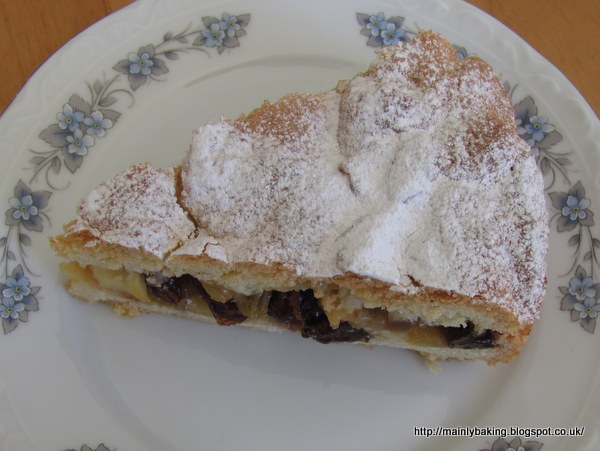
In the absence of any better ideas, and with no inspiration to be found in any of my books, I fell back on this family favourite. The recipe makes a shortcake style dough which sandwiches a layer of fresh and/or dried fruits. Almost any fruit can be used, although fruit which releases a lot of juice during cooking is best cooked and drained first. This time the filling was three sliced eating apples, 100g mixed dried fruit (including raisins and cherries), 100g thick-cut orange marmalade and the zest of a large orange.

The dough is made by melting 150g butter and mixing in 150g caster sugar and 1 large egg. When everything is blended together tip in 300g SR flour and mix to a soft dough. Spread 2/3 of the dough into the base of an 8"(20cm) springform cake tin - just spread it out with your fingers, trying to get an even thickness. If you think the filling might release a lot of juice, you can build up a small wall of dough around the edge of the tin, but this isn't necessary with this particular filling as the dried fruit absorbs any juices from the apples. Mix all the ingredients for the filling together and spread out on the dough. The remaining dough makes the topping - break it into small pieces and drop on top of the fruit, then flatten the pieces to cover as much of the fruit as possible. There may well be small gaps but the dough spreads while baking, so most of these will fill up, and any gaps look quite attractive, anyway! There's a bit more detail on making this cake, with some explanatory photos, here.

Bake for 50 - 60 minutes at 180C until the cake is golden brown and feels firm. Cool in the tin for at least 15 minutes before removing the sides of the springform tin. Dust with icing sugar before serving, if liked. The cake can be served warm as a dessert, or at room temperature as a cake.

Adding the orange elements - marmalade and orange zest - gave this cake a light refreshing flavour and made the mixture of apples and dried fruit more suitable for a summer cake.

Tuesday, 24 May 2016

Marmalade and Spice Cake

Opinions were divided about this cake. Although we both agreed that the cake crumb was too dry, I liked the subtle blend of orange (from marmalade) and mixed spice in the body of the cake. Hubby, on the other hand, didn't like much about the cake at all - he thought the marmalade glaze and glacé icing drizzle was the only redeeming feature.

I used this recipe from Waitrose's website, substituting mixed spice for the cinnamon and nutmeg used in the recipe. You can see from the proportion of flour to other ingredients that it's not supposed to be a rich cake, but a plain cake needn't be as dry as this was. I think, with a little more butter, and another egg in place of 50mls of the milk, this could be a very good cake. The aim would be to get the texture of a good Madeira cake - denser than a sponge cake but still tender and moist. If that could be achieved I think the flavour of the cake would seem much better.

The cake didn't go to waste though; I roasted some rhubarb to serve with it and drizzled the slices with the cooking syrup from the rhubarb. With vanilla yogurt on the side, this made a tasty dessert. The spiced orange flavour complimented the rhubarb very well.

Friday, 6 May 2016

Chunky Fig, Apricot and Prune Cake

I know! It's the middle of May; we ought to be well into lighter Spring flavours, but when I made this cake it was snowing in northern England! Anyway, I quite like fruit cakes at any time of the year, as they keep better than sponges and cakes with fresh fruit, which is a good thing when you are only baking for two people.

Ros, at The More Than Occasional Baker, has announced that as AlphaBakes has reached the end of the alphabet again, she and co-host, Caroline, at Caroline Makes, have decided to end the monthly challenge after this month's recipe link-up. It's understandable - life has moved on for both of them and they have different priorities now, but I will miss the monthly ritual of stretching my imagination and/or culinary skills.

As the last AlphaBakes Challenge, and the last letter of this second run through the alphabet, this month's entries  need to feature an ingredient or recipe name beginning with F. I found the recipe for this Chunky Fig, Apricot and Prune Cake, on the River Cottage site, while I was looking for a cake with dried figs in. It sounded ideal - not too heavy with fruit, lightly spiced and flavoured with citrus.

The recipe was simple to follow, although it's slightly unnerving to add large pieces of dried fruit, sticky with a marmalade coating, at the last stage of the recipe. Surely disaster would follow, with sinking fruit? The recipe does warn of the possibility, and I was prepared to add a little extra flour, if necessary, to make sure the batter was quite stiff (especially as I was using large eggs). However, extra flour (I was using spelt) wasn't needed, and the fruit didn't sink, so all was well!

All was well with the flavour too. Because the pieces of dried fruit were larger than usual, each could be individually tasted, and the background flavours of mixed spice and citrus (from both orange and lemon zest, and marmalade) added an extra dimension. The texture of the crumb was moist but not heavy, and sweetness levels were about right too, overall. Definitely one to repeat!

Thursday, 3 December 2015

Marmalade and Hazelnut Cake

I'm trying to keep my baking light in the lead up to the festive 'eating season', and this subtly flavoured cake was made using the odds and ends of store-cupboard ingredients which inevitably accumulate during the year. The marmalade and candied peel gave just a hint of citrus flavour and the nuts added texture. The batter is a little heavier than a traditional sponge cake, but not as dense as a Madeira cake.

Ingredients
175g softened butter
150g caster sugar
1 teaspoon vanilla extract
3 eggs
5 tablespoons coarse-cut orange marmalade
200g SR flour
1/2 teaspoon baking powder
50g toasted chopped hazelnuts
50g candied citrus peel, finely chopped (optional)

optional - extra tablespoon of chopped hazelnuts for topping

Method
Preheat oven to 160C and prepare a round 20cm(8") cake tin. Sift the flour and baking powder together.
In a large bowl, beat butter and sugar together until pale and well mixed.
Beat in the eggs, one at a time, with a spoonful of the flour. Add the vanilla extract with the first egg.
With the electric mixer (if using) on minimum, mix in the marmalade, then fold in the rest of the flour.
Fold in the nuts and citrus peel, if using.
Transfer the batter to the cake tin, level the top and sprinkle on the extra chopped nuts, if desired (sugar nibs or demerara sugar would make a good alternative topping). Bake for 50-60 minutes, until a test probe comes out clean.
Cool in the tin for 15 minutes, then transfer to a wire rack to cool completely

Monday, 26 October 2015

Orange and Ginger Jammy Oat Squares

For someone who always declares that there is no point in making jam, as it rarely gets eaten by anyone in the house, I seem to have accumulated a lot of half-eaten jars of the stuff - each bought for a specific baking purpose, rather than jam-on-toast type treats.

In order to use up some of these remnants, I decided to make a jam-filled oaty traybake, rather than the flapjacks I'd been thinking about. I followed this recipe, and was halfway through rubbing the butter into the other ingredients when I realised that it wasn't a lot different to my standard mix for fruit crumbles. This worried me a little, as I then began to doubt that the crumbs would stick together to make a solid base, even after being firmly pressed.

For the jammy middle layer, I used a mixture of equal quantities of coarse-cut orange marmalade and ginger preserves, which contained small cubes of ginger.

I baked in a slightly smaller tin (20cm (8") square) as past experience has shown that many American recipes for traybakes produce something far too shallow. The cooking time was the same.

Metric conversion of ingredients - 130g plain flour, 100g rolled oats, 140g light muscovado sugar, 1/4 teaspoon bicarbonate of soda, 115g butter, 300g jam for filling. Reserve 170g of the mixture for the topping.

These oat squares were really delicious, although the jam in the middle soaked into the base, rather than staying in a separate layer - but that might have been all that held the oaty crumbs together! The combination of sharp orange marmalade and fiery ginger preserves was particularly good! They made a nice change from flapjacks, and were just as quick to make and bake, but I've used nicer oat mixtures in other bakes, so probably won't use this recipe again.

Friday, 18 September 2015

Wholemeal Apple Cake with Orange and Cranberries

 - an Au-tummy cake for my second Clandestine Cake Club meeting.

My local branch of the Clandestine Cake Club has a new organiser, so I didn't want to miss the first event that she arranged, with the theme of 'Au-tummy cakes' (Autumn/tummy filling - geddit?). Unfortunately the date of the meeting was the day after I would be arriving home from our Spanish holiday, after 14 hours of travelling up through France, then through the Channel Tunnel, on trains and coaches. I knew I would probably be tired, and wouldn't have time for shopping before cooking, so I chose a foolproof recipe from my list of favorites, which can be made with just storecupboard ingredients plus fresh apples, and made sure I left apples in the fridge before going away.

This cake is a slight adaptation of this Nigel Slater recipe, (also published in 'Tender - Volume II') substituting 75g dried orange-flavoured cranberries, and 25g diced candied citrus peel for the sultanas or raisins suggested in the recipe. I happened to arrive home with a mandarin orange left over from our travelling rations, so a little fresh zest gave the cake a nice boost, but I was prepared to just leave out the zest, as the cranberries were orange-flavoured (left over from last Christmas's festive goodies from Aldi), and the marmalade had a high fruit content too.

I really like this cake, because it is moist and unexpectedly light, considering it's made with wholemeal flour. Many apple cakes are too dense and stodgy, because of the moisture from the fruit, but this cake is perfect! It can also be varied by changing the dried fruits used, and also swapping the marmalade for different flavoured jams or jellies (I have used smooth cranberry sauce quite successfully). Pears also work well instead of apples, as in this pear and ginger preserve variation.

With a theme of Autumn, there were several other apple-based cakes brought along to the Cake Club meeting, along with cakes containing plums, pears and blackberries. My cake was a little crumbly when cut - in an ideal world it would have been made the day before, so that it had time to rest properly - but so were some of the others, so I didn't feel too bad about it! I'm really happy to be moving into Autumn - possibly my favorite season for baking.

Thursday, 26 December 2013

Orange Marzipan Cake

My Alternative Xmas Cake

I've wanted to make this cake for years - ever since I bought Annie Bell's book 'Gorgeous Cakes' - but every Christmas something has happened to stop me making it. This year nothing interfered, not even the thought that I'd got for too much food already, and a cake wasn't really even necessary!

The cake consists of a shortbread layer, a madeira style cake flavoured with rum and dried fruit, and sandwiched between the two are layers of marzipan and marmalade. All this is topped of with a sprinkling of flaked almonds and pine nuts. It's always sounded a really delicious cake to me, perfect for those who don't like or want a traditional rich fruit cake at this time of year.

It was a delicious cake, but not perfect! One fault was mine, but if I was going to bake it again, I would make some changes to produce something even more delicious. My fault was being too enthusiastic with my new Kenwood Chef mixer, and believing the recipe book, which said that beating the eggs into the creamed sugar and butter at maximum speed would lessen the likelihood of curdling! I now know that you still need to go the traditional route of adding a little flour with each egg! The bad curdling resulted in a slightly stodgy texture, rather than the sponge-like appearance I had been expecting.

The recipe's problems, to my taste, were two-fold - firstly, there was not enough marzipan (although you could taste the marzipan, you couldn't really see it as a separate layer). I think the layer either needs to be thicker or it needs to be made from a better quality marzipan. I usually use Anton Berg marzipan which is 60% almonds, but it has disappeared off the shelves this year, possibly due to the much publicised almond shortage. Using a standard supermarket marzipan which was only 25% almonds might explain why it seemed to melt into the cake mixture. I guess a good alternative would be a homemade marzipan, although most of the recipes I've seen are less than 50% almonds when the sugar and binder are factored in

The second problem was not enough orange flavour. I think the cake needs at least the zest of an orange in the cake batter, and I would probably replace the rum with orange juice, as the rum flavour wasn't very noticeable. I used sultanas and dried cranberries in the cake, and these could be plumped up first in orange juice, if you wanted to keep the rum.

Apart from those problems, it was a really good cake. Having a crisp shortbread layer, and the marzipan only at the bottom of the cake, and pieces of nuts only at the top, made it interesting to eat, as there was a variety of textures and flavours depending on where you took a bite. Definitely a good alternative to a rich fruit cake - even FB, who avoids most dried fruit, liked it!

A few recipe details, to make a cake in a deep 20cm tin with a loose bottom - the shortbread layer was made from 90g butter, 40g golden caster sugar, 75g plain flour and 50g ground almonds. This was pressed into the cake tin and chilled. A circle made from 200g marzipan, spread with 75g coarse-cut marmalade was placed on top of the shortbread before the cake batter was added. The cake batter was made from 225g golden caster sugar and 225g unsalted butter, creamed together. 4 whole eggs and one egg yolk were added next, followed by 90mls rum. 225g SR flour plus 1 teaspoon baking powder was folded in, then 75g each of sultanas and dried cranberries (raisins in the original recipe) was stirred in gently. After this was transferred to the cake tin and spread evenly, 20g each of flaked almonds and pine nuts were scattered on top. The cake took around 70 minutes to bake at 170C, and was cooled in the tin.

AlphaBakes, a monthly baking challenge based on a randomly chosen letter of the alphabet is running out of easy letters. Providentially, December's letter is X, and X-mas is considered an acceptable choice of word to use as part of the name of what we produce. Hence I am entering this as my alternative X-mas cake! AlphaBakes is jointly hosted by Caroline of Caroline Makes, and Ros of The More Than Occasional Baker. The rules can be found here, and Ros is the host this month. There will be a festive round up at the end of the month, although I wonder if there will be any entries that found an alternative to X-mas!

Tuesday, 15 October 2013

Wholemeal Apple, Marmalade and Cranberry cake

This gorgeous cake is a slight adaptation of a Nigel Slater recipe, taken from his book Tender (Volume 2 - Fruit), but also published here, in his Observer column. I have quite a few tart apples, from my own tree, stored for baking and wanted a cake with autumnal flavours.

I almost made the cake with white flour and sugar, as I didn't want another heavy cake, after the previous bake, but in the end I stuck to the recipe and went with light muscovado sugar and wholemeal flour, and the cake was still really light and tender.

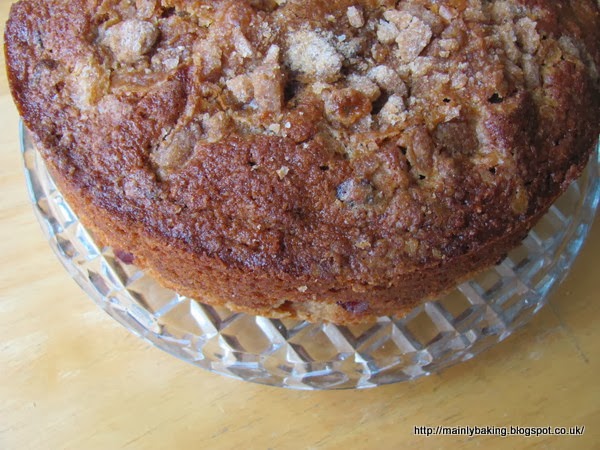
The changes I did make were a) use dried cranberries instead of golden raisins b) leave out the orange zest and c) use orange marmalade flavoured with whisky, which probably made up for having no orange zest. I also sprinkled the cake with crushed raw sugar cubes rather than Demerara, which gave a better finish, as Demerara often dissolves into the surface. This way, there were still small lumps of sugar left on the surface, as well as a crisp crust where some of the sugar had dissolved.

The cake was cut while still warm, and the first slices were rather crumbly, but the cake firmed up as it finished cooling. Both the orange (with whisky) and cinnamon  flavours were quite subtle, bringing out the apple and cranberry flavours, rather than masking them. Although it was a light cake, it was still moist, and the tart fruits stopped the cake from being too sweet with the added marmalade.

Definitely a cake to make again; I'd like to try it with ginger preserves and pears, with perhaps a few nuts thrown in. And, as usual, apologies for rough photos of brown cake!

Wednesday, 7 August 2013

Courgette and Lemon Marmalade Cake

I'm still using the abundance of courgettes growing in the garden - they've been added to sausage casseroles, pasta sauces, used as a side vegetable, and FB took a bag full for her work colleagues, but still they come! I'm going to try some sort of fritter next, in the savoury line, but I thought a cake would help reduce the stock building up in the fridge.

I liked the look of this recipe for a courgette cake because it used lemon to flavour the cake instead of chocolate or spices. I thought this would make the cake seem more summery. I was guided by the recipe, but made a few changes. I replaced the wholemeal flour with white, and the brown sugar with white too, as I wanted a lighter cake, both in colour and texture. I used just sultanas, rather than a mix of dried fruit.

I also separated the eggs and whisked the whites before folding them in as the last step of mixing the batter, in an effort to help the cake rise. This was only partially successful - the cake rose well during baking but sank a lot as it cooled. This left a cake which was moist and dense - too dense really, as there was a distinct layer of unrisen dough at the bottom of the cake.

The lemon marmalade wasn't really successful at getting a lot of lemon flavour into the cake either. I added a lemon glacé icing, decorated with shreds of lemon zest, to the top, which brightened the flavour, but overall this was not really a successful cake. I had hoped for something as light as the carrot cake I make from this recipe, but I think that courgettes hold more moisture than carrots, which would make such a light texture difficult to achieve. I might just try the carrot cake recipe with courgettes as a substitute, before giving up on the idea of a light cake being possible.

It's not often that Hubs makes many comments on what I bake, unless it is extremely good or overwhelmingly bad, but he asked me not to make this cake again!

Sunday, 31 March 2013

Sticky Marmalade Loaf

This all-in-one loaf is taken from a little Good Food (BBC books) recipe book - 101 Cakes and Bakes. The original recipe calls this a tea-loaf, but it doesn't fit what I consider to be a tea-loaf, so I'm just calling it a loaf. For me, a tea-loaf is a drier cake, with reduced quantities of fat and sugar, which makes it more like a scone in texture; slices are usually buttered before eating. 

To make this cake, the ingredients are all beaten together until smooth, except for 1 tablespoon of the marmalade which is warmed and brushed onto the still-hot cake as a glaze, and 25g of the halved pecans which are sprinkled over the top of the cake before baking. I made a slight change to the recipe, substituting the pecan nuts with sultanas, as FB doesn't eat pecans and I've been baking a lot with other nuts recently. I used 75g sultanas in the cake and just the marmalade glaze on top. The loaf, in a 2lb tin, takes about 75 minutes to bake at 180C, but needs covering loosely with foil halfway through the baking time.

Ingredients - 140g thick-cut marmalade, 175g softenend butter, 175g light brown sugar, 3 beaten eggs, 225g SR flour, 1/2 teaspoon baking powder, 2 teaspoons ground ginger, 1 teaspoon mixed spice, 100g halved pecans.

My initial reaction to the loaf was that it wasn't very orange-y, and that it would be better with the fresh zest of an orange added, but as I ate more, I began to appreciate the subtle flavour produced by the combination of the spicing and the marmalade, and decided it didn't really need the orange zest, unless one particularly wanted the orange flavour to be more dominant.

I tried to find this recipe online, as I prefer to give links rather than copy out a recipe which might be copyrighted, and once again I was surprised by how many bloggers are prepared to write out recipes as if they were original to them, or make slight alterations but fail to acknowledge the original recipe. To me, changing the marmalade to ginger marmalade, or using sultanas instead of pecans, as I did, doesn't mean you can claim the basic recipe as your own - but I do know views differ on this!

Sunday, 22 July 2012

Chocolate and Orange Marmalade Loaf

I first saw this recipe for Chocolate and Orange Marmalade Loaf  in a magazine, while in a hospital waiting room with my mother. I frantically scribbled it down at the back of her 'medical' notebook, which I keep to remind me what the docs say, hoping for once that her appointment wasn't on time!

The recipe is taken from Scandilicious Baking by Signe Johansen, a book about Scandinavian Baking (as if you can't work that out from the title!) Some of the other recipes published on the Daily Mail website look pretty good too. I'll have to check out the book when I'm next in a book shop - I try to avoid entering bookshops too often, as new books are too hard to resist!

I followed the recipe exactly, using a mix of honey and golden syrup, and fine cut marmalade. It's quite a complex recipe - I used 5 bowls just assembling the ingredients before mixing. The batter was quite wet very liquid, and it was probably a providential accident which lead me not to notice the chopped chocolate until the batter was in the cake tin. I scattered the chunks over the top of the cake, and left them to float or sink, as fate dictated. Most sank, but at least they didn't all settle at the bottom!

The cake took all of the suggested baking time, and even after 50 minutes, I wasn't sure it was properly cooked as it was so moist. Luckily I have one of those cake testing probes which changes colour when the centre of the cake has reached a high enough temperature, so I used that to test this cake. I don't always like using it, because it leaves quite a large hole, but this cake was going to be spiked after baking, so an extra hole didn't matter. Although the recipe warned that it might dip in the middle, it's very disheartening to see a cake deflate after it's taken from the oven.

Despite a lot of added sugar, in the marmalade, honey and the syrup, this cake wasn't oversweet - the natural bitterness of oranges used in marmalade balanced the sweetness, helped by the cocoa and coffee. However, although some people would argue that you can't have such a thing as a chocolate cake which is too moist, I think at some point it changes from a cake to a pudding - and that's what happened with this recipe. The excessive moistness made the texture just a bit too sticky, rather than having an open crumb.

Because it tastes really good, so I think it's a recipe worth tinkering with to see if the moistness can be reduced a little. For a start, I can use sugar instead of syrups next time, and possibly leave out the boiling water, and sift the cocoa into the dry ingredients instead.
As most people love the chocolate and orange combination, I think this would be a good recipe when baking for a cake stall, especially if the ground almonds were removed and more flour or some polenta used instead. I'm never happy about nuts in cakes for sale on cake stalls, even if they are well labelled. So I'm entering this cake into this month's Tea Time Treat Challenge, where we were asked to produce something suitable for cake stalls at summer fetes. Tea Time Treats (rules here) is a monthly challenge hosted alternately by Karen at Lavender and Lovage, and Kate, at What Kate Baked. Karen is the host at this month, and will be posting a round up of entries at the end of the month.

Monday, 23 May 2011

Marmalade Flapjacks

After making a batch of Halva Flapjacks for FB, which she didn't like, I felt obliged to make amends by baking her favourites - Dan Lepard's Marmalade Flapjacks.

I've said before that these are too soft for my taste, but they have a really good fresh taste, which isn't often found in flapjacks. Although they contain quite a bit of sugar, the bitterness of the marmalade cuts through this and also counteracts some of  the richness of the butter too. Soaking the raisins also makes sure you're not biting down on hard lumps which would detract from the general softness of the bar when you eat it.

I followed the recipe exactly, with no problems. The only thing I'd change is the baking time - they were a little too fragile, so I'd give them 5 minutes longer next time.

Sunday, 5 December 2010

Marmalade and Poppy Seed Cake

This cake, which was made following this recipe for Bitter Orange & Poppy Seed Cake, was a disaster on so many levels!  It just shows that even a trusted source of recipes gives an occasional dud!

So what went wrong? Althought the cake rose well during baking, and a probe test came out clean, the cake sank dramatically as it cooled - that was an ominous start. When I took it out of the baking pan it had dropped so much that the sides were beginning to cave inwards. When I cut it, there was a really dense stodgy layer at the bottom - it would have been impossible to  notice this with the usual probe test for being properly cooked. Baking911.com, my online bible, says the reason for this could be too much liquid or too many eggs - so a basic fault in the recipe.


The final problem was that the cake tasted of nothing in particular - it wasn't sweet enough and I couldn't taste the orange zest or the marmalade (I used a good quality marmalade, but a 'three fruit' flavour rather than orange, so perhaps that's my fault - an orange marmalade might have built up the orange flavour more). The poppy seed flavour wasn't very noticeable either, although they added their characteristic grittiness to the texture.

This cake will get eaten, as I can't abide waste - I think if it's warmed through in the microwave and served with some natural yogurt it might make a passable pudding - but I won't be trying the recipe again!

Thursday, 13 May 2010

Chocolate Marmalade Brownies

During my last baking session, I intended to soften some butter in the microwave, but inattention made me programme minutes, not seconds, into the timer. I ended up with a bowl of melted butter which was no use for that particular cake recipe. Once butter has been melted, it doesn't set into the sort of butter that can be used for creaming in the future (some water separates out), so to use this up I needed a recipe which used melted butter. As I seem to be alternating chocolate and non-chocolate recipes at the moment, brownies were an obvious answer. I also found half a jar of shredless orange marmalade hiding in the fridge, so Chocolate Marmalade Brownies looked like a possibility.

After a bit of searching, and discarding recipes which used much more marmalade than I had, and those which only added a tablespoon or two - how much affect would that have on the flavour? - I decided that this recipe from Best Ever Cookie Collection best suited my purpose. I used the butter I'd already melted, which was a fraction under a cup, and what marmalade was left in the jar, which may have been a tad less than the amount required, but otherwise followed the recipe exactly. No, wait a minute - I used light brown sugar and 100g of chopped pecans, which is more than specified, because the pecans were getting old and the light brown sugar was bought in mistake for muscovado sugar, so I wanted to get rid of it as quickly as possible in recipes where it wouldn't make much difference. I also baked in a 8 x 12" pan lined with baking parchment, as I didn't have the size of pan mentioned, and prefer deeper brownies anyway. The smaller pan did not affect the baking time; in fact 30 minutes was a bit too long, so if you try them, check on yours a few minutes sooner.

For my own records, I'm going to list the metric weights of the ingredients I used - 225g unsalted butter; 300g light brown sugar; 3 eggs; 150g marmalade; 1 teaspoon vanilla extract; 140g plain flour; 75g cocoa; 1 teaspoon baking powder; 1/4 teaspoon salt; 1/4 teaspoon cayenne; 100g plain chocolate chips; 100g chopped pecans.


I liked this recipe a lot, even though the marmalade flavour didn't come through strongly - I think this was down to the mild flavoured marmalade I was using. Using a more strongly flavoured marmalade, or adding the grated zest of an orange to accentuate the orange flavour, would be ways to get round this.

It's nice to have one or two chocolate recipes which just use cocoa powder, rather than a massive amount of melted chocolate, yet still achieve a rich flavour and moist texture. Here, the marmalade gave the moistness, and I think the brownie would have been quite rich in flavour even without the added chocolate chips. These brownies weren't as dense as the best brownies, but reducing the baking powder would remedy that. The small amount of cayenne pepper added gave a gentle warm after-taste which was just noticable.

This recipe will go on my list as a keeper, although I don't seem to get round to repeating recipes often at the moment. It might also be good to try it with jam and a complimentary dried fruit instead of nuts - cherry jam and dried soured cherries, for instance.

Saturday, 20 February 2010

Wholemeal Apple and Orange Cake

This is a Nigel Slater recipe, published recently in The Observer, and is one of his hearty, rustic cakes. I was a little worried how it would come out, as I only had wholemeal bread flour. I used half white plain flour, in an attempt to reduce the higher gluten of the bread flour, although I didn't really know if it would have any effect on the cake batter. I also made the mistake of actually melting the butter, when trying to soften it in the microwave, so I was also concerned that this would also have an adverse effect, as I couldn't beat in air when creaming.

If there were any negative ramifications of these mistakes and changes, then all I can say is that the cake would be superb when made properly, as it was very good as it was. The flavour was very subtle, and not strongly orangey - perhaps because the marmalade I used was shredless, and quite mild in flavour. A darker, richer marmalade, with chunks of peel, would have a more pronounced effect on the flavour. My only criticism was that most of the sprinkling of demerara sugar on the top dissolved into the batter - I'll try adding more next time.