Showing posts with label crumble. Show all posts

Monday, 24 June 2019

Rhubarb Streusel Muffins

This isn't a new recipe to me, but I wanted something quick to put together and bake, to take to the local Cake Club meeting. Whatever I made also needed to fit in with the theme of 'Summer', and as the recent heavy rain has given my rhubarb patch a late surge in growth, using some of that seemed the most obvious way to go.


I followed this recipe from Smitten Kitchen almost to the letter - the only changes I made were to use all white flour, rather than some wholemeal, and just demerara sugar in the crumble topping, for an extra bit of crunch.


The muffins were light, not too sweet and very subtly spiced. I used 200g of diced rhubarb but I think the recipe could have taken a little more, although you do have to be wary of the amount of fruit juice produced when the rhubarb cooks, which could make the muffins too damp and heavy.


Friday, 29 July 2016

Apple and Berry Crumble Cake

I've still got blackberries from last year, and also found a small container of frozen blueberries while assessing the space in the freezer, prior to this year's gooseberry harvest. I'd also got a couple of Bramley apples to use up, so something using all three seemed a good idea.

This recipe, for an Apple and Berry Crumble Cake, which I found on the Good to Know site, was quick to put together, as part of the base mixture was put aside for the crumble topping, rather than needing to make two separate mixtures. I used 300g total weight of mixed blackberries and blueberries as I had less than 100g of blueberries in my little pot in the freezer. I didn't bother thawing the berries ahead of use, either! In place of the mixed nuts in the topping, I used toasted chopped hazelnuts, but apart from these minor changes, I followed the recipe exactly. I didn't need to cover the cake while it was baking - even after the full cooking time it was only lightly browned.

I was worried that the combination of Bramley apples and frozen fruit would make the cake too wet but this wasn't the case, if anything the crumble topping was too dry and powdery. I think this would have made the cake quite unpleasant to eat on it's own, but it was fine as a dessert with vanilla yogurt. The fruit didn't have any extra sugar added to it, so it made a nice sharp layer between the sponge and the crumble.

Friday, 8 July 2016

Rhubarb and Pecan Crumble Cake

We're coming to the end of the rhubarb season now, and many of the stalks are too tough to use, so I'm always on the lookout for recipes which use smaller quantities of fruit. That means I can pick the few tender stems and leave the rest of the leaves to pass goodness back to the crown, to feed the plant for next year's growth.

This recipe, for a simple rhubarb and crumble topped sponge cake, which I found on the Tesco website, looked easy enough, and only used 250g of fruit,  but I ended up using four mixing bowls, which is more than I like to use unless I'm cooking for a special occasion. I followed the recipe exactly (except for using pecans instead of walnuts), but made the cake in a 22cm (9") springform tin. The only thing that didn't go according to plan was that it took an hour in the oven before I was satisfied that it was properly cooked - that was a bit of a surprise, as it was quite a hot oven too!

The cake was quite tasty  but I didn't think the rhubarb, which should have been the star of the show, really came through in the flavour. The rhubarb was sandwiched between two substantial layers of crumble, and while the bottom layer soaked up the juices from the raw fruit, so that the sponge cake didn't become soggy, the brown sugar in the crumble gave a toffee flavour which overwhelmed the rhubarb.

Overall, probably not worth the effort!

Monday, 14 December 2015

Not so Magic Cake, and other bits and pieces!

There's nothing wrong with the 'tiffin' style dessert pictured at the top of this post. It was made to Delia Smith's recipe for Chocolate-crunch Torte with Pistachios and Sour Cherries, following the recipe exactly, apart from using dried cranberries instead of dried sour cherries.

It was made as an quick replacement for an attempt at a 'magic' cake which I somehow knew had failed before it was even out of the baking tin. Magic cakes are so called because one cake batter separates into three layers during cooking - a thin dense pastry-like layer at the bottom, a custardy layer in the middle and a light sponge on top.

I used the chocolate and hazelnut magic cake recipe featured in this recent newspaper article, and even though I can now see where I might have made a mistake (trying to incorporate the egg whites evenly into the batter, rather than leaving it in clumps) I don't think the finished cake would ever have looked as attractive as the photo in the article, or tasted good either. 100g of Nutella-type chocolate hazelnut spread is not enough to make a cake taste strongly of chocolate, nor give it a good deep colour. This is what mine looked like - you can just about see three layers, but it was a really unattractive shade of beige, the custard was dense and slimy and it didn't really taste of anything definite - certainly not hazelnuts or chocolate. After trying one mouthful, for research, it went into the food waste recycling - and, as I've often said, food has to be really awful for me to throw it away!

I didn't bake a cake last weekend; it was my husband's birthday, and he wanted a stollen, which I buy rather than make as my yeast doughs are very unpredictable. I made a very tasty seasonal fruit crumble though, using 3 eating apples, 100g fresh cranberries, the zest of a clementine and the clementine segments, cut in half, to make 4 portions of dessert. I also added a teaspoon of mixed spice to my usual crumble recipe of equal weights (75g) of butter, brown sugar, plain flour and rolled oats.

I also tried my hand at apple-chilli jelly recently, using the homegrown apples which were too small to peel and use in any other way. The beauty of apple jelly is that the fruit is just roughly chopped - peel, cores and pips included - before cooking with water and adding some vinegar. The cooked fruit is strained, then reboiled with sugar and sliced chillies, until the setting point is reached. I used this recipe from gardener Sarah Raven, using just the regular mixed red and green chillies sold as moderately hot in the supermarket.

After cooking the apples in water and straining the juice I had about 1.5 litres of liquid; I was a little worried, as despite my careful handling of the fruit, the liquid looked cloudy at this point. I needn't have worried though, as soon as it came to the boil with the added sugar it miraculously cleared - I just wish this had been mentioned in any of the recipes I read! I used a sugar thermometer, to be sure that the setting point had been reached. I didn't manage to distribute the chillies very evenly when potting the jelly - the jar in the photo got the most - and it looked as if all the chilli slices were going to float, until I remembered a tip I'd read somewhere about turning the sealed jars upside down for about 10 minutes, then back again, and repeating as the jelly cooled and set. This procedure eventually traps some of the chillies near the bottom, despite their inclination to float! I think the chilli slices are for decoration - there's certainly a lot of heat in the jelly alone, so even the jars without much visible chilli will taste the same.

Wednesday, 23 September 2015

Jam-swirled Crumb Cake

Being away on holiday for most of the first half of the month has limited my entries to the various cooking challenges which I try to participate in regularly - I got an early entry into Belleau Kitchen's Simply Eggcellent, and the first of Caroline Makes' Formula 1 Foods, but the challenge from We Should Cocoa to use blackberries and chocolate together has fallen by the wayside due to lack of time.

Despite needing to lose the holiday weight, and get my diet back on track, I found time to make a simple crumb cake for the AlphaBakes challenge this month, which is to use the letter J, either for the first letter of a main ingredient, or the first letter of part of the name of the dish (eg J for Jalapeno or J for Jalousie). See the full set of rules here, for a complete explanation.

My J was for Jam - I swirled some reduced sugar 'cherries and berries' jam into the top half of a crumb cake batter, hoping the result would be colourful and add extra flavour to a fairly plain cake. My recipe is a slight adaptation of this one, found on the blog Bake or Break, which I've been reading for several years. I reduced the sugar a little, altered the topping to accommodate what I had available, and baked the cake in a 20cm (8") round tin.

Ingredients

Cake
210g plain flour
2 teaspoons baking powder
pinch salt
115g butter, softened
100g caster sugar
50g light muscovado sugar
1 teaspoon vanilla extract
1 large egg
120mls milk
1/3 cup jam

Topping
50g light muscovado sugar
2 tablespoons flour
1/4 teaspoon cinnamon
1 tablespoon ground almonds
25g cold butter, cut into small pieces
2 tablespoons chopped toasted hazelnuts

Method
Pre-heat the oven to 175C, and base line a 20cm springform tin.
Make the topping by putting the sugar, flour, almonds and cinnamon into a small bowl, then rubbing in the butter until the mixture looks like breadcrumbs. Stir in the hazelnuts, then set aside at room temperature.
Mix the flour, baking powder and salt together. In a large bowl beat the butter and sugars unril light and fluffy. Beat in the egg and vanilla, with a tablespoon of the flour mix. Then fold in the rest of the flour, alternately with portions of the milk, to make a stiff cake batter.
Spread about 2/3 of the batter into the cake tin, then spread on the jam, leaving a border of batter around the edge of the tin. Carefully spread on the remaining batter, then use a teaspoon handle to swirl through the cake batter, trying to keep in the top half of the mixture.
Sprinkle the topping over evenly, squeezing it together in your fingers to make it a little clumpier, rather than powdery.
Bake for 35 minutes, then reduce the temperature to 160C and bake until a tester comes out clean - about another 15 minutes (45-50 minutes in total). Cool in the tin.

Sadly, the finished cake didn't look as good as I'd hoped. It rose unevenly, sank back badly during cooling and when cut, it revealed that the jam layer had sunk during baking and lost a lot of it's vibrant colour. The hoped for swirls of colour in the top of the cake just didn't materialise! The crumb crust hadn't really adhered to the cake batter either, which made the cake difficult to cut and serve. It tasted fine though - the topping was sweet and nutty and the jam added a good fruity flavour to the cake. Overall, something that needs a little more work, but could be a good store-cupboard recipe!

The AlphaBakes Challenge is hosted alternately by Caroline, at Caroline Makes, and Ros, at The More Than Occasional Baker. Ros is this month's host, and will post a round-up of entries at the end of the month.


Friday, 31 July 2015

Red Gooseberry Crumble

Our little gooseberry bush which produces red berries has never fared as well as the green gooseberry bush. It was damaged by a falling branch a few years ago, and also grows in a shadier part of the garden, overshadowed by what has become a hazelnut grove in my neighbour's garden. This year I gathered just over 400g of gooseberries from the red bush, compared with 2.6kg of green gooseberries.
net cage to protect ripening green gooseberries

I learned early on in my gooseberry growing experience that the only way to be sure of harvesting fruit is to build a net cage around the bushes as soon as the fruit gets to a reasonable size; the first year I waited until I thought the majority of berries were perfectly ripe and decided to pick the next day. Unfortunately the local blackbirds (I assume, as they are notorious fruit eaters) also recognised the ripeness of the fruit and stripped the bush in the early morning, before I was even out of bed. I didn't lose a lot that year, as both bushes were small, but since then I protect them with netting before the end of June, and expect to harvest any time after the middle of July.

netting removed to show framework of  a cage
I decided to use the red gooseberries first, as there were just enough to make a fruit crumble. The green gooseberries were frozen in handy sized portions, to be used at a future date. Gooseberries are a fruit which keeps in the freezer really well, and despite preferring to eat seasonally, it's nice to be able to have a gooseberry pie or crumble in the middle of winter!

I made my crumble from 100g each of butter, caster sugar, plain flour and rolled oats, and also added 50g of chopped toasted hazelnuts, as I liked the combination of gooseberries and hazelnuts together in this dessert. I mixed the gooseberries with 70g sugar, 2 tablespoons of elderflower cordial and two teaspoons of ground rice to thicken the juices produced.

A recipe for gooseberry crumble isn't something I'd usually bother to write about, but the red berries produced such a glorious colour that I couldn't resist taking a photograph. I think the berries were a little riper than usual this year - they were certainly darker in colour than photos from previous years, and had more natural sweetness while still retaining the characteristic tartness of gooseberries.

Sunday, 7 December 2014

Pineapple Mincemeat Tart

with coconut crumble topping.

I might have gone a step too far here, in a bid to make something different for Christmas, but at least I've tried it out on just the two of us, rather than jumping straight in and making it for guests.

It started with the idea that a crumble topping would speed up the process of making a large quantity of mince pies - half the rolling out, less fiddle with putting tops and bottoms together etc. Then I thought about the fact that I usually add extra apples, oranges or cranberries to bought mincemeat to make it less sweet and a more personal recipe. Adding  chopped nuts to the crumble topping would add an interesting texture too. While I was playing around with ideas, I remembered the fresh pineapple which needed eating - why not try a tropical variation of a mince pie, with pineapple in the mincemeat and coconut in the topping?

I decided to try out the concept in one big tart, rather than fiddle about with individual pies - mainly for speed of getting things done. The base was basic shortcrust pastry with no sweetening, used to line a shallow 22cm diameter flan tin. The filling was 250g mincemeat, 150g of finely chopped fresh pineapple and a teaspoon of ground rice (to absorb any excess fruit juice), spread straight onto the raw pastry. The topping was a crumble mix made by rubbing 50g coconut oil into a mix of 50g plain flour, 50g porridge oats and 35g caster sugar. I intended to add desiccated coconut to the topping, but only had flaked coconut available, so tried to break the flakes up a little as I added 25g to the crumble mix. This was sprinkled evenly over the tart filling. 

I baked the tart for 20 minutes at 200C, then lowered the temperature to 180C and baked for another 20 minutes, covering the tart loosely when I lowered the temperature, as the coconut flakes were browning too quickly.

Although I liked the coconut in the crumble topping, I didn't think the pineapple added enough flavour to be worth using - it was overwhelmed by the spices in the mincemeat. I could just have easily have added a chopped apple for the same result, which was to give the mincemeat a fresher, more tart flavour, but not a noticeably pineapple one. So, I'll  be sticking to more traditional ingredients when it's time for Christmas baking, but I will be using a crumble topping in some form this year.

I've just noticed that this is my 500th blog post - I suppose that's a good enough time as any to be a little experimental!

Sunday, 9 November 2014

Gooseberry Crumble

 I'm a great believer in seasonal eating, but it's getting ever more difficult to stick to  eating just what is traditionally in season. Growing crops in poly tunnels means that even British fruit such as raspberries are available for 9 months of the year, and that's before you even consider imports from abroad. Another factor is the use of the freezer to preserve fruit and vegetables. Rather than throw away excess from a glut, or eat it for weeks ad nauseam, it can often be frozen for out of season use.

This is what happens to my gooseberries and green beans, most years; I know our forbearers bottled fruit and salted beans, but some of the original freshness was missing when these were used. If you choose your fruit well, there is no loss of quality on thawing and cooking - blackberries, gooseberries and plums in particular freeze well, but rhubarb is less successful in my opinion, so that is still a truly seasonal fruit for me. Consequently, however much I might like to stick to seasonal fruit in Autumn and Winter desserts, there are always these fruits calling to me from the freezer .

You don't really want a recipe for fruit crumble - I'm sure you all have your favourite recipes - but I thought it was worth noting that I made a successful gluten- and dairy-free crumble using a proprietary brand of gluten-free flour and pure oats (labelled as wheat, dairy and gluten free), and coconut oil instead of butter.

I used my usual recipe of 100g each of flour, oats, fat and sugar (caster in this case) to make 4-6 portions. I rub the fat into all the other ingredients, which seems to give a better texture after baking. When I'm using coconut oil, I chill the crumble mixture for 30 minutes before putting it on the fruit and baking; I do this because I was worried about the coconut oil becoming too liquid while being rubbed in (even though I handled it a little as possible to get it more or less rubbed in), and wanted to keep the effect of using a solid fat.

If I'm using a fruit which I expect to make a lot of juice when it cooks, such as gooseberries or rhubarb, as well as sweetening it, I add just a level teaspoon of ground rice for every 300g fruit. This seems to thicken the juices perfectly, without adding any unwanted flavour, and with not much change in texture. Beware of using too much though - ground rice absorbs much more liquid than other thickeners such as flour or ground almonds.

I was really pleased that the texture and flavour of the gluten- and dairy-free crumble were comparable to my usual recipe, and I was really pleased with the 'free-from' oats, from Sainsbury's, which were a lot sturdier than the usual 'value' rolled oats I use. They gave a slightly crisper finish to the baked crumble, but of course, I did pay a price premium for them!

Sunday, 30 March 2014

Rhubarb, Rhubarb, Rhubarb

Not much activity here lately, for two reasons. One is our continuing struggle with excess weight, which means less baking, as carbs are restricted, and the second, more worryingly, is the departure of my baking fairy. I've had a couple of baking disasters recently, which means I've had nothing to post about. One disaster was a silly mistake - picking up plain flour instead of self raising - but the other was trying a new recipe which just didn't work very well on several levels.

I tried this rhubarb self-saucing pudding, after it was published in the "Cook" section of the Guardian newspaper, and it just didn't hit the right buttons. There was very little 'sponge' on top, resulting in far too much sauce, and I didn't like the combination of rhubarb and a creamy, orange flavoured, sauce. I'm not sure if the recipe proportions are wrong, or if I should have cooked the pudding in a more shallow baking dish rather than a deeper casserole dish, but the batter was very thin and had to be poured over the fruit, rather than spooned and spread.

Anyway, to compensate for a less than perfect dessert last weekend, I made a rhubarb crumble this weekend. It worked perfectly, and as a bonus, I think I've found the perfect thickening agent for excess fruit juices in puddings of this sort - ground rice! It mixes easily with the fruit and sugar and you need very little to thicken the juice. I used 2 teaspoons of rice with roughly 500g of fruit, and could have used less, as there was no excess juice after baking. I think rice absorbs much more liquid than cornflour or ground almonds, which are often suggested as thickeners.

My crumble mix, for 4-6 portions, is 100g each of plain flour, sugar (any kind will do, I used white caster this time but often use light muscovado), rolled oats and butter. I put all the ingredients into a bowl, then rub in the butter, which makes a rougher crumble mix than rubbing the butter into the flour before adding the sugar and oats. Sprinkle on top of raw fruit, sweetened to taste, and bake at 180 - 200C until golden brown - around 35 - 50 minutes depending on oven temperature.

Sometimes, you just can't better something as simpler as a fruit crumble! The rhubarb in the top photo was just roasted with a sprinkling of caster sugar, for about 15 minutes at 190C - the best way to ensure the fruit keeps it's shape.

Tuesday, 11 February 2014

Cider Crumble Cake

 A strange cake, this! On first appearances, a very plain, almost dry, base topped with a layer of plum jam, then a crumble topping flavoured with cinnamon and walnuts. In fact, all the layers combined together to make eating the cake a very interesting experience. The jam was sweet and sticky, the topping crunchy and spicy and the cake was studded with pieces of chopped date. The use of cider in the cake batter gave the cake a subtle apple-y flavour too.

I choose this cake from 'Cakes and Cake Decorating' by Zoe Leigh, a 1974 publication that used to be one of my 'go-to' books for cake recipes. Despite owning the book for almost 40 years, this is one recipe I hadn't tried before. I was attracted to it now because the cake part was fatless and quite low in sugar - in keeping with my efforts to eat more healthily. As you can see, the recipe is so old it still uses Imperial weights and measures, and oven temperatures in Fahrenheit! According to the blog The Vintage Cake Spot, this was originally one of Marguerite Patten's recipes; this might explain the austerity of the recipe, which uses small quantities of strongly flavoured ingredients in the topping to give most of the flavour and texture.


This was a very quick and easy cake to make - the dry ingredients were mixed together, then the wet ingredients were mixed in. The only complicated bit was measuring 3 tablespoons of black treacle and dissolving it in the cider. The cake was baked to just past the half-way point before the jam layer and the crumble topping were added. This gave the batter time to set so that the jam could be spread easily, although I did warm it in the microwave to make this even easier. The crumble then stuck to the jam when it was sprinkled on. Because the cake batter was set, the jam didn't soak in completely and stayed as a sticky layer between the cake and the crumble, adding to the contrasting textures.

Monday, 7 October 2013

Apple, Pear and Maple Crumble

Producing a fruit crumble is nothing to boast about, but I just wanted to keep a note of the flavour combination, as it worked so well. 

I  briefly sizzled the chopped fruit, a mixture of three apples and three small conference pears (still very hard), in 30g of butter. When the fruit showed signs of softening I added a heaped tablespoon of cornflour and 3 tablespoons of maple syrup. I left the fruit to cool while I made the crumble.

I reduced the sugar in the crumble, and added two tablespoons of maple syrup after rubbing in the butter; this made the crumble a little lumpy, but that's a good thing - several recipes I've seen lately advocate adding a little liquid to improve the texture! The crumble recipe was 100g plain flour, 70g light muscovado sugar, 100g rolled oats, 100g butter, 50g chopped walnuts, 2 tablespoons maple syrup. Sprinkle the crumble over the fruit and bake for about 40 minutes at 180C, until golden and the fruit juices are bubbling.

I was aiming for a maple toffee flavour to the crumble and think it worked quite well. Using pecan nuts would have been better than walnuts, but I didn't have any.

Friday, 8 February 2013

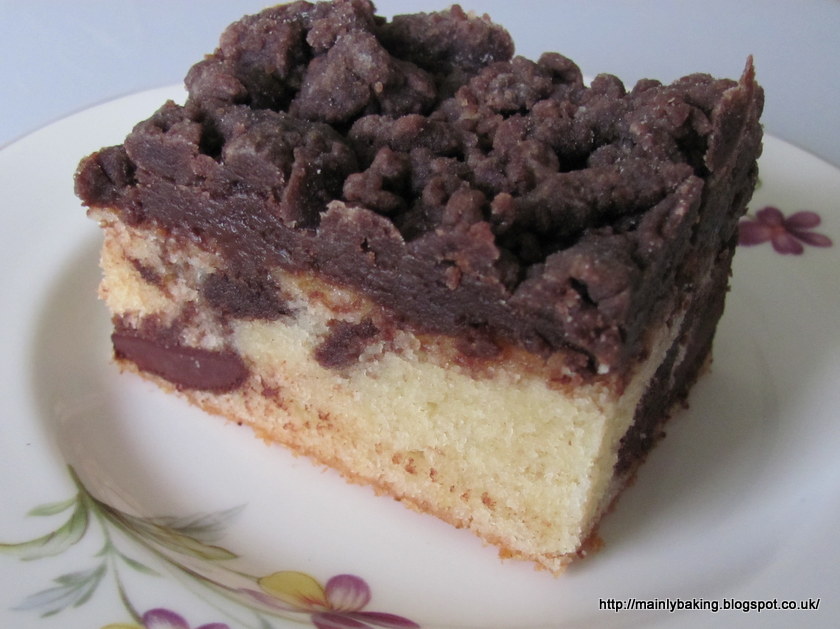
Marbled Chocolate Crumble Cake

I know I've baked this Dan Lepard recipe before, but as it dates back to 2008, it was probably before I started blogging! Anyway, it was so long ago that I came back to it with few memories of the past cake. FB had requested a chocolate cake, which is quite unusual for her, but I'm always happy to indulge in chocolate. Looking through my recipe books, I found this in Dan's latest book - Short and Sweet -  and while it stirred memories there were no definite feelings about whether I'd thought it a good cake or not, so it was definitely time to try it again.

It's a fairly simple recipe, although it requires a big act of faith to sprinkle the heavy clumps of chocolate crumble on a still wobbling, part-baked cake. I took the opportunity to make the cake special by using my huge chocolate 'chef's drops' from Willie's Cacao. I cut down the chocolate a little, to 75g, so that I only used half my tub of drops. It was still fantastic to bite into a large piece of good quality chocolate when eating the cake.

The balance of the cake is in favour of the vanilla portion of the batter (75%), but this is offset by adding chocolate drops and the slightly bitter chocolate crumble. Overall, there's chocolate in every bite, which is what matters most!  While it's cake with fairly standard sponge cake proportions of ingredients, it made a light, moist, well textured cake and the crumble topping lifted it out of the ordinary. This time I hope it's not forgotten for so long!

Sunday, 20 January 2013

Raspberry, Oat and Almond Bake

The Guardian newspaper is producing a new supplement in Saturday's edition, entitled Cook, which features more recipes, articles and cooking tips than is usually found in the Weekend magazine.

It looks as if Dan Lepard has swapped to teaching basic baking skills for a while, which is a pity for those of us who appreciate his more innovative recipes, but there's lots more to admire in the supplement, including a selection of readers' recipes on a given theme each week.

Last week, this dessert recipe, from the 'Good for You' section, featuring recipes from Rosie Sykes, caught my eye - it features frozen raspberries and marzipan baked with a crumble-like mixture of oats, sugar and flour. The result was layers of fruit and crumble with a really strong almond flavour, but without the excess juices you often get in a soft fruit crumble.

My only quibble with the recipe is that it was impossible to mix 70g of grated butter and 150g grated marzipan into 100g flour to make a breadcrumb-like mixture. I had to add the rest of the crumble ingredients to the mix and rub the butter and marzipan into that. I was slightly short of the required weight of raspberries, so added half  a grated apple to each layer of fruit.

The dessert was only lightly sweetened, although the quality of the marzipan will affect the overall sweetness - the marzipan I used was 60% almonds. The dessert was delicious with creme fraiche, as suggested, and I thought it better eaten slightly warm, rather than straight from the oven.

It felt quite decadent to be eating raspberries in January, but frozen ones are quite good value and make a change from the usual stodgy winter desserts (or in our case, a change from the self-imposed diet of yogurt for dessert!).

Friday, 31 August 2012

Do you Fancy a Fumble?

I'm sure you will fancy a Fumble when you know what it is - it's delicious!

A Fumble, in this case, is Hugh Fearnley-Whittingstall's name for a fruit fool topped with separately baked crumble crumbs. As he says, its a good way to get the three elements of a good dessert - fruit, something creamy and portion of a crisp carbohydrate -  together quickly and simply. You can see his recipe for Strawberry Fumble here, along with more ideas for the 'three-piece sweet' (his phrase, not mine!).

I thought the idea was a good way of allowing the dieters in the household (sob!) to eat dessert without all the calories of a traditional crumble. Those watching calories (more sobs!) can eat a large portion of fruit, topped with low fat yogurt and a few crumble crumbs for a contrasting texture. Everyone else can choose their own balance of fruit, cream or custard, and crumble topping - as much crunch as they like!

The idea worked very well with a warm compote of eating apples and blackberries. You don't get that lovely starchy layer, soaked in fruit juices, which forms between the fruit and the crisp crumble in the real thing, but it's close enough, and the texture contrast is good even with just a few pieces of crumble. I think the combination would be just as tasty with room temperature or chilled fruit mixtures too.

The crumble mix is pretty standard, although a bit heavier on the butter than the mixture I usually use - I found I had to fork through a couple of tablespoons of water to get the mixture to form clumps rather than a fine crumb, but maybe I rubbed in the butter too much. The clumps get crisper than a traditional crumble topping, but this helps them keep well, and you could always try sprinkling them over warm fruit and letting them stand for a while to soak up some fruit juice.

Monday, 18 June 2012

Lemon and Blueberry Cake with Coconut Streusel

This recipe is proving to be one of the best I've found. Not only can the basic flavour be varied easily, but the batter is stiff enough to take additions such as chocolate chips and dried fruit without them sinking during baking. The polenta and almonds can also be swapped for more flour, if that is more convenient, without spoiling the recipe. I find it really comforting to know I have a set of good recipes that I can rely on when my imagination fails or time is short.

This time I followed the basic recipe (leaving off the lemon syrup after baking), and added 70g of dried blueberries that had been soaked in boiling water for 15 minutes. For the topping, I mixed 75g plain flour, 50g sugar, 35g desiccated coconut and 50mls sunflower oil. The oil brought the other ingredients together into a nicely clumped crumble, which wasn't too dry and powdery when sprinkled over the cake. The topping seemed to insulate the cake from the oven heat, which meant the cake took about 10 minutes longer to bake. The coconut browned nicely during baking, giving the streusel topping an attractive appearance.

This was a lovely textured cake, moist but still light, with a delicate flavour. If it wasn't for the addition of the coconut and blueberries, I might have liked a stronger lemon flavour, but as it was, the three flavours were perfectly balanced.

My next step is to try this recipe with fresh fruit - if it works well then I have an almost complete set of low saturated fat, adaptable recipes which don't need improvement - a light chocolate cake, a sponge cake, a brownie recipe and this one which covers most other needs. I don't expect that I'll give up trying other recipes though - I'm always finding goodies I want to bake, and CT is hoping to leave home soon, so low saturated fat baking won't be necessary much longer!

Sunday, 27 May 2012

Hazelnut & Cinnamon Cake with Chocolate Streusel

Between having the kitchen taken over by plumbers performing emergency surgery on the hot water and heating system, and the rush to catch up with gardening jobs now that it's drier and warmer, there hasn't been much time for baking during the last week or so.

But I've got the kitchen back now, and have also been handed a project by FB, so there's no excuse (except the extreme heat) for avoiding it any longer. Not that I think baking is something to be avoided - I spent ages last week looking at the bakery shelves in the supermarkets, thinking either that things were too expensive to buy, or were too small to be worth the money asked for, or that I could make similar things much better. I played safe with muffins in the end - relatively cheap and I'm safe in the knowledge that CT often prefers commercial muffins to my home-baked ones, so he'd be happy, at least!

FB is moving on to a new job soon, and has promised a cake for her colleagues when she hands in her notice (and another when she leaves, no doubt!). She said she had thought up the idea of a cinnamon flavoured cake with a chocolate and hazelnut topping, and was quite miffed when I showed her that this idea wasn't original!

I didn't have any buttermilk, so decided that I'd have a trial run using the very adaptable Annie Bell recipe, which has been so useful in the past. I left out the lemon, and flavoured the cake with 2 teaspoons of cinnamon and a teaspoon of cocoa, and substituted 50g ground hazelnuts for the same weight of flour. Then I sprinkled over a crumble topping made by mixing 55g melted butter with 50g flour, 50g light muscovado sugar, 20g cocoa and 25g finely chopped toasted hazelnuts.  This makes a solid dough, which is then crumbled over the raw cake batter before baking - it usually works much better than a dry crumble mix, but in this case it sort of melted into the surface, and didn't look like a streusel topping!

This was a really well flavoured, light textured cake, but there are several things which need improving before FB can take it into work. The first is to increase the amount of topping, to give a complete streusel covering, and perhaps go back to a dry crumb mix. The chocolate flavour needs strengthening too - use chopped chocolate instead of, or as well as, the cocoa, maybe. There also needs to be more cinnamon in the cake mix - at least another teaspoon. Other than that, I'm pleased with the first version of this flavour combination, using this particular recipe.

Monday, 2 April 2012

Rhubarb and Ginger Crumble....

....... made with the first rhubarb of the year from my garden!!

I'm not a keen gardener, but if I am going to put in some effort, I like some reward, and what could be more satisfying than growing some of your own fruit, vegetables and herbs? It's so good to see the first rhubarb leaves pushing up through the soil and uncurling, and it's amazing how fast they grow. I can't tell how much we will be able to harvest this year, but we didn't get the cold winter that rhubarb needs to be really fruitfull. However, after this we have gooseberries, strawberries and apples to look forward to.

And once you've picked the first rhubarb, there's little to beat using it in a simple crumble. I added a little ginger to this one, in the form of 3 lumps of preserved ginger, roughly chopped, and two tablespoons of syrup from the jar, mixed into the rhubarb, along with 2 tablespoons of Light at Heart brown 'sugar' - a lower calorie sugar substitute. I didn't weigh the rhubarb - I just picked enough to fill my baking dish to about 3/4 full. I guess there was around 500g - rhubarb is usually sold in 400g packs.

I also used Light at Heart in the crumble mix. I've tried it before in baking, and wasn't happy with it's performance in cakes, where volume is important, but it's ideal in this sort of baking, where just the sweetening power is important. Light at Heart is a mix of sugar and stevia, blended so that exactly half the usual amount will give the same amount of sweetness. Half the amount of sugar means half the calories, of course!

For the crumble mix, I used 100g each of butter, SR flour and rolled oats, and 50g of brown Light at Heart. The butter was roughly rubbed into the other ingredients, leaving quite a few lumpy bits. This was then sprinkled over the fruit, pressed down lightly and baked at 190C for 45 minutes. Eat while still quite warm, although you can reheat in a low oven. I reheat leftover portions of fruit crumble in the microwave, but it's nowhere near as good as one that is freshly baked!

I received free samples of Light at Heart from Tate and Lyle at the end of last year, but wouldn't have carried on using it if I wasn't  pleased with it's performance. The only thing I don't like is the price - it's more than four times the cost of sugar! I don't think I'm likely to carry on with it once the free samples are used up!

Friday, 17 February 2012

Savoury Apple Crumble

This recipe, from Nigel Slater, is fast becoming a family favourite. It sounds strange, and it sounds as if it shouldn't work, but it makes a really tasty accompaniment to sausages.

The recipe comes from Nigel's most recent TV series, Simple Cooking and sums up the philosophy of the series, by using seasonal ingredients and not fussing too much about complicated recipes - just experiment with what you have available, and don't be afraid to try new flavour combinations.

I make quite a bit of adjustment to the recipe, to make this for three of us. I reduce the apples to four  or five, depending on their size, but reduce the crumble recipe by half. The first time I made it according to the recipe and it felt unbalanced - far too much crumble mixture.

I don't have madeira in the storecupboard, but I've found that adding a tablespoon of balsamic vinegar to  the apples enriches the flavour. I also make sure one of the apples I use is a Bramley cooking apple, so that the apple mixture is not too sweet. Today's apples were the Bramley, a Braeburn, a Jazz and two small Coxes. This time, I only had ordinary thyme to add, but it still tasted fine.

As well as this crumble, we ate broccoli and sweet potato wedges with our sausages. A lovely plate of comfort food!

Monday, 16 January 2012

Pineapple and Blackberry Crumble

This crumble was inspired by one of the dishes made in the third heat of the Celebrity Sport Relief Bake Off Challenge, shown on TV last week. TV presenter Anita Rani, who went on to be the overall winner, made a Pineapple and Blackberry Crumble with the coconut added to the crumble topping. No recipe was given for this, but it wasn't difficult to figure out a recipe which at least featured the same flavours in the dish. Anita added (I think) cinnamon and vanilla to her pineapple, and flamed it with rum while it was cooking. She then mixed in raw blackberries before adding the topping.

As usual, with this sort of thing, my recipe is a bit 'thrown together' as I don't weigh the fruit. I know that if I half-fill my large Pyrex dish with fruit and top it with a crumble mix made from 80-100g of each ingredient, I'm going to get 4-6 portions depending on appetite. I also took the opportunity to use more of the Light at Heart sugar/stevia mix that I've been given to try. The added stevia reduces the calories by half as you only need to use half as much sugar as usual.

So, this is roughly what I did!

Peeled, cored and chopped 2/3 of a standard sized supermarket pineapple into chunks.
Thawed a roughly equal volume of blackberries.
Melted about 40g unsalted butter in a frying pan and added the pineapple. As it started to cook I added 1 tablepoon of brown Light at Heart (or 2 tablespoons light muscovado sugar), a half teaspoon cinnamon and a teaspoon vanilla extract. I then poured on two tablespoons of rum which I mixed in and then flamed. I then turned up the heat and reduced the pan juices to a sticky caramel. The fruit was then cooled.
For the crumble mix, I rubbed 80g unsalted butter into 80g plain flour, 80g whole rolled oats and 40g white Light at Heart (use 80g regular white sugar). I then stirred in 20g desiccated coconut. I think it's important not to make the mixture too fine - leaving a few lumps of butter and some clumps of crumble adds to the texture.
The cooled pineapple was mixed with the blackberries, and 1 tablespoon of cornflour, to thicken any juices. The fruit was put into a deep casserole dish with a 1litre capacity, and the crumble mix was sprinkle evenly on top and pressed down lightly.
The crumble was baked until the top was golden brown and the fruit bubbling. I usually do this at 180C for about 45 minutes, but I started at a much higher temperature with this dish because I was cooking something else in the oven too. It had the first 10 minutes at 220C which didn't seem to do it any harm. It then finished off at 180C, with about 25 minutes cooking overall.

This was a really good combination of flavours - the pineapple, cinnamon, vanilla and hint of rum gave a tropical flavour, and fantastic smell, when added to the coconut in the topping. I'm not sure I'd have recognised the blackberries in a blind tasting but they added another taste dimension and a lovely colour to the dish. Coconut in the crumble topping is definitely an innovation I'll be using again with suitable fruit! Using the Light at Heart sugar in this context was fine too - I didn't notice anything different in the volume, taste or texture of the crumble mix.

Friday, 1 July 2011

Gooseberry Crumble Cake

I'm so excited by my little crop of home-grown gooseberries. They are such a rare fruit these days - I think it's about 4 years since I saw any in the supermarkets, which is what prompted us to plant a couple of bushes to grow our own. This wasn't a particularly good year; it was such a dry spring that the berries were very small. Another problem we had was that the bush producing the red fruit was damaged when we had a tree felled and is taking a long time to recover, so it isn't producing as much fruit as the green-fruited bush yet.  Nevertheless, we got enough fruit for a two portion crumble (heavenly), this crumble cake and a further portion for the freezer for later use.

This cake isn't very pretty - it's not as deep as I would have liked and the top buckled where the gooseberries collapsed - but it was certainly very tasty! It's an amalgamation of a couple of recipes and my own ideas for flavouring the gooseberries and crumble topping. The sponge cake base comes from this Rachel Allen recipe; the only change I made was to use elderflower cordial instead of milk, in the batter mix. I baked it in a 9"(23cm) diameter springform tin, but I think it would have been better in an 8"(20cm) tin.

For the fruit layer, I mixed 340g (roughly 12oz)  fruit with 2 teaspoons cornflour, 1 tablespoon caster sugar and 2 tablespoons eldeflower cordial. This was spread on the uncooked sponge mix base.

The crumble topping is based on an idea from Martha Stewart website, where I first read about melting the butter for a crumble topping and then mixing in the other ingredients. The resulting soft dough is then broken up into small pieces and scattered evenly over the base layers. In this case I used 100g melted butter, 75g SR flour and 75g caster sugar, plus a half teaspoon of cinnamon and a teaspoon cocoa to give some colour contrast to the crumble mix.

The cake took about an hour to bake at 180C - it was difficult to tell if it had cooked properly as the top was fluid from the hot fruit, so didn't feel firm, and a toothpick picked up moisture from the fruit.

The only disappointment was that I couldn't taste the elderflower cordial - I had used some in the gooseberry crumble I'd made the day before, with much better results. I think it was just too dilute in this cake. The cocoa and cinnamon in the crumble added just a hint of extra flavour, and the gooseberries were still wonderfully sharp. The crisp crumble topping was a good contrast to the soft sponge and moist fruit layer. This was delicious eaten warm as a dessert with vanilla yogurt or creme fraiche, or on it's own as a cake when it had cooled fully. I stored it in the fridge, but let it come up to room temperature before eating.