Showing posts with label cream cheese. Show all posts

Saturday, 2 November 2019

Cherry Cheesecake Brownies

I've made these Cherry Cheesecake Brownies once before; an attempt which was delicious, but not altogether successful, because the cherry jam sank through the (reduced fat) brownie batter, and ended up in pools on the liner of the baking tin.

This time I went back to my favourite brownie recipe, made with butter. It's the one I've been using for more than 20 years, with a small reduction in sugar being the only modification I've made to the recipe in that time.

This time the recipe worked perfectly! The swirls of tart cherry jam balanced the sweetness of the cheesecake and both were a good contrast to the dense, chewy brownie.

Which makes it all the more annoying that I didn't get any photographs before some of the brownies were eaten, and the rest distributed between my children, for them to take home after dinner. I was left with this one portion for myself - a remarkable feat of restraint on my part!

Ingredients
Brownies: 140g butter
140g plain chocolate - about 70% cocoa solids
300g light muscovado sugar
1 teaspoon vanilla extract
3 large eggs
160g plain flour
3 tablespoons cocoa
Cheesecake: 180g full fat cream cheese
50g caster sugar
1 large egg
1/2 teaspoon vanilla extract
Plus: 125g cherry jam

Method
Line a 20cm(8") square baking tin with baking parchment. Pre-heat oven to 180C/160C fan.

To make the brownie batter: Melt together the butter and chocolate in a large bowl, over a pan of simmering water. Cool to around 40C if necessary (so that the eggs don't start to cook) then mix in the sugar and vanilla extract, followed by the eggs, one at a time. Finally sift in the flour and cocoa, and fold in until thoroughly mixed. Put 3/4 of this batter into the baking tin, reserving the rest for the swirls in the topping.

For the topping: Beat together the cream cheese, caster sugar, vanilla extract and egg until smooth. It will be quite runny. Pour this over the brownie layer in the baking tin. Dot the cherry jam over the surface, about a teaspoon at a time, then do the same with the reserved brownie batter, putting the blobs between the areas of jam. Use the handle of a teaspoon, or something like a chopstick, to swirl the jam and brownie batter blobs into the cheesecake mixture - you get a better pattern if you swirl deep enough to get into the lower brownie layer just a bit.

Bake for 40 minutes until just firm, then cool in the pan before cutting into the desired sizes. I cut into 16 squares, but less greedy people might prefer smaller bars.

Tuesday, 14 May 2019

Date and Banana Loaf

With a wet afternoon ahead of me, and some over-ripe bananas in the kitchen, I was looking for a recipe which I could make using just my storecupboard ingredients. This recipe for Easy Date and Banana Loaf, on the Waitrose website looked promising, and used my favourite storecupboard sweetener - date syrup - which was an added bonus.

Following the recipe exactly didn't quite work out, as I didn't have Medjool dates or enough butter and SR flour, but my substitutes worked well, producing a well-flavoured moist loaf with a firm but not heavy texture. I used cream cheese in place of the missing amount of butter, light spelt flour and some extra baking powder in place of some of the flour, and basic soft dried dates instead of Medjool dates.

Ingredients
100g butter, softened
75g full fat cream cheese, at room temperature
100g SR flour
100g light spelt flour
1 teaspoon baking powder
1 teaspoon ground ginger
1 teaspoon cinnamon
2 eggs
3 tablespoons date syrup (plus extra for drizzling)
2 large ripe bananas, mashed roughly
100g chopped soft dried dates
demerara sugar for topping (optional)

Method
Line a 900g (2lb) loaf tin with baking parchment or a pre-formed liner. Pre-heat oven to 160C.
Put all the ingredients except the bananas, dates and demerara sugar into a large bowl and beat until smooth, then beat in the bananas. Finally, fold in the dates.
Transfer the batter to the loaf tin, level the surface and sprinkle over the demerara sugar, if using.
Bake for about 75 minutes, or until a test probe comes out clean.
Cool in the tin for a few minutes, then transfer to a wire rack and drizzle with a little more date syrup.

The resulting loaf was moist enough to eat as a cake, although butter spread on this sort of loaf is always an option worth considering. The subtle spicing enhanced the overall flavour of the cake, but it was the dates which stood out as the strongest flavour.

Friday, 3 May 2019

Chocolate Orange Cheesecake

This is a really good cheesecake recipe, in so many respects, that it's a pity the topping lets it down a little. The base has just the right proportions of plain chocolate digestive biscuits and butter, so that it isn't too crumbly nor does it set too hard to cut. The cheesecake mixture is light and delicate in texture and flavour, and doesn't crack while cooling (although I did run a knife around the edge as soon as it came out of the oven to help prevent that).

The idea of the topping, which is a mixture of orange flavoured chocolate, and chocolate with almonds in it, is lovely, and it tasted delicious, but the chopped (or grated) chocolate melted on the hot cheesecake, then set to a crisp brittle layer, which made it difficult to cut and serve neatly. What is even more annoying, is that this didn't happen the first time I made the cheesecake - then the tiny pieces of chopped chocolate stayed as a 'rubble' across the top and didn't hamper cutting it at all. I suppose I must have used a different brand of chocolate this time.

I didn't experience any problems with the recipe for this Chocolate and Orange Cheesecake, apart from the issue with the topping. I don't have a large food processor, so mixed with a hand-held electric beater, on a slow setting, after the eggs has been whisked thoroughly. As usual, even a double layer of foil failed to prevent a little water getting between the foil and the springform tin - perhaps it was condensation, as I was using extra-strong foil, which shouldn't have got holes in it with my careful handling.

I've been trying to think of a different way to top the cheesecake. Piped and set chocolate shapes or a thin layer of ganache, left to drip down the sides, are two options to keep the chocolate flavour. Another possibility is orange curd swirled into lightly whipped double cream or mascarpone. Overall, though, this is a recipe worth repeating.

Sunday, 30 October 2016

Chai Swirl Loaf Cake


My local branch of The Clandestine Cake Club held it's most recent meeting to coincide with the Great British Bake-Off final. I think it was an inspired idea from our organiser as it was fun to watch the final in the company of other enthusiastic bakers.  A very brief video of our meeting was even shown on the BBC's Victoria Derbyshire show the following day, during her tribute to GBBO and it's demise from the BBC.

For me, the final was a bit of an anti-climax, as it lacked the tensions of the previous weeks. Without an elaborate show-stopper which required assembly, there were no nail-biting moments when collapse looked imminent, and after the picnic finale, it seemed to me that Candice won more because of the others' soggy pastry than anything really outstanding on her part, which isn't how it should be.

Our brief for taking a cake to the Clandestine Cake Club meeting was any recipe from any of the GBBO contestants over the 7 years of competition. I have to admit that I don't own any books by any of the contestants (although I would like Chetna Makan's book), so I had to trawl the internet to see what I could find. I wanted something unusual in flavour, but not so fancy or complicated that I wouldn't enjoy baking it.

Because of her time as a columnist for The Guardian newspaper, there were a lot of Ruby Tandoh's recipes available. I made one of the recipes she published during that time and wasn't very impressed with the result, which rather put me off trying any more, but when I couldn't find anything else suitable from other contestants I had another look and found this recipe for a Chai Swirl Loaf Cake. It's based on the classic sponge cake proportions, and has a swirl of marbling made by adding brown sugar, and the spices traditionally used to flavour chai, to a portion of the batter. The recipe adds a cream cheese frosting, but I didn't use that for the trial bake.

For the trial I simplified the recipe by making an all-in-one sponge with SR flour and an extra half teaspoon of baking powder. Experience has shown that for simple cakes the all-in-one method works as well as the traditional creaming method, as long as the butter is very soft. I decided to add an extra tablespoon of milk to slacken the batter slightly, so that it would spread more easily in the cake tin.

The recipe suggested dolloping alternate spoonfuls of batter into the cake tin, and running a knife through to marble the two mixtures together, but the accompanying photo showed a cake produced by layering the batters alternately and letting the convection currents within the batter swirl the mixture as it cooked. I prefer this method which gives a much smarter appearance. So, starting with the plain batter, I layered up four layers of batter alternately with three layers of flavoured batter. Each layer was roughly two heaped tablespoons of batter, and needed to be eased towards the sides of the tin, although the weight of each successive layer helps spread those beneath.

The spices used in the flavoured portion of batter were cardamom, fennel, cinnamon, ginger and black pepper and they came together with the extra sugar to make a really unique mixture - warm, mellow, and sweet, with a slight mouth-tingling kick. I didn't think the cake really needed any frosting, as it was light and tender, but I did add a cream cheese frosting to the cake I make for the CCC meeting, although not Ruby's recipe, as I have a very reliable recipe from Dan Lepard. As usual, baking a cake for others didn't go as smoothly as the trial bake - for one thing, the cake stuck to my baking parchment liner - how could that have happened? - and the swirls weren't as well defined, but those who tried it really liked the unusual flavour.

This cake may not have been a show-stopper in appearance, but it was certainly a star when it came to flavour!

Friday, 1 January 2016

Festive Fruit Pie

Most of the Christmas leftovers have been dealt with by now. The last slice of ham, a few chunks of turkey and half a dozen chestnuts, together with a few mushrooms, in a mustard-y cream and white wine sauce, made a very tasty pie. What hasn't been eaten has been packed into the freezer, hopefully to make pies and curries over the next few weeks, and not just forgotten about. However, I am also determined not to leave too many half-used jars and packets of seasonal ingredients lurking about, as by springtime I'm past the point of wanting to eat things like mincepies and cranberry sauce.

Allow me a slight digression here - have you noticed that cream cheese is sold in 280g packs now, and not 300g? Luckily I was using a modern cheesecake recipe which took account of that, but many of my older recipes use multiples of 300g, so leftovers are inevitable, even if buying smaller packs, which are proportionally more expensive, to make up the weight.

Even so, as a result of scaling down a cream cheese frosting recipe, I was left with around half a pack of cream cheese and happened to read this recipe at Belleau Kitchen for a delicious sounding pastry using cream cheese, orange zest and ground almonds. It seemed perfect for the 'leftovers' fruit pie that I had decided to make. I made a slight adaptation to the recipe - I reduced the sugar to 50g and used icing sugar (which I think is incorporated more easily into pastry), and also used the zest of a small orange instead of a clementine, but otherwise I followed Dom's recipe, which originates from Dan Lepard's 'Short and Sweet'.

I used 2/3 of the pastry to line a deep pie dish, and the remainder to make a lattice for the top. I assembled the lattice on a sheet of baking parchment, and chilled it, along with the pie case, for about 20 minutes, before putting the pie together for baking.

For the filling I mixed together:
200g of mincemeat
roughly 125g of a good quality cranberry sauce (over 50% fruit)
two eating apples, peeled and cored and cut into small dice
80g of ready-to-eat dried dates, snipped into small pieces
1 teaspoon of ground rice to absorb excess fruit juices

I put the filling into the unbaked pie case, and placed the pre-made lattice on top. The excess pastry around the top of the pie case was folded over the edges of the lattice to seal the base and lattice together. The top was brushed with beaten egg white and sprinkled with caster sugar and the pie was baked at 180C for about 40 minutes until golden brown.

Both elements of this pie were very good! The pastry was very short and crumbly, but very easy to work with, and probably would have been even more delicious with a blander pie filling. The orange zest could be tasted in the pastry when eaten alone, but it was overwhelmed by the spices and other flavours in the mincemeat mixture. The pie filling still tasted predominantly of mincemeat but the addition of tart cranberries and apples cut through the usual sweetness and added a greater depth of flavour. The overall spice level of the mincemeat was reduced too, allowing the combination of dried and fresh fruits to dominate. Altogether, a successful experiment - the pastry is wonderful (thanks Dom!) it's worth buying cream cheese specially for it, and the filling mixture reduced my stock of opened jars while tasting much better than such a haphazard mixture might have done!

Sunday, 27 December 2015

Gingerbread Cake with Caramel Biscuit Frosting

This was another recipe from the Christmas 2015 (November) issue of Good Food magazine. I wanted a cake which looked good as a centre piece on the Christmas dining table, as well as tasting good. This Gingerbread Cake with Caramel Biscuit Icing certainly looked good on the cover of the magazine, but it was far too big for my needs and the decoration was too elaborate and twee for a group of four adults. Fortunately the recipe was easy to split into thirds, so I made two layers of cake instead of three, and decorated it much more simply, using fondant snowflakes, ginger crunch pieces and gold glitter and just half the quantity of frosting from the recipe.

I was really pleased with the flavour of both the cake and the cream cheese frosting, which used Lotus  caramel biscuit spread to give it a delicate flavour of caramel and cinnamon. The cake had quite a mild  ginger flavour, but anything stronger would have overwhelmed the flavour of the frosting. What didn't turn out so well was the texture of the cake. It was dense and solid, rather than sponge-like, and didn't really rise at all. It was as if the baking powder hadn't worked, although once I realised what the cake was like, I went back and tested it, and it worked OK. I'm sure I remembered put it in (!!??).

Unfortunately I didn't realise how bad the texture of the cake was until it was cut after being decorated. Had I realised earlier I'd have started again and made another cake. It wasn't inedible, but it wasn't what I'd expected, and rather spoiled the overall eating experience, despite the good flavours. I'd definitely use the frosting recipe again - I can think of many cakes which would be enhanced by it.


Monday, 15 June 2015

Gooseberry and Elderflower Cheesecake

While checking around the garden recently, I noticed how quickly the gooseberries were growing. That reminded me that there were still some of last year's gooseberries in the freezer, which ought to be used before this year's excess fruit went in. So when I needed a dessert to take to lunch with friends, something that could be made with frozen gooseberries seemed the best idea.

The biggest problem with taking desserts to other people is carrying them with no damage. It's also a good idea to take something ready to serve, so you're not doing last minute cooking in someone else's kitchen, or taking up oven space at an inconvenient time. A cold dessert, which was not likely to spill while travelling, seemed ideal and I eventually decided on cheesecake. After looking at several very different recipes, I chose a Mary Berry recipe (from her book 'Ultimate Cake Book') for a set gooseberry and elderflower cheesecake using gelatine. A gelatine based cheesecake could be transported still in the springform tin in which it was made, and the sides removed when ready to serve.

I never like to make an untried recipe for other people, so I had a trial run with the cheesecake the weekend before it was needed.

I adapted the recipe slightly so that I could use leaf gelatine, which I find much easier to use than powdered. I also made a few other changes, such as leaving the sugar out of the biscuit base, using the whole 250g tub of cream cheese, rather than having 25g left over, and leaving off the whipped cream decoration, as extra cream didn't seem necessary for the trial run. All I needed to do, to use leaf gelatine, was to soften nine leaves in cold water, then add them to the sieved gooseberries while the purée was still warm.

As with the rhubarb meringue pie I made recently, the addition of cream to the fruit seemed to mute the flavour. It was good, but decidedly 'delicate', and not as sharp as when using gooseberries in a pie or crumble. The crumb base was thin but this was good, as thick bases can be too hard to cut and eat easily. The set cheesecake mixture had bonded with the base well, so there wasn't any danger of things falling apart. The texture was very light and aerated - very mousse-like - so it didn't really seem like eating a cheesecake at all.

Because I was a little worried about the lack of flavour, I decided to make a tangy gooseberry sauce to eat with the cheesecake when I made it the second time, for those who liked the sharpness of gooseberries. I made this by simmering 550g of gooseberries with 80g of sugar until softened. I strained the juices back into the pan and reduced them by about half, until syrupy, while I sieved the cooked gooseberries to remove the pips. The concentrated juices were stirred back into the purée - more sugar could be added at this stage, to taste, but I decided to leave the sauce quite sharp.

By the time I made the second cheesecake, the elderflowers were almost out, so I decorated the cheesecake with small sprigs of flower buds and gooseberry leaves, rather than whipped cream, and served it with creme fraiche. Unfortunately, as I had to leave it in the springform tin for transportation, I couldn't get a good photo of the second cheesecake.

As the mousse-like texture of this cheesecake relies on beaten egg whites, I'm entering this into Belleau Kitchen's Simply Eggcellent bloggers link-up for June, which is for recipes where free-range eggs feature heavily. Dom hasn't set a theme for this month - anything goes - but a light cheesecake with seasonal fruit is perfect for this time of year.

Sunday, 5 April 2015

Chocolate Cheesecake

An Easter Eggstravaganza!

Easter wouldn't be Easter, in this household, without chocolate. Not Easter Eggs though - our children quickly caught on that you didn't get much chocolate for your money in an Easter Egg, so our tradition became a Terry's chocolate orange (or something similar) and a chocolate dessert for the weekend. Now that they are adults we've stopped buying chocolate presents, but the tradition of a chocolate dessert lingers on.

I decided on a baked cheesecake because it's fairly light on added sugar, compared to some of the desserts I could have chosen. I picked this recipe from Good Food, because it sounded quite light (despite some of the reviews claiming it was too rich!). The recipe uses cocoa and relatively small amount of plain chocolate to get a good flavour, rather than a lot of chocolate.

As usual, I only used the recipe as a guide to the correct quantities for the cheesecake mixture. I introduced a hint of nuts by adding finely chopped toasted hazelnuts to the biscuit base, and Amaretto liqueur to the cheesecake mix instead of a coffee liqueur. I also used plain chocolate instead of one with coffee flavour.

The base was made from 170g of chocolate and oat biscuits from IKEA, 50g toasted hazelnuts and 60g butter. I reduced the butter a little from the usual 50% of the weight of biscuit because I wasn't sure how absorbent the biscuits would be, and I didn't want the base to be too heavy - I prefer a slightly crumbly base rather than one which is dense and crisp. I followed the recipe for the cheesecake mixture as far as quantities of ingredients were concerned, just making the changes I've already mentioned.

I was rather concerned about how liquid my cheesecake mixture was - the recipe said to smooth the top after pouring it onto the base, but my mixture flowed like custard and certainly didn't need any help from me to become smooth and level. Perhaps because of this, the cheesecake took a little longer to cook than stated in the recipe. It also cracked badly, with one deep crack going right down to the base (which explains why there's no photograph of the whole cheesecake!). When cold, I decorated the top with a drizzle of plain chocolate, rather than the cream and chocolate sauce suggested in the recipe. I thought it better to serve cream as an optional extra, rather than force everyone to eat some.

Although I'd expected this cheesecake to be light, it was very different in texture to what I had hoped for. It was more like a set cheesecake or a mousse than other baked cheesecakes I've made. It still tasted good though, which is the main consideration. The hint of nuttiness was just right, and the chocolate flavour was strong enough without being too rich at the end of a meal.

I didn't really manage to get any good photographs after the cheesecake was cut. By the following morning the remnants were a bit worse for wear  - the chocolate topping was a bit weepy, and the cheesecake was crumbly to cut straight from the fridge. I think this bottom photo shows the texture quite well, despite all that.

I'm entering this cheesecake into the April 'Simply Eggcellent' link-up set by Dom (of Belleau Kitchen); with due consideration for our priorities at Easter, his theme for this month is chocolate.


Monday, 9 February 2015

Chocolate Brownies with Coconut and Matcha Cream Cheese Swirl

When the theme of this month's We Should Cocoa challenge was set, by Katie at Recipe for Perfection, to be brownies, I thought I'd better rise to the occasion and do something out of the ordinary. I wanted something which would both look and taste different to a plain brownie. Don't get me wrong - there's not much that can beat the best dense, fudgy, rich, sweet, chocolate-laden brownie for flavour, but if you've made and photographed as many brown squares as I have over the years, you want to make something which will stand out in a baking challenge.

And nothing stands out as much as something green, when it comes to cake! Blue and green are supposed to be the worst food colours to use, to persuade people to eat something, particularly if the food is unfamiliar, or it's an unexpected colour to be used in that context.  Whereas green used to suggest only mint flavour, today it's just as likely to be green tea (matcha) providing the flavour, as with these brownies.

Once I'd decided to use green tea, which pairs very well with dark chocolate, it was difficult to decide on what other flavour to add, if any. I like citrus flavours with green tea, but not in brownies, and ginger might have worked well, but my last cake was a ginger cake. I think I must dream about food, even if I don't remember these dreams, because I woke up one morning thinking of coconut. I hadn't a clue whether the two flavours would work well together, but it seemed worth the risk! To make the green tea stand out against the dark chocolate, it became clear that adding both it and the coconut to a cream cheese swirl was the best way forward.

I used the coconut cream cheese swirl from this recipe, adding a tablespoon of matcha powder. The amount of add depends on the strength of the matcha used - mine doesn't seem especially strong, from previous experience. (I used a 200g pack of full-fat cream cheese and 40g desiccated coconut as a conversion of 1/2 cup.) I decided to adapt my favourite brownie recipe, an 'old-faithful' that I've been using for more than 10 years, although it's hardly recognisable in this form. I made 2/3 of a batch and decided the time was right to try reducing the amount of sugar in the recipe, from 400g to 300g. I used coconut oil instead of butter, and also decided that 2 eggs plus an egg white was a near enough equivalent of 2/3 of 4 eggs (to avoid waste)!

Ingredients - cream cheese layer
200g full fat cream cheese, at room temperature
50g caster sugar
1 large egg yolk
1 teaspoon vanilla extract
40g desiccated coconut
1 tablespoon matcha (green tea powder)

 - brownie layer
140g coconut oil
140g 70% plain chocolate
300g  light muscovado sugar
1 teaspoon vanilla extract
2 large eggs plus one egg white
160g plain flour
3 tablespoons cocoa

Method
Line a 20cm (8") square baking tray, with baking parchment and pre-heat oven to 180C.
In a medium bowl, beat together all the ingredients for the cream cheese swirl, until smooth.
Put the coconut oil and chocolate into a large bowl, and melt together over a pan of simmering water. Remove from the heat and add the sugar and vanilla, stirring until well mixed and smooth.
Beat in the whole eggs and the egg white, one at a time.
Sift in the flour and cocoa and fold in.

Spread 3/4 of the brownie batter into the prepared tin, then top with the cream cheese mixture, which should spread almost to the edges of the tin. Put blobs (7-9) of the remaining brownie batter over the surface, then use the end of a teaspoon, or something similar to swirl the batter into the cream cheese layer below.

Bake for 40-45 minutes until an inserted probe comes out with just a few damp crumbs sticking to it. Cool in the tin, then cut into 16 pieces.

I think these brownies were a great success; they looked attractive, without the green colour being too lurid and off-putting, and the sweet coconut and cream cheese balanced out the sometimes bitter edge of the matcha flavour well. The brownies were dense and fudgy, with a slight taste of coconut from the oil.

We Should Cocoa (rules here) is a chocolate baking challenge started by Choclette at Chocolate Log Blog. She shares her hosting duties with other chocolate-loving bloggers, and this month has handed over to Katie, at Recipe for Perfection, who has chose brownies as the theme, and will post a round-up of entries at the end of the month.


Wednesday, 12 March 2014

Lemon and Ginger Cheesecake Pots

This simple recipe for a set lemon cheesecake is quick and easy to make. It's a great stand-by dessert for when time is short, as if decorated carefully, it can look like the sort of dessert you've spent hours over! The only time consuming thing is setting it properly in the fridge - it needs at least 6 hours.

I speeded up proceedings even more, the last time I made it, by just pounding 6 gingernut biscuits to crumbs and sprinkling them evenly into the bottom of 3 individual dishes; I usually make the traditional firm biscuit crumb base by adding melted butter to crumbs, but as these cheesecakes were in individual dishes that didn't seem necessary.

The cheesecake mixture was made by beating 200g full fat cream cheese, 3 tablespoons caster sugar and the rind and juice of 1 lemon until smooth. Then 150mls of softly whipped double cream was folded in. By the time the cream is folded into the cheese, the mixture is already beginning to thicken through the action of the lemon juice.

This amount of cheesecake made enough to fill three x 200ml dishes. You need to take a little care filling the dishes, so that the crumb base is not disturbed. I decorated the top with thin slices from a ball of stem ginger, which were washed and dried to remove the syrup. To give the cheesecake a stronger ginger flavour, a little finely chopped stem ginger could be mixed into the cheesecake.

Tuesday, 23 April 2013

Honey Cheesecake, with a hint of Chocolate

If more than two years of the We Should Cocoa challenge has taught me anything, it is that I am no longer of the opinion that anything can be improved by the addition of chocolate. The idea for We Should Cocoa is that we should make something containing chocolate and an additional specified ingredient - a spice, fruit, nut or other flavour component. Over time, I've realised that I'm more of a purist than I thought, and although I've found new flavour combinations that I unexpectedly enjoy, I've also found a lot of combinations that just don't work for me.

 This month's challenge to use honey is a case in point. I tried to think of recipes where the flavour of the honey would be prominent, as that is surely the aim of the challenge - there's no point using an ingredient if you can't taste it in the finished article. There was the added problem that baking with large amounts of honey can be problematic too, as I found with a batch of biscuits that ended up like a lace curtain across the baking tray. The pieces tasted great, when I eventually got them to harden and set, but it was impossible to half-coat them in chocolate, which had been my intention.

Eventually, using leftovers from Easter, I decided to make a cheesecake, using chocolate coated oat biscuits for the base, and adding a chocolate sour cream layer on top. Unfortunately, although each component worked well on it's own (apart from a slightly soggy base!), the honey cheesecake mixture just didn't taste right with the two chocolate layers. It may just have been the particular honey I used - my current favourite is a Romanian Lime Blossom honey which has a distinctive citrus flavour, and I'm always wary of pairing citrus, other than orange, with chocolate.

I couldn't find a recipe for a cheesecake mixture which was exactly what I wanted, but in the end I used this recipe from Canadian Living as the basic inspiration. I had to reduce the quantities a little to accomodate the fact that I only had 400g cream cheese, and I cut back the honey even more - to 100g - as I didn't want it to be too sweet.

Ingredients
180g chocolate coated biscuits - I used IKEA Kakor Chocladflard (double chocolate crisps) but would have used chocolate coated hobnobs if these weren't sitting in my storecupboard approaching the use-by date!
90g melted butter
400g full fat cream cheese
100g Lime Blossom honey
2 medium eggs
60g sour cream
rind and zest of 1 small lemon
140ml tub sour cream
2 tablespoons caster sugar
25g finely grated 100% cacao block
Method
Use a 7" springform tin and cover the outside with several layers of aluminium foil, so that it can go into a bain-marie. Heat oven to 180C.
Crush the biscuits to fine crumbs, stir in the butter and use to make an even, compressed base in the springform tin. Bake for 10 minutes, then cool.
Beat the cream cheese with the honey, until smooth, then mix in the eggs, lemon and the 60g quantity of sour cream until well combined. Pour onto the crumb base and bake in a bain-marie for 45 minutes or until set but still wobbly. Remove from oven, but leave in bain-marie.
Combine the tub of sour cream with the sugar and grated cacao, spread over the cheesecake and return to the oven for 15 minutes. Turn off the heat, open the oven door slightly and leave the cheesecake for 30 minutes. Remove from oven, and run a knife between the cheesecake and the sides of the tin (may help prevent cracking).
When the cheesecake is cooled to room temperature, refrigerate for at least 6 hours before serving. Don't cover the cheesecake until it is fully chilled as you may get condensation on the surface!

As I said earlier, apart from a soggy bottom in the centre of the cheesecake, each of the three parts were very good. The base was well flavoured with chocolate and oats, the cheesecake mixture was smooth with a hint of citrus alongside the honey flavour, and the set sour cream topping with added chocolate was delicious. They just didn't work together.

So, not a great success, but I was really pleased with the chocolate sour cream topping, which I'm sure to use again.

We Should Cocoa is a baking challenge started by Chele from Chocolate Teapot, and Choclette from Chocolate Log Blog. Each month a different ingredient is chosen to be paired with some form of chocolate in our cooking. This month's choice of honey was made by Choclette, who will be posting a round-up at the end of the month.

Saturday, 13 April 2013

Cherry Cheesecake Swirl Brownies

This was a recipe which didn't quite work, but which was so tasty that it will be worked on to achieve an improvement. The only problem was the brownie batter - I chose one of my favourite low saturated fat recipes which was too thin to support the weight of the cream cheese mixture and the blobs of morello cherry jam.

I've previously had success with making cheesecake swirl brownies using a brownie batter made with mayonnaise, but I didn't have enough mayonnaise in stock to use it this time. All I wanted to do was repeat this recipe adding some teaspoons of cherry jam swirled into the brownie mix with the cheesecake, but you can see from the second picture that although the cheesecake swirls weren't too bad, most of the jam sunk straight to the bottom of the tin, and sat in separate blobs after the brownies were cooked.

To be honest with you, the only way we could eat the brownies easily was to serve them upside down, and a lot of the jam had to be scraped off the non-stick baking paper and put back into the holes left in the baked brownies.

But they were delicious - the flavour of the rich, sweet cherry jam was stronger than the brownie flavour, but the plainer cheesecake swirls in the brownie helped balance the flavour and sweetness. Definitely a recipe worth working on, particularly as I know exactly what went wrong.

Monday, 11 March 2013

Chocolate Guinness Cake - We Should Cocoa

The theme for this month's We Should Cocoa challenge has been set by Lucy of The KitchenMaid, and she has chosen the theme of 'fame'.

Well, putting together fame and chocolate certainly provoked a lot of thought on my part - it can have such a wide interpretation. Famous recipes? Recipes named after famous people or places? There are plenty of recipes out there, but nothing seemed very appealing. I rejected the original Toll House cookie recipe, Sachertorte, Nanaimo Bars (done those already) and several others.

It wasn't until I reached into the back of a cupboard, for a tin of Guinness stout for a beef casserole, that inspiration struck. A chocolate recipe containing a famous ingredient! What could be more famous worldwide than the drink Guinness?

Nigella's chocolate Guinness cake is the first recipe to come up on a Google search, but I didn't have any sour cream. The second recipe needed buttermilk, also not in stock, but the third, from Delicious,  looked OK, and also had the advantage of cutting down the sugar quite a bit. The accompanying photo looked good too  - the frosting made the cake look like a glass of Guinness with a good head!

Making the cake itself went quite smoothly, although my batter wasn't pourable. The cake rose well, but sank a little in the middle on cooling. I wasn't too worried about this as the photo accompanying the recipe showed a sunken centre to the cake!

The frosting was a different story! I've told my husband that if I ever pick a recipe which melts white chocolate again he has to forcibly restrain me from making it! After half an hour in a double boiler, the white chocolate (Menier brand) still showed no signs of melting and looked distinctly scorched in places. I was about to throw it away and start again when I read a tip online about adding a little butter or vegetable oil. Two tablespoons of sunflower oil worked it's magic, and loosened up the chocolate. I had to pick out one or two large scorched lumps which showed no signs of melting, and the molten chocolate was still a little grainy, but I went ahead and used it. I didn't have any sour cream, so used 4 tablespoons of fromage frais in the frosting instead. The resulting white chocolate cheesecake frosting was deliciously sweet and creamy..

The cake texture was soft and quite crumbly, but not dry. The flavour was delicious, not too sweet and very chocolatey. It definitely needed the sweetness of the frosting to contrast with the slight bitterness of the Guinness in the cake.

We Should Cocoa is a monthly cooking challenge which brings together chocolate in some form with a specially chosen ingredient. Originally hosted by Choclette of Chocolate Log Blog and Chele of Chocolate Teapot, the challenge now often uses guest hosts, as with Lucy The KitchenMaid, this month. Lucy will post a round up at the end of the month, although entries so far can be seen on this link to the challenge.

Thursday, 3 January 2013

Lime & Lemon Curd Ripple Cheesecake

I didn't intend to post about this cheesecake; it was a complete disaster on so many levels. a) it took ages longer to cook than the recipe suggested b) it cracked badly as it cooled c) the curd ripples weren't discernible within the cheesecake - only those on top could still be seen, and I used too much curd for them to look good and d) to cap it all, it broke in half while I was trying to plate it for presentation.

It did, however, have two redeeming features - it tasted fantastic and had a gorgeous texture. My sister said it was the best baked cheesecake she had tasted for years! This just about outweighed the problems, and made me decide to post about it.

So - this is the recipe, from Epicurious.

I used my usual crumb base - 200g crushed digestives and 100g melted butter - which from previous experience, is exactly the right amount for a 24cm springform tin. The amount in the recipe would have given a very sparse coverage.

I used 300g of citrus curd, from a batch made from the juice of 4 limes, the zest of one lime and the zest and juice of two lemons (100mls juice), 4 egg yolks and 1 whole egg, 150g butter and 150g sugar. This was slightly too much when divided as suggested by the recipe - the cheesecake needed less than half of this amount on top to have better defined swirls.

Other than those changes, I made the cheesecake mixture as per the recipe, using vanilla paste with seeds.

It took 90 minutes before the cheesecake got to the slightly wobbly in the centre stage, but by then the edges were very solid and puffed up, and the start of cracks could already be seen across the surface. These deepened as the cheesecake cooled. The cheesecake breaking was my own fault - I should have left it on the base of the springform pan, as I usually do.

As I said previously, the ripples of curd within the cheesecake had all but disappeared, but I think the butter and eggs in the curd was what added so much to the texture of the cheesecake - it was smooth, creamy and very rich without being heavy. The flavour was more of lemon than lime, but overall it was well balanced and not very tart - although I like sharp tasting lemon desserts, not everyone does!

I'm not sure I would make this recipe again, as I don't know what to do to correct the faults. The cooking time is an insurmountable problem - at 45 minutes the whole thing was still liquid! A longer cooking time causes cracks! Rippling the citrus curd didn't work well either, but I'm not sure just folding it in would have had the same effect.

Wednesday, 26 December 2012

Dan Lepard's Mont Blanc Layer Cake

Christmas desserts are a difficult area. After a big meal, forcing down a traditional rich Christmas pudding can feel like a chore rather than the delight that a dessert should be. Tastes are changing too - so many people don't even like  Christmas pudding nowadays, which is a very puzzling phenomenon to me. Neither of my children eat Christmas pudding, so with no Christmas Day guests it was going to be  pointless to produce one.

This year, I dithered so long trying to decide what to make that FB stepped in and produced this recipe for a tower of meringue and chestnut cream from her recipe file. I'm not very experienced with meringues, but the recipe seemed simple enough and there was no-one here but family to see if it didn't turn out well.

Fortunately things turned out well, after an initial miscalculation with the circle sizes for the meringue layers, which almost had me making 6" circles instead of 7". I don't even know why I tried to translate the centimetre measurements to inches in the first place as I usually consider myself bilingual in baking weights and measures!  I had a little weeping on one of the meringue layers, but not enough to spoil the appearance of the dessert, once it was constructed.

The only thing I changed about the dessert construction was to leave off the 'peak' of whipped cream on the top. This was because I didn't read the instructions properly and didn't have the time or energy to whip extra cream or pipe the chestnut cream at the last minute stage, as I had left the assembly until just before serving. I think I only added about 4 tablespoons of extra sugar to the chestnut cream, but I was just pouring it from the bag and tasting as I beat everything together. It was difficult to decide how sweet to make the cream as the sweetness of the meringues had to be considered - I stopped adding sugar just before I felt the cream was sweet enough to eat alone.

This was a great choice for a dessert to follow a large meal - light but still rich enough to seem special! We were all surprise by how subtle and mild the flavour of the chestnut purée was, but it gave extra body to the creamy layer and balanced the sweetness of the meringue. The general consensus was that the dessert needed more chocolate for a better flavour, but we are a family of chocoholics - more is always better! I was a little concerned about how well the meringue would hold up after the dessert was constructed, so I made a warm chocolate sauce to serve with the leftovers on the second day, in case the meringue was too soggy. This got everyone's approval as an improvement over the original. Although the dessert kept fairly well, it was collapsing a bit by the second day, so is something that ideally should be eaten all at once.

Wednesday, 18 July 2012

Blackcurrant Jam Cake

with White Chocolate Cream Cheese Frosting

Things are busy at the moment; CT is moving out (eventually) but his new place needs some work on it first, and he's not very practically minded, so needs our help. There are the also the contents of his room, and his new things, to move into his home - although he can carry his own books up two flights of stairs! In addition, my mother is getting old and frail, and needs more help with errands and the increasing number of hospital appointments. Then there's the battle between the garden and the weather - the weeds are growing fast at the moment, so there's always work to do out there. With all this vying for my attention, time is running out to take part in my usual monthly baking challenges.

Luckily, this odd cake fits the brief for two of the challenges that I take part in regularly - We Should Cocoa (using chocolate and blackcurrants together) and AlphaBakes (where W is the randomly generated letter). I was going to include it in the Tea Time Treats challenge, as a traybake suitable for a cake stall, but decided that anything with nuts in carried a risk of triggering an allergy, so was best avoided, even though I do label my cake stall donations with an ingredient list.

Blackcurrants  are a fruit that I've never considered pairing with chocolate before this We Should Cocoa challenge, and even after scouring the internet for ideas, I couldn't come up with anything using dark chocolate that sounded a good way to combine them. White chocolate seemed a much better option. There was also the not inconsiderable problem of not finding any fresh fruit in my usual supermarkets, so having to use a processed version instead - in this case, jam. However, my searches threw up 'jam cakes', a speciality of the southern states of the USA, although I did find one reference to them also being a wartime adaptation to deal with sugar shortages here in the UK - presumably using jam laid down in the years prior to rationing.

After reading a lot of recipes, I decided to use this UK recipe from Annie Bell, as she is a reliable recipe writer, and this cake wasn't as huge as those produced in other recipes. Although this recipe uses a buttercream filling, many of the US recipes use a cream cheese frosting, and it seemed a logical step forward to add white chocolate to a cream cheese frosting, which would fit the challenge brief perfectly. As well as combining chocolate and blackcurrants for We Should Cocoa, white chocolate gave me the W for AlphaBakes

I decided to bake the cake as a traybake, and use a topping instead of a filling - a wise decision, as it turned out, as the cake wasn't really deep enough to split easily. My only adaptations to the recipe were to use blackcurrant jam instead of strawberry (many US recipes specify blackberry jam - a similar dark colour) and to add dried blueberries instead of raisins. I then added a white chocolate cream cheese frosting of my own devising. I intended to bake the cake in a 20 x 30cm tray, but it was clear after making the batter that it wouldn't go that far, so I changed to a 20cm square tin.

While the cake was cooling I tried to make the frosting, which reminded me how much I hate working with melted white chocolate. Melting 100g white chocolate with 20g butter, in a bowl over hot water, left me with a thick paste in the bottom of the bowl. This was made liquid by the addition of a tablespoon of milk. After cooling the mixture a little, I incorporated 100g icing sugar, followed by 150g full fat cream cheese. The sugar made the mixture very stiff, but beating in the cream cheese turned it back to a thinner consistency which needed refrigerating to get it to a spreadable texture - unfortunately it never did set to the firmer consistency that I hoped for.

I called this an odd cake earlier because the outcome didn't really match the ingredients put in - I expected a fruitier flavour, but the spices were predominant, although even there, the flavour was quite delicate. The cake stayed an interesting purply colour and the nuts and dried blueberries added a chewy texture. The frosting was a pleasant vanilla flavour, but didn't really do anything to enhance the cake - it would have been better if had set more firmly. Overall, although we didn't dislike the cake, no-one liked it enough for it to be made again - bland and tasteless was one description, but others might think differently!

PS - July 19th. The flavour of the cake matured overnight! It was a much better flavour the next day, but it still wasn't special enough to make me want to make it again.


The We Should Cocoa Challenge (rules here) is hosted jointly by Chele from Chocolate Teapot and Choclette from Chocolate Log Blog, this month's challenge, to use blackcurrants, was set by Choclette. The round-up of entries will be on Chocolate Log Blog at the end of the month.


The AlphaBakes Challenge (rules here) is a monthly baking challenge to make something  featuring a randomly chosen letter - this can be part of the name of the product or one of the major ingredients. It is hosted jointly by Caroline, from Caroline Makes, and Ros from The More Than Occasional Baker, who take turns to generate a random letter and collate the entries. This month Caroline is the host, and her random letter generator picked W!


Sunday, 3 June 2012

Vanilla Cheesecake

LOOK! No cracks!
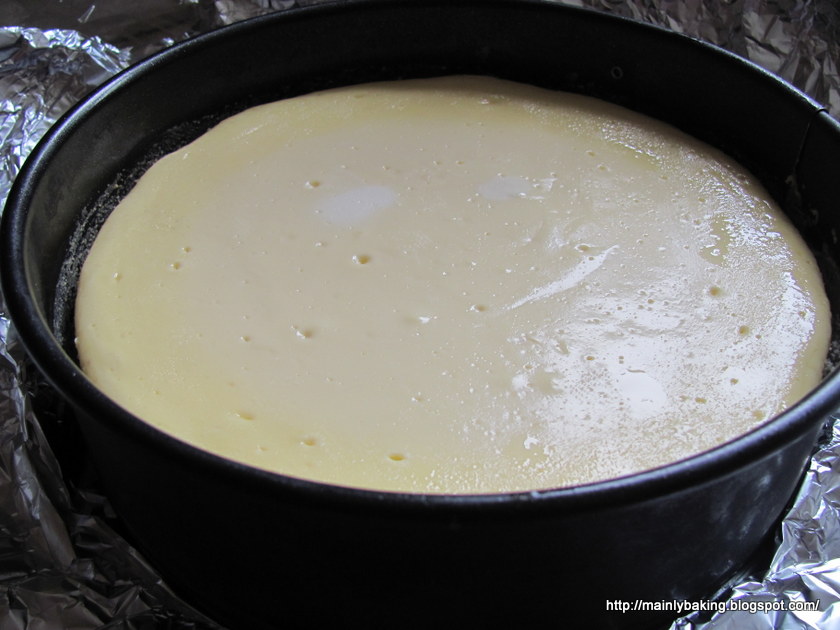
This first picture isn't pretty, but I just had to prove that I made a cheesecake that didn't split open as it cooled - a rarity for me!

The recipe is a Gordon Ramsay one, which has only been published online in the Times, so is no longer available unless you are a subscriber. It's a fairly standard mix of cream cheese, sour cream, eggs, sugar and vanilla, on a digestive biscuit crumb base, and I originally chose it because it used the same amount of cream cheese (500g) and sour cream (300g) that I had leftover after Christmas baking one year! Add 200g sugar, 3 eggs, 2 tablespoons cornflour and a splash of vanilla extract, et voila! After an hour's baking at 150C, it is supposed to be golden brown on top, but I've never achieved that effect with this recipe - it stays pale and interesting.

Vanilla Cheesecake
In fact, after an hour the cheesecake is always still very wobbly, and usually I bake for a bit longer, but this time I decided to be more courageous and  switched off the oven. I left the cheesecake for 30 minutes in the closed oven, then ran a knife between the tin and the cheesecake to free it from the tin, and left it to cool completely in the oven with the door open slightly. I don't know if it was the shorter baking time, or freeing the cheesecake from the tin which stopped it cracking, but it's the first time I've made this particular recipe without the cracks appearing.

This is one of my favourite baked cheesecake recipes; the proportions of cream cheese, sour cream and eggs gives a lovely texture which isn't too heavy or claggy. The only criticism is that as a vanilla cheesecake, it's a little too sweet. Previously I've always made it as a lemon version, so hadn't really noticed how sweet it is, as the lemon has cut through the sugar.

Take your pick...
add strawberries, roasted rhubarb or chocolate sauce.
We have a variety of tastes in this family - CT eats hardly any fresh fruit, if he can avoid it, and is a chocoholic, while the rest of us like fruit, but don't always want the same fruit at the same time, or the same amounts of fruit in relation to cheesecake. To cater for everyone, I decided to leave the cheesecake plain, and offer strawberries, roast rhubarb or chocolate sauce as an accompaniment.

It's a long weekend, to celebrate the Queen's Diamond Jubilee, so we felt deserving of a more luxurious dessert than I usually make. CT and FB are enjoying extra time to relax away from work, and Hubs and I, being retired, are carrying on as usual. We're not exactly anti-royalists, but we're not really celebrating or taking part in any organised events either; I tried to come up with a red, white and blue dessert, to stay with the spirit of things, but the rest of the family told me not to bother - taste was more important than looks to them!

I've just realised that Vanilla Cheesecake could be a contender for this month's Alpha Bakes Challenge - bake something with a 'V' in the name or ingredients list - but I'll  hold it in reserve for the moment, as I'd like to find something more interesting than V for Vanilla.