Showing posts with label polenta. Show all posts

Wednesday, 14 March 2018

Plum and Cinnamon Loaf

This cake was going to be a half-sized attempt at Dan Lepard's tried and tested Stone Fruit Yogurt Cake, until I realised that I was lacking the necessary semolina. Not one to be easily thwarted, I used polenta instead and carried on!

I wouldn't usually buy fresh plums at this time of year, as they have been trekked halfway round the world, but the checkout till at Waitrose kindly printed out a coupon for a pack of 6 'Perfectly Ripe' plums at half price. This recipe used three plums - they were quite large, weighing about 80g each, I seem to remember.

One of my baking books tells me that a 20cm round deep cake tin is equivalent to a 900g (2lb) loaf tin, so I hoped that half the quantities in Dan's recipe would be OK in a 450g(1lb) loaf tin. It was a near thing - the batter filled more of the tin than I was happy with, but fortunately the cake didn't rise too much. I made a couple of slight alterations to the recipe, but nothing that altered it substantially from the original.

Ingredients
90g caster sugar + 2 teaspoons extra
90g softened butter +15g extra
3 large ripe plums
1 large egg
1 teaspoon vanilla extract
80g full-fat Greek-style natural yogurt
40g polenta
85g plain flour
1/2 teaspoon cinnamon (optional)
1 teaspoon baking powder

Method
Line a 450g loaf tin with foil, pressing it well into the corners without tearing it, and grease with a little of the extra butter. Dot the remainder of the extra butter over the base, and sprinkle over 1 teaspoon of caster sugar.
Preheat the oven to 180C.
Halve and de-stone the plums, and cut each half into 4 slices. Arrange about 2/3 of the plum slices in the base of the loaf tin, and sprinkle over another teaspoon of sugar. Chop the remaining slices of fruit into small pieces.
Mix the flour, polenta, cinnamon and baking powder together in a small bowl.
Cream the butter and sugar together until light and fluffy, then beat in the egg and vanilla extract, adding a spoonful of the flour mix to prevent curdling.
With the mixer on it's slowest speed, stir in the yogurt, followed by the rest of the flour mix.
Fold in the remaining chopped plums with a spoon, then transfer the batter to the baking tin.
Bake for about 60 minutes, covering for the last 15-20 minutes if the cake seems to be browning too quickly. A test probe should come out clean of cake batter, although you might hit a piece of fruit which will make the probe look damp.
Leave for 10 minutes, then turn out onto a plate and carefully peel away the foil. If any of the fruit topping becomes dislodged, it can be gently put back into place. Cool before serving.

The slices of plums on top of the loaf were a really pretty pink colour - it was lovely to photograph something which wasn't brown! There was just enough cinnamon to taste, without it overwhelming the plums, which were both sweet and sharp and gave the cake a fresh taste which I've been missing all winter!

Incidentally, I was pleasantly surprised at how tasty the plums were, but I think I still prefer to buy fruit as locally and seasonally as possible.

Saturday, 5 August 2017

Blueberry and Lemon Polenta Cake

gluten-free

We planted two blueberry bushes earlier this year, but we weren't sure whether or not they would bear fruit straight away. Fortunately they did, although the fruit doesn't all ripen at once, so I'm picking 100-150g every five days or so. I've also found out that I really prefer cooked blueberries to raw, so I've made blueberry sauce for some cheesecake pots, and added some to baked rhubarb.

I decided to put the latest pickings into a cake, but had to find a recipe using a small amount. I also had some lemons that needed using, so a blueberry and lemon cake seemed in order. I soon found this Sainsbury's recipe for a lemon and blueberry polenta cake, which only used 100g of fruit. I had to adapt the recipe a little, using vanilla yogurt instead of natural. As I was using a yogurt with a separate topping of toasted oat flakes (about a tablespoonful), I sprinkled them on top of the cake too.

This was a deliciously light cake, although I think it could have taken another 50g of fruit, as the blueberries were very thinly spread. The zest of another lemon would have improved the flavour from my point of view but I do like a tart lemon cake - others might appreciate the subtlety of a milder flavour.

It's also nice to add another gluten-free cake to my repertoire.

Thursday, 13 April 2017

Rhubarb, Marzipan and Citrus Cake

I've been harvesting our homegrown rhubarb since the middle of March, and this traybake recipe is perfect for the beginning of the season when there are some thin stalks to pick. If you can only get thick sticks, then I suggest you cut them into fairly thin slices, both to distribute the rhubarb evenly through the cake, and make sure it cooks properly.

I picked this Rhubarb, Marzipan and Citrus Cake recipe because I wanted something portable to take to my daughter, who was cooking a Mother's Day dinner, and also because I know she loves marzipan.

I followed the recipe exactly, although I used the zest from the whole lemon and orange, as I didn't see the point of leaving half grated fruit - this turned out to be a good move, as the citrus flavour wasn't very pronounced, even with the extra zest. I also used fine cornmeal rather than polenta, as I can only get the quick-cook sort which is relatively coarse.

What the recipe doesn't mention is that initially the cake batter seems too stiff, and although it does slacken a little when the fruit is added, it never gets to the 'dropping' stage. Resist the temptation to add more liquid -  more juices will be released from the fruit during baking.

We all loved this dessert - there were subtle citrus notes amongst the tang of the rhubarb, and the marzipan gave concentrated pockets of the sort of almond flavour you don't get from ground almonds alone. My husband reckoned it would come a close second to rhubarb crumble in his 'favourites' list!

Thursday, 21 April 2016

Rhubarb and Ginger Polenta Cake

Gluten-free & Dairy-free

This is a recipe I've been using for years - two layers of shortcake-style dough enclosing some fresh fruit. I usually make it with butter and SR flour, but wanted to see whether the recipe worked if it was made both gluten- and dairy-free. I decided to use polenta in place of 1/3 of the flour, as in this Nigel Slater recipe, a commercial brand of gluten-free flour and a non-dairy spread instead of butter.

This recipe works well with any type of fresh fruit filling, but something like rhubarb, which releases a lot of liquid during cooking, needs to be cooked first, then drained. I roasted 500g of rhubarb (the first of the season, incidently), cut into 4cm lengths, with about 50g of sugar; you might need more sugar if you don't like really sharp fruit.

Ingredients
150g caster sugar
150g non-dairy spread, suitable for baking
100g polenta (I only had the instant kind)
200g gluten-free plain flour
1 teaspoon baking powder
1/2 teaspoon xanthan gum
1/2 teaspoon ground ginger
1 large egg
500g sweetened cooked rhubarb, drained of cooking juices
3 balls of stem ginger, finely chopped

Method
My usual method is to melt the butter, then stir in the sugar and egg, then lastly add the flour, but I didn't think this would work as well with the non-dairy spread. Instead I followed the method in Nigel's recipe, which is to put all the dry ingredients into a bowl, rub in the fat, then mix to a sticky dough with the egg. The gluten-free flour and polenta made a much stickier dough than usual, which was almost too soft to work with - next time I think I'll add another 25g of flour.

Pre-heat the oven to 180C.
Once mixed, 2/3 of the dough is spread over the base of a 20cm springform tin, which has been greased and base-lined with baking parchment. The dough needs to be worked up the sides of the tin to make a wall about 2cm high.
Spread the fruit onto the base, packing it closely together but leaving the 'wall' uncovered.
Sprinkle the chopped stem ginger over the rhubarb, then drop the remaining dough on top of the the fruit in small teaspoonsful, starting at the edges and working inwards. Use the spoon to flatten and spread the dough as much as possible, but it isn't necessary to completely cover the fruit.
(The method of assembling the cake is covered in more detail, and with photographs, in this post.)
Bake for about 55 minutes until the cake is golden and feels solid. Cool in the tin.
The cake can be served warm but this gluten-free version is quite fragile, so I'd recommend serving at room temperature.

If liked, the top can be sprinkled with flaked almonds or demerara sugar before baking, or the cooled cake can be dusted with icing sugar before serving. As I mentioned earlier, almost any fruit can be used as a filling - sliced apples and a handful of sultanas, for instance, or sliced plums - and complimentary spices can be used in the dough, rather than ginger.

Rhubarb and ginger is a classic combination which worked well in this cake. There was just a hint of ginger in the cake dough, but the stem ginger in the filling was more pronounced and added an extra texture too, along with the graininess of the polenta. This cake was softer and more fragile than the same cake made with the usual ingredients, but I was pleased with how well the 'conversion' to a gluten- and dairy-free version turned out.

Sunday, 27 September 2015

Gluten-free Cornbread

We both really like cornbread, as an occasional alternative to rice, with a chilli, but I've yet to find the perfect recipe. The biggest problem is the bread being too crumbly, then there are recipes that are too sweet and recipes that are too bland. Flavours can easily be worked on, but it's getting the right balance of dry to wet ingredients which is proving elusive (although I have to admit that this recipe, from Ben Mims seemed pretty good the first time I tried it - I just forgot about it until now!). Add into the mix, the desire for a gluten-free cornbread and things get complicated.


It's fairly widely recognised that adding some wheat flour is better than 100% cornmeal, if a light cornbread is required, but this can't be used in gluten-free baking. This recipe, found on Jamie Oliver's website, uses equal volumes of a gluten-free flour mix and cornmeal, and allows for the use of non-dairy milk, if required. The only thing I didn't like, at first glance, was the amount of sugar added, so I cut this down from  80g to 50g. I added half a teaspoon of xanthan gum, just because I had it to hand, and it's meant to replicate the effects of gluten in wheat flour ie  cuts down on the crumbliness of baked products. I also used a mix of 50% polenta and 50% fine cornmeal instead of all cornmeal.

Converted to metric weights, I used: 200g gluten-free flour, 220g cormeal/polenta mix; 50g sugar, 2 tablespoons honey, 2 teaspoons baking powder, 1 teaspoon bicarbonate of soda, 1 teaspoon salt, 1/2 teaspoon xanthan gum, 2 large eggs, 360mls milk, 75g melted butter + another 10g to grease the skillet.

The method is fairly standard - mix dry ingredients in one bowl, wet in another, melt butter. Add wet ingredients and melted butter to dry ingredients and mix until just combined (don't overmix!). Pour into a pre-heated and well-greased skillet and bake in a hot oven. I used a fan oven at 160C and found that the cornbread was cooked in 25 minutes, rather than the 30-35 minutes suggested in the recipe.

The texture of this cornbread was good, but still a little crumbly. The Ben Mims recipe uses a much higher proportion of liquid, so it shouldn't spoil this recipe to increase the amount used, although it might need an extra egg too. I thought there was still a touch too much sugar in the recipe, so will cut it down even more in future. My next attempt will be to try a version of this recipe which is dairy-free too.

Tuesday, 1 September 2015

Almond, Raspberry and Rose Polenta Cake

- both gluten and dairy free

This was my second attempt at this recipe; the first being this cake, where I changed both the nuts and fruit used. The outcome was delicious, but the fruit sank and spoiled the look of the cake. This time, I made even more adaptations (naughty me!) because I wanted the cake to be dairy-free as well as gluten-free, and I also didn't want to use any citrus fruit. While I was making changes, I decided to replace half the polenta with fine cornmeal, to reduce the graininess of the texture

Ingredients
225g dairy-free spread (I used Pure sunflower spread)
225g caster sugar
3 large eggs
60g fine cornmeal (not cornflour)
65g polenta (the instant kind is all I can get)
125g ground almonds
1 teaspoon gluten-free baking powder
1/4 teaspoon salt
1 teaspoon rose water (or more, depending on strength*)
a few drops of almond extract*
50mls water*
200g raspberries

* The rose water, almond extract and water replaces the citrus juice and zest in the original recipe. 50mls is less than the juice of 2 lemons, but I felt the batter was too sloppy the first time I made this cake. 

I only used 1 teaspoon of rose water as the brand I use is quite concentrated. I often see recipes using a lot more, so the strength must vary from brand to brand. I once made the mistake of adding more of the Neilsen-Massey rose water, and the result was inedible because of the overpowering rose flavour.

Method
Grease and line the base of a 23cm springform tin. Pre-heat the oven to 160C.
Cream together the spread and sugar, in a large bowl, until light and fluffy.
In another bowl, mix together the cornmeal, polenta, almonds, baking powder and salt.
Add the rose water and almond extract to the fat and sugar mix, then beat in the eggs, one at a time, adding a tablespoon of the dry ingredients with each egg.
Fold in the rest of the dry ingredients, in portions, alternating with a splodge of the water, until all ingredients are added.
Let the batter stand for 5 minutes (I was distracted by a phone call at this point, and the batter thickened a little while I was away - I think this may be an advantage, so I'll be adding this stage to the recipe in future!).
Spread half the batter in the baking tin, then sprinkle with half the raspberries (I used the small and broken fruit in the middle). Gently spread over the remaining batter, then arrange the rest of the raspberries on top, spacing them evenly.
Bake for 50-60 minutes, until the cake is golden brown and just firm in the centre (I use a colour-changing cake tester, as a probe isn't always reliable when there's fresh fruit in  a cake).
Cool the cake in the tin, and if desired, dust with icing sugar before serving.

I think this cake is one of the best gluten and dairy free cakes I've ever made, and possibly the most delicious seasonal fresh fruit cake I've eaten this summer! That's really saying something, because, as you know, I'm quite critical of my baking and can usually find something wrong.

Unfortunately, I was taking this cake to a friend's house for lunch, and only managed to photograph the cake still in it's baking tin, and the leftovers, so for such a great cake, I'm not showing it at it's best! As you can see, though, the fruit didn't all sink (hooray - main objective achieved!).

The rose flavour was subtle and well balanced against that of the raspberries and almonds. The addition of a few drops of almond extract really brought out the flavour of the nuts - sometimes ground almonds on their own don't have a very strong flavour, which is OK if you're just interested in adding moisture and texture, but not good enough if you want a cake to taste of almonds. The texture was good too - moist, but still quite light, with an even close crumb, and not too gritty from the polenta. I think the only improvement I could make would be to add another 50g of fruit - 200g in such a large cake is quite sparsely distributed.

Late decision - rather than miss the next round of Formula 1 Foods, run by Caroline, from Caroline Makes, because I will be on holiday for most of the first half of September, I will enter this cake. The next F1 GP race takes place in Italy, during the first weekend in September. Almonds and polenta seem to crop up frequently in Italian cake recipes, so this could be said to be an Italian inspired cake, although I'm not sure raspberries and rose flavour really fits the bill! It's this or nothing, Caroline!

Another late decision - as this is by far the best cake I've made for ages, I'm also adding it to the Simply Eggcellent link-up over at Belleau Kitchen. Dom's theme this month is cakes, so I'm looking forward to seeing all the entries and getting some new ideas!


Thursday, 20 August 2015

Blackberry and Hazelnut Polenta Cake (gluten-free)

Several weeks ago I bookmarked a gluten-free cake recipe that I wanted to try, but for various reasons I hadn't got around to making it. After we'd been blackberry picking, I remembered the cake, and even though it was made with raspberries, I thought the recipe would work well with blackberries too, and make a change from apple and blackberry crumble. My husband loves a fruit crumble above all else, so he needed a little persuasion that change was a good thing!

Necessity forced a few other changes too - ground hazelnuts instead of almonds, and the zest and juice of a lemon and a tangerine, instead of 2 lemons. I really don't like making huge alterations to recipes before I try them as written, but I was confident that my changes would only affect the flavour, not the technical aspects of the recipe. I might have been wrong about that!

The cake batter looked a little strange when mixed - it was very grainy but I put this down to my home-ground hazelnuts not being as fine as commercially ground almonds. It was also quite sloppy, possibly for the same reasons - I hoped that once the polenta started absorbing the moisture during baking it would sort itself out. It did sort itself out in the oven, but not before all the fruit sank to the bottom. This could have been because of the sloppy batter, or because blackberries are heavier and juicier than raspberries.

Now I'm interested in trying the recipe exactly as written, to see if my changes affected the outcome, or whether it wasn't such a good recipe in the first place, and the fruit will sink even when raspberries, and finely ground almonds are used.

None of this stopped the cake being absolutely delicious. Hazelnuts and blackberries are a good flavour combination, and the subtle hint of citrus blended in well without overwhelming everything. If the fruit had stayed evenly distributed throughout the cake, I'd have said that 200g wasn't really enough, but more sinking fruit would have made the bottom of the cake too moist.

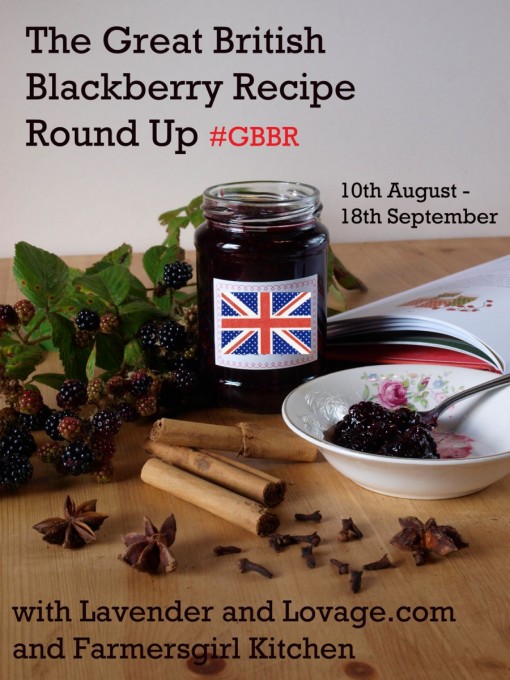
The Great British Blackberry Recipe Round-Up
Karen, over at Lavender and Lovage, and Janice at Farmersgirl Kitchen are co-hosting a round-up of blackberry recipes until mid-September, so I'm submitting this recipe for it's deliciousness, even if the technical execution wasn't perfect!