Showing posts with label oats. Show all posts

Monday, 30 August 2021

Sultana and Lemon Buckwheat Flapjacks

For some long forgotten reason, I have buckwheat flakes in my store of baking ingredients and they need using soon. They look like rolled oats, so I wondered if they would make good flapjacks. I was relying on them having the same sort of absorbency as rolled oats, but in case they hadn't, I decided to use them 50:50 with oats for the first trial, and take a tip from Lynn Hill at Traditional Home Baking, and add 50g of plain flour to my usual recipe. This makes the flapjacks softer and less sticky, so if absorbency was a problem, extra flour would help.

In case the flapjacks didn't work well, I used some of the cheapest add-ins that I had - sultanas. I also had a couple of lemons in the fridge which really needed using up, so added the zest of both of them to the mix. This turned out to be a flavour combination which worked really well.

I needn't have worried. Although the flapjack mixture initially looked wetter than usual, everything was absorbed during baking and the flapjacks emerged from the oven looking as good as ever! 

I tasted both the buckwheat flakes and oats raw, and although some online sources describe buckwheat as nutty and slightly bitter, I thought they were both equally bland and tasteless. So although buckwheat probably isn't something one would use to add flavour to anything, it does have nutritional benefits. It is gluten-free, high in fibre and magnesium and relatively high in protein.

The recipe is very simple: 

Melt together 160g butter, 70g golden syrup and 100g sugar. (I usually use light muscovado, but only had soft brown sugar in stock - even white would do!) This can be done in a bowl in the microwave, or a pan on the hob. Only heat until the butter has melted; don't let the mixture boil. To this mixture add 120g rolled oats, 120g buckwheat flakes (or use all oats), 50g plain flour, 100g sultanas and the finely grated zest of 2 lemons. Mix well until everything is combined evenly. Tip into a 20cm square shallow baking tray, lined with baking paper, spread evenly, then press down firmly. Bake at 180C/160C fan for 25 minutes, until golden brown. 

Rest for 5 minutes, then mark into bars or squares with a sharp knife. Leave in the tin until cold - they may crumble if lifted while warm

This gives soft, chewy flapjacks - if you like them crisper, bake for a few minutes longer. If you like sticky flapjacks, leave out the flour.


Saturday, 8 May 2021

Helen Goh's Anzac Cake

I'm not sure what to think about Helen Goh's Anzac cake (from the Australian Good Food site), which is inspired by the ingredients of the traditional ANZAC biscuit. It's a lovely close-textured, moist cake, but without the topping, the flavour really wasn't anything special. The coconut milk used in the cake batter wasn't enough on it's own to give a really strong coconut flavour.

The problem was, the topping didn't work well for me! In fact, most of it ended up on the floor of the oven as it ran off the cake. The flavour was fine - a sort of caramelised coconut macaroon - but as well as just sliding off the cake, what was left didn't stick well, making the cake difficult to cut and serve.

I think part of the problem may be that UK baking tins are different in size to Australian tins - the recipe states using a 1kg capacity tin, whereas standard UK loaf tins are 450g or 900g. The difference didn't seem enough to matter to me, and indeed, it didn't for the cake itself. However, the cake rose above the top of the tin, and domed in the middle, meaning there was nothing to stop the topping sliding off as it warmed up again in the oven.

I'd  like to repeat this cake, with either something extra in the cake, such as a spice, or some dried fruit, to make it better to eat without the topping, or with a different sort of topping. This could be a coconut frosting put onto the cooled cake, but I also wondered if a more traditional macaroon topping, adding egg, would stay in place better, both during and after cooking.

Wednesday, 11 November 2020

Apricot, Cranberry and Ginger Flapjacks

Up until now, I thought my recipe for flapjacks was perfect. Over the years the ratios of sugar, syrup and butter were tweaked and the quantities adjusted until the flapjacks were thick and chewy.

One thing I have never done is add flour to my flapjacks, so I was intrigued to see that Lynn Hill of Traditional Home Baking is an advocate of doing so, maintaining that it helps to give the flapjacks the desired chewy texture. Although I like the texture of the flapjacks produced by my recipe, I'm not too proud to see if this suggestion is an improvement.

I followed Lynn's recipe for Fruity Flapjack, but rather than the fruits suggested in the recipe, I used 100g of chopped dried apricots, 50g of cranberries and 30g of chopped glacé ginger, which had been rinsed and dried to remove the syrup coating. I also added 2 teaspoons of ground ginger to make sure there was enough ginger to taste. The mix of apricots and cranberries is one of my favourite combinations in baking.

Our recipes are very similar in the quantities of ingredients used (apart from the flour), although Lynn's bakes in a slightly larger tin, so I was interested to see how much difference adding the flour would make. 

It was huge! 

The texture was completely different - much softer as well as chewy. I think adding the flour also helped absorb the butter mixture more completely too - my flourless flapjacks are usually a bit stickier.

Both recipes have their merits so I'll probably use both in future, depending on the result I want. Mine are chewy and sticky, Lynn's are softer and chewy. However, when I do use flour, I think that I will go back to baking in a slightly smaller tin, as I prefer a thicker flapjack.

Saturday, 22 August 2020

Ginger, Oat and White Chocolate Cookie Squares


I think I've found a new favourite recipe for cookie bars or squares. It's another recipe from Lynn Hill at Traditional Home Baking. Lynn has published several recipes using this basic cookie dough, but the only one for which I had the 'add-in' ingredients already available was this one for Ginger and White Chocolate.

The recipe was simple to follow and easy to make. The only worrying moment was when it looked as if the beaten sugar and butter mix wouldn't take all the dry ingredients, but a little perseverance soon put that right!

I was slightly annoyed that I didn't have a baking tray anywhere near the right size for this recipe - I had to use my deep adjustable cake tin to make one which was nearly correct, but the deep sides made it a little more difficult to spread the dough easily. 

The texture of these cookie squares was very short, but made a little more substantial by the addition of the oats. It was this combination of 'melt in the mouth' but chewy which I liked so much!

As both white chocolate and glacé ginger are very sweet, I found these bars a little too sweet, but I'm looking forward to trying a version with dried fruits and/or nuts. Lynn has a recipe using apricots and almonds but there are many other variations that I can think of.

Friday, 10 July 2020

Flapjacks with Blueberries and Cranberries

A friend gave me a box of 8 sachets of  'Super Goodness' Porridge, with ingredients designed to boost the immune system. As the freeze-dried fruit was only 10% of the porridge, I'm not sure how much effect it would have (3.5g of fruit in each serving), but I suppose if you ate porridge for breakfast every day you're not going to do any harm, and might gain some benefits! There were some added vitamins too, which never hurts!

However, I don't like porridge, but could see the potential for the mixture to be used for flapjacks. The oats in the porridge were wholegrain rolled oats, not instant oats, so I figured they would work as a direct substitute for plain oats. The only adjustment I made to my usual recipe was to reduce the added sugar to compensate for the sugar already in the porridge mix (16%).

Ingredients
160g butter
70g golden syrup
50g caster sugar
280g Quaker Oats 'Super Goodness' Porridge with Blueberries, Cranberries and Guava.


Method
Preheat oven to 180C/160C fan and line a 20cm square shallow cake tin with baking parchment.
Melt the butter, golden syrup and sugar together  - I do it in the microwave, but a saucepan on the hob is fine too. Don't boil the mixture, just heat enough for the butter to completely melt.
Stir in the porridge mixture and mix thoroughly. 
Transfer the mixture to the baking tin, spread evenly and press down firmly.
Bake for 30 minutes until golden brown. Cool for 5 minutes then mark into bars or squares, but allow to cool completely before removing from the tin.

Despite the fruit content of the porridge being only 10% (and 2% of that was guava powder), there was enough to give the flapjacks a strong fruit flavour. I think being freeze-dried makes the fruit lighter than ordinary dried fruit, so there's more volume of fruit in the 28g in the recipe - it certainly looked a lot!  These flapjacks were a little crisper than those made following my basic recipe, but they were still chewy enough!


Sunday, 24 May 2020

Malty Prune Flapjacks

In line with government recommendations, I'm trying to shop as infrequently as possible. Where I live, supermarket shopping is the least safe activity - I have plenty of open spaces and wide pavements when I go out for exercise, but I can't avoid needing food.

I'm fit and healthy, and don't yet fit any of the categories of people who should be taking extra precautions, so haven't tried to get any supermarket delivery slots, preferring to leave those for the more vulnerable members of the community. It's taken a while, but I've now figured out the quietest times to shop, so I take a list and shop as quickly as possible.

This is a big change for me, as I loved to browse the shelves, looking for bargains, new products or just what looked good that day. I used to go out almost every day and just buy a few bits and pieces, as I needed them. As I don't drive and have to carry my shopping a mile back home, what it also means is that, for the moment, I'm only buying the basic essentials, as fruit and vegetables and other necessary fresh foods are quite heavy when you're buying everything at once instead of spreading it out over several trips.

This is starting to impact on my baking (even though I'm not baking very frequently) - aside from what seems like a permanent lack of flour, there aren't always eggs or sugar available, and I'm running low on things like dried fruits and nuts. So wanting to bake means looking through the cupboard and seeing what's there before making decisions.

This time I found some 'out of date' prunes which still tasted OK and the scrapings from a jar of malt extract which could replace golden syrup if I made flapjacks. I'd been looking at malt loaf recipes but didn't have enough malt extract, so the idea of something malt-flavoured was still niggling away at me.

I followed my usual recipe, just substituting 50g of the golden syrup with malt extract, although I'd hoped to have enough malt extract to replace all the golden syrup.

First, melt together 160g butter, 50g malt extract, 20g golden syrup, and 100g caster sugar. This can be done in a saucepan, or in a large bowl in the microwave. Try not to let the mixture boil - it just needs to melt the butter completely. Then stir in 240g of porridge oats, 50g sultanas, 70g soft prunes (cut into pieces the same size as the sultanas) and 1 teaspoon of mixed spice. Mix thoroughly.

Tip this mixture into a 20cm square cake tin, lined with baking parchment. Level the mixture and press down firmly, then bake at 180C for 25 minutes. Cool for 5 minutes then mark into squares or bars while still hot. Leave to cool completely before removing from the tin.

I like flapjacks to be chewy, and these were gloriously chewy! More so than when I make the recipe with golden syrup. Additionally, the slight bitter edge to the malt extract cuts the sweetness a bit - you're not reducing the sugar you consume, but it tastes as if you are! The prunes worked well here too - they have a strong enough flavour to be tasted over the maltiness.

Monday, 9 September 2019

Date and Ginger Flapjacks

Another roll out of an old favourite - flapjacks are really quick to mix and bake so are ideal for occasions when you don't have much time, or just want to make something from store-cupboard ingredients. I think I overdid the ginger here, so the flavour of the dates didn't come through strongly, but their chewiness added to the texture. The recipe is really simple, and can be made in one bowl or saucepan, depending on how you want to melt the butter, syrup and sugar together.

As long as you don't exceed 150g, you can use any combination of dried fruit, nuts or seeds that you have in stock, or know you family likes, adding appropriate spices or other flavouring, such as citrus zest.

For a 20cm (8") square tin, melt together 160g butter, 70g of golden syrup and 100g of light muscovado sugar. I do this in a large bowl in the microwave, but it can also be done in a saucepan on the hob. When all the butter has melted add in 240g porridge oats, 2 teaspoons ground ginger, 1/2 teaspoon of ground cinnamon, 80g of chopped dates and 50g crystallised or glacé ginger,  both chopped quite finely. Mix until well combined then transfer to the baking tin, which should be lined with baking parchment. Press down firmly to give an even layer, then bake at 180C for about 25 minutes, to give a chewy flapjack. If you like a slightly crisper finish, bake for a few minutes longer. Cool in the tin for 5 minutes, then mark into bars or squares, but leave in the tin until completely cold.


Thursday, 6 December 2018

Banana and Coconut Flapjacks

Just occasionally, I need a mid-morning snack before going out to do something energetic, such as a long walk or a session of lifting and carrying crates of food at the local Food Bank, where I do some volunteer work. In my normal daily routine, I'm quite happy to go without breakfast and have a early lunch at noon, but if I'm using extra energy I need food beforehand. I usually have a banana topped with a couple of tablespoons of natural yogurt, a sprinkling of granola and a drizzle of date syrup.

As I don't eat bananas at any other time, I sometimes end up with one that needs using up, which is what happened here. It's difficult to find recipes using one banana - banana breads, cakes and muffins seem to need a minimum of two - so I decided to add it to a batch of flapjacks. I followed my usual recipe but reduced both the butter and sugar slightly to allow for the banana although I wouldn't claim it made the flapjacks any healthier!

Ingredients
125g unsalted butter
50g golden syrup
80g caster sugar
200g rolled oats
50g desiccated coconut
100g golden raisins
1 ripe banana, mashed

Method
Preheat the oven to 180C and line a 20cm square baking tin with parchment.
In a medium saucepan, melt the butter, golden syrup and sugar together until the sugar has dissolved - the mixture will feel smooth under the spoon with no grittiness from the sugar - and the mixture is just beginning to bubble.
Meanwhile, weigh the oats, coconut and raisins in to a large bowl.
Tip the hot butter mix over the oats and mix together thoroughly, then stir in the mashed banana.
Transfer the oat mixture to the baking tin, spread evenly and press down firmly. Bake for 25 minutes until golden brown.
Cool for 10 minutes then mark into bars or squares while still warm. Allow to cool completely before removing from the tin.

These were delicious, with a good balance of flavours between the banana and coconut. My only criticism would be that although 25 minutes is the right time to bake my usual flapjack recipe, these were underbaked and a little too soft. Another 5 minutes, to compensate for the additional moisture from the banana, would have made them a little firmer but still chewy. If you like crisper flapjacks you might need 35-40 minutes baking time, but watch they don't get too brown.

Monday, 2 July 2018

Seeded Flapjack

made with caramelised condensed milk

After making the salted caramel and chocolate shortbread squares, I had half a tin of caramelised condensed milk to use up (this seems to be a constant refrain whenever I use condensed milk!). I wanted to make flapjacks, and decided to search for a new recipe, even though I have several recipes for flapjacks made with either condensed milk, or caramelised condensed milk already. I eventually found this one on a blog called Salutation Recipes; the photos attracted me initially, because the flapjacks looked dense and chewy, and when I read the description of 'fudgy', I knew I'd found what I was looking for! I didn't think substituting caramelised condensed milk for ordinary condensed milk would have any adverse affect on the recipe - if anything it would increase the fudginess (if that's even a word!).

To salve my conscience slightly, I decided to add 100g of mixed seeds - a mix of pumpkin, sunflower, sesame and linseed. I used light muscovado sugar instead of golden caster, and also left out the vanilla extract - it seemed like a waste of an expensive ingredient in this sort of thing.

The recipe is a bit vague about exact amounts and the cooking time, but these are the weights of the ingredients that I used - 125g butter, 100g golden syrup, 90g light muscovado sugar,  200g caramelised condensed milk, 280g rolled oats, 100g mixed seeds. After melting the butter, syrup and sugar together, I stirred in the caramel until smoothly blended, then added the oats and seeds to the saucepan (off the heat) and mixed thoroughly. After transferring the mixture to a lined 20cm square baking tin and spreading evenly and firmly, I baked for my usual flapjack time of 25 minutes at 180C (160C fan), and allowed the tray to cool for 10 minutes before marking into 16 squares.

The flapjacks seemed very crumbly at this stage, which was a little worrying, but once they were completely cold they had set into exactly what I was hoping for - dense, chewy, fudgy flapjacks. Almost perfect - they were still a little crumbly around the edges, but within acceptable limits!

I think all flapjacks benefit from some add-ins to counteract the uniformity of the oat base. In this case the seeds added some crunch to contrast with the chewiness, and also some extra flavour.

Thursday, 1 February 2018

Salted Caramel Flapjacks, with Chocolate and Hazelnuts

If I'm going to carry on baking regularly, I'm going to have to find recipes for smaller cakes, or experiment with halving some of the recipes I use regularly. Flapjack recipes are easy to divide, because there are no fractions of eggs involved, and the quantities of ingredients aren't critical to the nearest gram - a bit more or less of any of the main ingredients and you end up with a slightly crunchier, or chewier flapjack. Not a disaster, and a lesson for revised quantities next time.

This recipe was inspired by this Annie Bell recipe, which I've used once before, and was chosen to use up an open jar of salted caramel - mainly to stop me just dipping in with a spoon and eating it on its own. I used half quantities of all the ingredients, but rather than drizzle melted chocolate over the baked flapjacks, I added 40g of chopped dark chocolate and 30g of coarsely chopped hazelnuts to the oat mixture.

As I expected, the chocolate melted in the heat of the flapjack mixture, but I was careful to add the chocolate as the last ingredient, and fold it in quickly. This meant that most of the chocolate stayed in discrete areas, giving the flapjacks a marbled appearance. The chopped nuts added an extra texture of crunch to the very chewy flapjacks, as well as flavour.

I baked the oat mixture in a tin measuring 20cm x 12.5cm (8" x 5") - I used a deep adjustable cake tin - but finding the right size baking trays for brownies and other traybakes is proving difficult. Everything I look at is either too big or too small for half-sized recipes, but I'm not sure fiddling around with more complicated calculations is worth the effort!

Ingredients: 120g salted butter; 90g light muscovado sugar; 112g salted caramel*; pinch sea-salt crystals; 175g oats; 30g chopped hazelnuts; 40g chopped 70% chocolate.

*If you only have basic caramel, add a little extra sea-salt

It's the usual flapjack method - melt together the butter, sugar and caramel. Stir in the oats, salt and nuts, then lastly, quickly fold in the chocolate. Spread into a baking tray lined with baking parchment and press down well. Bake for 25 minutes at 180C. Mark into portions while still hot, but cool completely before removing from the tin.

There was a lot of butter bubbling on the surface of the flapjack when it was removed from the oven, but it was all absorbed back in as the mixture cooled. It does make me think that the amount of butter in the recipe could be cut back a little, though.

Tuesday, 29 August 2017

Raisin and Coconut Flapjack

Various family issues have meant that baking time has gone out of the window at the moment. I haven't really baked much since sometime in Spring, when Hubby said he wanted to cut down on cakes and puddings to lose a bit of weight. Nearly all my posts since April have been clearing a backlog of things which hadn't been written about. However, I did want to make something for the Bank Holiday weekend, as a little indulgence seemed acceptable.

I've said before that flapjacks are a really good way of using up ends of packets in the baking storecupboard, and this sometimes leads to exciting flavour combinations that work really well. This time I also had a pack of granola breakfast cereal that needed using up - it was just a basic granola containing raisins and almonds, so I added some golden raisins and desiccated coconut to up the flavour a bit. Granola already contains quite a lot of sugar, and often some fat too, so my basic flapjack recipe had to be adjusted a little to compensate for this.

Ingredients
140g butter
50g golden syrup
80g light muscovado sugar
165g granola breakfast cereal
100g porridge oats
35g golden raisins
35g desiccated coconut

Method
Line a 20cm (8") square shallow baking tin with parchment, folding it so that the sides of the tin are lined too. Preheat the oven to 180C.
Melt the butter, syrup and sugar together. I usually do this in a large mixing bowl in the microwave, but a saucepan on the hob is fine too. The mixture doesn't have to boil, just get hot enough for the sugar to dissolve.
Stir in the other ingredients and mix thoroughly.
Transfer to the baking tin, spread evenly and press down firmly.
Bake for 25 minutes, until just turning golden brown. This timing gives a chewy flapjack - if you like it crunchy, then bake for a little longer.
Cool for a few minutes, then cut into fingers or squares, but don't remove from the tin until completely cold.
 

Tuesday, 18 October 2016

Apple Pie Flapjacks

Although these flapjacks, containing fresh apple, certainly filled the kitchen with the smell of apple pie while they were baking, to me, with the texture given by the oats, they were more evocative of apple crumble, as I always use oats in my crumble mixes.

I have to admit that I was dubious about this recipe. Would adding such a large amount of grated apple put too much moisture into the mix? Would it hold together? Would the flapjacks be crisp, chewy or just a soggy mess? The oat mixture made a good thick layer in the baking tin, which was a promising start, as thin flapjacks can become too crisp.

In fact, the flapjacks were fine, while they were fresh, but they didn't keep that well, becoming progressively more moist until they were much too soft for my taste. I like my flapjacks chewy, rather than biscuit-crisp, but I don't like them flabby. The flavour was excellent though, so if the flapjacks are going to be eaten all in one go, soon after baking - at a Hallowe'en or Bonfire party, for instance - then I'd say go for it!

Adding fresh apple reduced the 'almost too much' sweetness that you can get with flapjacks too, as well as making them seem more healthy, and the flavour of apples and cinnamon came through well. If there was any criticism it would be that 50g of walnuts wasn't enough to make a real impact.

Friday, 8 July 2016

Rhubarb and Pecan Crumble Cake

We're coming to the end of the rhubarb season now, and many of the stalks are too tough to use, so I'm always on the lookout for recipes which use smaller quantities of fruit. That means I can pick the few tender stems and leave the rest of the leaves to pass goodness back to the crown, to feed the plant for next year's growth.

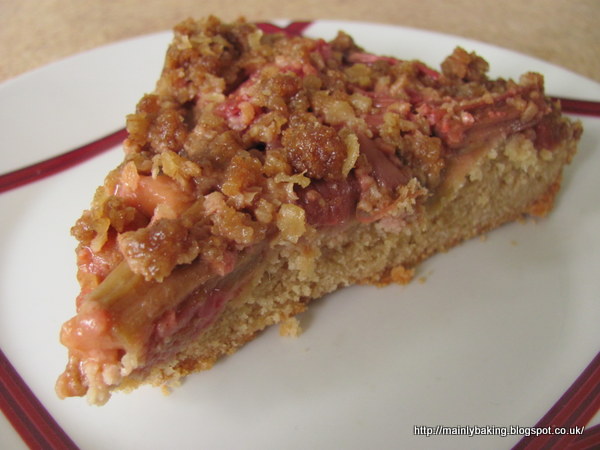
This recipe, for a simple rhubarb and crumble topped sponge cake, which I found on the Tesco website, looked easy enough, and only used 250g of fruit,  but I ended up using four mixing bowls, which is more than I like to use unless I'm cooking for a special occasion. I followed the recipe exactly (except for using pecans instead of walnuts), but made the cake in a 22cm (9") springform tin. The only thing that didn't go according to plan was that it took an hour in the oven before I was satisfied that it was properly cooked - that was a bit of a surprise, as it was quite a hot oven too!

The cake was quite tasty  but I didn't think the rhubarb, which should have been the star of the show, really came through in the flavour. The rhubarb was sandwiched between two substantial layers of crumble, and while the bottom layer soaked up the juices from the raw fruit, so that the sponge cake didn't become soggy, the brown sugar in the crumble gave a toffee flavour which overwhelmed the rhubarb.

Overall, probably not worth the effort!

Thursday, 9 June 2016

Rhubarb Streusel Cake

Another recipe from Sue Lawrence's book 'On Baking' - this was the one I'd originally planned to bake, before I turned the page and saw the recipe for Date and Ginger Shortbread Squares, which I couldn't resist! I haven't added many rhubarb recipes to the blog this year, as my husband's favourite dessert is rhubarb crumble, which is so easy to prepare that I'm happy to make it regularly during the rhubarb season. This cake made a nice change from crumble, but to be honest, it wasn't as good!

Sue bakes this recipe in a 20cm (8") square cake tin, but it wasn't clear from the recipe how deep the tin needed to be, so I played safe and used a 22cm (9") round tin instead, then cut the cake into wedges to serve. It would have been OK in a shallow square pan, of the type used for brownies, as it wasn't a very deep cake, so now I'll know if I want to make it again. The dough base was quite scone-like after baking, and quite dry, rather than a light cake, but this was balanced by the moistness of the rhubarb layer on top. To enjoy this cake at it's best, it really needs eating fresh, on the day it is made.

The only change I made to the recipe was to roast the rhubarb and sugar, rather than cook it in a saucepan on the hob. I find the rhubarb is more likely to keep it's shape this way. I also drained off the juice formed during cooking.

Filling - 450g rhubarb, chopped into 3cm lengths, roasted with 50g light muscovado sugar at 180C for about 20 minutes, until tender, then cooled and drained.

Base - 85g ground almonds; 170g SR flour; 85g light muscovado sugar; 115g butter; 1 egg; 1/2 teaspoon vanilla extract.

Streusel Topping - 2 heaped tablespoons porridge oats; 2 tablespoons plain flour; 3 tablespoons light muscovado sugar; 1 heaped teaspoon ground ginger; 2 tablespoons sunflower oil.

Method
Preheat the oven to 180C and grease and base-line a shallow cake tin  - 20cm square or 22 cm round.
Put the flour and almonds into a bowl and rub in the butter. Mix in the sugar, then the vanilla and the egg until everything is evenly mixed. This will not be a soft batter at this stage, more like pastry to handle.
Tip the dough into the baking tin, and use dampened finger tips to spread evenly over the base.
Carefully spoon the rhubarb over the base, leaving a small margin around the edges.
For the topping, mix all the ingredients together in a small bowl, then sprinkle evenly over the fruit.
Bake for about 50 minutes, until well-risen and golden. Cool in the tin.

Overall, this was a pleasant cake, but nothing special. If I made it again, I think I'd double the amount of topping, and perhaps add some flaked almonds, as the cake seemed a little unbalanced with such a small amount of streusel, although it was nice to see the pink rhubarb poking through.

Saturday, 4 June 2016

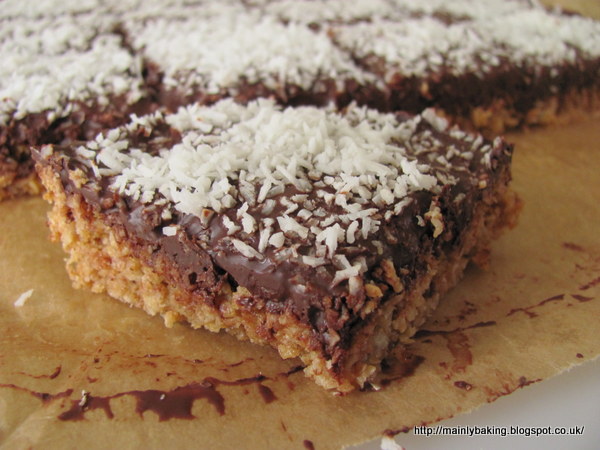
Chocolate-topped Coconut Flapjack

When this recipe, for Bounty Flapjacks, popped up on my Facebook page, I was instantly smitten. As I have a reliable recipe of my own for flapjacks, I decided to adapt that, rather than follow She Who Bakes' recipe, but I want to acknowledge where the idea came from!

Ingredients
100g butter
60g coconut oil
100g light muscovado sugar
70g golden syrup
240g porridge oats
70g desiccated coconut

Topping - 150g plain chocolate and extra desiccated coconut (about 25g) for sprinkling

Method
Preheat the oven to 180C and line a shallow 20cm (8") square baking tin with baking parchment.

In a large bowl, in the microwave, melt the butter, coconut oil, sugar and syrup together and stir until the the mixture is smooth. It doesn't need to get to boiling point, just hot enough to dissolve the sugar. Alternatively use a saucepan on the hob.

Stir in the oats and coconut and mix well to coat everything in the butter mix. Spread evenly in the baking tin and press down firmly. Bake for 25 minutes, until just beginning to colour.

While the flapjack is cooking, finely chop the chocolate. Remove the cooked flapjack from the oven and turn off the heat. Sprinkle the chocolate fairly evenly over the oat base and pop back into the oven for 5 minutes. After this time, spread the melted chocolate right to the edges of the flapjack, with a spatula or the back of a spoon and sprinkle heavily with desiccated coconut.

I usually cut my flapjacks into squares while still warm, and did the same this time, but that meant the chocolate topping dribbled down the sides of the squares a little. I wasn't sure how well the flapjack would cut when cold, and was also worried that the chocolate would crack in the wrong place if I left it until set, but that meant I didn't get the clean looking squares that are shown with She Who Bakes recipe!

Once cut, the flapjack needs to be left until the chocolate has set before removing from the baking tin - this can take a surprisingly long time!

These were delicious! I wouldn't go so far as to call them Bounty Flapjacks as the chewy, oat-packed flapjack, with it's typical caramel-like flavour from the butter and brown sugar is more dominant than the Bounty Bar characteristics, but the combination of plain chocolate and coconut is always a winner with me, and adding it to flapjack is a brilliant idea.

Wednesday, 18 May 2016

Chocolate Toffee Oaty Squares

This recipe, which featured in Sainsbury's 'The Magazine' in August 1996 is so decadent that I only make it once in a blue moon. One good thing about 20 year old recipes is that they don't come with a nutritional analysis to scare you off completely, but you don't have to be a genius to realise that a traybake containing 200g plain chocolate, 240g Mars bars, 150g butter, 150g sugar and 150ml of double cream is going to contain a lot of calories per piece - and that most of the calories are from fat and sugar.

One thing had to be checked before starting the recipe; my husband has been complaining for ages that one of his favourite chocolate bars - Mars bars - seems smaller these days. He was right! In the 1990s a standard Mars bar weighed around 65g; today the bars in a multi-pack weigh a tad less than 40g. So the 4 bars in the recipe had to be replaced by 6 of today's bars.

The only change I made to the original recipe was to use plain chocolate as the first layer of the filling, rather than milk chocolate. It reduces the sweetness a bit, and increases the contrast between the chocolate and the 'toffee' layers. I cut the squares into a variety of sizes - some large pieces for my son to take home, and smaller pieces for us to eat - but I reckon you should get a minimum of 24 pieces out of the tray, although the recipe recommends 32.

Unless you don't like chocolate, you couldn't fail to enjoy these bars. The oat mixture makes a crisp base, the chocolate layer sets hard and the fudgy toffee layer, which is made from melted Mars bars and cream whisked together, stays melt-in-the-mouth soft - almost like a sauce on top, although it just holds it's shape.

Ingredients
225g plain flour
110g porridge oats
150g light brown sugar
1/2 teaspoon bicarbonate of soda
1/4 teaspoon salt
1 medium egg, beaten (I used the smallest from a box of large eggs)
225g deluxe milk chocolate, roughly chopped (I used 70% plain)
150ml double cream
Enough large Mars bars to give close to 240g (don't use mini bars or snack-sized as the proportion of chocolate to filling will be wrong)

Method
The recipe is made in a 9" x 13" (23 x 32cm) shallow tin. The nearest I could get to this, using an adjustable tin, was 10 x 12", which is a tiny bit larger. I lined the tin with baking parchment.

The dough can be made in a food processor, but I made it by hand, by rubbing the butter into the flour, oats, sugar, bicarbonate of soda and salt, then mixing in the egg until the dough held together when squeezed. If using a processor, pulse to cut in the butter, then again to blend in the egg. 3/4 of the dough was spread evenly into the baking tin, and pressed down firmly with the back of a metal spoon.

The 225g of chocolate was melted in a bowl over simmering water, then spread over the base, leaving a 1cm margin all round. The tray was then chilled until the chocolate was set - about 30 minutes in the fridge, or 10 minutes in the freezer.

Pre-heat the oven to 180C. Bring the double cream to the boil in a small heavy-based pan, then reduce the heat to a minimum and add the chopped Mars bars. Stir until the Mars bars have melted, then whisk until creamy. Pour this over the chocolate layer and spread evenly, leaving a small margin all round the edges, as before.

Crumble the remaining dough mixture over the top, as evenly as possible - there won't be enough to completely cover the surface.

Place the baking tin on a  baking sheet and bake for 25 minutes, then cool in the tin until the toffee has set - at least 2 hours. Cut into small squares.

I decided to push the boat out with these Chocolate Toffee Oaty Squares after Choclette, at Tin and Thyme, chose oats as the additional ingredient for this month's We Should Cocoa link-up. Each month either Choclette or a guest host chooses an ingredient, which must be used with some form of chocolate, to produce a tasty treat. I thought about making one of my chocolate flapjack recipes, but decided that a We Should Cocoa entry needed something a bit more out of the ordinary


Wednesday, 27 January 2016

Sesame and Ginger Oat Biscuits

 - made from pastry scraps!

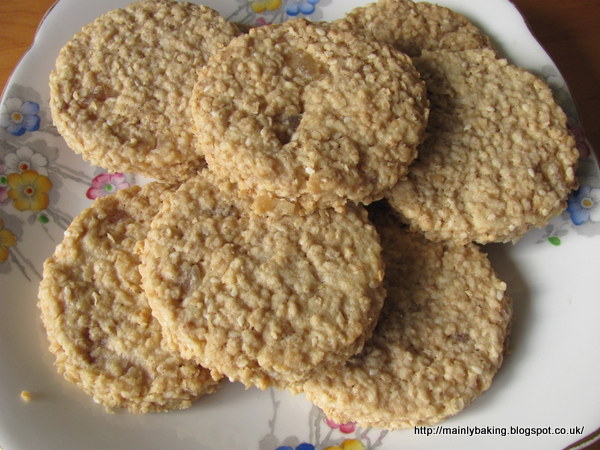
I've used this recipe before, when I've had a substantial amount of leftover shortcrust pastry. Last time I reduced the sugar in the original recipe and made savoury oat biscuits, this time I left in the suggested amount of sugar, added some sesame seeds and some crystallised ginger and made some fairly plain, not too sweet, biscuits which provided welcome relief from the excesses of rich food over the Christmas period.


It's more of a baking tip than a recipe - you weigh your pastry leftovers, then add the same weight of rolled oats and half that weight of butter and sugar. I started with 180g of shortcrust pastry, so added 180g of oats, 90g butter and 90g of soft brown sugar. I also added 2 tablespoons of sesame seeds and 50g of finely chopped crystallised ginger.

After leaving the bowl of ingredients for half an hour or so, for the pastry and butter to soften, everything is kneaded together either by hand or in a food processor. The dough is then rolled out to about 5mm thick and cut into shapes of your choice. These take about 15 minutes to bake at 180C - they need to be firm but not coloured too darkly.

The recipe I used, plus some other suggestions for using up leftover pastry, can be found on this link to the Guardian 'Readers' Recipe Swap'.

Monday, 11 January 2016

Spiced Fig Squares

I make no apologies for posting two consecutive bakes based on oats - flapjacks, and this type of fruit-filled square, are quick to assemble and bake and we all know oats are healthy, don't we?

I based my recipe on these Date Squares from Joy of Baking, but I used figs for the filling and scaled the recipe down to fit a smaller baking tin - 20cm(8") square. I also used spelt flour instead of wheatflour in the dough.

Ingredients
250g soft dried figs
150mls water
1 1/2 teaspoons mixed spice*
2 tablespoons pomegranate molasses
160g porridge oats
100g spelt flour
100g soft light brown sugar
scant 1/2 teaspoon bicarbonate of soda
pinch of salt
180g butter

*I used Waitrose Signature Spice mix, which is predominantly cinnamon but also contains ginger,  nutmeg, cardamom, allspice, star anise, black pepper, tangerine oil and cloves.

Method
Cut the figs into small pieces, either with scissors, as I did, or in a food processor. Put into a small saucepan with the water and bring to the boil. Simmer for about 5 minutes until the water is absorbed. Stir in the spice and pomegranate molasses.
Pre-heat the oven to 180C and line the base and sides of a 20cm (8") square baking tin with baking parchment.
Put the oats, flour, sugar, bicarbonate of soda and salt into a large bowl and rub in the butter (or use a food processor to mix in cold butter in pulses until the mixture is crumbly and just beginning to come together).

Put roughly 2/3 of the dough into the baking tin, spread evenly then press down firmly.
Dot small heaps of the fruit mix over the dough, and use a knife or back of a spoon to spread out into an even layer, right to the edges of the tin.
Crumble over the rest of the dough mix and again, spread evenly. Press down gently to firm the mixture.
Bake for about 40 minutes, until golden brown. Cool in the tin, marking into squares or bars before it cools completely.

These spiced fig squares were a little crumblier than I really like, although they did firm up a bit after the first day. The spiced fig filling was delicious, although I would use a bit more spice if I made them again, and cut the figs into smaller pieces in my mini-processor, rather than snip into pieces with scissors.


Tuesday, 5 January 2016

Chocolate and Ginger Flapjack

As a sort of antidote to Christmas, when chocoholic cooks often try their best to impress their friends and family with showstopping desserts, cakes and other home-made treats, the theme for this month's We Should Cocoa challenge is........ Simple Recipes!

The We Should Cocoa challenge, to use some form of chocolate together with a monthly theme, was devised by Choclette at Tin and Thyme, but this month's theme of Simple Recipes has been chosen by guest-host Lisa, at Lovely Appetite.

I guess everyone's idea of simple will be slightly different, but to me, a simple recipe is more about ease and speed of preparation and cooking rather than the number of ingredients. After all, there aren't many ingredients in a macaron, but only an expert would call then 'simple' to make!

The recipe for Chocolate and Ginger Flapjack couldn't be much more simple - melt chocolate, butter, golden syrup and sugar together in a large bowl in the microwave (or in a pan on the hob, if you prefer). When all the chocolate has melted and the mixture is quite hot, stir in rolled oats and crystallised ginger pieces. Transfer to a baking tin, bake, cool and eat - simple!

To make sure the flavour of the flapjack wasn't as simple as it's recipe, I used 100% cacao, and the ginger was from a Christmas box of Turkish crystallised ginger pieces which were really fiery - I don't think I've ever eaten ginger that hot before! The bitterness of the cacao, and the heat of the ginger, gave these flapjacks a taste which might not appeal to children, but the effect could be toned down by using a chocolate with a lower percentage of cocoa solids (say 60-70%) and a milder ginger, or even replacing some of the ginger with dried fruit such as chopped dried apricots, so that the flapjacks taste sweeter.

Ingredients
100g dark chocolate or 100% cacao (I used Willie's Peruvian Black 100% Cacao)
100g butter
65g golden syrup
100g caster sugar
250g rolled oats
100g crystallised ginger, chopped into pieces about 1cm cubed (leaving the chunks of ginger quite large makes sure you get a good hit of the heat when it's eaten!)

Method
Pre-heat the oven to 180C (160C fan) and line the base and sides of a 20cm (8") square baking tin with baking parchment.
Melt the chocolate, butter, syrup and sugar in a saucepan on the hob, or in a bowl in the microwave. The mixture needs to be quite hot to dissolve the sugar, but doesn't need to boil.
Add the oats and the pieces of ginger to the chocolate mixture and stir until the oats are well coated.
Transfer the mixture to the baking tin and spread into an even layer, pressing down firmly with the back of a spoon.
Bake for 25 minutes, then cool for 10 minutes. at that point, while still warm, mark into squares or fingers of the desired size. Leave in the tin until completely cold.

This recipe makes flapjacks which stay together well and are chewy rather than crisp and crunchy. If you prefer crisp flapjacks bake for a little longer - another 10 minutes, perhaps.

I'm also entering these flapjacks into January's AlphaBakes challenge, where co-host Ros, at The More Than Occasional Baker has chosen the letter G. Ros alternates her hosting duties with Caroline, at Caroline Makes. G is for Ginger, in this instance, of course!

Wednesday, 25 November 2015

Cherry and Walnut Flapjack

This was a quick mid-week bake, just to keep us supplied with sweet treats. I rummaged through my box of goodies to see what needed using up and found a pack of dried cherries and 50g of walnut pieces left over from something else. I added the last two tablespoons of desiccated coconut from a packet and made this delicious flapjack, which was in the oven within a few minutes of deciding to bake.

Melt 160g butter, 70g golden syrup and 100g light muscovado sugar together, either in a large bowl in the microwave (my preference) or in a saucepan on the hob. It doesn't need to boil, just melt together. Stir in 240g rolled oats, 50g dried cherries (chopped if large), 50g walnut pieces and 2 tablespoons desiccated coconut. Tip the mixture into a 20cm(8") square baking tin, lined with baking parchment. Spread evenly, press down firmly and bake at 180C for 25-30 minutes. Mark into squares or bars while still warm, but cool completely before removing from  the tin.