Showing posts with label mixed spice. Show all posts

Sunday, 24 May 2020

Malty Prune Flapjacks

In line with government recommendations, I'm trying to shop as infrequently as possible. Where I live, supermarket shopping is the least safe activity - I have plenty of open spaces and wide pavements when I go out for exercise, but I can't avoid needing food.

I'm fit and healthy, and don't yet fit any of the categories of people who should be taking extra precautions, so haven't tried to get any supermarket delivery slots, preferring to leave those for the more vulnerable members of the community. It's taken a while, but I've now figured out the quietest times to shop, so I take a list and shop as quickly as possible.

This is a big change for me, as I loved to browse the shelves, looking for bargains, new products or just what looked good that day. I used to go out almost every day and just buy a few bits and pieces, as I needed them. As I don't drive and have to carry my shopping a mile back home, what it also means is that, for the moment, I'm only buying the basic essentials, as fruit and vegetables and other necessary fresh foods are quite heavy when you're buying everything at once instead of spreading it out over several trips.

This is starting to impact on my baking (even though I'm not baking very frequently) - aside from what seems like a permanent lack of flour, there aren't always eggs or sugar available, and I'm running low on things like dried fruits and nuts. So wanting to bake means looking through the cupboard and seeing what's there before making decisions.

This time I found some 'out of date' prunes which still tasted OK and the scrapings from a jar of malt extract which could replace golden syrup if I made flapjacks. I'd been looking at malt loaf recipes but didn't have enough malt extract, so the idea of something malt-flavoured was still niggling away at me.

I followed my usual recipe, just substituting 50g of the golden syrup with malt extract, although I'd hoped to have enough malt extract to replace all the golden syrup.

First, melt together 160g butter, 50g malt extract, 20g golden syrup, and 100g caster sugar. This can be done in a saucepan, or in a large bowl in the microwave. Try not to let the mixture boil - it just needs to melt the butter completely. Then stir in 240g of porridge oats, 50g sultanas, 70g soft prunes (cut into pieces the same size as the sultanas) and 1 teaspoon of mixed spice. Mix thoroughly.

Tip this mixture into a 20cm square cake tin, lined with baking parchment. Level the mixture and press down firmly, then bake at 180C for 25 minutes. Cool for 5 minutes then mark into squares or bars while still hot. Leave to cool completely before removing from the tin.

I like flapjacks to be chewy, and these were gloriously chewy! More so than when I make the recipe with golden syrup. Additionally, the slight bitter edge to the malt extract cuts the sweetness a bit - you're not reducing the sugar you consume, but it tastes as if you are! The prunes worked well here too - they have a strong enough flavour to be tasted over the maltiness.

Wednesday, 17 January 2018

Apple and Raisin Muffins


Although I've lost a lot of weight over the last 5 years, I'm still a few kilograms short of getting into the 'healthy' BMI range, and I know that keeping weight off is going to be a lifelong struggle for me. Acknowledging that I'm always going to have to be careful about how much I eat means I'm still interested in TV programmes about weight loss, especially if cooking and providing recipes is involved. I'm watching Tom Kerridge's  current series (Lose Weight for Good) with interest, as he's also dealing, to some extent, with the psychological barriers to losing weight, as well as claiming to produce tastier low calorie recipes, using his knowledge and experience as a Michelin starred chef.

In view of all that, I really expected to like these Apple and Raisin Muffins, even though, in general, I don't like using low-calorie sweeteners in place of sugar. In his recipe, Tom reduces the sugar and fat content by using just a little honey, low-calorie sweetener and mashed bananas. He briefly cooks the apples in caramelised honey and adds spices and roasted sesame oil to give a boost to the flavour.

As I've used it in the past, and was relatively happy with it, I decided to buy Truvia (a no-calorie sweetener made from Stevia) to use as a sweetener, as it seems more natural to me than the other forms of sweetener available. Guided by the information on the pack, I used two teaspoons of Truvia, equivalent to 6 teaspoons of sugar. Other than that, I followed the recipe exactly. One point to note about the recipe is that you need to cook the apples in the honey ahead of any other preparation, as they take a while to cool down. Apart from this stage, the recipe is fairly standard and simple to follow. The muffins produced rose well and looked really good.

Unfortunately the looks promised much more than the muffins actually delivered! I found the texture quite stodgy, and the muffins stuck really firmly to the paper cases, to the extent that quite a bit of the muffin was lost (unless you want to scrape the case for every last crumb). I could have overlooked this if the flavour had been better, but I found the muffins quite bland; I couldn't taste the spices at all, even though I could still smell them in the baked muffin. In addition to that, the presence of the sesame oil was more of a scent than a flavour - after the first mouthful, I didn't really notice it. The pieces of apple were well flavoured, but didn't make up for the blandness of the crumb.

It's difficult to assess the claim that these are low calorie - 190 calories per muffin - as it's generally only muffins that claim to be healthy (and often found on diet and healthy eating websites) that give a calorie count. The nearest basic apple muffin recipe I could find, with no claims to reduced fat or sugar, contained 250 calories per muffin, but I'm afraid, even with a 20% reduction in calorie content, these disappointing muffins weren't worth the calories. 190 calories is quite a big chunk out of a restricted calorie diet, although I think Tom was suggesting eating them for breakfast, not as an extra treat. If you do want a treat there are a lot of tastier ways of using that number of calories - most involving chocolate, I have to say!


Monday, 17 April 2017

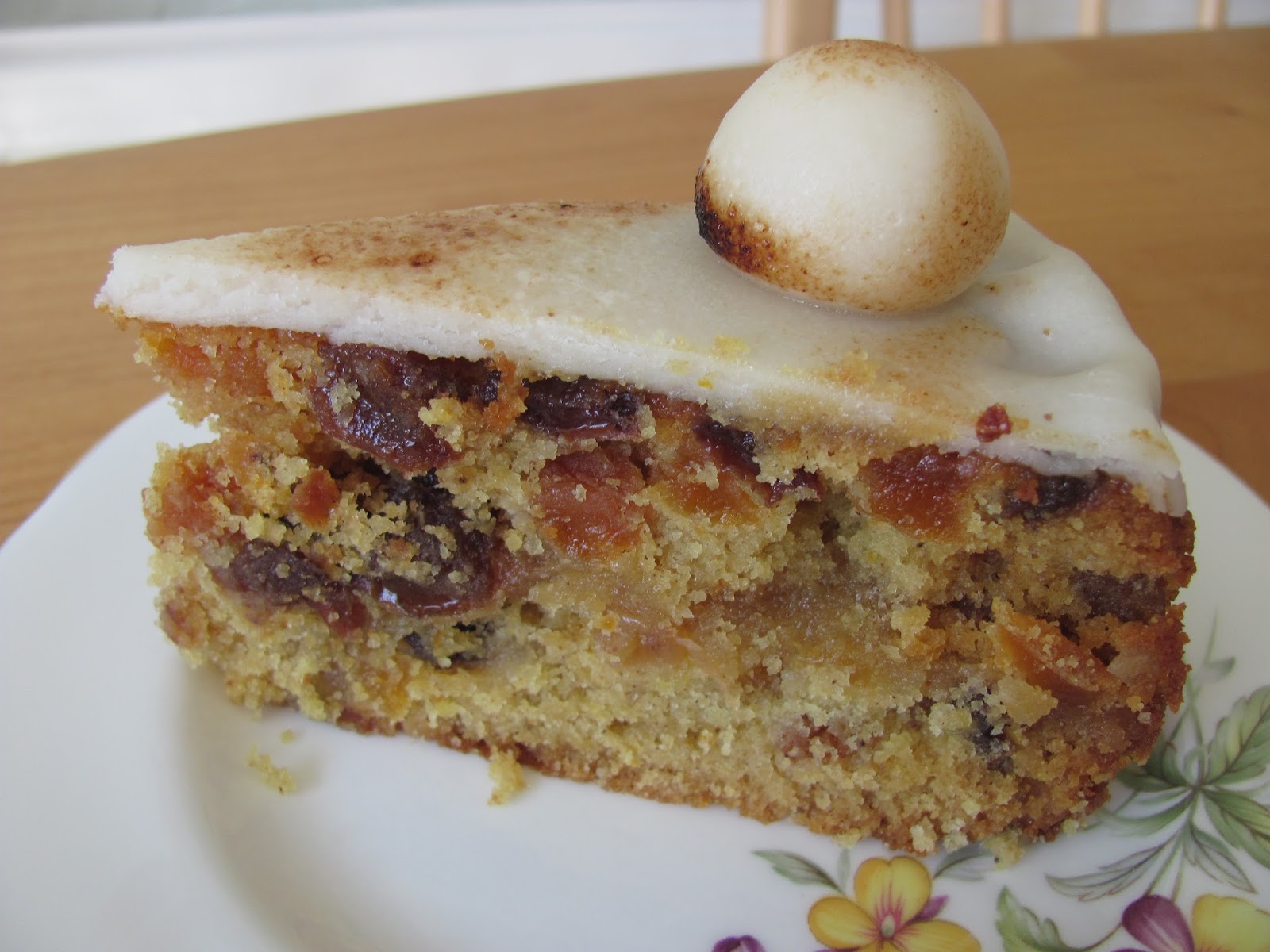
Golden Simnel Cake

My family's festive celebrations have never included traditional fruit cakes - we're more of a mini chocolate appreciation society -  so I was surprised when my daughter asked me to make a Simnel Cake for Easter this year. I'm not averse to traditional recipes but I still wanted to put a spin on this cake to make it more personal, so I decided to make a golden fruit cake.

After looking at several recipes, I thought that Felicity Cloake's recipe from her 'How to Cook the Perfect.....' series in The Guardian would be the best one to adapt to what I wanted. I particularly liked the idea of adding saffron to help the golden colour of the cake I was planning.

I used the same quantities of all ingredients, although I used caster sugar instead of light brown sugar, to keep the crumb colour as pale as possible. Instead of using 400g of the fruit Felicity suggested (sultanas, currants and glacé cherries) I used 115g of each of sultanas, golden raisins and chopped apricots and 55g chopped dried peaches. I left the mixed peel in the recipe but took out the chopped almonds, as my daughter doesn't always like chewing on pieces of nuts, even though she loves the flavour of almonds. I used shop-bought white marzipan instead of yellow - just a personal preference!

It's a pity I didn't cross reference Felicity's decision making processes with the sources she used, or I would have discovered that her oven temperature was for a fan setting, not a conventional oven - after 2 hours at the quoted temperature the cake batter was still raw. It took another hour with the oven turned up another 20C for the cake to cook. Anyone with any experience of fruit cakes would have noticed the error straight away, but I've hardly ever made a rich fruit cake, even in 40 + years of cooking!

I was quite impressed with the look of the finished cake, although if I ever make another I will use more marzipan so that I can put thicker layers inside and on the top. The size of the 11 decorative balls, at 15g each, was about right, however. When cut, the colour of the crumb was just right for a golden cake.

I liked the flavour of the cake - a delicious subtle balance between spice and citrus, with all the fruits working in harmony, so that none stood out more than others. The soft inner layer of melted marzipan added a note of bitter almonds to the cake, although it hadn't stayed level in the cake, possibly a result of the error in cooking temperature.

There were other faults too, which might have been caused by the same error - the fruit wasn't evenly distributed in each layer, and although the cake was really moist, it was also crumbly and didn't cut cleanly. However, these faults were outweighed by the lovely flavour; all it really meant was that it was difficult to get a good photograph. I will have to try the recipe again, and cook it properly next time!


Thursday, 1 December 2016

Gingerbread with Macadamia Nuts and Cranberries

This is a traditional gingerbread recipe - one of those cakes where the top gets sticky over time! I added some chopped macadamia nuts and dried cranberries to use up supplies approaching the 'best-before' date. I'm happy to use dried fruit past it's best, but nuts can go stale quite quickly. I've been using this recipe for over 40 years know, but haven't found anything better. The amount of black treacle can be reduced to make a lighter cake, without the characteristic bitterness, as long as it is replaced by the same weight of golden syrup. The total weight of the two syrups must be 230g

Ingredients
110g butter
60g light muscovado sugar
170g black treacle
60g golden syrup
150mls milk
2 eggs
220g plain flour
1 teaspoon mixed spice
3 teaspoons ground ginger
1 teaspoon bicarbonate of soda
50g macadamia nuts, roughly chopped
50g dried cranberries

Method
Preheat oven to 150C and line a deep 20cm(8") square cake tin with baking parchment.
In a large saucepan, heat the butter, sugar, and syrups until the fat has melted. Remove from the heat, add the milk and cool until lukewarm.
Beat the eggs and blend into the melted mixture.
Sift the flour, spices and bicarbonate of soda into a large bowl and add the liquid. Stir briskly to combine, but do not beat. Lastly stir in the fruit and nuts.
Transfer the batter to the baking tin and bake for about 60 minutes, until a test probe comes out clean.
Cool in the tin and preferably leave for a day before cutting.

I don't think the addition of fruit and nuts contributed much to the flavour, as the spiciness of  the gingerbread and the bitterness of treacle is so strong, but the nuts added a nice crunch to the texture.

Tuesday, 24 May 2016

Marmalade and Spice Cake

Opinions were divided about this cake. Although we both agreed that the cake crumb was too dry, I liked the subtle blend of orange (from marmalade) and mixed spice in the body of the cake. Hubby, on the other hand, didn't like much about the cake at all - he thought the marmalade glaze and glacé icing drizzle was the only redeeming feature.

I used this recipe from Waitrose's website, substituting mixed spice for the cinnamon and nutmeg used in the recipe. You can see from the proportion of flour to other ingredients that it's not supposed to be a rich cake, but a plain cake needn't be as dry as this was. I think, with a little more butter, and another egg in place of 50mls of the milk, this could be a very good cake. The aim would be to get the texture of a good Madeira cake - denser than a sponge cake but still tender and moist. If that could be achieved I think the flavour of the cake would seem much better.

The cake didn't go to waste though; I roasted some rhubarb to serve with it and drizzled the slices with the cooking syrup from the rhubarb. With vanilla yogurt on the side, this made a tasty dessert. The spiced orange flavour complimented the rhubarb very well.

Friday, 6 May 2016

Chunky Fig, Apricot and Prune Cake

I know! It's the middle of May; we ought to be well into lighter Spring flavours, but when I made this cake it was snowing in northern England! Anyway, I quite like fruit cakes at any time of the year, as they keep better than sponges and cakes with fresh fruit, which is a good thing when you are only baking for two people.

Ros, at The More Than Occasional Baker, has announced that as AlphaBakes has reached the end of the alphabet again, she and co-host, Caroline, at Caroline Makes, have decided to end the monthly challenge after this month's recipe link-up. It's understandable - life has moved on for both of them and they have different priorities now, but I will miss the monthly ritual of stretching my imagination and/or culinary skills.

As the last AlphaBakes Challenge, and the last letter of this second run through the alphabet, this month's entries  need to feature an ingredient or recipe name beginning with F. I found the recipe for this Chunky Fig, Apricot and Prune Cake, on the River Cottage site, while I was looking for a cake with dried figs in. It sounded ideal - not too heavy with fruit, lightly spiced and flavoured with citrus.

The recipe was simple to follow, although it's slightly unnerving to add large pieces of dried fruit, sticky with a marmalade coating, at the last stage of the recipe. Surely disaster would follow, with sinking fruit? The recipe does warn of the possibility, and I was prepared to add a little extra flour, if necessary, to make sure the batter was quite stiff (especially as I was using large eggs). However, extra flour (I was using spelt) wasn't needed, and the fruit didn't sink, so all was well!

All was well with the flavour too. Because the pieces of dried fruit were larger than usual, each could be individually tasted, and the background flavours of mixed spice and citrus (from both orange and lemon zest, and marmalade) added an extra dimension. The texture of the crumb was moist but not heavy, and sweetness levels were about right too, overall. Definitely one to repeat!

Sunday, 1 May 2016

Date, Banana and Rum Loaf

Gluten-free and dairy-free.

This Date, Banana and Rum Loaf, found on the BBC Good Food website, could be considered a healthy cake, as it has no added fat or sugar. The natural sweetness comes from almost 800g of fresh and dried fruit packed into the loaf, and the only significant fat is that which is contained in the nuts - 100g of pecans.

I was a little worried about making the cake, as some of the comments on the Good Food website said the cake was quite crumbly, but I needn't have worried. I followed the basic cake recipe closely and made a dense, very moist fruit cake, which even survived being dropped (in it's cake box); quite frankly I was amazed that just the puréed fruit, 100g of fine cornmeal and 2 egg whites made a batter that actually held everything together! In a slight departure from the recipe, I added 1/2 teaspoon of xanthan gum, as it's easy to get hold of now, although it wasn't when this recipe first appeared in 2008; I don't know if it made any difference but it couldn't have done any harm!

One other thing I did, not mentioned in the recipe, was to cut each date in half, cross-ways, before cooking them. I found two stones while doing this, so it's well worth the extra time spent, as unnoticed stones could damage food processor blades.  When I drained the cooked dates I didn't get enough liquid, so I added water to get to the 100mls needed for the recipe. I varied the topping, as I don't really like banana chips - I used the remaining pecans, chopped coarsely, and 4 crushed brown sugar cubes (optional if you don't want to add sugar).

I really enjoyed this cake, but I would leave the sugar off the topping next time. It only added a crunch when the cake was fresh, and quickly dissolved in the moisture from the cake. Unlike a lot of other recipes that rely on the natural sweetness of the ingredients, rather than adding any additional sugar, this cake did taste sweet enough. This is definitely a recipe I'll be using again!

One small criticism - sultanas and raisins are very similar in looks and taste; the cake might have been more attractive and even tastier if a different mix of dried fruit was used. Cranberries, cherries, chopped apricots and/or golden raisins could be used to replace some of the 400g of raisins and sultanas used in the loaf.

Monday, 11 January 2016

Spiced Fig Squares

I make no apologies for posting two consecutive bakes based on oats - flapjacks, and this type of fruit-filled square, are quick to assemble and bake and we all know oats are healthy, don't we?

I based my recipe on these Date Squares from Joy of Baking, but I used figs for the filling and scaled the recipe down to fit a smaller baking tin - 20cm(8") square. I also used spelt flour instead of wheatflour in the dough.

Ingredients
250g soft dried figs
150mls water
1 1/2 teaspoons mixed spice*
2 tablespoons pomegranate molasses
160g porridge oats
100g spelt flour
100g soft light brown sugar
scant 1/2 teaspoon bicarbonate of soda
pinch of salt
180g butter

*I used Waitrose Signature Spice mix, which is predominantly cinnamon but also contains ginger,  nutmeg, cardamom, allspice, star anise, black pepper, tangerine oil and cloves.

Method
Cut the figs into small pieces, either with scissors, as I did, or in a food processor. Put into a small saucepan with the water and bring to the boil. Simmer for about 5 minutes until the water is absorbed. Stir in the spice and pomegranate molasses.
Pre-heat the oven to 180C and line the base and sides of a 20cm (8") square baking tin with baking parchment.
Put the oats, flour, sugar, bicarbonate of soda and salt into a large bowl and rub in the butter (or use a food processor to mix in cold butter in pulses until the mixture is crumbly and just beginning to come together).

Put roughly 2/3 of the dough into the baking tin, spread evenly then press down firmly.
Dot small heaps of the fruit mix over the dough, and use a knife or back of a spoon to spread out into an even layer, right to the edges of the tin.
Crumble over the rest of the dough mix and again, spread evenly. Press down gently to firm the mixture.
Bake for about 40 minutes, until golden brown. Cool in the tin, marking into squares or bars before it cools completely.

These spiced fig squares were a little crumblier than I really like, although they did firm up a bit after the first day. The spiced fig filling was delicious, although I would use a bit more spice if I made them again, and cut the figs into smaller pieces in my mini-processor, rather than snip into pieces with scissors.


Monday, 14 December 2015

Not so Magic Cake, and other bits and pieces!

There's nothing wrong with the 'tiffin' style dessert pictured at the top of this post. It was made to Delia Smith's recipe for Chocolate-crunch Torte with Pistachios and Sour Cherries, following the recipe exactly, apart from using dried cranberries instead of dried sour cherries.

It was made as an quick replacement for an attempt at a 'magic' cake which I somehow knew had failed before it was even out of the baking tin. Magic cakes are so called because one cake batter separates into three layers during cooking - a thin dense pastry-like layer at the bottom, a custardy layer in the middle and a light sponge on top.

I used the chocolate and hazelnut magic cake recipe featured in this recent newspaper article, and even though I can now see where I might have made a mistake (trying to incorporate the egg whites evenly into the batter, rather than leaving it in clumps) I don't think the finished cake would ever have looked as attractive as the photo in the article, or tasted good either. 100g of Nutella-type chocolate hazelnut spread is not enough to make a cake taste strongly of chocolate, nor give it a good deep colour. This is what mine looked like - you can just about see three layers, but it was a really unattractive shade of beige, the custard was dense and slimy and it didn't really taste of anything definite - certainly not hazelnuts or chocolate. After trying one mouthful, for research, it went into the food waste recycling - and, as I've often said, food has to be really awful for me to throw it away!

I didn't bake a cake last weekend; it was my husband's birthday, and he wanted a stollen, which I buy rather than make as my yeast doughs are very unpredictable. I made a very tasty seasonal fruit crumble though, using 3 eating apples, 100g fresh cranberries, the zest of a clementine and the clementine segments, cut in half, to make 4 portions of dessert. I also added a teaspoon of mixed spice to my usual crumble recipe of equal weights (75g) of butter, brown sugar, plain flour and rolled oats.

I also tried my hand at apple-chilli jelly recently, using the homegrown apples which were too small to peel and use in any other way. The beauty of apple jelly is that the fruit is just roughly chopped - peel, cores and pips included - before cooking with water and adding some vinegar. The cooked fruit is strained, then reboiled with sugar and sliced chillies, until the setting point is reached. I used this recipe from gardener Sarah Raven, using just the regular mixed red and green chillies sold as moderately hot in the supermarket.

After cooking the apples in water and straining the juice I had about 1.5 litres of liquid; I was a little worried, as despite my careful handling of the fruit, the liquid looked cloudy at this point. I needn't have worried though, as soon as it came to the boil with the added sugar it miraculously cleared - I just wish this had been mentioned in any of the recipes I read! I used a sugar thermometer, to be sure that the setting point had been reached. I didn't manage to distribute the chillies very evenly when potting the jelly - the jar in the photo got the most - and it looked as if all the chilli slices were going to float, until I remembered a tip I'd read somewhere about turning the sealed jars upside down for about 10 minutes, then back again, and repeating as the jelly cooled and set. This procedure eventually traps some of the chillies near the bottom, despite their inclination to float! I think the chilli slices are for decoration - there's certainly a lot of heat in the jelly alone, so even the jars without much visible chilli will taste the same.

Wednesday, 14 October 2015

Date Gingerbread

More seasonal baking! Something dark and spicy this time. This recipe comes from one of my oldest baking recipes book, which was published in 1974, the year I got married.  It's so old that the weights and measures are just in ounces and pints (although it does provide American cup volumes too!), and the oven temperatures in Fahrenheit!

I'd usually translate to metric weights, but I was feeling lazy, so I switched my scales to 'lbs and oz' instead. The book gives the basic cake recipe, then suggests variations; I wanted to try the fig and walnut version, but couldn't find any figs in my slightly ramshackle storage system, so made the date version instead. I increased the ground ginger to 3 teaspoons instead of 2, and added an extra 2oz of crystallised ginger pieces too, to ramp up the ginger levels.

Ingredients
4oz butter
2oz light muscovado sugar
6oz black treacle
2oz golden syrup
1/4 pint milk
2 eggs
8oz plain flour
1 teaspoon bicarbonate of soda
1 teaspoon mixed spice
3 teaspoons ground ginger
4oz chopped dates
2oz crystallised ginger, in small pieces.

Method
Pre-heat the oven to 150C and line a deep 8" (20cm) square cake tin with baking parchment.
Melt the butter, sugar and syrups in a pan over a low heat, just until the butter has melted. Add the milk and cool.
Beat the eggs and add to the melted mixture.
Sift the flour, spices and bicarbonate of soda into a large bowl, then add the liquid and stir just enough to combine the ingredients - check there are no pockets of unmixed flour. Do not beat!
Fold in the chopped dates and crystallised ginger.
Pour into the prepared tin and bake for 75-90 minutes, until a test probe comes out clean. Cool in the baking tin, and leave for a day before cutting, to allow the top to become sticky.

Note - my cake cooked in only 60 minutes - I suspect modern ovens are more efficient than most of those around in the 1970s!

This cake was moist and spicy - sometimes the old traditional recipes can't be beaten! The little pieces of dates added a chewy caramel note and the crystallised ginger added extra heat.

Tuesday, 7 July 2015

Ginger Brownies

I wanted to bake something for my son, who needed a little bit of TLC after an unpleasant hospital procedure. Unfortunately this happened in the middle of the recent heatwave, and while I was happy to quickly mix something and throw it in the oven (and then get out of the kitchen), I wasn't in the mood for complex or new recipes.

As he loves chocolate, it was simplest to fall back on my trusty brownie recipe. This time I added ground ginger, mixed spice and crystallised ginger pieces to the mix. It was easier to use crystallised ginger rather than stem ginger in syrup, as the pieces could be cut with scissors where necessary, and I didn't get sticky in the process.

The basic method is: Melt together 140g plain chocolate and 140g unsalted butter. Cool to lukewarm and beat in 300g light muscovado sugar and three eggs, one at a time. Sift  160g plain flour, 3 tablespoons cocoa, 1 teaspoon ground ginger and 1/2 teaspoon of mixed spice together, and fold into the chocolate mixture, then fold in 100g crystallised ginger, cut into small pieces if necessary.

Spoon the batter into an 8" square tin, lined with baking parchment, and bake for around 30 minutes at 180C, depending on how gooey you like your brownies. Cut into squares or fingers while still warm, but cool completely in the tin before removing the brownies.

This was a nice amount of spice to use in the brownies - not too strong, but complimenting the warmth of the ginger pieces in the batter, I've reduced the amount of sugar I use in this recipe - it used to contain 400g - but the revised version still makes a dense chewy brownie, just the way we like them!

Thursday, 6 March 2014

Upside-down Toffee Apple Squares

Alphabakes, a monthly challenge to bake something based on a randomly chosen letter of the alphabet, has reached the end of it's first run through the alphabet. This month's letter is U, and although I've managed some imaginative entries for other difficult letters, I can't come up with anything better than 'Upside-down' cake this time.

However, I have found a recipe which is a departure from the more common pineapple cake, although my very favourite upside-down cake is Dan Lepard's 'Stone fruit yogurt cake'. This recipe, for upside-down toffee apple squares, appears in my recipe book as a brownie recipe, but I can't bring myself to call something without chocolate, a Brownie! There is a mistake in the ingredients list of the linked recipe - it should read 175g light muscovado sugar for the cake batter, not 15g. I used 1 1/2 teaspoons mixed spice instead of the spices listed there, and also added 85g chopped hazelnuts, as per my recipe.

Containing two grated apples, this cake batter makes a moist light cake and is chock full of chopped hazelnuts for added flavour and texture. The fact that the squares of cake are so light also mitigates against calling these brownies. I really liked the cake on it's own, but the topping (base, before baking) of slices of apple and a butter and sugar mixture, which set as a really good toffee mixture after baking, made it even more special. I had a problem cutting through the cooked slices of apple neatly, which spoiled the appearance of some of the squares, but that's just a small niggle.

AlphaBakes (rules here) is a challenge based on a randomly chosen letter of the alphabet. The dish made must feature something beginning with that letter as one of the main ingredients or part of the name. It is hosted jointly by Ros at The More Than Occasional Baker and Caroline at Caroline MakesRos is this month's host with the letter U, and will feature a round-up of entries at the end of the month.

Wednesday, 26 June 2013

Hazelnut and Courgette Fruitcakes

This recipe contains ingredients better suited to Autumn - courgettes, apples, hazelnuts, spices and dried fruit - but I was looking for something to use up excess courgettes without using citrus flavours, which have dominated my baking recently.

The recipe comes from the revamped Good Food site, and all I did differently was to bake the mixture in two 1lb loaf tins, rather than a 8" round cake tin. I also squeezed out some of the moisture from the grated courgette and apple. For the dried fruit, I used a mixture containing raisins, apricots, pineapple and papaya. After tasting, I realised the tropical fruits were a mistake and I should have stuck to fruits more in keeping with the other flavours from more temperate regions  - dried pears, peaches or cranberries would have been better additions to vine fruits and apricots.

The cake was very moist and quite dark in colour - I think it might have been better made with white caster sugar rather than  light muscovado, as more of the colour from the courgettes might have shown through. As it was there were only occasional flecks of green to be seen.

Although the cake, as I made it, wasn't quite to my taste, with a little tweaking and a better choice of dried fruit, I'm sure it would make a good cake for colder afternoons in front of the fire.

Monday, 5 November 2012

Parsnip and Maple Syrup Cake


This recipe was a the winner of a Good Food competition to create a birthday cake for the magazine's 20th birthday in 2009. I've been wanting to bake this cake since then, but haven't had the coincidence of both maple syrup and parsnips available at the same time, until this weekend. It's true, I could have made the effort to get the ingredients together, but it's only been a passing thought whenever I notice the cake in a recipe search.

As this month's Tea Time Treat's challenge was to celebrate it's first birthday by baking a cake, this recipe seemed quite appropriate, as it was created with celebration in mind.

I didn't want a layer cake, though, and also didn't want a fresh cheese frosting, so I baked the cake as a traybake, in a 20 x 30 cm (8 x 12") tin, and topped with a light buttercream recipe. The only change I made to the recipe was to use 50g chopped toasted hazelnuts instead of pecans, to suit my daughter's dislike of some nuts. Because the tin size I chose made a deeper cake than if it was baked in two sandwich tins, it took a little longer to bake - about 40 minutes in total. My buttercream recipe was based on that in the Hummingbird Bakery Cookbook, which uses only 80g butter to 250g icing sugar. I added two tablespoons of maple syrup and a teaspoon of vanilla extract as a flavouring, and then sprinkled the frosted cake with maple sugar crystals.

This cake was very moist and quite dense (but not in a bad way!). I'm glad I baked it as a traybake, as I'm not sure that I would have liked it as a layer cake - I think it was a bit too moist for that. FB reckoned she could taste the parsnips, but I'm not so sure - to me, the grated parsnip and apple added moisture and texture rather than specific flavour. Even the maple syrup wasn't a strong flavour in the cake, although I could taste it in the buttercream. In the cake, the parsnip, apple, mixed spice, maple syrup and orange seemed to blend into a unique flavour, rather than any one of them being separately identifiable. The unique flavour was a very good one, however!
 
Tea Time Treats is a monthly baking event co-hosted by Karen at Lavender and Lovage and Kate at What Kate Baked. Each month the challenge is to produce something which celebrates the (almost) lost ritual of the tea-time; this month the host is Karen, who has chosen cake in celebration of a whole year of baking for Tea Time Treats! She will be publishing a round-up at the end of the month.