Showing posts with label rum. Show all posts

Monday, 14 May 2018

Molasses and Coconut Rum Cake

I'm so glad I decided to bake this Molasses and Coconut Rum Cake, even though it was too big for me, and I had to freeze half of it in slices. It's the best cake I've tasted for a long time!

The recipe, from the ever reliable and inventive Dan Lepard, popped up on my Facebook feed recently, as I follow the Australian Good Food site. A lot of the recipes there aren't immediately relevant, as the seasons are reversed, but a lot of cake recipes, like this one, aren't seasonal anyway.

As is often the case with Dan, the recipe has a slightly unusual method - it wasn't difficult, but there were one or two points worth remembering for next time. The recipe says to heat the sugar and molasses (I used black treacle) together until any lumps of sugar have softened, but not to boil the mixture. The butter is then melted in the warm sugar. I don't think I heated the sugar enough, as when it was tipped into my mixing bowl a layer set on the bottom, which was really difficult to mix back in, and the butter, which I had cut into small cubes, only just melted. Better to have a little more heat, I think, then wait for the sugar and butter mixture to cool a little, if necessary, before going on to the next stage of adding the eggs, so that the excess heat doesn't cook the eggs.

I used a 900g (2lb) loaf tin, which made a more shallow cake than the one shown with the recipe, but a 450g (1lb) tin would have been too small, and we don't have an in-between size in the UK, as far as I'm aware.

I added about 3 tablespoons of rum to the cake - all there was left in the bottle - and it soaked in easily. I'd probably add a bit more next time, as the flavour wasn't as strong as I'd expected.

Because I was going to freeze part of the cake, I didn't make the frosting. I don't often add frostings to everyday cakes, but I think I'd add one if I made this for a special occasion - and the cake is certainly good enough for that!

There was a relatively large amount of desiccated coconut in this recipe, compared to traditional British coconut cake recipes, but it was almost overwhelmed by the stronger flavours of the black treacle and the spices. The texture of the cake was soft but not too sponge-like; in some ways it was more like a gingerbread than a coconut cake, although it didn't get a sticky top when stored.

This is definitely a recipe to repeat!

Monday, 17 April 2017

Golden Simnel Cake

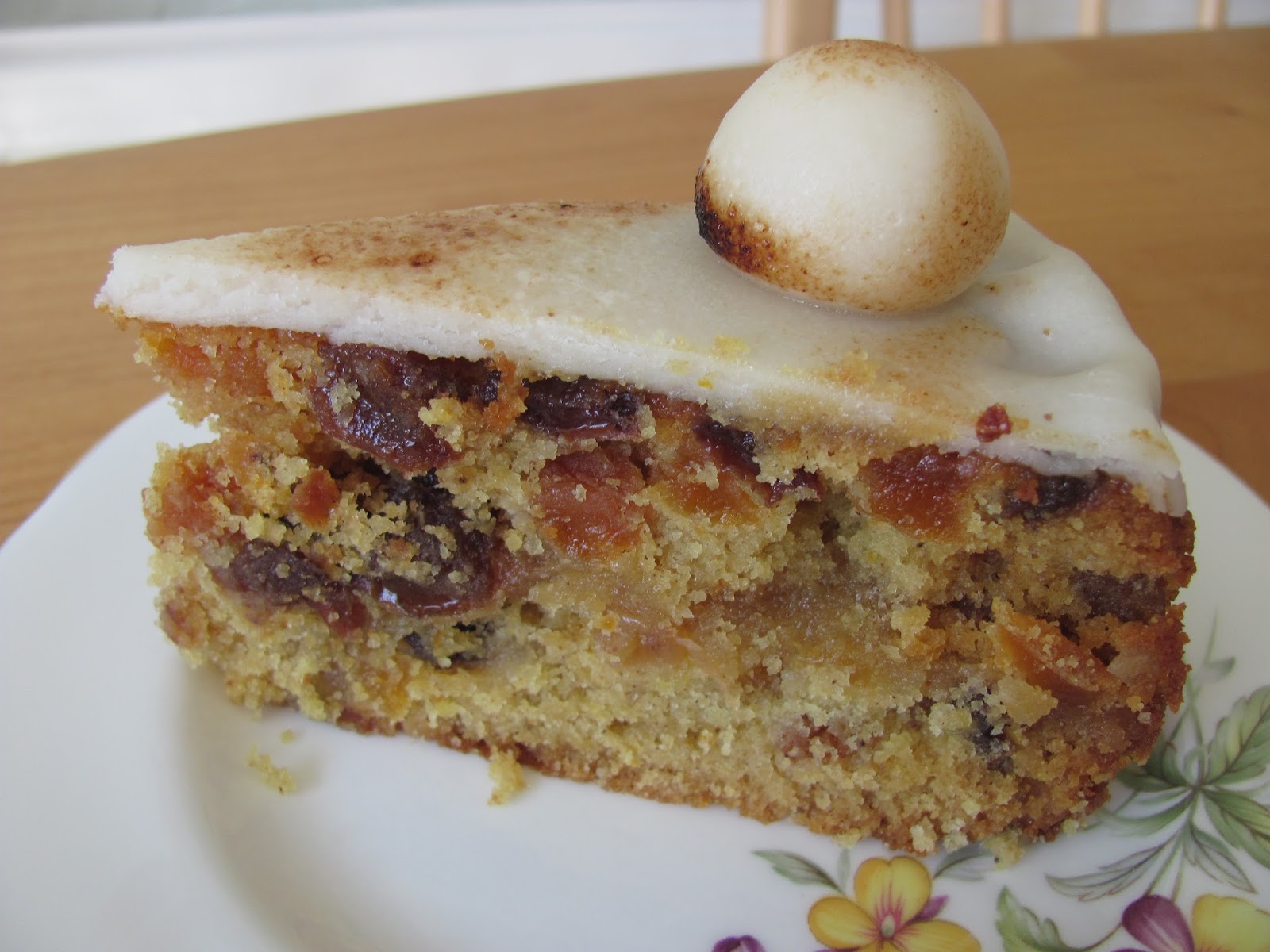
My family's festive celebrations have never included traditional fruit cakes - we're more of a mini chocolate appreciation society -  so I was surprised when my daughter asked me to make a Simnel Cake for Easter this year. I'm not averse to traditional recipes but I still wanted to put a spin on this cake to make it more personal, so I decided to make a golden fruit cake.

After looking at several recipes, I thought that Felicity Cloake's recipe from her 'How to Cook the Perfect.....' series in The Guardian would be the best one to adapt to what I wanted. I particularly liked the idea of adding saffron to help the golden colour of the cake I was planning.

I used the same quantities of all ingredients, although I used caster sugar instead of light brown sugar, to keep the crumb colour as pale as possible. Instead of using 400g of the fruit Felicity suggested (sultanas, currants and glacé cherries) I used 115g of each of sultanas, golden raisins and chopped apricots and 55g chopped dried peaches. I left the mixed peel in the recipe but took out the chopped almonds, as my daughter doesn't always like chewing on pieces of nuts, even though she loves the flavour of almonds. I used shop-bought white marzipan instead of yellow - just a personal preference!

It's a pity I didn't cross reference Felicity's decision making processes with the sources she used, or I would have discovered that her oven temperature was for a fan setting, not a conventional oven - after 2 hours at the quoted temperature the cake batter was still raw. It took another hour with the oven turned up another 20C for the cake to cook. Anyone with any experience of fruit cakes would have noticed the error straight away, but I've hardly ever made a rich fruit cake, even in 40 + years of cooking!

I was quite impressed with the look of the finished cake, although if I ever make another I will use more marzipan so that I can put thicker layers inside and on the top. The size of the 11 decorative balls, at 15g each, was about right, however. When cut, the colour of the crumb was just right for a golden cake.

I liked the flavour of the cake - a delicious subtle balance between spice and citrus, with all the fruits working in harmony, so that none stood out more than others. The soft inner layer of melted marzipan added a note of bitter almonds to the cake, although it hadn't stayed level in the cake, possibly a result of the error in cooking temperature.

There were other faults too, which might have been caused by the same error - the fruit wasn't evenly distributed in each layer, and although the cake was really moist, it was also crumbly and didn't cut cleanly. However, these faults were outweighed by the lovely flavour; all it really meant was that it was difficult to get a good photograph. I will have to try the recipe again, and cook it properly next time!


Sunday, 23 October 2016

Blackberry and Coconut Crumble Cake

This cake is based on this recipe, although I made a few minor changes along the way. For a start, I didn't have enough butter in the house, so I decided to use coconut oil instead. As I reduced the amount of fat used in the recipe, to compensate for coconut oil being 100% fat, I thought I would need more liquid in the cake batter, but I only needed about half the volume of milk suggested in the recipe (and a couple of tablespoons of rum), to give a good dropping consistency. If I'd used the amount of liquid originally suggested, I'm not sure the blackberries would have stayed on the surface.

These are the ingredients I used to make the sponge base, which was spread into a 22cm springform tin: 160g coconut oil, 170g caster sugar, 2 large eggs, 1 teaspoon vanilla paste, 2 tablespoons rum, 150g SR flour, 150g plain flour, enough milk to give a dropping consistency (about 100mls). On top of this I spread 230g blackberries in a single layer, then topped with a crumble mix made from 75g plain flour, 50g butter, 55g light muscovado sugar and 45g desiccated coconut. This was baked at 180C for 85 minutes, covered with foil after an hour.

I wasn't expecting a light sponge, as there was double the amount of flour to fat and sugar, and half of it was plain flour, but this really was a dense cake! It was very tasty though, as it wasn't over-sweet and the tang of the blackberries was still evident. The coconut in the crumble added a good flavour and texture, and it was nice to use blackberries with something other than apples.

Because of the denseness of the sponge, this would probably have been better as a warm dessert, with custard, as suggested. I think if I made it again as a cake, I would use all SR flour to try to make it a little lighter.

Sunday, 1 May 2016

Date, Banana and Rum Loaf

Gluten-free and dairy-free.

This Date, Banana and Rum Loaf, found on the BBC Good Food website, could be considered a healthy cake, as it has no added fat or sugar. The natural sweetness comes from almost 800g of fresh and dried fruit packed into the loaf, and the only significant fat is that which is contained in the nuts - 100g of pecans.

I was a little worried about making the cake, as some of the comments on the Good Food website said the cake was quite crumbly, but I needn't have worried. I followed the basic cake recipe closely and made a dense, very moist fruit cake, which even survived being dropped (in it's cake box); quite frankly I was amazed that just the puréed fruit, 100g of fine cornmeal and 2 egg whites made a batter that actually held everything together! In a slight departure from the recipe, I added 1/2 teaspoon of xanthan gum, as it's easy to get hold of now, although it wasn't when this recipe first appeared in 2008; I don't know if it made any difference but it couldn't have done any harm!

One other thing I did, not mentioned in the recipe, was to cut each date in half, cross-ways, before cooking them. I found two stones while doing this, so it's well worth the extra time spent, as unnoticed stones could damage food processor blades.  When I drained the cooked dates I didn't get enough liquid, so I added water to get to the 100mls needed for the recipe. I varied the topping, as I don't really like banana chips - I used the remaining pecans, chopped coarsely, and 4 crushed brown sugar cubes (optional if you don't want to add sugar).

I really enjoyed this cake, but I would leave the sugar off the topping next time. It only added a crunch when the cake was fresh, and quickly dissolved in the moisture from the cake. Unlike a lot of other recipes that rely on the natural sweetness of the ingredients, rather than adding any additional sugar, this cake did taste sweet enough. This is definitely a recipe I'll be using again!

One small criticism - sultanas and raisins are very similar in looks and taste; the cake might have been more attractive and even tastier if a different mix of dried fruit was used. Cranberries, cherries, chopped apricots and/or golden raisins could be used to replace some of the 400g of raisins and sultanas used in the loaf.

Thursday, 26 December 2013

Orange Marzipan Cake

My Alternative Xmas Cake

I've wanted to make this cake for years - ever since I bought Annie Bell's book 'Gorgeous Cakes' - but every Christmas something has happened to stop me making it. This year nothing interfered, not even the thought that I'd got for too much food already, and a cake wasn't really even necessary!

The cake consists of a shortbread layer, a madeira style cake flavoured with rum and dried fruit, and sandwiched between the two are layers of marzipan and marmalade. All this is topped of with a sprinkling of flaked almonds and pine nuts. It's always sounded a really delicious cake to me, perfect for those who don't like or want a traditional rich fruit cake at this time of year.

It was a delicious cake, but not perfect! One fault was mine, but if I was going to bake it again, I would make some changes to produce something even more delicious. My fault was being too enthusiastic with my new Kenwood Chef mixer, and believing the recipe book, which said that beating the eggs into the creamed sugar and butter at maximum speed would lessen the likelihood of curdling! I now know that you still need to go the traditional route of adding a little flour with each egg! The bad curdling resulted in a slightly stodgy texture, rather than the sponge-like appearance I had been expecting.

The recipe's problems, to my taste, were two-fold - firstly, there was not enough marzipan (although you could taste the marzipan, you couldn't really see it as a separate layer). I think the layer either needs to be thicker or it needs to be made from a better quality marzipan. I usually use Anton Berg marzipan which is 60% almonds, but it has disappeared off the shelves this year, possibly due to the much publicised almond shortage. Using a standard supermarket marzipan which was only 25% almonds might explain why it seemed to melt into the cake mixture. I guess a good alternative would be a homemade marzipan, although most of the recipes I've seen are less than 50% almonds when the sugar and binder are factored in

The second problem was not enough orange flavour. I think the cake needs at least the zest of an orange in the cake batter, and I would probably replace the rum with orange juice, as the rum flavour wasn't very noticeable. I used sultanas and dried cranberries in the cake, and these could be plumped up first in orange juice, if you wanted to keep the rum.

Apart from those problems, it was a really good cake. Having a crisp shortbread layer, and the marzipan only at the bottom of the cake, and pieces of nuts only at the top, made it interesting to eat, as there was a variety of textures and flavours depending on where you took a bite. Definitely a good alternative to a rich fruit cake - even FB, who avoids most dried fruit, liked it!

A few recipe details, to make a cake in a deep 20cm tin with a loose bottom - the shortbread layer was made from 90g butter, 40g golden caster sugar, 75g plain flour and 50g ground almonds. This was pressed into the cake tin and chilled. A circle made from 200g marzipan, spread with 75g coarse-cut marmalade was placed on top of the shortbread before the cake batter was added. The cake batter was made from 225g golden caster sugar and 225g unsalted butter, creamed together. 4 whole eggs and one egg yolk were added next, followed by 90mls rum. 225g SR flour plus 1 teaspoon baking powder was folded in, then 75g each of sultanas and dried cranberries (raisins in the original recipe) was stirred in gently. After this was transferred to the cake tin and spread evenly, 20g each of flaked almonds and pine nuts were scattered on top. The cake took around 70 minutes to bake at 170C, and was cooled in the tin.

AlphaBakes, a monthly baking challenge based on a randomly chosen letter of the alphabet is running out of easy letters. Providentially, December's letter is X, and X-mas is considered an acceptable choice of word to use as part of the name of what we produce. Hence I am entering this as my alternative X-mas cake! AlphaBakes is jointly hosted by Caroline of Caroline Makes, and Ros of The More Than Occasional Baker. The rules can be found here, and Ros is the host this month. There will be a festive round up at the end of the month, although I wonder if there will be any entries that found an alternative to X-mas!

Monday, 16 January 2012

Pineapple and Blackberry Crumble

This crumble was inspired by one of the dishes made in the third heat of the Celebrity Sport Relief Bake Off Challenge, shown on TV last week. TV presenter Anita Rani, who went on to be the overall winner, made a Pineapple and Blackberry Crumble with the coconut added to the crumble topping. No recipe was given for this, but it wasn't difficult to figure out a recipe which at least featured the same flavours in the dish. Anita added (I think) cinnamon and vanilla to her pineapple, and flamed it with rum while it was cooking. She then mixed in raw blackberries before adding the topping.

As usual, with this sort of thing, my recipe is a bit 'thrown together' as I don't weigh the fruit. I know that if I half-fill my large Pyrex dish with fruit and top it with a crumble mix made from 80-100g of each ingredient, I'm going to get 4-6 portions depending on appetite. I also took the opportunity to use more of the Light at Heart sugar/stevia mix that I've been given to try. The added stevia reduces the calories by half as you only need to use half as much sugar as usual.

So, this is roughly what I did!

Peeled, cored and chopped 2/3 of a standard sized supermarket pineapple into chunks.
Thawed a roughly equal volume of blackberries.
Melted about 40g unsalted butter in a frying pan and added the pineapple. As it started to cook I added 1 tablepoon of brown Light at Heart (or 2 tablespoons light muscovado sugar), a half teaspoon cinnamon and a teaspoon vanilla extract. I then poured on two tablespoons of rum which I mixed in and then flamed. I then turned up the heat and reduced the pan juices to a sticky caramel. The fruit was then cooled.
For the crumble mix, I rubbed 80g unsalted butter into 80g plain flour, 80g whole rolled oats and 40g white Light at Heart (use 80g regular white sugar). I then stirred in 20g desiccated coconut. I think it's important not to make the mixture too fine - leaving a few lumps of butter and some clumps of crumble adds to the texture.
The cooled pineapple was mixed with the blackberries, and 1 tablespoon of cornflour, to thicken any juices. The fruit was put into a deep casserole dish with a 1litre capacity, and the crumble mix was sprinkle evenly on top and pressed down lightly.
The crumble was baked until the top was golden brown and the fruit bubbling. I usually do this at 180C for about 45 minutes, but I started at a much higher temperature with this dish because I was cooking something else in the oven too. It had the first 10 minutes at 220C which didn't seem to do it any harm. It then finished off at 180C, with about 25 minutes cooking overall.

This was a really good combination of flavours - the pineapple, cinnamon, vanilla and hint of rum gave a tropical flavour, and fantastic smell, when added to the coconut in the topping. I'm not sure I'd have recognised the blackberries in a blind tasting but they added another taste dimension and a lovely colour to the dish. Coconut in the crumble topping is definitely an innovation I'll be using again with suitable fruit! Using the Light at Heart sugar in this context was fine too - I didn't notice anything different in the volume, taste or texture of the crumble mix.