Showing posts with label white chocolate. Show all posts

Saturday, 22 August 2020

Ginger, Oat and White Chocolate Cookie Squares


I think I've found a new favourite recipe for cookie bars or squares. It's another recipe from Lynn Hill at Traditional Home Baking. Lynn has published several recipes using this basic cookie dough, but the only one for which I had the 'add-in' ingredients already available was this one for Ginger and White Chocolate.

The recipe was simple to follow and easy to make. The only worrying moment was when it looked as if the beaten sugar and butter mix wouldn't take all the dry ingredients, but a little perseverance soon put that right!

I was slightly annoyed that I didn't have a baking tray anywhere near the right size for this recipe - I had to use my deep adjustable cake tin to make one which was nearly correct, but the deep sides made it a little more difficult to spread the dough easily. 

The texture of these cookie squares was very short, but made a little more substantial by the addition of the oats. It was this combination of 'melt in the mouth' but chewy which I liked so much!

As both white chocolate and glacé ginger are very sweet, I found these bars a little too sweet, but I'm looking forward to trying a version with dried fruits and/or nuts. Lynn has a recipe using apricots and almonds but there are many other variations that I can think of.

Sunday, 31 March 2019

Chocolate Swirl Blondies

Have you ever been cleaning up after baking, and found an important ingredient underneath a tea-towel, or behind a packet of flour? Well, that's what happened here. These blondies were supposed to be flavoured with coffee, but I took the little dish of instant coffee over to the draining board to add the boiling water, so as not to spill any water on my work area - and that's where the little dish stayed!

The only reason I'm writing up the recipe is that even unflavoured these blondies were pretty good - they were dense and chewy, something not often found with blondies - so with the added coffee (turning them into Mocha Swirl Blondies) they should be excellent.

The recipe, by GBBO contestant Martha Collison, was in a recent 'Weekend' newspaper given away by Waitrose supermarket. I'm always wary of baking with white chocolate, but  this recipe involved adding it to a mixture of melted butter and sugar, which seemed much safer than trying to melt it on its own. The mixture did separate out as it cooled, but adding the eggs and beating well seemed to remedy that problem. A note for next time - the blondies were well baked after 25 minutes, so need looking at a few minutes sooner.

The small amount of cocoa added to a portion of the batter, to make the swirl, was more for visual effect than flavour, I think, but maybe it would be  different with the coffee added. I'm determined to try these again soon, and do it properly next time.

Tuesday, 19 February 2019

Rose Blondies

with pistachios and cocoa nibs

This recipe is appearing a little late for St. Valentine's Day, but it was made for my local Cake Club meeting, which didn't take place until after that date. Roses and chocolate are synonymous with St. Valentine's celebrations, so it seemed natural to use them together to flavour my bake. I  chose to make blondies rather than brownies so that the full effect of the colourful additions of rose petals, chopped pistachios and cocoa nibs could be seen.

This is a recipe which I've used once before, back in 2011, when it was very much an experiment. I made a bigger batch this time, doubling up the basic recipe but not all the add-ins. I also decorated the blondies to fit in with the Valentine's theme - something I wouldn't usually do.

Ingredients
150g plain flour
pinch salt
scant 1 teaspoon baking powder
60g unsalted butter
100g caster sugar
2 tablespoons milk
200g white chocolate
2 eggs
1 1/2 teaspoons rosewater*
80g pistachios, chopped
30g cocoa nibs
1 tablespoon rose petals (optional)

* Different brands of rosewater vary a lot in strength. I used Neilsen-Massey, which is very strong. Add to taste, according to what you have experienced with your particular brand, remembering that too strong a flavour can be off-putting.

Method
Preheat oven to 160C and line a 20cm square shallow baking tin with parchment.
Mix the flour, salt and baking powder in a small bowl.
In a large pan, melt the butter, sugar and milk together on a low heat. When the butter has melted add the white chocolate and stir until the chocolate has melted. Remove from heat.
Beat in the eggs and rosewater, then sieve in the flour mixture and fold in, followed by the nuts, cocoa nibs and rose petals, if using.
Transfer the batter to the prepared tin and bake for 25 minutes, or until an inserted probe comes out just dry.
Cool in the tin then cut into bars or squares for serving.

I used a glacé icing coloured with 'hot pink' gel, and some bought chocolate hearts to finish off the decoration.

These blondies were dense and chewy, as they should be, but a little on the dry side. Most people trying them agreed that the rose flavour was just about right.


Tuesday, 6 September 2016

Chocolate Chip and Peanut Butter Blondies

The classic combination of peanut butter and chocolate, and a recipe from Green and Black's website. I have one of their chocolate recipe books (Unwrapped), but this recipe isn't in it. I found this while checking whether another of the recipes from the book was online, and decided it looked worth trying

I made these blondies primarily for my son, who doesn't get home-baking very often now that he's away from home. Of course, I had to make sure they were OK before passing them on to him, so after dividing the tray into 16 pieces, he got 12 and we had two each! I liked them a lot, although it looked, in the couple of pieces I tried, that some of the white chocolate had melted into the batter, rather than staying in lumps. He liked them enough to email me to say how good they were!

I only made one change to the recipe - I didn't have crunchy peanut butter, but wanted to add the crunch of nuts, so I used 125g of smooth peanut butter and 30g of finely chopped  roasted (but unsalted) peanuts.

Blondies nearly always turn out more cakey than brownies, because you don't have melted chocolate to give a fudgy texture, but this recipe was on the dense end of the spectrum, rather than the light and sponge-y end. This is definitely a recipe to make again!


Because these were so good, I'm adding them to September's We Should Cocoa link-up. After 6 years, Choclette at Tin and Thyme has changed the format of WSC; instead of setting a theme each month, anything containing some form of chocolate can be added. I'm a little sad to lose the challenge that WSC gave me - I baked many things, and used many odd combinations of ingredients, that I wouldn't have thought of trying without needing to bake for WSC.

Thursday, 14 July 2016

Chocolate Cake with White Chocolate and Mascarpone Buttercream

My son and I both have July birthdays, and we are both chocoholics, which makes decisions on birthday cakes very easy. What's not so easy is finding something new and 'special' to make each year. I was in the process of looking for this year's cake when this recipe from Dan Lepard popped up on my Facebook page. I still miss Dan's weekly column in the Guardian newspaper, so the fact that he has new recipes appearing occasionally on Australian Good Food is very exciting for me. Even though I'm not a big fan of white chocolate (neither eating it nor using it), this cake seemed just what I was looking for, so I was prepared to try white chocolate once more.

My first problem, after reading the recipe, was finding solid-based deep sponge tins. After finding only one brand in my local cookware shop, at £10 a tin, I went for a cheap supermarket brand. I bought 3 tins for less than £10 - my thinking, which proved correct, was that they weren't very deep, so I would probably need to make three layers, rather than two. Incidentally, another surprise, while shopping, was to notice that silicone bakeware has almost disappeared from the marketplace. I've never been a big fan of silicone for large cakes as the early examples were too flexible, and bulged in the wrong places, but  I thought those problems had been overcome. I didn't realise the trend had passed altogether!

The second problem was that the three cakes didn't rise very evenly, probably due to uneven heating. Although I was using the fan oven to cook all three cakes at the same time, two of the cakes were on the same shelf and quite near to the walls of the oven. These irregularities were overcome, when assembling the cake, by slicing an off-centre bulge off one cake, carefully positioning the bottom two cakes so that the overall effect was level, and choosing the best cake for the top layer.

Apart from that everything went smoothly, even though it was quite an unconventional recipe. I decided to use sunflower oil rather than olive oil, but that was the only change I made to the ingredients. Once the cake batter was made and divided between three tins, using scales for accuracy, they only needed 25 minutes in the oven.

I was really careful when melting the white chocolate for the buttercream, as I've always had problems in the past. I used Green and Black's White Cooking Chocolate, as it had the highest levels of cocoa solids of all the brands I could find. I put the bowl of chocolate over a pan of just boiled water and removed it when the chocolate was about 2/3 melted, so that it didn't overheat. I was also careful not to overbeat the mixture when adding the mascarpone and white chocolate to the basic buttercream, as mentioned in the recipe. The recipe made more than enough buttercream to fill and top the three cakes - I still had leftovers, even with the additional layer! Just to finish off, I topped the cake with a dusting of grated 100% cacao

I was very pleased with this cake; the cake layers were dark, rich, tender and very moist - everything you want in a special occasion chocolate cake! The buttercream didn't seem as sweet as I expected, possibly because of the addition of the mascarpone, and complimented the bitter notes of the cake very well. Green and Black's White Cooking Chocolate contains quite a lot of vanilla, and this additional flavour worked well in the buttercream too.

I'm sending this cake to July's We Should Cocoa event, hosted by Choclette at Tin and Thyme. Choclette also has a July birthday, as do many of her friends and family, so wants participants in this long-running event to just celebrate July with chocolate! Anything goes, as far as a theme is concerned, as long as it's celebratory, so my birthday cake should fit in well!


Tuesday, 21 June 2016

Malted Chocolate Cake

for We Should Cocoa

The added ingredient for this month's We Should Cocoa event, hosted by Green Gourmet Giraffe, is malt. The idea of We Should Cocoa, which originated from Choclette at Tin and Thyme, is to pair chocolate, in some form, with the added ingredient or theme chosen by each month's host.

My first (and only!) idea was to use malted milk powder in a chocolate cake, so I bought an individual sachet of Horlicks; it was then that I found that most recipes used upwards of a quarter of a cup of malted milk powder - more than I had.

After a lot of searching, I found two versions of a Peyton and Byrne cake on two of the blogs I read regularly - Tin and Thyme (a fitting coincidence) and The More Than Occasional Baker - which only used a tablespoon of malted milk powder, so I used this as my starting point. The sachet of Horlicks I had looked as if it contained about 2 tablespoons, and I used 40g of malt extract in place of 40g of the dark muscovado sugar in the recipe, to increase the maltiness. In the absence of any milk chocolate in the storecupboard, I used white chocolate.

I followed the method in the recipe I found on The More Than Occasional Baker, as it was so unusual that I thought it must be nearest to the original. It might have been that my loaf tin was too short and deep, but I found the cake took 60 minutes to cook, rather than the 35-40 minutes suggested in the recipe (something Choclette at Tin and Thyme found too).

Ingredients
70g light muscovado sugar
70g dark muscovado sugar
40g malt extract
140g SR flour
1/2 teaspoon salt
32g (1 individual sachet) Horlicks malted milk powder
125g softened butter, in small pieces
1 large egg
1/2 teaspoon vanilla extract
50g plain chocolate, melted
110mls milk
75g white chocolate, chopped

Method
Preheat oven to 170C and line a 2lb loaf tin with baking parchment.
Combine the sugars, malt extract, flour, salt and malted milk powder in a large bowl.
Add the butter and beat with a hand-held mixer, on a slow speed, until evenly combined.
Add the egg and vanilla extract and beat until light and fluffy, then beat in the melted chocolate and milk until evenly combined.
Stir in the white chocolate pieces and transfer the batter to the baking tin.
Cook until a test probe comes out clean. The original recipe suggested 35-40 minutes, but my loaf took 60 minutes.
Cool in the tin for 15 minutes then transfer to a wire rack to finish cooling.

I really liked the flavour combination of malt and chocolate, but this particular recipe really didn't work out very well. Although the loaf seemed to rise well in the oven, it sank a lot while cooling and became quite dense. It also dried out a bit around the edges, due to the longer cooking time.

Friday, 15 April 2016

Cauliflower and Apple Cake

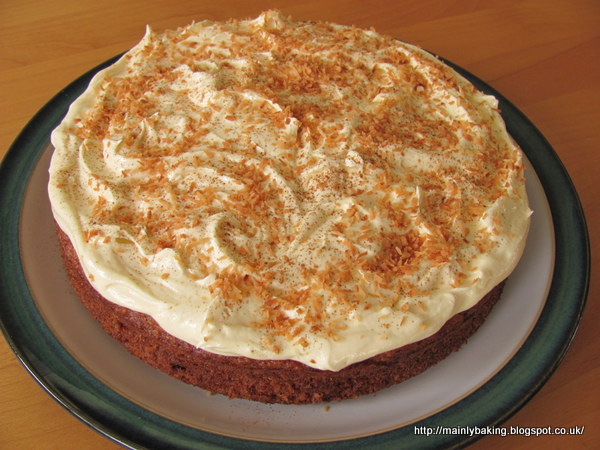
If your first thought on reading this post title is 'Why?', then I have to say that was my reaction too! Why use cauliflower in a cake?  The recipe featured in April's edition of Waitrose Food magazine as 'Dish of the Month' and comes from award-winning patissier and chocolatier Will Torrent. The introduction says that although baking with cauliflower may seem unusual, it works well with the flavours of apple, white chocolate and coconut. I discussed the recipe with a group of internet friends and the general opinion was that, although the photo of the cake looked attractive, using cauliflower in a sweet cake didn't sound very pleasant. I decided to take up the challenge!

The recipe is based on using a food processor, which I don't have, so I had to adapt the method a little. I also didn't want a layer cake, so baked the cake in a larger tin, and used 2/3 of the buttercream in the recipe, just as a topping

Ingredients
150g unsalted butter, softened, plus a little extra for greasing
150g cauliflower, in small florets
150g caster sugar
2 small braeburn apples, grated (I used 1 1/2 large apples and peeled and cored them, although the recipe doesn't specify peeling.)
2 eggs (mine were large)
175g plain flour
1 teaspoon cinnamon
1 teaspoon baking powder
1/2 teaspoon bicarbonate of soda
50g sultanas
50g desiccated coconut

*Buttercream (the amounts I used):
50g white chocolate, chopped
100g unsalted butter, softened
110g icing sugar, sifted
1 tablespoon milk
1/2 teaspoon vanilla extract
extra cinnamon (optional)
25g toasted desiccated coconut optional)

**My Method
Grease and base line a 20cm springform tin.
Simmer the cauliflower in boiling water for 16 minutes until very soft, cool under a running tap then drain, and dry on layers of kitchen towel.
Pre-heat oven to 180C, gas 4.
Sift together the flour, baking powder, bicarbonate of soda and cinnamon.
Process the cauliflower and grated apple in a small food processor to make a purée.
In a large bowl, using an electric mixer, beat the butter and sugar until well combined, then beat in the eggs, one at a time, with a tablespoonful of the flour mixture.
On the slowest mixer speed (or by hand) mix in the cauliflower and apple purée and the rest of the flour mixture.
Lastly, fold in the sultanas and coconut by hand.
Transfer the batter to the baking tin, level the surface and bake for about 45 minutes, until a test probe comes out clean. Cover after 35 minutes if it's getting too brown.
Cool in the tin for 15 minutes then transfer to a wire rack.
For the buttercream, melt the white chocolate with 25g of the butter and the milk, in a bowl over a pan of barely simmering water, stirring occasionally until smooth, then cool slightly. Meanwhile beat the rest of the butter, the icing sugar and the vanilla extract together until light and fluffy. Beat in the chocolate mixture, then spread the frosting over the cake. Decorate, if desired, with a light dusting of cinnamon and some toasted coconut.

**The food processor method was to first chop the cauliflower into small pieces, then pulse in the butter, sugar and apple. Gradually add the beaten eggs before sifting in the flour, cinnamon and raising agents. Pulse to combine, then fold in the sultanas and coconut. 
The original cake was baked in a 18cm tin for 45-55 minutes, then split in half when cooled. 

*A larger amount of frosting was made by melting the 75g white chocolate on it's own and stirring it into a buttercream made from 150g butter, 175g icing sugar, 1 1/2 tablespoons milk and 1/2 teaspoon vanilla extract, and used to sandwich and top the cake layers. I couldn't bring myself to melt the chocolate on it's own as I always have trouble melting white chocolate - hence my method of adding some of the butter and the milk to stop it getting too hot and seizing.


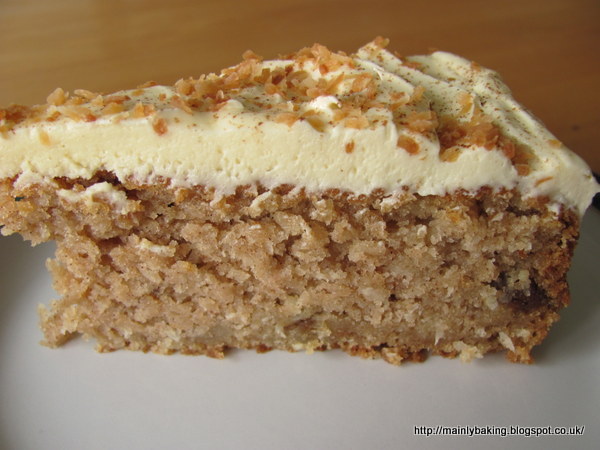
The result really surprised me! This odd assortment of ingredients produced a delicious, moist and incredibly light textured cake with a delicate cinnamon flavour. I couldn't taste either the apples or the cauliflower at all (fortunately, perhaps!) and even the coconut didn't come through strongly. The cake wasn't over-sweet, which meant that the very sweet white chocolate and vanilla frosting was a nice counterbalance to the cake. The one disconcerting note about the cake was that although I couldn't taste it in the raw batter or finished cake, there was a strong smell of cauliflower while the cake was baking!

Perhaps it was the subtle blending of all the ingredients which produced such a surprisingly tasty cake, but I think I'm still asking the question of why the cauliflower was used at all? Apart from the novelty value of telling people that there's cauliflower in the cake (and I didn't tell my husband until after he'd eaten it) the only reason I can come up with it that the apples and cauliflower add bulk, and perhaps moisture, but not so many calories. A similar sized cake would normally use more sugar, butter and egg.


Wednesday, 17 June 2015

White Chocolate, Coconut and Raspberry Flapjack

This recipe was devised to use up a carton of Jordan's 'Country Crisp with Raspberries'  breakfast cereal. The cereal is made up of clusters of oats and barley flakes, stuck together with sugar and palm oil and flavoured with small quantities of dried raspberries, hazelnuts and coconut. It's very tasty, and very calorific if you eat the recommended portion size, but unfortunately my husband didn't find it as filling as his usual brands of granola and muesli. Never one to waste food, flapjacks seemed a good use of what was left after he'd tried it for a few days.

I adapted my usual flapjack recipe, reducing the amount of  butter, sugar and syrup used to allow for the fat and sugar already in the cereal, and adding rolled oats for substance and a little more coconut for flavour. I also threw in the remains of a pack of white chocolate chips, just to use them up!

Ingredients
200g butter
75g golden syrup
125g light muscovado sugar
250g Country Crisp cereal
150g rolled oats
30g desiccated coconut
50g white chocolate chips

Method
Melt the butter, syrup and sugar together in a large bowl in the microwave, or a saucepan on the hob, then mix in the other ingredients. Spread evenly into a 30 x 20cm (12 x 8") baking tin, lined with baking parchment, and press down firmly. Bake at 180C for 30 minutes. Cool for 10 minutes, then mark into bars with a heavy knife (I get 18 pieces out of this size of tin, but you may prefer smaller bars). Leave in the baking tin until completely cold before cutting into pieces, and storing in an airtight tin.

These flapjacks were light and crunchy, as I think some of the cereal is puffed during the manufacturing process.  This crunchiness made them harder than those I usually make, but it's nice to have an occasional change from chewy flapjacks. Although there was only a small percentage of dried raspberries (2.5%) in the cereal, their flavour was noticeable, and complimented the coconut well.

The AlphaBakes challenge,  hosted by Caroline at Caroline Makes, and Ros at The More Than Occasional Baker, is to make something whose name, or principal ingredient begins with a randomly chosen letter of the alphabet.

This month the challenge is hosted by Caroline, and the chosen letter is O, so I'm entering these flapjacks because they contain OATS.

Wednesday, 6 May 2015

Chocolate Tarts x 2

1) chocolate tarts with Nutella and white chocolate/vanilla ganache
2) chocolate and marzipan tarts.

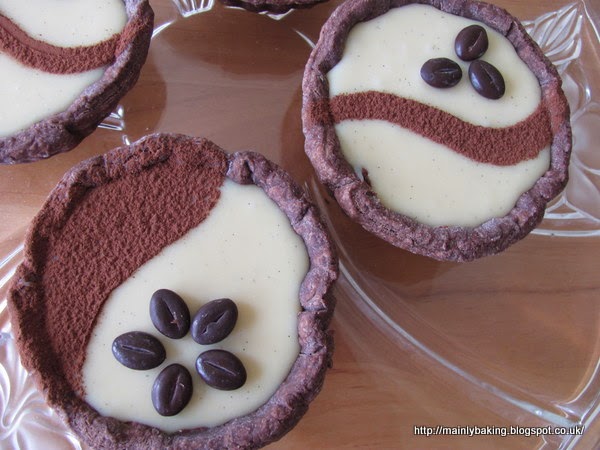
These chocolate tarts with Nutella and white chocolate/vanilla ganache filling were made our Bank Holiday dessert, but also fit the bill for for this month's We Should Cocoa Challenge. Karen, at Lavender and Lovage, is the guest host for the challenge started by Choclette at Tin and Thyme (formerly Chocolate Log Blog) and has asked us to use vanilla and chocolate together.

I decided to make extra chocolate pastry when making these ganache filled tarts, and used it to make smaller tarts filled with a disc of marzipan and a chocolate frangipane topping.

The recipes for both were just cobbled together as I went along, and I didn't take careful notes, but here's more or less what happened:

I made an unsweetened shortcrust pastry, from 270g plain flour, 30g cocoa, 75g butter and 75g lard. After rubbing the fats into the flour and cocoa, I added 1 teaspoon of instant coffee dissolved in a tablespoon of hot water, followed by enough cold water to make a firm dough. After resting in the fridge, I lined 12 jam tart moulds and four 9cm diameter individual tart moulds with pastry, and baked blind.

I originally intended just to fill the larger tart cases with white chocolate ganache but thought this might not have quite enough flavour, so before pouring in the ganache I spread a tablespoon of Nutella over the base of the pastry. I then chilled the cases for 10 minutes, so that the ganache didn't disturb the Nutella when it was poured on. The ganache was made by heating 125ml of double cream until just at boiling point, then stirring in 170g of good quality white chocolate and a teaspoon of vanilla bean paste with seeds. I allowed this to cool a little before pouring into the pastry cases, then cooled to room temperature before refrigerating. Once cold, the tarts were decorated with cocoa sifted through stencils, and chocolate coffee beans. I  brought the tarts up to room temperature before serving.

For the chocolate and marzipan tarts I put a quarter of a teaspoon of apricot jam into each case, with a small disc of marzipan (made from a pea-sized piece) on top. I made the frangipane mixture by beating together 40g ground almonds, 25g SR flour, a heaped teaspoon of cocoa, 50g caster sugar, 1 egg, 50g softened butter and a few drops of almond extract until smooth. This was just enough batter to put a heaped teaspoonful into each tart case. I sprinkled a few flaked almonds on top before baking at 160C until the frangipane felt solid - about 15 minutes.

I was right about the white chocolate tarts needing more flavour than just vanilla. Adding the chocolate  hazelnut spread gave them just that bit more interest, but afterwards I wondered if peanut butter might have been even better, as it would have counteracted the sweetness of the ganache too.

I had been a little worried about the ratio of cream to chocolate for the ganache, as recipes I looked at ranged from equal amounts of each (200ml cream to 200g chocolate) down to only adding 50ml of cream to 200g chocolate. The ganache I made was about right for a tart filling - holding it's shape, but not too hard, at room temperature.


The smaller chocolate and marzipan tarts were delicious too, but it's hard to go wrong when combining chocolate and marzipan!


Monday, 24 November 2014

Hazelnut and White Chocolate Brownies

I whipped up a quick batch of brownies for CT to take home with him after he had dinner with us recently. I used my usual oil-based recipe, this time using sunflower oil and adding 50g chopped toasted hazelnuts and 50g of white chocolate chips, instead of all chocolate. 
 
 
They were as good as they always are - dense, moist and chewy, as a good brownie should be!

Friday, 11 October 2013

Sweet Potato and White Chocolate Cake

 I don't know if Jibber Jabber, the host of this month's We Should Cocoa challenge had a premonition of what was to come on Week 8 of The Great British Bake Off, but after a week of magnificent 3-D vegetable cakes which were also non-dairy, I'm sure that anything containing vegetables that I can bake will be an anti-climax. Fortunately I don't have to make a non-dairy cake or turn it into a novelty cake, and even more fortunately, I must include chocolate in some form to take part in We Should Cocoa. I've gone for substance over style (unlike Ruth) but this cake really was a little too substantial. I could be like Christine, and claim that the 'bread-pudding like' texture was intentional, but I really don't think that's how it should have been.

I scoured the internet for recipes which went beyond the usual carrots, courgettes or beetroot and in the end decided to use sweet potato. I also decided to use white chocolate, as most dark chocolate vegetable cakes I've tried lose the vegetables under the intensity of the chocolate flavour. I really wanted to get the full effect from the sweet potato. I used this recipe from The Good Food Channel, adding the zest of an orange, as suggested in the 'Tips' part of the recipe.

I know I've said in the past that I was never again going to make a recipe which melted white chocolate, but here the chocolate was melted with the oil, so what could go wrong? It didn't go drastically wrong, but the white chocolate still didn't melt easily and I really had to work hard to amalgamate it with the oil. The only other change I made was to finely grate the sweet potato, as I don't have a food processor which would reduce raw vegetables to a purée

The cake rose well in the oven and I tested it with a heat sensitive probe at the end of cooking time, and it appeared cooked. However, once out of the oven it collapsed quite a bit, to the extent that the sides of the cake collapsed inwards too. I'm not sure if it was undercooked or if there was too much liquid or raising agent, or whether it was just the addition of the chocolate, but the collapse made the cooled cake quite dense and pudding-y. Luckily, the flavour was excellent, although very sweet for our taste, so after the first taste I added a drizzle of 85% chocolate over the top of the cake. The flavour was predominantly of the orange zest; as usual the white chocolate added vanilla notes and the sweet potato seemed to add colour and texture rather than much flavour.

I'm quite disappointed that the vegetable cakes I've made recently have been heavy. I use a carrot cake recipe which always produces a light cake, so perhaps I should just vary the vegetables in that, rather than trying to find different recipes.

We Should Cocoa was started by Chele from Chocolate Teapot and Choclette from Chocolate Log Blog, and the rules can be found here. This month, the theme of pairing chocolate with vegetables was chosen by guest host, Jibber Jabber, who is accepting entries by Linky this month, and will do the usual round up at the end of the month.

Monday, 11 March 2013

Chocolate Guinness Cake - We Should Cocoa

The theme for this month's We Should Cocoa challenge has been set by Lucy of The KitchenMaid, and she has chosen the theme of 'fame'.

Well, putting together fame and chocolate certainly provoked a lot of thought on my part - it can have such a wide interpretation. Famous recipes? Recipes named after famous people or places? There are plenty of recipes out there, but nothing seemed very appealing. I rejected the original Toll House cookie recipe, Sachertorte, Nanaimo Bars (done those already) and several others.

It wasn't until I reached into the back of a cupboard, for a tin of Guinness stout for a beef casserole, that inspiration struck. A chocolate recipe containing a famous ingredient! What could be more famous worldwide than the drink Guinness?

Nigella's chocolate Guinness cake is the first recipe to come up on a Google search, but I didn't have any sour cream. The second recipe needed buttermilk, also not in stock, but the third, from Delicious,  looked OK, and also had the advantage of cutting down the sugar quite a bit. The accompanying photo looked good too  - the frosting made the cake look like a glass of Guinness with a good head!

Making the cake itself went quite smoothly, although my batter wasn't pourable. The cake rose well, but sank a little in the middle on cooling. I wasn't too worried about this as the photo accompanying the recipe showed a sunken centre to the cake!

The frosting was a different story! I've told my husband that if I ever pick a recipe which melts white chocolate again he has to forcibly restrain me from making it! After half an hour in a double boiler, the white chocolate (Menier brand) still showed no signs of melting and looked distinctly scorched in places. I was about to throw it away and start again when I read a tip online about adding a little butter or vegetable oil. Two tablespoons of sunflower oil worked it's magic, and loosened up the chocolate. I had to pick out one or two large scorched lumps which showed no signs of melting, and the molten chocolate was still a little grainy, but I went ahead and used it. I didn't have any sour cream, so used 4 tablespoons of fromage frais in the frosting instead. The resulting white chocolate cheesecake frosting was deliciously sweet and creamy..

The cake texture was soft and quite crumbly, but not dry. The flavour was delicious, not too sweet and very chocolatey. It definitely needed the sweetness of the frosting to contrast with the slight bitterness of the Guinness in the cake.

We Should Cocoa is a monthly cooking challenge which brings together chocolate in some form with a specially chosen ingredient. Originally hosted by Choclette of Chocolate Log Blog and Chele of Chocolate Teapot, the challenge now often uses guest hosts, as with Lucy The KitchenMaid, this month. Lucy will post a round up at the end of the month, although entries so far can be seen on this link to the challenge.

Sunday, 11 November 2012

Salted Vanilla Chip Oatmeal Cookies

I have to report that the second recipe I choose to make from the book, Pure Vanilla, which I reviewed recently, was a total disaster. Firstly,  the flavour wasn't to my taste - the cookies were far too sweet, and the vanilla salt topping didn't help to offset this. If the recipe had worked well, then I would have just put this down to differences in taste preferences, but the recipe was a complete failure too, and initially I couldn't see anywhere in the method or ingredient quantities where I might have made a mistake.

The cookie dough spread in the oven, as far as it was possible to spread - the cookies were almost thin enough to make tuiles! In addition they didn't cook properly;  it appeared to me that the oats hadn't absorbed any of the dough ingredients, leaving the cookies raw-looking and greasy. They were neither crisp nor chewy, just a mess of half-baked goo which fell apart when handled. I left the cookies in an airtight tin overnight and this morning there was just a heap of damp cookies which had slumped and melded together.

The only thing I can see that might have caused the problem, rather than the recipe itself, is that I used whole rolled oats, rather than oats labelled porage oats, which is what I usually use for baking. The recipe itself suggested 'old-fashioned rolled oats'. It might be that in a short baking time these whole oats couldn't absorb enough of the butter, sugar and egg mix, leaving only the smaller quanity of flour to do this, unsuccessfully. Unfortunately, given the cost of the ingredients, and the fact that we didn't really like them, I don't feel inclined to repeat the recipe with different oats. If anyone wants to try the recipe for themselves, get in touch and I'll send you a copy.

At the moment, I'm trying to dry out the cookies in a low oven, in the hope that I can use the broken morsels for something such as 'compost' cookies, which often use remnants of broken biscuits, potato crisps(chips) and breakfast cereals for added flavour. I do have a photo, but it doesn't really do justice to how bad these were!
 
I'm really disappointed that this recipe went so badly, but I do realise that I may have used an ingredient which wasn't going to work. I hope this is the case, as the first recipe I tried worked so well, and I want to try other recipes in the book.
 

Tuesday, 30 October 2012

Lemon-Vanilla Dream Bars

The first recipe I tried from Pure Vanilla, by Shauna Sever, was one of the simplest in the book - Lemon-Vanilla Dream Bars. Shauna describes these as a 'less messy and more portable' version of lemon bars, which are one of the classic American baked treats. This recipe is essentially a white chocolate blondie rippled with lemon curd, and flavoured with both vanilla extract and vanilla bean paste. I used Green and Black's White Chocolate which contains vanilla seeds(caviar), so adding another dimension of vanilla flavouring.

The recipe seemed straightforward, but I had a typical heart-stopping moment that always seems to happen when I work with white chocolate. The first stage of the recipe is to melt white chocolate and butter together over simmering water, and I just couldn't get the two to combine smoothly. In fact I thought the white chocolate had seized completely, and it wasn't until I whisked in the eggs that I realised the mixture was going to come together smoothly.

After that it was plain sailing, although I forgot to fold in the chocolate chunks and had to sprinkle them over the surface of the batter after it had been in the oven a few minutes. Fortunately, the bars seemed none the worse for this!

This recipe is reproduced with permission from the publishers, and I have included the metric weights I used, where appropriate:

Ingredients:
10oz (300g) white chocolate, 50g chopped into chip-sized pieces
6 tablespoons (150g) butter
1/4 cup (50g) granulated sugar (I used caster sugar)
1/2 teaspoon salt
2 large eggs at room temperature
1 teaspoon vanilla extract
1 teaspoon vanilla bean paste
1 cup (130g) all purpose (plain) flour
1/2 cup (125g) lemon curd

Method
Pre-heat the oven to 350F (180C) and line a 8" (20cm) square tin with baking parchment.
Melt the butter and 250g of the white chocolate together in a large bowl, over a pan of simmering water.
Remove the bowl from the heat and stir in the sugar and salt.
Whisk in the eggs, one at a time, then whisk in both the vanilla extract and bean paste.
Gently fold in the flour, followed by the chopped chocolate, and put the batter into the baking tin.
Dollop the lemon curd onto the batter in 5 or 6 equal portions, and swirl into the batter using a knife and a figure of 8 movement.
Bake for around 25 minutes, until a tester comes out clean.
Cool on a wire rack, then cut into 12 bars when completely cold.

These were really delicious! The batter gave the perfect dense texture of a fudgy blondie, and the lemon curd was partly absorbed by the batter and partly remaining in little pockets that were intensely lemony. This lemon note really contrasted well with the sweet base, but still allowed the vanilla flavours to shine through.

My bars don't look perfect, because of sprinkling the chocolate chunks over the batter instead of folding them in. This caused little hollows to form as the larger chunks sank, although these hollows seemed to happen where lemon curd was left on the surface too.

This recipe is worth repeating just for the blondie base, if I can face the trauma of working with white chocolate again, perhaps with dark chocolate or fudge chips added, and Shauna also suggests replacing the lemon curd with any good quality low-sugar jam with a tart flavour, to ring the changes.

I'm so pleased my first recipe from this book was a success; it gives me confidence to tackle some of the more complicated recipes, and endorses my positive review of the book given from the first reading. Although I received a free copy of this book, I was not required to give a positive review of either the book, or the recipes I tried, in return.

Wednesday, 18 July 2012

Blackcurrant Jam Cake

with White Chocolate Cream Cheese Frosting

Things are busy at the moment; CT is moving out (eventually) but his new place needs some work on it first, and he's not very practically minded, so needs our help. There are the also the contents of his room, and his new things, to move into his home - although he can carry his own books up two flights of stairs! In addition, my mother is getting old and frail, and needs more help with errands and the increasing number of hospital appointments. Then there's the battle between the garden and the weather - the weeds are growing fast at the moment, so there's always work to do out there. With all this vying for my attention, time is running out to take part in my usual monthly baking challenges.

Luckily, this odd cake fits the brief for two of the challenges that I take part in regularly - We Should Cocoa (using chocolate and blackcurrants together) and AlphaBakes (where W is the randomly generated letter). I was going to include it in the Tea Time Treats challenge, as a traybake suitable for a cake stall, but decided that anything with nuts in carried a risk of triggering an allergy, so was best avoided, even though I do label my cake stall donations with an ingredient list.

Blackcurrants  are a fruit that I've never considered pairing with chocolate before this We Should Cocoa challenge, and even after scouring the internet for ideas, I couldn't come up with anything using dark chocolate that sounded a good way to combine them. White chocolate seemed a much better option. There was also the not inconsiderable problem of not finding any fresh fruit in my usual supermarkets, so having to use a processed version instead - in this case, jam. However, my searches threw up 'jam cakes', a speciality of the southern states of the USA, although I did find one reference to them also being a wartime adaptation to deal with sugar shortages here in the UK - presumably using jam laid down in the years prior to rationing.

After reading a lot of recipes, I decided to use this UK recipe from Annie Bell, as she is a reliable recipe writer, and this cake wasn't as huge as those produced in other recipes. Although this recipe uses a buttercream filling, many of the US recipes use a cream cheese frosting, and it seemed a logical step forward to add white chocolate to a cream cheese frosting, which would fit the challenge brief perfectly. As well as combining chocolate and blackcurrants for We Should Cocoa, white chocolate gave me the W for AlphaBakes

I decided to bake the cake as a traybake, and use a topping instead of a filling - a wise decision, as it turned out, as the cake wasn't really deep enough to split easily. My only adaptations to the recipe were to use blackcurrant jam instead of strawberry (many US recipes specify blackberry jam - a similar dark colour) and to add dried blueberries instead of raisins. I then added a white chocolate cream cheese frosting of my own devising. I intended to bake the cake in a 20 x 30cm tray, but it was clear after making the batter that it wouldn't go that far, so I changed to a 20cm square tin.

While the cake was cooling I tried to make the frosting, which reminded me how much I hate working with melted white chocolate. Melting 100g white chocolate with 20g butter, in a bowl over hot water, left me with a thick paste in the bottom of the bowl. This was made liquid by the addition of a tablespoon of milk. After cooling the mixture a little, I incorporated 100g icing sugar, followed by 150g full fat cream cheese. The sugar made the mixture very stiff, but beating in the cream cheese turned it back to a thinner consistency which needed refrigerating to get it to a spreadable texture - unfortunately it never did set to the firmer consistency that I hoped for.

I called this an odd cake earlier because the outcome didn't really match the ingredients put in - I expected a fruitier flavour, but the spices were predominant, although even there, the flavour was quite delicate. The cake stayed an interesting purply colour and the nuts and dried blueberries added a chewy texture. The frosting was a pleasant vanilla flavour, but didn't really do anything to enhance the cake - it would have been better if had set more firmly. Overall, although we didn't dislike the cake, no-one liked it enough for it to be made again - bland and tasteless was one description, but others might think differently!

PS - July 19th. The flavour of the cake matured overnight! It was a much better flavour the next day, but it still wasn't special enough to make me want to make it again.


The We Should Cocoa Challenge (rules here) is hosted jointly by Chele from Chocolate Teapot and Choclette from Chocolate Log Blog, this month's challenge, to use blackcurrants, was set by Choclette. The round-up of entries will be on Chocolate Log Blog at the end of the month.


The AlphaBakes Challenge (rules here) is a monthly baking challenge to make something  featuring a randomly chosen letter - this can be part of the name of the product or one of the major ingredients. It is hosted jointly by Caroline, from Caroline Makes, and Ros from The More Than Occasional Baker, who take turns to generate a random letter and collate the entries. This month Caroline is the host, and her random letter generator picked W!