Showing posts with label dried apricots. Show all posts

Wednesday, 11 November 2020

Apricot, Cranberry and Ginger Flapjacks

Up until now, I thought my recipe for flapjacks was perfect. Over the years the ratios of sugar, syrup and butter were tweaked and the quantities adjusted until the flapjacks were thick and chewy.

One thing I have never done is add flour to my flapjacks, so I was intrigued to see that Lynn Hill of Traditional Home Baking is an advocate of doing so, maintaining that it helps to give the flapjacks the desired chewy texture. Although I like the texture of the flapjacks produced by my recipe, I'm not too proud to see if this suggestion is an improvement.

I followed Lynn's recipe for Fruity Flapjack, but rather than the fruits suggested in the recipe, I used 100g of chopped dried apricots, 50g of cranberries and 30g of chopped glacé ginger, which had been rinsed and dried to remove the syrup coating. I also added 2 teaspoons of ground ginger to make sure there was enough ginger to taste. The mix of apricots and cranberries is one of my favourite combinations in baking.

Our recipes are very similar in the quantities of ingredients used (apart from the flour), although Lynn's bakes in a slightly larger tin, so I was interested to see how much difference adding the flour would make. 

It was huge! 

The texture was completely different - much softer as well as chewy. I think adding the flour also helped absorb the butter mixture more completely too - my flourless flapjacks are usually a bit stickier.

Both recipes have their merits so I'll probably use both in future, depending on the result I want. Mine are chewy and sticky, Lynn's are softer and chewy. However, when I do use flour, I think that I will go back to baking in a slightly smaller tin, as I prefer a thicker flapjack.

Saturday, 28 December 2019

Festive Desserts

I made two desserts for the Christmas period, as something chocolate is obligatory, but my daughter had also asked for a repeat of Dan Lepard's Mont Blanc Layer Cake.

The Mont Blanc Layer Cake recipe, based on meringue, is far too big for just three of us, particularly as it doesn't keep well, so I made a meringue roulade with only 3 egg whites, filled it with a half quantity of the chestnut and ricotta cream and drizzled melted chocolate over the top.

We decided, on trying the dessert, that although it was delicious, we all preferred the crisper meringue of the original recipe, which gives a better textural contrast with the chestnut cream than the soft meringue of the roulade.

For  the chocolate dessert, I made a half-sized quantity of Delia Smith's Chocolate Truffle Torte, which fitted nicely into a 7" (18cm) shallow cake tin. The only departure from the recipe was to use Amaretto liqueur instead of rum.

My daughter also contributed a batch of mince pies, which has become a tradition now. She uses this Mary Berry recipe, which adds dried apricots to the mincemeat and tops the tarts with grated marzipan.

Friday, 12 April 2019

Apricot, Prune and Almond Cake

This was a small loaf cake, using just store-cupboard ingredients. I've been trying to avoid home-baking as there's so much pressure to 'eat up' before the cake gets stale, but if there's no cake I find myself eating chocolate and biscuits anyway!

A friend gave me a pack of ground whole almonds, which hadn't had the skins removed before they were ground. They were much darker in colour, but not much different in flavour, so I still added a few drops of almond extract, to make sure the almond flavour came through properly. I also had the remains of a bag of dried apricots, and some prunes bought for breakfast when my sister was staying a while back.

I used the 'all-in-one' method, which is absolutely fine for even these type of loaves, which have a higher proportion of flour than sponge cakes. For speed, the butter can be softened (gently) in the microwave, or you can use baking spread.

Ingredients
100g softened butter
100g caster sugar
100g SR flour
50g ground almonds
2 large eggs
a few drops almond extract
1/2 teaspoon baking powder
50g soft dried apricots, *chopped into small pieces
50g soft dried prunes, *chopped into small pieces
2 tablespoons flaked almonds

*easiest to do with scissors

Method
Preheat oven to 180C and prepare a small (1lb, 450ml) loaf tin - I used a pre-formed non-stick liner.
Put all the ingredients, except the dried fruit and flaked almonds, into a bowl and beat until well mixed and smooth. You may need to add a tablespoon or so of milk or water to get a dropping consistency.
Stir in the dried fruit and transfer the batter to the prepared loaf tin.
Level the top and sprinkle over the flaked almonds.
Bake for 50-60 minutes, or until a test probe comes out clean
Cool in the tin for 10 minutes, then transfer to a wire rack. Store in an airtight container when completely cold.

The ground whole almonds made the cake much darker in colour, and to be honest, I didn't find that very attractive - I think the rest of the almonds will be saved for things like gingerbread and chocolate cakes, where the colour doesn't matter. The cake tasted fine, though - the little pieces of dried fruit kept the cake moist, and gave a good blend of flavours with the almonds.

Tuesday, 5 March 2019

Date and Apricot Cookies

I didn't intend to bake last weekend, but I had an online discussion with friends about whether a weird sounding recipe that we'd all noticed would actually work. The recipe in question was this one, from former GBBO contestant Tamal Ray, in the Guardian Feast magazine. Not only did the recipe sound strange - so much liquid! - the accompanying picture didn't look particularly attractive either - should a baked cookie still look shiny? As I had all the ingredients to hand, including date syrup, one of my favourite sweeteners, I decided to set my doubts aside and give it a go.

The result was a delicious soft cookie, strongly date flavoured, with nuggets of sweet dried fruit. I can't say the recipe was entirely successful, as the cookie dough was too soft to shape initially, and had to be chilled for 90 minutes before I could roll it into balls. And my cookies didn't look much like the picture in the magazine, either, but for my personal taste, that was an improvement.

Because the dough had been chilled I allowed an extra 3 minutes baking, but otherwise followed the recipe exactly (apart from needing to chill the dough, of course). I didn't have medjool dates, but did have some large soft dates to use instead, and I used the zest of two tangerines instead of an orange - but neither of these changes substantially altered the recipe.

The cookies were quite large - if I make them again I think I would make them a little smaller - and very soft, and both the orange and almond flavours were overwhelmed by the date syrup, but I'm still glad I decided to risk the experiment, and that the recipe worked (with just a little adjustment!).


Wednesday, 22 November 2017

Apricot and Lemon Bread and Butter Pudding

I made this 2-portion pudding in individual dishes, but if it was made in one dish it could easily feed three people; I was a little too greedy! The ingredients list is a bit vague, because the only thing I measured accurately was the milk.

Ingredients
*4 thick slices of brioche, each about 10cm square
butter, softened
apricot jam
a handful of soft dried apricots, chopped
a small chunk of glacé lemon peel chopped finely (optional)
2 medium eggs
225mls semi-skimmed milk
zest of half a lemon
1 tablespoon caster sugar, plus a little more for sprinkling on top
freshly grated nutmeg

*or use plain white bread from a small loaf  - slightly stale bread can be used for this sort of pudding

Method
Thickly butter two individual baking dishes, which have roughly 350mls capacity each (or use one larger dish).
Mix the apricots and peel together, if using.
Use more butter and some apricot jam (fairly thinly spread), to make two sandwiches with the brioche.
Cut the sandwiches into suitably sized pieces to fit into your chosen dishes - I cut mine into 8 tiny triangles to get a tight fit.
Share half the pieces of sandwich between each dish and sprinkle with 2/3 of the fruit.
Arrange the rest of sandwiches on top, trying to keep the top fairly level and sprinkle over the rest of the fruit.
Mix the eggs, milk, lemon zest and caster sugar together in a jug and divide equally between the two dishes. Leave to stand for up to an hour to allow the custard mixture to soak into the bread.
When ready to cook, preheat the oven to 180C (160 fan). Sprinkle a little more sugar over each pudding and then grate over some nutmeg.
Cook for 25-30 minutes, until golden brown and crisp on top. One large pudding might take a few minutes longer.

This was a tasty version of the standard B & B pudding - the touch of lemon, and the tartness of the dried apricots, cut through the sweetness added by the jam.

I apologise for the awful photo - I wanted to get the puddings fresh from the oven, as they deflate as they cool and don't look so attractive, so had to use flash.


Sunday, 4 June 2017

Apricot, Date and Ginger Flapjack

Flapjacks are often my 'go to' recipe, when I need something quick to mix and bake. In this case it was after an afternoon working in the garden, so that the flapjacks could bake while I was getting dinner ready. Once you have melted the butter and sugars together, it only takes a few more minutes to get the tray into the oven. The other good thing about flapjacks is they are ideal for using up the last remnants of bags of dried fruit, to stop them building up in the store cupboard.

Ingredients
60g dried apricots
40g dried dates
30g crystallised ginger
160g butter
70g golden syrup
100g light muscovado sugar
240g porridge oats

Method
Pre-heat the oven to 180C, and line a 20cm (8") square shallow baking tin with a single piece of baking parchment, folding it into the corners, so that the sides of the tin are lined too.
Chop the dried fruit and ginger into pieces about the size of a sultana.
Melt the butter,  golden syrup and sugar together - I find it easiest to use a mixing bowl in the microwave, but a saucepan on the hob is fine too.
Add the oats, dried fruit and ginger and mix together thoroughly. Tip into the baking tin and spread evenly, pressing down firmly with the back of a spoon.
Bake for 25 minutes until golden. This baking time gives a chewy flapjack; if you like yours crisp, then add a few more minutes.
Cut into squares or fingers while still hot, but cool completely in the tin before removing.

Monday, 17 April 2017

Golden Simnel Cake

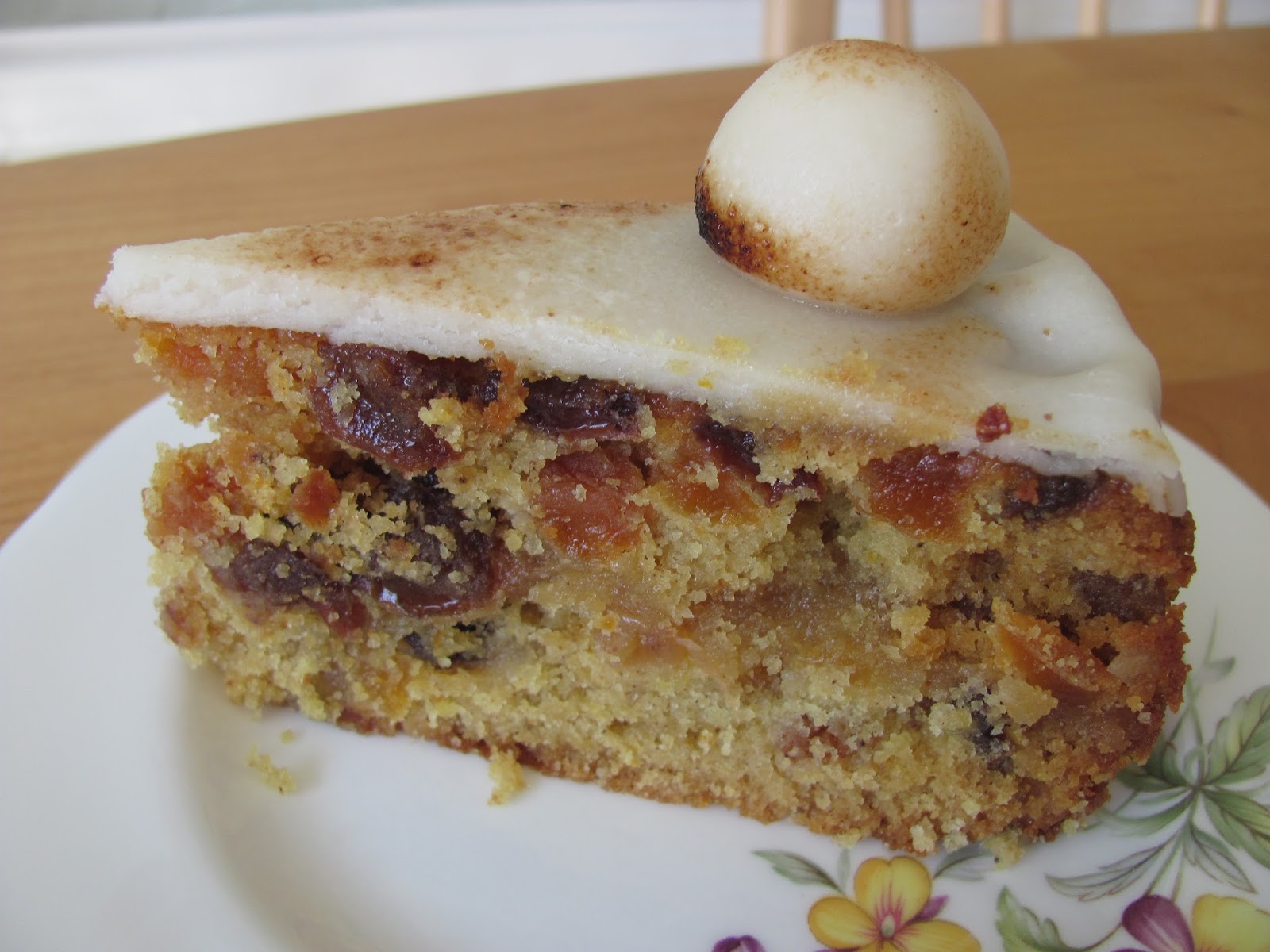
My family's festive celebrations have never included traditional fruit cakes - we're more of a mini chocolate appreciation society -  so I was surprised when my daughter asked me to make a Simnel Cake for Easter this year. I'm not averse to traditional recipes but I still wanted to put a spin on this cake to make it more personal, so I decided to make a golden fruit cake.

After looking at several recipes, I thought that Felicity Cloake's recipe from her 'How to Cook the Perfect.....' series in The Guardian would be the best one to adapt to what I wanted. I particularly liked the idea of adding saffron to help the golden colour of the cake I was planning.

I used the same quantities of all ingredients, although I used caster sugar instead of light brown sugar, to keep the crumb colour as pale as possible. Instead of using 400g of the fruit Felicity suggested (sultanas, currants and glacé cherries) I used 115g of each of sultanas, golden raisins and chopped apricots and 55g chopped dried peaches. I left the mixed peel in the recipe but took out the chopped almonds, as my daughter doesn't always like chewing on pieces of nuts, even though she loves the flavour of almonds. I used shop-bought white marzipan instead of yellow - just a personal preference!

It's a pity I didn't cross reference Felicity's decision making processes with the sources she used, or I would have discovered that her oven temperature was for a fan setting, not a conventional oven - after 2 hours at the quoted temperature the cake batter was still raw. It took another hour with the oven turned up another 20C for the cake to cook. Anyone with any experience of fruit cakes would have noticed the error straight away, but I've hardly ever made a rich fruit cake, even in 40 + years of cooking!

I was quite impressed with the look of the finished cake, although if I ever make another I will use more marzipan so that I can put thicker layers inside and on the top. The size of the 11 decorative balls, at 15g each, was about right, however. When cut, the colour of the crumb was just right for a golden cake.

I liked the flavour of the cake - a delicious subtle balance between spice and citrus, with all the fruits working in harmony, so that none stood out more than others. The soft inner layer of melted marzipan added a note of bitter almonds to the cake, although it hadn't stayed level in the cake, possibly a result of the error in cooking temperature.

There were other faults too, which might have been caused by the same error - the fruit wasn't evenly distributed in each layer, and although the cake was really moist, it was also crumbly and didn't cut cleanly. However, these faults were outweighed by the lovely flavour; all it really meant was that it was difficult to get a good photograph. I will have to try the recipe again, and cook it properly next time!


Saturday, 17 December 2016

Orange and Cranberry Cake

with apricots and macadamia nuts

This loaf cake is based on the proportions of a madeira cake, rather than a sponge - equal quantities of butter, sugar and eggs, but a larger amount of flour. This makes the cake softer and richer than the more basic fruit loaf recipe I sometimes use, and the extra flour helps prevent any added fruits and nuts from sinking. I usually make these little loaves as an all-in-one mixture, to save time. For this cake, I was using up oddments from the storecupboard, including the remnanats of a pack of mixed macadamia nuts and dried cranberries, plus some extra cranberries from another pack, so I'm not sure of the exact weight of each individual ingredient, although there were more cranberries than anything else - as long as the total weight is around 150g the cake will be OK

Ingredients
100g softened butter
100g caster sugar
2 large eggs
150g SR flour
zest of an orange, finely grated
milk to mix, if needed
150g of a mixture of dried cranberries, dried apricots and macadamia nuts

Method
Preheat the oven to 180C and line a small (450g/1lb) loaf tin.
Put the butter, sugar, eggs, flour and orange zest into a mixing bowl and beat with an electric mixer until the batter is well blended and smooth. Add a little milk if necessary to give a dropping consistency.
Fold in the dried fruit and nuts with a spoon, then transfer the mixture to the prepared tin.
Bake for about 50 minutes, or until a test probe comes out clean.

As I said a few posts back, cranberries and apricots is one of my favourite combinations of dried fruits. Here, the orange zest adds a freshness to the cake and the macadamia nuts give a contrasting texture.

Friday, 25 November 2016

Coconut, Apricot and Cranberry Cake

This was a small loaf cake, quickly put together from storecupboard ingredients. I used coconut oil, but a slightly larger quantity of butter could be used instead.

Ingredients
200g SR flour
40g desiccated coconut
100g caster sugar
100g coconut oil (or 115g butter, cut into small cubes)
1 large egg
60g dried cranberries
60g dried apricots, chopped into pieces of similar size to the cranberries
about 100mls semi-skimmed milk to mix

Method
Preheat the oven to 180C and line a small 1lb/450g) loaf tin.
Put the flour into a large bowl. Cut in the coconut oil with a table knife or a fork, until the coconut oil is in very small pieces and well mixed in (if using butter, rub in as if making pastry).
Add the desiccated coconut, sugar and dried fruit.
Mix in the egg and enough milk to make a fairly stiff batter.
Transfer the batter to the loaf tin, level the surface and sprinkle with a tablespoon of demerara sugar,
Bake for about 60 minutes, until golden and firm, and a test probe comes out dry.

Cranberries and apricots is one of my favourite combinations of dried fruit, and the coconut flavour in the cake worked well with this pairing. It's sheer bad luck that the slice of cake I took for the photograph shows such a weird uneven distribution of the two fruits at that point; it wasn't like that right through the cake!

Tuesday, 27 September 2016

Courgette and Apricot Cake

This was a last ditch attempt to make a light and sponge-like courgette cake. After the numerous attempts I've made, I've always said that I wanted a cake which was as light as the 'Yummy Scrummy Carrot Cake' (I can't bear that name!) on the Good Food site, and that each particular version I tried wasn't quite right!

Finally the light dawned - why not use that recipe, with courgettes instead of carrots?

As I've often thought that the problems with courgette cakes are down to courgettes being a much more watery vegetable than carrots, I grated about 30% more courgettes than the recipe required and squeezed out as much excess water as possible, using a clean tea-towel, before weighing the 140g needed. I replaced the raisins with chopped dried apricots and used 1/2 teaspoon of nutmeg as the only spice, leaving out the cinnamon. Everything else followed the recipe!

Surprise, surprise - it worked! I'm sure that part of the reason this recipe was more technically successful was that it used a smaller proportion of courgettes than other recipes I've tried, and the other part was probably down to squeezing out excess water. The flavour of the cake was less successful -  I didn't feel that the dried apricots and nutmeg worked well together - but that's easily remedied in the future.

I'm happy to find a courgette cake recipe which gives me what I've been looking for, although it isn't one that will make a huge dent in the usual summer glut!

Friday, 6 May 2016

Chunky Fig, Apricot and Prune Cake

I know! It's the middle of May; we ought to be well into lighter Spring flavours, but when I made this cake it was snowing in northern England! Anyway, I quite like fruit cakes at any time of the year, as they keep better than sponges and cakes with fresh fruit, which is a good thing when you are only baking for two people.

Ros, at The More Than Occasional Baker, has announced that as AlphaBakes has reached the end of the alphabet again, she and co-host, Caroline, at Caroline Makes, have decided to end the monthly challenge after this month's recipe link-up. It's understandable - life has moved on for both of them and they have different priorities now, but I will miss the monthly ritual of stretching my imagination and/or culinary skills.

As the last AlphaBakes Challenge, and the last letter of this second run through the alphabet, this month's entries  need to feature an ingredient or recipe name beginning with F. I found the recipe for this Chunky Fig, Apricot and Prune Cake, on the River Cottage site, while I was looking for a cake with dried figs in. It sounded ideal - not too heavy with fruit, lightly spiced and flavoured with citrus.

The recipe was simple to follow, although it's slightly unnerving to add large pieces of dried fruit, sticky with a marmalade coating, at the last stage of the recipe. Surely disaster would follow, with sinking fruit? The recipe does warn of the possibility, and I was prepared to add a little extra flour, if necessary, to make sure the batter was quite stiff (especially as I was using large eggs). However, extra flour (I was using spelt) wasn't needed, and the fruit didn't sink, so all was well!

All was well with the flavour too. Because the pieces of dried fruit were larger than usual, each could be individually tasted, and the background flavours of mixed spice and citrus (from both orange and lemon zest, and marmalade) added an extra dimension. The texture of the crumb was moist but not heavy, and sweetness levels were about right too, overall. Definitely one to repeat!

Sunday, 20 March 2016

Chocolate Hot Cross Bun and Butter Pudding

The We Should Cocoa cooking link-up, hosted this month by Linzi at Lancashire Food, (WSC is the brainchild of Choclette, at Tin and Thyme, who usually hosts the link-up on alternate months) has the seasonal theme of eggs. The challenge of putting eggs and chocolate together isn't difficult, but I wanted to bake something that relied on eggs for it's substance rather than just choosing a cake with the usual eggs in.

As it was a cold weekend I decided to treat us to a hot dessert rather than make a cake, and the proliferation of Hot Cross Buns in the shops in the run-up to Easter gave me the idea of making a bread and butter pudding with them. This fitted in well with the theme of eggs, as egg custard is an essential component, and adding chocolate to B & B pudding didn't seem a step too far!

The most challenging part of the dessert was slicing the buns thinly! I wanted to retain the crosses on the six buns for the top of the pudding, and still slice the remaining bun in half. Once that was done, I sandwiched the bun slices with butter and ginger jam, cut them in half crossways, and packed the little sandwiches into a buttered baking dish, as you would for a regular bread and butter pudding. I then scattered 50g of chopped dried apricots amongst the buns and placed the slices of bun with the crosses flatly on top. Finding the right sized baking dish is quite important here, so that the pudding looks right!

For the custard, I heated 350mls of semi-skimmed milk to about 60C, so that it would melt 50g plain chocolate when it was added. I then poured the chocolate milk onto 3 eggs and 2 tablespoons caster sugar and whisked together to mix evenly and dissolve the sugar. The custard mix was then poured over the buns in the baking dish and left to stand for an hour or so, to let the eggy mixture soak into the bread.

The pudding was baked for 45 minutes at 180C (160C, fan) and then cooled for about 20 minutes before serving.

This was a tasty dessert, with just enough chocolate to compliment the added ingredients and the fruit and spices already in the Hot Cross Buns without overwhelming them and becoming the dominant flavour. Using ginger jam was a good step, as it contained quite large pieces of preserved ginger to add to the bun spice. Unfortunately, it wasn't very pretty to look at, and I was also photographing it in bad light, so you'll just have to believe me that it tasted better than it looked!

Over a Belleau Kitchen, Dom's Simply Eggcellent link-up this month is a celebration of eggs with a focus on seasonal dishes, including those suitable for Easter. As Easter is early this year and it looks as if it might not be good weather, this hot pudding certainly fits the bill.

Friday, 20 November 2015

Buttermilk Fruit Cake

When I decided to make a chocolate and banana cake, and was looking for recipes, I initially decided on a chocolate chip cake using buttermilk. When I changed my mind, I was left with a carton of buttermilk which needed using quite quickly, as it didn't have a long 'use-by' date. Another search for a recipe was on! This time I wanted something seasonal, not too big, and not too fancy.

This fruit cake recipe, found on Joy of Baking, which adds dates, spices and other dried fruit to a buttermilk cake batter, fit the bill perfectly. The recipe didn't need any eggs, which was quite intriguing, just relying on the action of bicarbonate of soda with buttermilk to raise the cake. I didn't have currants or raisins needed to follow the recipe exactly, but used 100g sultanas and 100g of a mix of chopped dried apricots, sour cherries and crystallised ginger instead.

Making the cake was straightforward - just mix wet ingredients into dry ingredients, then stir in the dry fruit, so only a saucepan, a couple of bowls and a spoon was needed. As my buttermilk was cold, I melted the butter in a saucepan, then added the buttermilk and just warmed it slightly. I also dropped my dates into the measured flour, then cut them into small pieces with scissors, rather than chopping them on a board - much easier.

The thing I really enjoyed about this cake was the spice mix; allspice isn't something I use often but it really worked well with cinnamon and nutmeg to give a warm and peppery background flavour to the dried fruit. Overall the cake was moist and well textured - the absence of eggs wasn't obvious.

Baking the cake in a 9" x 5" tin made what my mother would have called a 'slab cake' - something deeper than a traybake but shallower than normal for a cake. I think a smaller baking tin would have made a cake with better proportions, but it may not have cooked as well; I'm sure there was a good reason for that sized tin being used.

Tuesday, 20 January 2015

Apple and Apricot Cake

I got carried away by the success of the Cranberry-Date Crumble Squares, and tried another baking recipe, using cooked red lentils, from the same website. Unfortunately, this time I produced something with the density and appearance of a house brick, which was even rejected by the garden birds, and ended up in the food waste recycling.

After that disaster, I needed a fast, fool proof recipe to restore my confidence - this cake is very fast to put together, although it does need quite a long baking time - plus I've been making it for years and it never fails. It was ideal for fitting into a day when I hadn't planned any baking time.

Ingredients
150g unsalted butter
200g caster sugar - divided 150/50
1 large egg
300g SR flour
30g chopped toasted hazelnuts
80g soft dried apricots, cut into slices with scissors
2 or 3 apples - I used 2 small coxes and a Bramley cooking apple - peeled, cored and sliced.
icing sugar to serve - about 1 teaspoon

Method
Preheat oven to 180C, and grease and base-line a 20cm springform tin.

Melt the butter  in a large bowl in the microwave. If it becomes really hot, leave to cool until it's not much hotter than hand-hot.
Mix in the 150g portion of sugar and the egg, stirring until well mixed.
Add the flour and mix to a soft smooth dough.
Put 1/3 of the dough into a separate bowl and mix in the chopped hazelnuts.
Place the larger plain portion of dough into the baking tin and spread evenly over the base and also creating a small wall of dough around the edge, to hold in any fruit juices.

In a small bowl, mix the apples, dried apricots and remaining 50g sugar. Put the fruit in an even layer over the dough base.

The remaining dough, with the added nuts, needs to be crumbled and spread  over the fruit to make a thin topping layer. It may not be possible to fill all the gaps, but it's best not to leave any large gaps around the edges.  (See this photo from a previous recipe) The dough spreads as it bakes, but gaps around the edge may leak fruit juice and cause the cake to stick in the tin.

Bake for 50-60 minutes until the cake is golden brown and feels solid. Cool in the tin, then remove and dust with icing sugar to serve

The cake dough for this recipe bakes to something between pastry and a cookie. It's also a little scone-like and is what I imagine an American Strawberry Shortcake recipe to be like. This makes the cake crumb quite dense and dry, and not oversweet, but the cake is kept moist by the layer of fresh fruit in the centre. The combination of apples, dried apricots and hazelnuts was very tasty.

This cake makes a good dessert, as well as a tea-time cake, and almost any fruit can be used in the centre, although you might want to add a little ground rice or cornflour to any fruit which produces a lot of juice as it cooks.

Tuesday, 26 August 2014

Goat's Cheese, Apricot and Walnut Savoury Cake

Now that sugar has been recognised as a bigger threat to health than saturated fats, I'm wondering what implications this will have on the recent surge in home baking. Will we all switch to savoury baking? Make bread, quiches and meat pasties instead of sugar-heavy brownies and cookies? I doubt that sweet baking will be abandoned entirely though - at least with home baking, as with all types of cooking, it's easier to control the amount of sugar that you add. Perhaps the way forward is to re-run our favourite recipes and see how much the sugar can be reduced without spoiling the finished product.

Something I like once in a while are savoury cakes, although they will never replace sweet cakes entirely. There are times when a slice of savoury cake goes down well - early evening, with a glass of wine or with a lunchtime salad, but what you need with your mid-morning cup of tea or evening coffee is normal sweet cake.

I chose this versatile recipe from Hugh Fearnley-Whittingstall (second recipe down), and following his suggestions, changed the raisins and hazelnuts for dried apricots and walnuts, as that was what I had in stock. I also used parmesan instead of hard goat's cheese.

This was a pleasant savoury cake, but I think I would have preferred it to be totally savoury. The dried fruit in this recipe was sweet enough to overwhelm the savoury elements, even the parmesan cheese, resulting in something which didn't fall satisfactorily into either the sweet or savoury camp. In this respect, the other two recipes on the link look more interesting - the ham and olive one in particular, although another recent TV programme has warned of the dangers of processed meats!

Thursday, 26 June 2014

Coconut Cake with Apricots and Cherries...........

made using Cocofina coconut flower nectar.

I was determined to use some of the coconut flower nectar that I received from Cocofina in a cake, but I didn't have much luck finding a recipe for anything I liked the look of. Most people seem to use it for 'health' reasons, and the resulting recipes are correspondingly specialised, often containing seeds, odd grains and lots of raw ingredients that I just don't keep in stock.

OK - maybe coconut flower nectar does have a low GI, but it has a similar amount of calories to any other form of sugar, so it's not exactly the 'guilt-free' eating that some people like to portray. I just wanted to find out how it reacted to baking and what it tasted like in a cake. In the end, I had a brainwave and started looking for cake recipes made with honey. Even then I had difficulties; so many recipes - even those called honey cakes - used a tiny proportion of honey and the usual amount of refined sugar. Same thing when I looked at maple syrup recipes (maple syrup has a similar viscosity to coconut flower nectar). What I wanted was a recipe where the only form of sugar was honey.

Eventually I stumbled across this US site, the National Honey Board, which had a huge recipe section. I found this recipe for Apricot Honey Bread, which served as the starting point for my recipe, although I made quite a few changes. The biggest alteration was reducing the sweetener (honey) by 1/3, as 300g not only sounded a huge amount, it would use up almost all my supply of coconut flower nectar.

Ingredients
250g spelt flour
100g plain white flour
3 teaspoons baking powder
1/2 teaspoon bicarbonate of soda
1/2 teaspoon salt
zest of half an orange
300mls semi-skimmed milk
200g coconut flower nectar (or honey)
2 tablespoons coconut oil (or vegetable oil)
1 large egg, beaten
120g dried apricots, chopped
100g naturally coloured glacé cherries, halved, rinsed and tossed with a tablespoon of the measured flour
75g desiccated coconut.

Method
Prepare a suitable baking tin (I used a 2lb loaf tin which was almost too small - I think an 8"(20cm) square deep cake tin might have been a better size). Pre-heat the oven to 180C.

Mix the flours, baking powder, bicarbonate of soda, salt and orange zest in a large bowl.
In another bowl whisk together the milk, coconut flower nectar, egg and oil; add this to the flour mix and blend until just combined - don't over-mix. Finally fold in the dried apricots, glacé cherries and desiccated coconut.

Transfer to the baking tin and bake for 50-60 minutes, or until a test probe comes out clean. Cover the cake after 40 minutes if it seems to be browning too quickly. Cool in the tin for 20 minutes before turning out onto a wire rack.

I was really pleased with this cake - although quite sturdy, it had a lighter texture than I expected, and was much more moist too. With such a small amount of fat, and only one egg, as well as using a liquid sugar, I was expecting it to have a much heavier texture.

The flavours of coconut, apricots and cherries complimented each other well, with just a hint of citrus from the orange zest. Reducing the amount of sweetener didn't seem to have a detrimental effect, either. Unfortunately, I think the delicious flavour of the coconut flower nectar was masked by all the other flavours, although it's hard to tell without making the same cake with ordinary sugar and tasting them side by side.

It's good to know that coconut flower nectar can be successfully used in baking, but it's so difficult to find suitable recipes, and adapting recipes can be such a hit-or-miss experience that I doubt I will use it again unless a liquid sweetener is needed in the original recipe. If you are adapting your diet to use less refined sugar, then coconut nectar, with it's low GI, is definitely a good substitute, but for me, it's best used in simpler things such as sweetening cooked fruits or drizzling over natural yogurt (a truly delicious instant dessert!). It's also quite expensive, which is another reason for not using so much in one go - used sparingly in situations where it's flavour comes through means it will go a lot further and probably still do as much good in the long run.

Tuesday, 18 March 2014

Chocolate & Coconut Bars


 As soon as this month's We Should Cocoa challenge was announced I knew that I wanted to make a layered coconut bar - a chocolate biscuit base with a topping that was mostly coconut. A cake version of a Bounty Bar, perhaps, one of my favourite chocolate bar treats!

I didn't think it would be difficult to find a recipe, but repeated searches, using various combinations of key words, didn't find anything which seemed quite right. These Black-Bottom Coconut Bars, from Martha Stewart, were close but the brownie base looked a bit too rich for me, although I have bookmarked the recipe as a possibility for the future.

The only answer seemed to be to combine two existing recipes, and I turned to my current favourite book (1001 Cupcakes, Cookies and Other Tempting Treats by Susanna Tee) for inspiration. I soon found a simple biscuit base that could be made into a chocolate version by substituting cocoa for some of the flour. The topping was an adaptation of a recipe called Coconut Paradise Slices, although I varied the ingredients to include chocolate. Instead of just using glacé cherries and sultanas, I used a mix of dried apricots, glacé cherries and chopped plain chocolate. I thought apricots paired better with chocolate than sultanas, but left some cherries as they compliment coconut so well.

Although both recipes were designed for a 9" square tin, I used one which was 8" square, so the layers were slightly deeper. The biscuit layer came out lovely and crisp, but I think it might have been a little too fragile if made in a larger tin. Here's my recipe adaptations to make Chocolate and Coconut Bars:

Base layer - Rub 80g butter into 175g  plain flour, then stir in 40g of light muscovado sugar and 25g cocoa. Sprinkle these crumbs evenly into a parchment-lined 8" square baking tin, press down firmly and bake at 190C for 15 minutes. Remove from the oven and reduce the heat to 180C.

Topping layer - cream 100g butter and 200g caster sugar until smooth and fluffy. Beat in two large eggs, then stir in 200g desiccated coconut, 75g halved glacé cherries, 75g dried apricots (chopped into pieces about the same size as the cherry halves, and 75g coarsely chopped plain chocolate. Spread this over the biscuit base, and bake for another 30 minutes until the coconut mixture is set and golden brown on top. Cool thoroughly before cutting into bars. I made 12 bars, but cutting into 15 pieces would still have given bars of a good size.

These bars were perfect (and it's not often I say that!). The top layer had a chewy macaroon-like texture and the intense coconut flavour was just what I wanted. The added chocolate and fruit gave just the right balance of flavours and the crisp biscuit base finished the whole thing off with a good contrast of textures. I wouldn't change a thing!

We Should Cocoa (rules here) is the brainchild of Choclette from Chocolate Log Blog. She alternates hosting duties with guest hosts, and this month it was Laura from I'd Much Rather Bake Than.... who chose coconut as the ingredient to be used with some form of chocolate to make delicious treats. Laura will be posting a round-up of entries at the end of the month, and I'm looking forward to seeing them, as I really love coconut!


Sunday, 23 February 2014

Apricot (and Chocolate) Linzer Torte

The theme for the Tea Time Treats Challenge this month is chocolate - not a difficult challenge for me, as a lot of my baking is based on chocolate (although less so now that I'm not baking regularly for CT). Although I've baked twice with chocolate already this month, I didn't think either of them were worthy enough to be a challenge entry, so I looked around for something a bit different.

This Linzer Torte recipe is based on a Mary Berry recipe from a book called 'Desserts and Confections' published in 1991, well before she became a TV celebrity. Surprisingly, I can only find one online reference to the recipe, here at Scandi Home; I made a few changes to the recipe - one out of necessity, one out of laziness,  one to increase the flavours in the pastry, and one to boost the chocolate content.

The pastry dough is made by mixing everything together in a food mixer - really easy for me now with my new Kenwood Chef mixer. I departed from the recipe and used 60g of ground hazelnuts and 60g of ground almonds (instead of all almonds), 265g plain flour, 200g caster sugar, 175g softened butter, 30g cocoa, 1 egg, 1 teaspoon ground cinnamon and the finely grated zest of a lemon. When everything is well blended, the ball of dough is halved. One half is used to line a shallow flan tin, by spreading and pressing into place using fingers. The recipe called for a 28cm tin, but mine was a little smaller - it was all I had!


The first step, however, before making the dough, is to make the apricot filling as it needs time to cool. 350g chopped dried apricots were simmered with 500ml of water and 100g caster sugar until the liquid was all absorbed or evaporated. The recipe used 250mls orange juice as part of the liquid, but I didn't have any to hand - I don't think it would have made a lot of difference to the final flavour, as dried apricots have a very concentrated flavour. The original recipe also sieved the cooked apricots to make a smooth purée, but I skipped this in favour of just mashing the fruit and having a coarser texture.

Before spreading the apricot filling over the pastry, I spread a layer of grated 100% cacao over the base; I estimated I used only about 30g, but it was very finely grated and went a long way! I hoped this would noticeably boost the chocolate flavour (it did!) and cut through what seemed an awful lot of sugar in both the pastry and the filling.

The last step is to make a lattice topping out of the second portion of dough. I had intended to make a real interwoven lattice, but the dough was too fragile, so I had to follow Mary's instructions to lay down a bottom row of strips, then a top row on the diagonal, pressing down the top row lightly to give the look of a lattice.

The torte was baked for 10 minutes at 200C then another 30 minutes at 180C - I baked it for a little longer than the recipe stipulated, as I thought the base dough would be thicker because of using a smaller tin. After cooling in the tin, the torte was dusted with icing sugar before serving.

The dough was short and crumbly - more like a biscuit than pastry; the apricot filling was sticky and strongly flavoured and the layer of chocolate really made the whole tart taste of rich chocolate. On the whole though, I think I prefer the traditional non-chocolate versions as the flavours of nuts and spices in the dough stand out more.

Tea Time Treats (rules here) is a monthly baking challenge hosted alternately by Karen from Lavender and Lovage and Jane from the Hedgecombers. The idea is to bake something suitable for the tea table, following the theme chosen by the host. This month's host is Karen, who will post a roundup at the end of the month.


Sunday, 29 December 2013

Mincemeat Streusel Slice

This is the last of my festive baking; after this there are bought Christmas goodies which must be eaten before I do any more baking.

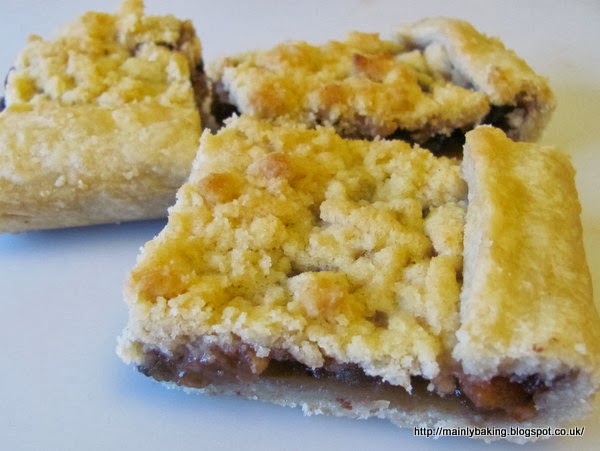
I based this Mincemeat Streusel Slice on this recipe from Mary Berry, shown on this year's Great British Bake Off Christmas Special. The only part of the recipe I took exactly was the streusel topping - I used my own sweet shortcrust pastry recipe and used 500g bought mincemeat with 100g chopped apricots and a grated eating apple added to it.


Once I had lined the baking tray and spread the mincemeat over the pastry, I decided not to waste the excess pastry at the sides of the tin, so folded it down over the filling. This worked very well as it gave most of the slices a solid edge to hold onto after they were cut.


I liked Mary's recipe for the streusel topping - I often similar topping from Martha Stewart, I think, which first brought the tip of using melted butter to my attention. Using melted butter and bringing the ingredients together into a dough, for later crumbling, makes the topping less powdery. The semolina in this recipe adds a little extra crispness. I found that the streusel dough couldn't be grated as Mary suggested, but crumbling it evenly over the mincemeat was just as effective, and probably quicker than grating.


HAPPY NEW YEAR to YOU ALL!