Showing posts with label rosewater. Show all posts

Tuesday, 19 February 2019

Rose Blondies

with pistachios and cocoa nibs

This recipe is appearing a little late for St. Valentine's Day, but it was made for my local Cake Club meeting, which didn't take place until after that date. Roses and chocolate are synonymous with St. Valentine's celebrations, so it seemed natural to use them together to flavour my bake. I  chose to make blondies rather than brownies so that the full effect of the colourful additions of rose petals, chopped pistachios and cocoa nibs could be seen.

This is a recipe which I've used once before, back in 2011, when it was very much an experiment. I made a bigger batch this time, doubling up the basic recipe but not all the add-ins. I also decorated the blondies to fit in with the Valentine's theme - something I wouldn't usually do.

Ingredients
150g plain flour
pinch salt
scant 1 teaspoon baking powder
60g unsalted butter
100g caster sugar
2 tablespoons milk
200g white chocolate
2 eggs
1 1/2 teaspoons rosewater*
80g pistachios, chopped
30g cocoa nibs
1 tablespoon rose petals (optional)

* Different brands of rosewater vary a lot in strength. I used Neilsen-Massey, which is very strong. Add to taste, according to what you have experienced with your particular brand, remembering that too strong a flavour can be off-putting.

Method
Preheat oven to 160C and line a 20cm square shallow baking tin with parchment.
Mix the flour, salt and baking powder in a small bowl.
In a large pan, melt the butter, sugar and milk together on a low heat. When the butter has melted add the white chocolate and stir until the chocolate has melted. Remove from heat.
Beat in the eggs and rosewater, then sieve in the flour mixture and fold in, followed by the nuts, cocoa nibs and rose petals, if using.
Transfer the batter to the prepared tin and bake for 25 minutes, or until an inserted probe comes out just dry.
Cool in the tin then cut into bars or squares for serving.

I used a glacé icing coloured with 'hot pink' gel, and some bought chocolate hearts to finish off the decoration.

These blondies were dense and chewy, as they should be, but a little on the dry side. Most people trying them agreed that the rose flavour was just about right.


Saturday, 9 December 2017

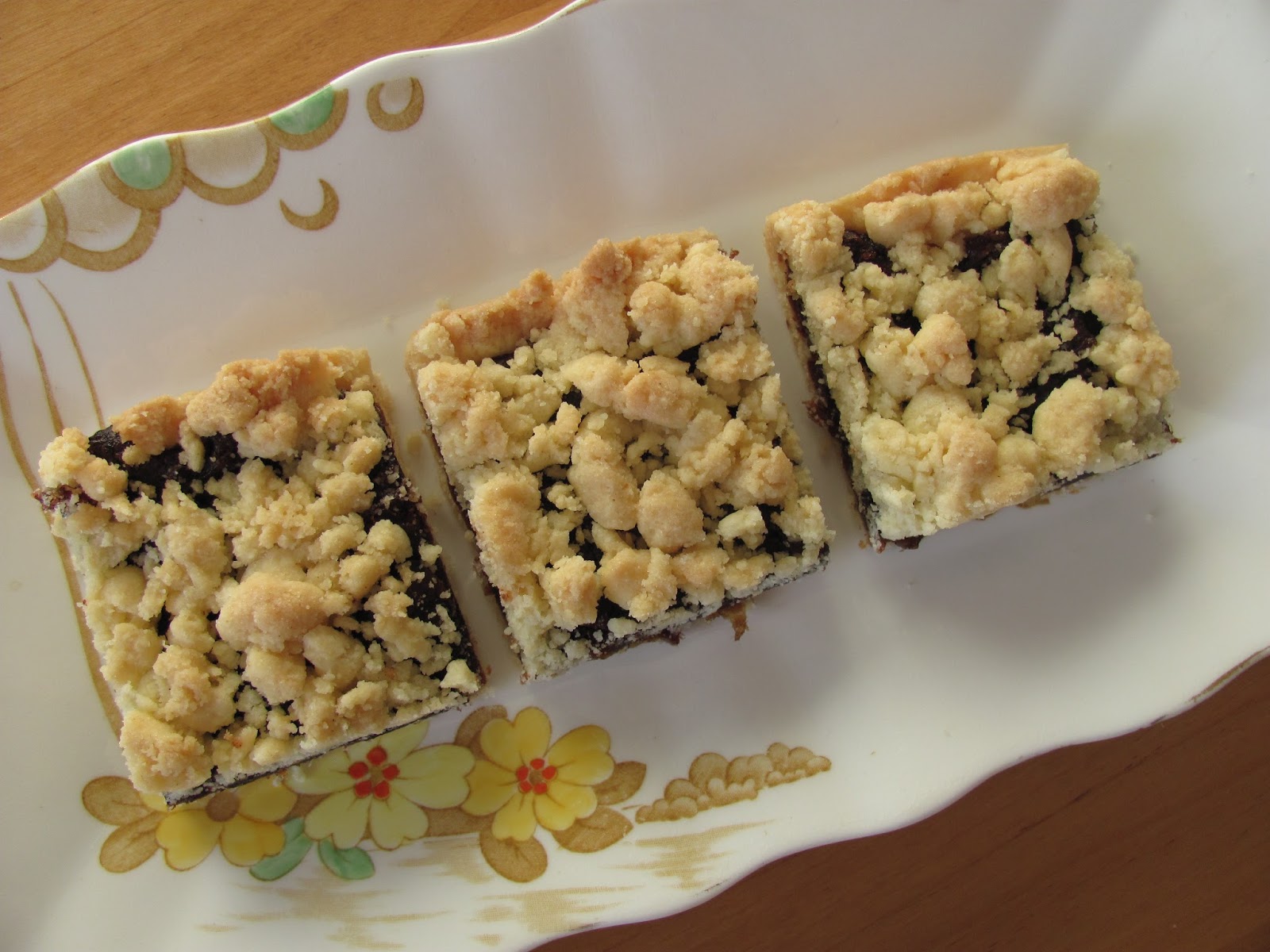
Date Shortbread Squares

 - gluten-free, plus dairy-free option

This is an adaptation of my favourite 'shortbread squares' recipe, which comes from 'On Baking' by Sue Lawrence, to make it gluten-free. Instead of wheat flour and semolina, I used a gluten-free flour, ground rice and added a little xanthan gum. It's the shortbread part of the recipe which is so good - quick to make, as it uses melted butter, and very crisp and light after it's baked. Any type of filling can be used, such as mincemeat or re-hydrated and cooked dried apricots - just make sure it's not too wet; for this version I made the filling from dates flavoured with pomegranate molasses, cinnamon and a little rosewater.

Ingredients
Filling:
225g dates - chopped
3 tablespoons pomegranate molasses
3 tablespoons water
1/2 teaspoon cinnamon
1/2 teaspoon rosewater

Shortbread:
255g gluten-free plain flour
85g ground rice
1/2 teaspoon xanthan gum
170g butter (or hard vegetable fat such as Stork*)
85g caster sugar

*see note at end of post

Method
Preheat the oven to 190C (170C fan)

Start by making the filling. Put all the ingredients into a small saucepan and bring to the boil. Cover the pan, turn the heat to low, and simmer for a few minutes until the dates are soft. At this stage you can blend the filling until smooth, but I prefer to just mash the dates with a fork, to make a rough purée. You may also need to add a splash more water to make the purée easy to spread, if all the added liquid has been absorbed during cooking.

For the shortbread, mix the gluten-free flour, ground rice and xanthan gum in a bowl.
Warm the butter and sugar together in a small pan, until the sugar has dissolved, then pour onto the flour mixture. Stir well to combine thoroughly - the mixture will form a crumbly dough.
Put 2/3 of the dough into a 20cm (8") square shallow tin, lined with baking parchment, spread evenly and press down firmly.
Spoon over the date filling, spread evenly, leaving a small margin around the edges.
Use your hands to crumble the remaining shortbread mixture evenly over the dates to cover as much as possible, and press down lightly with the palm of your hand.
Bake for 30 minutes until pale golden in colour. Cut into squares (16) while still hot, but leave the squares to cool completely before trying to remove them from the tin, as they are fragile when warm.

My only criticism of these is that the added flavourings were a little too subtle - both the cinnamon and the rosewater could have been increased.

* Dairy-free: I made a second batch of these date shortbread squares which were dairy-free as well as gluten-free, using Stork vegetable fat instead of butter. The shortbread was a little more crumbly than when using butter, for some reason, and they didn't taste as rich, but the recipe was largely successful.

Thursday, 12 October 2017

Date, Apple and Walnut Cake

I bought walnuts for my last bake - Nigella's Emergency Brownies - and I know that they don't keep fresh for long, so decided to use them in this cake too. I added a twist to the traditional British autumnal flavours of dates, apples and walnuts by using date syrup in place of some of the sugar and adding a little rosewater too.

Ingredients
100g softened butter
75g caster sugar
3 tablespoons date syrup
*1 teaspoon rosewater
2 large eggs
150g SR flour
50g chopped soft dates
50g chopped walnuts
1 small eating apple, peeled cored and chopped
a sprinkle of demerara sugar for topping (optional)

*or to taste, depending on the strength of the brand you are using

Method
Preheat oven to 180C (fan 160C) and line a small 450g (1lb) loaf tin. I used a loaf tin liner, but baking parchment can be used too.
Put the butter, sugar, syrup, rosewater, eggs and flour into a large bowl and beat together until the mixture is smooth and light. If the batter seems too thick, add a little milk or water to give a dropping consistency.
Stir in the dates, walnuts and apple pieces.
Transfer the batter to the prepared tin, level the surface and sprinkle on the demerara sugar, if using.
Bake for about 60 minutes, until a test probe comes out clean.
Cool in the tin for a few minutes, then transfer to a wire rack to cool completely.

Using the date syrup intensified the date flavour, and deepened the colour of the cake crumb, which I was pleased about. I liked the flavour combination of dates, apples and walnuts with rosewater, but it became a summery cake rather than an autumnal one. Probably fitting, as we seem to be having a bit of an Indian summer at the moment, but for a really seasonal cake a little cinnamon or other spice would have been better than the rosewater.


Saturday, 5 March 2016

Rose and Raspberry Chocolate Chip Cake

It's not often that I turn my hand to fancy cake decorating - I'm usually happy with a dusting of icing sugar or a drizzle of glacé icing. However, the challenge of producing a cake on the theme of 'In Bloom!' for a Clandestine Cake Club meeting spurred me on to decorate the cake too. I used fondant icing and gel colouring to produce a simple ribbon effect, and added a few dried rose petals and chopped pistachio nuts for added visual appeal. I think, later in the year, crystallised fresh rose petals would look very pretty, and for the more artistic sugarcrafters, flowers made from fondant icing could be added.

I used the basic Madeira Cake style recipe I made recently, and added 2 teaspoons Nielsen-Massey rose water, 50g chopped pistachio nuts, 100g chopped dark chocolate flavoured with raspberry and 10g of freeze dried raspberry pieces (a whole tube of supermarket own brand).

I was a little disappointed that the cake was a bit dry and crumbly when cut, but the it tasted just right. Rose was the predominant flavour, which was what I wanted, but the other ingredients were all noticeable. It looked quite pretty too, with the little flecks of pink from the raspberries contrasting with the green pistachios and dark chocolate. Ideally, larger pieces of dried raspberry, and more of them, would have been better, but I hadn't planned well enough ahead to get hold of any by mail order and had to make do with what was stocked locally.

Using floral essences in baking is difficult - too much and the perfume overwhelms the flavour and makes the cake taste of Granny's toiletries, too little and the subtleness of the floral notes is lost. I was happy with the level of rose flavour in my cake, but I know that different brands of rose water differ in strength, so it's something that each baker needs to judge for themselves if trying a similar cake.

At the Clandestine Cake club meeting there were several other cakes also flavoured with rose, the most ambitious of which was a layer cake with Turkish delight flavours - lemon, rose, pistachio and vanilla layers with lemon cream filling and rose frosting. This was delicious, but very rich! One of the more unusual cakes was a chocolate cake with a cream filling flavoured with parma violets - an interesting combination! Lavender and elderflower flavours were also used in cakes, and some cake-makers chose to interpret the theme visually - decorating cakes with flowers, or to look like a flower pot with buds beginning to show through, in the case of one ambitious baker!

The raspberry chocolate I used in the cake was from the Divine range of Fairtrade chocolate. It's currently Fairtrade Fortnight, and this year the campaign is focusing on Breakfast. This cake isn't breakfast food, but using Fairtrade chocolate does give me an excuse to mention the organisation! Read about the aims of the Fairtrade foundation here.

This is the sort of cake which probably should be promoted for a celebration of  Mother's Day tomorrow, but as I made it myself, and what was left for us to eat after Cake Club has long gone, it's not being used as such here. Let's call it a celebration of the coming Spring!

Tuesday, 1 September 2015

Almond, Raspberry and Rose Polenta Cake

- both gluten and dairy free

This was my second attempt at this recipe; the first being this cake, where I changed both the nuts and fruit used. The outcome was delicious, but the fruit sank and spoiled the look of the cake. This time, I made even more adaptations (naughty me!) because I wanted the cake to be dairy-free as well as gluten-free, and I also didn't want to use any citrus fruit. While I was making changes, I decided to replace half the polenta with fine cornmeal, to reduce the graininess of the texture

Ingredients
225g dairy-free spread (I used Pure sunflower spread)
225g caster sugar
3 large eggs
60g fine cornmeal (not cornflour)
65g polenta (the instant kind is all I can get)
125g ground almonds
1 teaspoon gluten-free baking powder
1/4 teaspoon salt
1 teaspoon rose water (or more, depending on strength*)
a few drops of almond extract*
50mls water*
200g raspberries

* The rose water, almond extract and water replaces the citrus juice and zest in the original recipe. 50mls is less than the juice of 2 lemons, but I felt the batter was too sloppy the first time I made this cake. 

I only used 1 teaspoon of rose water as the brand I use is quite concentrated. I often see recipes using a lot more, so the strength must vary from brand to brand. I once made the mistake of adding more of the Neilsen-Massey rose water, and the result was inedible because of the overpowering rose flavour.

Method
Grease and line the base of a 23cm springform tin. Pre-heat the oven to 160C.
Cream together the spread and sugar, in a large bowl, until light and fluffy.
In another bowl, mix together the cornmeal, polenta, almonds, baking powder and salt.
Add the rose water and almond extract to the fat and sugar mix, then beat in the eggs, one at a time, adding a tablespoon of the dry ingredients with each egg.
Fold in the rest of the dry ingredients, in portions, alternating with a splodge of the water, until all ingredients are added.
Let the batter stand for 5 minutes (I was distracted by a phone call at this point, and the batter thickened a little while I was away - I think this may be an advantage, so I'll be adding this stage to the recipe in future!).
Spread half the batter in the baking tin, then sprinkle with half the raspberries (I used the small and broken fruit in the middle). Gently spread over the remaining batter, then arrange the rest of the raspberries on top, spacing them evenly.
Bake for 50-60 minutes, until the cake is golden brown and just firm in the centre (I use a colour-changing cake tester, as a probe isn't always reliable when there's fresh fruit in  a cake).
Cool the cake in the tin, and if desired, dust with icing sugar before serving.

I think this cake is one of the best gluten and dairy free cakes I've ever made, and possibly the most delicious seasonal fresh fruit cake I've eaten this summer! That's really saying something, because, as you know, I'm quite critical of my baking and can usually find something wrong.

Unfortunately, I was taking this cake to a friend's house for lunch, and only managed to photograph the cake still in it's baking tin, and the leftovers, so for such a great cake, I'm not showing it at it's best! As you can see, though, the fruit didn't all sink (hooray - main objective achieved!).

The rose flavour was subtle and well balanced against that of the raspberries and almonds. The addition of a few drops of almond extract really brought out the flavour of the nuts - sometimes ground almonds on their own don't have a very strong flavour, which is OK if you're just interested in adding moisture and texture, but not good enough if you want a cake to taste of almonds. The texture was good too - moist, but still quite light, with an even close crumb, and not too gritty from the polenta. I think the only improvement I could make would be to add another 50g of fruit - 200g in such a large cake is quite sparsely distributed.

Late decision - rather than miss the next round of Formula 1 Foods, run by Caroline, from Caroline Makes, because I will be on holiday for most of the first half of September, I will enter this cake. The next F1 GP race takes place in Italy, during the first weekend in September. Almonds and polenta seem to crop up frequently in Italian cake recipes, so this could be said to be an Italian inspired cake, although I'm not sure raspberries and rose flavour really fits the bill! It's this or nothing, Caroline!

Another late decision - as this is by far the best cake I've made for ages, I'm also adding it to the Simply Eggcellent link-up over at Belleau Kitchen. Dom's theme this month is cakes, so I'm looking forward to seeing all the entries and getting some new ideas!


Friday, 17 April 2015

Date Cake with Middle Eastern Flavours

or Kaikat al Khaleej

I love the flavours used in Middle East desserts and sweets, so was quite confident of finding something to make for the Bahrain round of Formula 1 Foods, the new blog challenge from Caroline, at Caroline Makes. The idea is to follow the Grand Prix racing season and cook something inspired by the country in which each race is held.

My confidence lasted until I started searching, when I discovered that almost all recipes for cooked pastries from the Gulf States involve deep frying. It's understandable - a desert lifestyle isn't conducive to building or using ovens, so most traditional recipes, even for breads, are cooked over open fires (or on the hob for more modern cooks). Unfortunately, I have an uneasy relationship with deep frying, dating back to setting fire to the kitchen over 30 years ago, so didn't really want to deal with fried desserts.

However, on this great blog about Middle Eastern food, called Ya Salam Cooking, I found a recipe for a baked date cake in the Bahraini section. I'm not sure how authentic it is - it may be that the author is just combining Middle Eastern flavours with a Western style of cooking, but I found a few similar recipes, often called Arabic Date Cakes, on Google. That was good enough for me!

This cake combines dates with rose water, cardamom, saffron and sesame seeds to give a wonderfully fragrant and moist cake. The quality of the dates is important, and I found some delicious soft and sticky dates in the snack food section in Waitrose. I didn't need to pre-soak them, as suggested in the recipe. They were so sticky that I tossed them in a tablespoon of flour from the recipe quantity, to make sure the pieces didn't stick together or sink in the cake batter.

I followed the recipe almost exactly; the only difference was the amount of water I used. By the time I'd added 150mls of water I already had a batter with a soft dropping consistency. At this point I was worried that a sloppier batter wouldn't cook properly, or support the chopped dates, so decided not to add any more water. My loaf took quite a bit longer to cook than the recipe suggested, but the picture with the recipe suggests a much larger 'loaf' tin was used, as the cake looks much shallower than the one I produced in a 2lb loaf tin.

As the recipe only used 1 egg, a relatively small proportion of butter and only water to mix the batter, I wasn't sure how well it would turn out. I needn't have worried - it was light and moist, with a close crumb. The chewy, sweet dates, which stayed soft, made the cake seem rich to eat, and the rosewater and cardamom added fragrant and spicy notes. I really love the flavour of rose in cakes and desserts but even small quantities can be quite strong, so use with caution! The only thing I wasn't sure about was the saffron - it didn't seem to add anything to either the colour or the flavour of this cake (and my saffron was new, so I can't blame old stock that had lost it's quality). As it's so expensive, I don't think I'd use it, if I made this cake again.

Saturday, 7 March 2015

Semolina Cookies

One Batch of Dough, Two Delicious Cookies

The same basic dough is used for these Date Bars and Pistachio Cookies. It's a Dan Lepard recipe, given Middle Eastern flavours with pomegranate molasses, rose water and orange blossom water. I made one batch of dough from this recipe, and made a half quantity of the Date Bars and half a batch of these Pistachio Cookies.

I had decided to use semolina for this month's AlphaBakes Challenge (Ros of The More Than Occasional Baker has chosen the letter S), and was trying to decide between a cake  or biscuits when Janie of The Hedge Combers announced that the March Tea Time Treats challenge was for cookies and biscuits. The decision was made for me - I would make semolina cookies which could be an entry for both baking challenges.


Semolina seems to be common in Middle Eastern and Asian cooking, but is less well known in the UK as a baking ingredient. It's sometimes added to shortbread to make it crisper and crumblier, but is best known as the basis for the sort of milk pudding that we all hated at school! Semolina is the coarse centres of durum wheat grains, left after the flour has been milled away. 

I looked at many recipes for semolina cookies, which all looked similar, but they had small differences in the proportions of fat, flour and eggs, so that it was impossible to decide if one recipe was going to work out better than another. In the end I found Dan's recipe and was persuaded by the extra flavours added to the cookie dough. After trying it, I'm sure the dough on it's own would have made delicious cookies.

In the first recipe the dough is rolled out and wrapped around a filling of spiced date purée and in the second, chopped pistachios and a little more sugar is added, and then the dough is just rolled into balls. Both recipes were fairly straightforward - just a little fiddly - and gave good results. One tip I can pass on - if you are going to purée dried dates in a food processor, cut each one in half across the length, to check that the stones have been removed. I found two left in in my pack of dates. Trying to process a date stone could be a costly blunder!

The dough was a little dryer than I expected, and I eventually realised (after it was too late to put things right) that I hadn't added quite enough liquid, as I had used less of the rose water and orange flower water (mine are quite concentrated and I've been caught out in the past by following recipe instructions and finding out I'd used too much) but hadn't made up for the lower volume of liquid.

The dry dough was difficult to roll out and meant that the dough round the Date Bars cracked a little during baking. It was also difficult to incorporate all the chopped nuts for the Pistachio Cookies, but I'm not sure if that was due to the dryness, which made the dough crumbly, or the sheer volume of nuts - probably a bit of both.  At least I know how to remedy the problem - a couple of tablespoons of milk or water is all that is needed next time.

Additionally, next time I will flatten the Date Bars a little before cooking. This wasn't mentioned in the instructions, so I expected that they would flatten naturally during cooking to turn out as in the photograph accompanying the recipe (see the link above). As you can see from the photographs of my Date Bars, this didn't happen!

Both these cookies were delicious, in different ways. The Date Bars were the best - the moist spicy date filling and the crunchy sesame seed coating were a good contrast to the crumbly cookie dough.

However, with the Pistachio Cookies the added flavours in the dough shone through, particularly the rose water, as the pistachio nuts did not have a strong flavour.

AlphaBakes (rules here) is hosted alternately by Ros, of The More Than Occasional Baker and Caroline of Caroline Makes.

Tea Time Treats (rules here) is hosted alternately by Janie of The Hedge Combers and Karen of Lavender and Lovage.

Saturday, 18 October 2014

Iraqi Date-filled Pastries - Klaicha

I only had one reason for making these cookies, but I'm really glad I did. The reason was that the letter I had come around again in this month's AlphaBakes challenge, and it's a really difficult letter to use  - not many ingredients begin with it and not many recipe names start with it, so, like the last time, I looked for traditional recipes from a country beginning with I, and found these little date filled pastries from Iraq.
I followed the recipe carefully, but ended up with a very soft dough which I found quite difficult to work with (my conversion of 3 cups of flour to 400g might have been a little off). By the time I realised I wasn't going to be able to shape the cookies in a mould, and they wouldn't hold the marks from fork tines, it was too late to have a go at the alternative shape of logs which would be sliced after baking (see the bottom photo in the link above; it's taken from the book I was using - The Complete Middle East Cookbook, by Tess Mallos). Instead, I flattened the filled balls of dough slightly, and used a tiny cookie cutter to make a light impression on top.
 
My only other deviation from the recipe was to add a few tablespoons of water to the chopped dates while they were cooking as they had become very dry in storage, and wouldn't soften with just the butter.
 
These unassuming little cookies were actually quite delicious; I used rose water in the pastry which complimented the date flavour very well, as well as giving the cookies a wonderful aroma. One complaint from my husband was that he thought the pastry was too thick in relation to the amount of filling, but as the pastry was crumbly, sweet and flavoursome, this wasn't a huge problem.

AlphaBakes is a monthly baking challenge jointly hosted by Caroline, of Caroline Makes and Ros The More Than Occasional Baker. The host (it's Caroline this month) introduces a randomly chosen letter of the alphabet, and then publishes a roundup of entries at the end of the month. Entrants must use the chosen letter as a significant ingredient or part of the name of the recipe they bake. For example, B could be for Banana or Bakewell Tart.
 

Tuesday, 8 May 2012

A Trio of Tarts

The plan was to complete all my monthly baking challenges in one afternoon, with three varieties of shortcrust pastry tarts which fitted in with the themes of each challenge, but you know what they say about the best laid plans.....

I'll gloss over the mishap quickly. The Tea Time Treats challenge for May was to use flowers in some form. I'd seen Dan Lepard's recipe for Rosewater Delight Jam Tarts a few weeks ago, and this seemed an ideal opportunity to try it. Unfortunately my Rosewater flavoured jam filling was far from delightful - it was bitter, chemical tasting, and frankly, inedible! It may be that there are different grades or strengths of Rosewater on the market, and I guess, rather than following the recipe blindly, I should have been warned by the fact that the last time I baked with this brand of Rosewater, I only needed a teaspoon to flavour a whole batch of blondies. The tarts looked very pretty, with the deep pink colour from the strawberry jam, and sprinkled with chopped pistachios, but in the end I was grateful that the filling was only enough for two 9cm (3 1/2") tarts. So, back to the square one for a Tea Time Treat this month.

These Chocolate and Marzipan Tarts, were far more successful. They were made for We Should Cocoa , where the challenge this month is to use almonds.

I used a sweet shortcrust pastry to line 4 tartlet tins, then put a teaspoon of smooth apricot jam in the bottom of each unbaked case. I topped this with a 2mm thick circle of marzipan which just fit inside the pastry case. The chocolate topping was an all-in-one sponge mix of 50g each of sugar and butter, 1 egg, 35g SR flour, 15g of cocoa, with 50g melted plain chocolate folded into the cake batter. This was baked at 180C for about 25 minutes, until the pasrty was cooked and the filling felt firm.

I didn't get to taste these, but the reports were that although the marzipan couldn't be seen, there was a tasty sticky almondy layer at the bottom of each tart, which complimented the chocolate cake topping.

The third variety of tart was Rhubarb and Hazelnut, and these are for the AlphaBakes challenge - this month the letter H was randomly chosen by Caroline at Caroline Makes; H is for Hazelnuts, of course! 

For these I filled 4 unbaked pastry cases with a hazelnut frangipane made from 50g each of sugar and butter, 1 egg, 40g ground hazelnuts and 20g plain flour beaten together. This was divided between the pastry cases, then a few pieces of cooked rhubarb were pressed into the surface. Again. these were baked at 180C for about 25 minutes, until the frangipane was golden brown, and the pastry cooked.

These were delicately flavoured, but very tasty, although I think the concept would have been more successful in a large tart, where more rhubarb could have been used. I haven't tried the combination of rhubarb and hazelnuts before, but it will definitely be used again!

Despite the disappointment of the Rosewater Delight Jam Tarts, this was a good baking session and gave me a chance to use my new tartlet tray from Sainsbury's, as well as make my entries for two of the baking challenges that I take part in. The family got some lovely Bank Holiday treats too!

We Should Cocoa is a monthly cooking challenge to use chocolate and a nominated ingredient or cooking method together. It is jointly hosted by Choclette at Chocolate Log Blog, and Chele at Chocolate Teapot, although this month the theme was chosen by a guest host - Laura of How to Cook Good Food
The AlphaBakes Challenge is a monthly baking challenge to make something  featuring a randomly chosen letter - this can be part of the name of the product or one of the major ingredients. It is hosted jointly by Caroline, from Caroline Makes, and Ros from The More Than Occasional Baker, who take turns to generate a random letter and collate the entries. 

Sunday, 12 February 2012

Tea Time Treats - Almond and Cranberry Shortbread with Rose Frosting

I don't do romance. It's not just the cynicism of increasing age - Hubs has never made a romantic gesture, or given a gift just for the sake of romance and we have never taken any notice of Valentine's Day. The last time I got excited about Valentine's Day was as a teenager at an all-girl's school - and I was never the one getting the anonymous cards! So, to bake a Tea Time Treat with the theme of Romance brings out all the clichés of what others say is romantic - hearts and roses and pink colouring!

Tea Time Treats is a Monthly Baking Challenge run jointly by Kate at What Kate Baked and Karen at Lavender and Lovage. This month's theme of romance has been chosen by Kate. My contribution is these heart-shaped Almond and Cranberry Shortbreads with Rose Flavoured Frosting.

These biscuits are not true shortbreads, as the dough contains an egg yolk, but I was looking for a recipe which could be rolled and cut out, and wouldn't spread during cooking. The resulting recipe was an amalgamation of several recipes, as the basic recipe I found for almond shortbread had no additons and didn't seem sweet enough. I also only had enough icing sugar for the frosting, not to add to the shortbread dough as well. As I don't have a large food processor, the method had to be adapted a little too.

Ingredients

300g plain flour
100g caster sugar
50g ground almonds
225g slightly salted butter, cubed, a little above fridge temperature
1 egg yolk
1/2 teaspoon vanilla extract
1/2 teaspoon almond extract
50g dried cranberries, chopped

Frosting - 75g icing sugar
1 teaspoon liquid glucose
1 teaspoon rose water
red food colouring paste

Method

Put the flour, sugar and butter into a bowl and rub in the butter as if making pastry. Stir in the almonds, cranberries and two extracts. Mix in the egg yolk with a table knife, then use hands to gather the dough into a ball and knead lightly until smooth.

Roll out to about 1cm thick, cut out the desired shapes. Knead trimmings together and re-roll. Place the biscuits on a baking sheet lined with parchment and bake at 180C for 15-20 minutes until just beginning to colour.

Cool, then mix the icing sugar, glucose and rosewater with enough water to make a thick paste. Add enough food colouring to give the colour you prefer. Spoon into a strong plastic bag - a small freezer bag is ideal - then snip off the corner of the bag and drizzle a random pattern over the biscuits. Allow to dry before storing in an airtight tin or box.

The tip about adding glucose to water icing comes from Dan Lepard's book, Short and Sweet - he says it helps the icing to set well and keeps it glossy. He adds it at the rate of 25g to 225g icing sugar.

These biscuits have a good shortbread texture, and the cranberries cut through the sweetness well. I don't usually chop cranberries into smaller pieces, but it was the right thing to do for these biscuits. The rose flavour in the frosting was just a subtle hint of flavour which is what I wanted - I find the flowery flavours can easily overwhelm other things. I should have added more colour to the frosting - it looked dark enough in the bowl, but barely pink once it was drizzled onto the biscuits.

Tuesday, 16 August 2011

Rose and Pistachio Blondies - We Should Cocoa; August

August's We Should Cocoa challenge was set by Choclette at Chocolate Log Blog. Carrying on with the seasonal theme, she challenged us to use roses in some form, in our chocolate based product. I have to admit that I wasn't very excited by this challenge, perhaps because roses suggests something more delicate than the things I usually bake. It's also a flavour that I haven't used before, so I was unsure how a rose flavoured product would be received by other family members.

By the time I got round to baking these, I'd already had two attempts to make rose sugar, which hadn't really worked, so I bought some rose water and dried the petals of a deep red rose for this recipe.

After some thought I decided that the flavour of the rosewater would probably be overwhelmed by dark chocolate, and that if I wanted the roses to be visible in the final product I would have to use white chocolate again. Blondies were my first thought, even though I made blondies for June's challenge. To contrast with the sweetness of this I decided to add cocoa nibs. The final decision was to add pistachio nuts for a pleasing colour combination of pink, black and pale green.

Because of my concerns about using rose flavour, I only made a small batch of these blondies. The recipe could easily be doubled and cooked in a 20cm square tin for a few minutes longer.

Ingredients
30g butter
50g caster sugar
1 tablespoon water
100g white chocolate
1 egg
1 teaspoon rosewater
75g plain flour
scant 1/2 teaspoon baking powder
pinch salt
40g chopped pistachio nuts
25g cocoa nibs
dried petals of 1 red rose, shredded

Method
Heat oven to 160C and prepare a loaf tin, or a 22 x 10cm (9 x 4") shallow tin.
Mix the flour, salt and baking powder in a small bowl.
Heat the butter, sugar and water in a saucepan until the butter has melted, then add the chopped white chocolate and stir until the chocolate has melted. Remove from heat.
Beat in the egg, then stir in the rosewater.
Add the flour mix and fold in, then mix in the pistachios, cocoa nibs and rose petals.
Spread the batter evenly in the prepared tin and bake for 30 minutes or until a test probe is clean. Cool in tin.
Cut the cake into bars for serving.

I was surprised at how strongly flavoured the rosewater was; I think I could easily have made something with plain chocolate without masking the flavour. I'd expected the scent of roses but these blondies also tasted strongly of Turkish Delight. The pistachios, cocoa nibs and rose petals gave a great multi-coloured speckled look to the bars (thankfully the petals kept a lot of their colour) and the nuts and nibs gave some crunch to the texture.

Overall I was very pleased with these, but I don't think they are likely to become a regular item in my repertoire.