Showing posts with label bread. Show all posts

Sunday, 7 June 2020

Flatbreads

Regular readers will know that yeast and I don't get on together well, which makes it all the more surprising that I haven't come across this simple flatbread recipe before.

I guess it's popping up a lot online because strong bread flour and yeast are difficult to get hold of at the moment, although you're lucky if you can find any sort of flour in the supermarkets. Fortunately, I still have half a bag of SR flour, which is the type of flour needed for this recipe.

All you do is mix equal weights of SR flour and Greek-style yogurt (I always have full-fat yogurt in stock) and knead lightly; if the dough is too dry at this stage add more yogurt a teaspoon at a time, if it's too wet sprinkle over a little more flour and knead in.


Then divide into portions (I got 4 individual breads from 200g of flour and 200g yogurt), roll out as thin as you like, brush very lightly with oil (optional), then cook on a hot griddle pan (or in a heavy non-stick frying pan) until golden brown.

I added some flavourings, as I was serving the bread with a curry, and wanted it to taste like a Nan bread. The first time I made the bread, I added salt, pepper and a teaspoon of nigella seeds to 200g of flour. The second time, I added more nigella seeds (a teaspoon to 100g flour) and a 1/4 teaspoon of each of ground cumin and ground coriander, as well as the salt and pepper.

My first attempt tasted fine, but I didn't roll the breads thinly enough. The second attempt, rolling the dough out to around 0.5cm thickness, worked much better, both in terms of flavour and texture. I think it would be difficult to tell that you weren't eating a yeasted bread.


The great thing about this recipe is that it can be made in small quantities, which means I can make just enough for 1 meal, and not be tempted to eat too much. The dough can be mixed and cooked as quickly as you'd cook rice or potatoes, so doesn't mean extra time in the kitchen either.

The top photo shows the four flatbreads made  in the first batch, which were too thick. They were cooked on a cast-iron ridged griddle for about 3 minutes each side. The bottom photo shows the two I made on my second attempt, when the 100g portions of dough were rolled out to twice the size as the first time. These were cooked on a smooth griddle and took less than two minutes on each side.

Wednesday, 12 February 2020

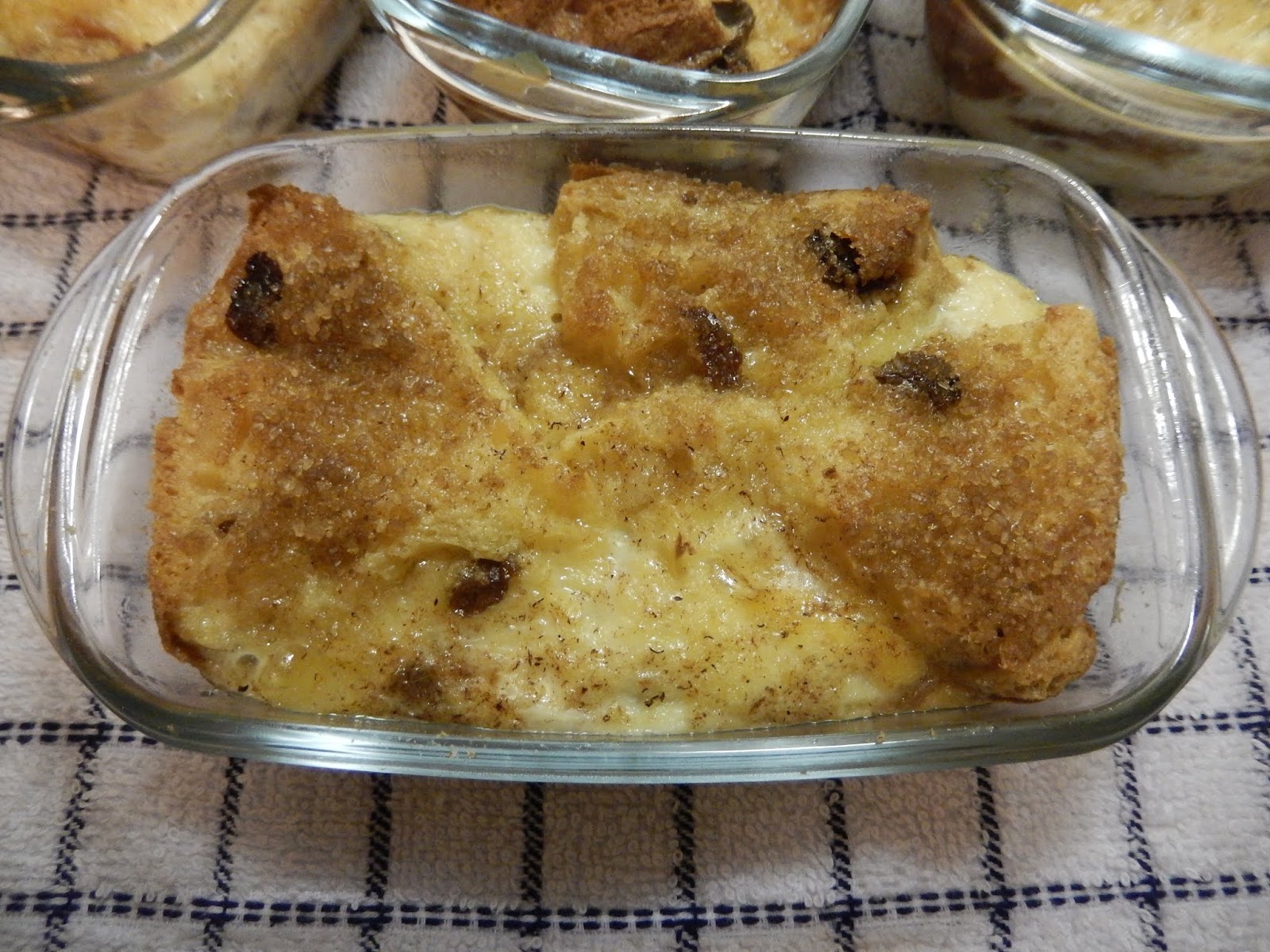
Lemon Bread and Butter Pudding

This dessert used up a panettone  bought for Christmas, in case of an unexpected need which didn't arise. I also had fresh lemons and an opened jar of lemon curd to use up, so as the panettone contained mixed peel, a lemon B & B pudding seemed the way to go.

I decided to make 4 individual puddings so that 2 could be frozen. I'm not sure how well they'll freeze, but I thought it was worth a try, rather than eating  a calorific dessert for 4 days running. I'd eaten one portion of the panettone, so I estimate there was about 425-450g left of the loaf.

I halved the loaf from top to bottom and sliced one portion into thin semicircular slices, which I sandwiched in pairs, spread with lemon curd. The rest of the panettone was cut into 4 slices to fit in the bottom of the dishes - I spread these with lemon curd too, and put into thickly buttered dishes curd side uppermost. Any trimmings and leftover pieces of panettone were crumbled and divided between the 4 dishes, then the semicircular sandwiches were cut and arranged neatly on top. I brushed the top of each pudding with more melted butter to help it crisp in the oven.

I hadn't realised until I started comparing recipes the wide range of egg:milk ratios used, as well as various baking times and temperatures, so the rest of the preparation went on a kind of average of the recipes I looked at.

I whisked together 3 large eggs, 50g caster sugar, the zest of 1 lemon and 500mls of semi-skimmed milk, and divided it between the 4 dishes. These were left standing for 30 minutes before baking, to allow the liquid to be absorbed into the bread - I pressed down with a fork occasionally to make sure the top pieces of panettone soaked up the custard mixture.

I added a little grated nutmeg and a sprinkling of demerara sugar to the top of each pudding, before baking at 160C (fan assisted) for 35 minutes. I intended to bake until the puddings were set, but still wobbling a little in the middle, but I think I baked for about 5 minutes too long.

These were lovely little puddings; adding lemon curd boosted the flavour nicely. I think adding some more dried fruit (such as a handful of sultanas) would have been an improvement and using a little more milk - another 100ml, perhaps - would have made the puddings softer and lighter, but I was pleased with them as they were.

As usual, with things that look their best straight from the oven, I didn't manage to get very good photographs of these. Not only were the light conditions far from perfect, they were visibly deflating as I watched them!

Wednesday, 22 November 2017

Apricot and Lemon Bread and Butter Pudding

I made this 2-portion pudding in individual dishes, but if it was made in one dish it could easily feed three people; I was a little too greedy! The ingredients list is a bit vague, because the only thing I measured accurately was the milk.

Ingredients
*4 thick slices of brioche, each about 10cm square
butter, softened
apricot jam
a handful of soft dried apricots, chopped
a small chunk of glacé lemon peel chopped finely (optional)
2 medium eggs
225mls semi-skimmed milk
zest of half a lemon
1 tablespoon caster sugar, plus a little more for sprinkling on top
freshly grated nutmeg

*or use plain white bread from a small loaf  - slightly stale bread can be used for this sort of pudding

Method
Thickly butter two individual baking dishes, which have roughly 350mls capacity each (or use one larger dish).
Mix the apricots and peel together, if using.
Use more butter and some apricot jam (fairly thinly spread), to make two sandwiches with the brioche.
Cut the sandwiches into suitably sized pieces to fit into your chosen dishes - I cut mine into 8 tiny triangles to get a tight fit.
Share half the pieces of sandwich between each dish and sprinkle with 2/3 of the fruit.
Arrange the rest of sandwiches on top, trying to keep the top fairly level and sprinkle over the rest of the fruit.
Mix the eggs, milk, lemon zest and caster sugar together in a jug and divide equally between the two dishes. Leave to stand for up to an hour to allow the custard mixture to soak into the bread.
When ready to cook, preheat the oven to 180C (160 fan). Sprinkle a little more sugar over each pudding and then grate over some nutmeg.
Cook for 25-30 minutes, until golden brown and crisp on top. One large pudding might take a few minutes longer.

This was a tasty version of the standard B & B pudding - the touch of lemon, and the tartness of the dried apricots, cut through the sweetness added by the jam.

I apologise for the awful photo - I wanted to get the puddings fresh from the oven, as they deflate as they cool and don't look so attractive, so had to use flash.


Sunday, 20 March 2016

Chocolate Hot Cross Bun and Butter Pudding

The We Should Cocoa cooking link-up, hosted this month by Linzi at Lancashire Food, (WSC is the brainchild of Choclette, at Tin and Thyme, who usually hosts the link-up on alternate months) has the seasonal theme of eggs. The challenge of putting eggs and chocolate together isn't difficult, but I wanted to bake something that relied on eggs for it's substance rather than just choosing a cake with the usual eggs in.

As it was a cold weekend I decided to treat us to a hot dessert rather than make a cake, and the proliferation of Hot Cross Buns in the shops in the run-up to Easter gave me the idea of making a bread and butter pudding with them. This fitted in well with the theme of eggs, as egg custard is an essential component, and adding chocolate to B & B pudding didn't seem a step too far!

The most challenging part of the dessert was slicing the buns thinly! I wanted to retain the crosses on the six buns for the top of the pudding, and still slice the remaining bun in half. Once that was done, I sandwiched the bun slices with butter and ginger jam, cut them in half crossways, and packed the little sandwiches into a buttered baking dish, as you would for a regular bread and butter pudding. I then scattered 50g of chopped dried apricots amongst the buns and placed the slices of bun with the crosses flatly on top. Finding the right sized baking dish is quite important here, so that the pudding looks right!

For the custard, I heated 350mls of semi-skimmed milk to about 60C, so that it would melt 50g plain chocolate when it was added. I then poured the chocolate milk onto 3 eggs and 2 tablespoons caster sugar and whisked together to mix evenly and dissolve the sugar. The custard mix was then poured over the buns in the baking dish and left to stand for an hour or so, to let the eggy mixture soak into the bread.

The pudding was baked for 45 minutes at 180C (160C, fan) and then cooled for about 20 minutes before serving.

This was a tasty dessert, with just enough chocolate to compliment the added ingredients and the fruit and spices already in the Hot Cross Buns without overwhelming them and becoming the dominant flavour. Using ginger jam was a good step, as it contained quite large pieces of preserved ginger to add to the bun spice. Unfortunately, it wasn't very pretty to look at, and I was also photographing it in bad light, so you'll just have to believe me that it tasted better than it looked!

Over a Belleau Kitchen, Dom's Simply Eggcellent link-up this month is a celebration of eggs with a focus on seasonal dishes, including those suitable for Easter. As Easter is early this year and it looks as if it might not be good weather, this hot pudding certainly fits the bill.

Sunday, 27 September 2015

Gluten-free Cornbread

We both really like cornbread, as an occasional alternative to rice, with a chilli, but I've yet to find the perfect recipe. The biggest problem is the bread being too crumbly, then there are recipes that are too sweet and recipes that are too bland. Flavours can easily be worked on, but it's getting the right balance of dry to wet ingredients which is proving elusive (although I have to admit that this recipe, from Ben Mims seemed pretty good the first time I tried it - I just forgot about it until now!). Add into the mix, the desire for a gluten-free cornbread and things get complicated.


It's fairly widely recognised that adding some wheat flour is better than 100% cornmeal, if a light cornbread is required, but this can't be used in gluten-free baking. This recipe, found on Jamie Oliver's website, uses equal volumes of a gluten-free flour mix and cornmeal, and allows for the use of non-dairy milk, if required. The only thing I didn't like, at first glance, was the amount of sugar added, so I cut this down from  80g to 50g. I added half a teaspoon of xanthan gum, just because I had it to hand, and it's meant to replicate the effects of gluten in wheat flour ie  cuts down on the crumbliness of baked products. I also used a mix of 50% polenta and 50% fine cornmeal instead of all cornmeal.

Converted to metric weights, I used: 200g gluten-free flour, 220g cormeal/polenta mix; 50g sugar, 2 tablespoons honey, 2 teaspoons baking powder, 1 teaspoon bicarbonate of soda, 1 teaspoon salt, 1/2 teaspoon xanthan gum, 2 large eggs, 360mls milk, 75g melted butter + another 10g to grease the skillet.

The method is fairly standard - mix dry ingredients in one bowl, wet in another, melt butter. Add wet ingredients and melted butter to dry ingredients and mix until just combined (don't overmix!). Pour into a pre-heated and well-greased skillet and bake in a hot oven. I used a fan oven at 160C and found that the cornbread was cooked in 25 minutes, rather than the 30-35 minutes suggested in the recipe.

The texture of this cornbread was good, but still a little crumbly. The Ben Mims recipe uses a much higher proportion of liquid, so it shouldn't spoil this recipe to increase the amount used, although it might need an extra egg too. I thought there was still a touch too much sugar in the recipe, so will cut it down even more in future. My next attempt will be to try a version of this recipe which is dairy-free too.

Monday, 2 March 2015

Jammy Bread and Butter Pudding

As a cake and dessert maker, a lot of what I make contains eggs - cakes, tray bakes, brownies, cookies, mousses and cheesecakes. They are indispensable for perfect results, and often the most nutritious part of many recipes. So I'm happy to join in with Belleau Kitchen's new blogger link-up - Simply Eggcellent - which celebrates the versatility of eggs.

Bread and Butter Pudding is made from bread soaked in a simple egg custard - usually just eggs and milk or cream, and maybe some sugar. The fun comes with the extras that can be added - dried and fresh fruit, chocolate, alcohol, preserves, nuts and spices.

This Jammy Bread and Butter Pudding was a spur of the moment dessert, to use up the end of a stonebaked sourdough baguette and the last of a carton of sour cream. I decided to keep things simple and use gooseberry jam to provide the main flavour, some sultanas for juicy fruit chewiness and a little nutmeg to spice it up a little.

I sliced the bread thinly and made jam sandwiches, which I fitted into a small ovenproof dish, interspersed with a handful of sultanas. The baguette was quite thin, making it impossible to remove the crusts, so I arranged the bread with the crusts uppermost, so that they would make a crisp topping after cooking.

I was only making two portions, with about 100g of bread, so a custard made from one large free-range egg, 50ml sour cream and 150g milk was sufficient. I didn't add any extra sugar to the custard as the jam was going to provide a lot of sweetness.

I poured the egg mixture over the bread and left the dish to stand for about an hour before baking, to allow the custard to soak into the bread. Before baking I sprinkled the top of the pudding with Demerara sugar and a grating of nutmeg. I baked the pudding in a bain marie, at 180C for 45 minutes.

Using jam to flavour this bread and butter pudding worked very well; together with the sultanas and sugar topping it was plenty sweet enough. The custard soaked bread was light and moist, with a lovely crisp crunchy topping made from the crusts on the slices of bread and the sugar.

As usual, it isn't good for food photography to take something out of the oven at 6pm, and need to get it photographed before it's eaten a few minutes later, so I apologise for the strange colour!

You can read all about Simply Eggcellent on the link above. I look forward to seeing how Dom, at Belleau Kitchen, develops the core theme of eggs over the coming months.

Saturday, 28 February 2015

Banana and Date Loaf

Having bananas that need to be used up is something that hardly ever happens in this household. Although I don't eat them, my husband eats one for breakfast, every day, without fail, but no more than that. So I know I need seven bananas a week and that is what I buy, every week. Except for last week, when I was tempted by a large bag of single ripe bananas at half price. There were two bananas left by the end of the week, so banana bread beckoned me. After looking at several recipes, and finding I didn't have any walnuts in the store cupboard, I decided to make a banana and date loaf.

I based my recipe on this one, found at Cake Recipe, although I made a few minor changes. My bananas weren't quite as big as those stipulated in the recipe, so I added 50g sour cream; I used sunflower oil instead of melted butter; added a teaspoon of ground cinnamon and left out the walnuts. My cake took about 10 minutes longer to bake than the recipe suggested, but that could have been down to a differently shaped loaf tin - some are short and deep, some longer and shallower - or the changes I made to the recipe.

Ingredients - 350g bananas (weighed with skins on); 1 tablespoon lemon juice; 300g SR flour; 1 teaspoon baking powder; 125g caster sugar; 1 teaspoon cinnamon; 125ml sunflower oil; 2 large eggs; 50g sour cream; 175g chopped dried dates, crushed brown sugar cubes for topping.

The method is standard - mash bananas with lemon juice; mix dry ingredients in one bowl, wet in another; combine the two bowls of ingredients, and the bananas, without over-mixing, then fold in the chopped dates. Transfer to 2lb loaf tin, sprinkle sugar over surface and bake at 160C for about 70 minutes.

This was a lovely textured loaf, moist but not dense. The pieces of dates had a chewy, toffee-like quality, and added most of the flavour to the cake. My husband complained that it didn't taste of bananas, but I don't think banana cakes ever really do.

It was nice to butter the slices of cake, but they were moist enough to be eaten without added butter, if calories are a big consideration.

Tuesday, 24 February 2015

Cornbread with Green Chillies

Although I've liked the flavour of cornbread that I've made in the past, I've never been really happy with it - the dry crumbly texture can make it  faintly unpleasant to eat sometimes. Nearly all the recipes I've looked at use a very similar proportion of liquids to dry ingredients, so perhaps that's the way cornbread is supposed to be, but I wanted to make something with a softer, more cakey texture.

I wasn't having much luck until I came across a reference in Felicity Cloake's 'How to Cook the Perfect Cornbread' article in the Guardian. She wrote "....food writer Ben Mims, also Mississippi-born, uses equal parts of flour and cornmeal in a recipe judged by the Southern Living test kitchen, no less, as 'perfect'.", although she went on to say that she preferred a denser, more crumbly cornbread. When I checked the recipe, not only did this recipe use half wheat flour, it also had a higher proportion of liquids than most other recipes I'd seen. This seemed worth a try.

During several attempts at cornbread, based on Ben Mims' recipe, I made a few changes - some out of necessity, some just because of a whim! The nearest thing I could find to coarse cornmeal was polenta. Even though Felicity Cloake's article warned against instant polenta and my packet said it was 100% pre-cooked, which made it sound instant, I decided it would have to do. I used a mixture of full fat natural yogurt and semi-skimmed milk instead of buttermilk (and a slightly lower proportion of liquid to dry ingredients), and a mix of chilli-infused oil and butter instead of all butter. The butter was only melted, rather than browned, but was still poured into the batter while hot. Finally, I add a finely chopped, de-seeded, green chilli.

As I was only cooking for two, I halved the recipe, and cooked it in a six-hole silicone shallow bun tray. I do have a small skillet, but I calculated it would be too small - after seeing how much the cornbread rises, I think it would be OK to use, and should give a better crust, as the batter is best poured into a hot pan.

So, I used 105g polenta, 45g plain flour, 1/2 tablespoon baking powder, 1/2 teaspoon of salt, 1/8 teaspoon bicarbonate of soda and 1 finely chopped green chilli, mixed together in a large bowl. In a measuring jug, I mixed 150ml full fat natural yogurt, 50mls semi-skimmed milk, 1 large egg and 1 tablespoon of chilli-infused oil.

The wet ingredients were mixed quickly into the dry mix, followed by 45g melted butter (still hot). The batter was divided between six moulds and baked at 220C, until risen and firm - about 15 minutes.

The texture of these were just right - soft, still moist but not too dense but I still need to work on the seasoning, as the flavour was a little bland. Although I picked a recipe which didn't use any sugar, I think a small amount, say a tablespoon or so, might have improved things, and a bit more salt is probably needed too.


Monday, 26 May 2014

Blueberry and Orange Bread and Butter Pudding

This turned out to be a very tasty version of bread and butter pudding, which is traditionally made with dried vine fruits. I also reduced the fat content of a traditional recipe by only using a little melted butter to grease the baking dish and drizzle over the top of the layers of bread to give some crunch when baked. Usually each slice of bread is spread with butter.


This recipe will make 4 generous portions, or 6 portions for those with more delicate appetites!

Ingredients
25g butter, melted
5 - 6 slices bread from a large loaf, not too thinly sliced (optional - remove crusts).
120g orange curd - approximately
zest of 1 orange, finely grated
300mls semi-skimmed milk
2 eggs
120g frozen or fresh blueberries. (If using frozen, don't thaw before assembling the pudding)
3 tablespoons Demerara sugar for sprinkling on top (optional)

Method
Use a little of the melted butter to grease a 2 litre baking dish.
Make sandwiches using the bread and a generous amount of orange curd, and cut into small triangles. 
Arrange half of the small sandwiches over the bottom of the baking dish and sprinkle over the blueberries and orange zest.
Arrange the rest of the sandwiches evenly on top, with some of the points sticking up, if possible.
Drizzle over the remaining melted butter and leave for about 10 minutes to allow the butter to soak in and set.
Beat the eggs and milk together and pour over the bread, pressing down with the back of a spoon to submerge the bread initially.
Allow to stand at room temperature for about 40 minutes, then sprinkle over the sugar and bake at 180C for 30-40 minutes, until the pudding is gold and crispy on top and the custard is set.

Best served warm rather than straight out of the oven, so allow to stand for about 20 minutes.

I used frozen blueberries, which didn't all burst when cooked; this looked good as there wasn't a lot of fruit juice spoiling the colour of the custard. The orange curd gave a strong flavour which was freshened by the orange zest. Using fresh fruit instead of dried made the pudding seem lighter and more suitable for summer.

Thursday, 17 October 2013

Apple, Guinness and Cheese Soda Bread

How could I have been so stupid as to make this recipe, from Hugh Fearnley-Whittingstall without reading any of the comments attached to the published online recipe? On both the River Cottage site and the C4 site there are comments stating that there is too much liquid in the recipe as printed and that it should be 250mls of Guinness or buttermilk, not 250mls of each, and several bloggers who have also made it picked up on the published error.

Anyway - this idiot used both, and ended up with a sloppy batter which couldn't be shaped by hand. I scraped it into a large casserole dish lined with scrunched up baking parchment and got a decently shaped cob-like loaf out of it. However it didn't cook properly, even after more than an hour in a very hot oven, and the cut loaf showed both a dense, too moist texture and a line of under-baked dough at the bottom of the loaf.

The flavour combination of cheese and apple should have been great, but the loaf had a bitter after-taste which neither of us found pleasant to eat. Guinness is notorious for bitterness but I don't usually find it a problem, so I'm wondering if there was a weird interaction between the Guinness and the buttermilk.

There's a lot of potential in this soda bread so I really want to try it again, with just one of the suggested liquids, but can't really find an occasion to do so, as neither of us are eating bread at the moment, except for Saturday lunch, when I don't think Hubs would give up his crusty baguette.

I was going to enter this quick soda bread into this month's Tea Time Treats challenge, which is for breads, but as the recipe was a failure, and we didn't even like the flavour of the finished loaf, it hardly seems right to do so!

Sunday, 25 November 2012

Chocolate Bread and Butter Pudding

I knew this month's We Should Cocoa challenge, to combine a yeast-raised dough with chocolate, was going to be difficult for me, as yeast doughs are not one of my strong points. By the time I'd got two thirds of the way through the month, and still hadn't had time to tackle a yeast dough, I knew it wasn't going to happen. So, in the spirit of not wanting to avoid the challenge (and in anticipation of my entry being rejected), I offer a Chocolate Bread and Butter Pudding. It's made with yeast raised dough (white bread) - I just didn't make it myself - and plenty of dark chocolate!
Pudding before baking
My basic inspiration came from this recipe on the Schwartz spices site, but I made a few changes to the recipe. I liked the idea of chocolate rippling through the pudding rather than all the custard being chocolate flavoured, but I only used 150g of plain chocolate with a 20g knob of butter. Two thirds of this was spread over the first layer of bread slices and the rest was drizzled over the top, before the custard was poured on. I made my custard from 3 eggs and 500mls of milk (closer to Delia Smith's proportions for bread and butter pudding custard) and sweetened it with 2 tablespoons of caster sugar. I left out the cinnamon but added 1 teaspoon of vanilla paste and dotted the pudding with more butter before baking. I used a 9" square baking dish which is smaller than stipulated, but I like a deeper pudding!
 
The baked pudding
This was a delicious dessert, eaten warm. The top acquired the desired crisp top (desired by me, at least!) and was filled with a soft wobbly custard and gooey chocolate ripple. The lower amount of chocolate used still gave a good flavour. Using only a small amount of sugar and a good plain chocolate meant the dessert was not too sweet either.

The only thing missing was the traditional chewiness of dried fruit, and I really think this dessert would have been improved by a handful of sultanas or cranberries, plumped up in orange juice, and perhaps a little orange zest in the custard too.

This month's We Should Cocoa  challenge (rules here) was chosen by guest host Nazima of Franglais Kitchen, but the regular hosts are Choclette from Chocolate Log Blog and Chele from Chocolate Teapot. The idea of the challenge is to incorporate some form of chocolate into a dish along with the chosen ingredient or method. At the end of each month, the host choosing the ingredient to use in the challenge posts a round-up of entries.

Friday, 6 April 2012

Hot Cross Buns

Yet again, I've been touched by whatever jinx it is that makes my yeast baking fail! 

These Hot X Buns, from the recent Dan Lepard recipe published in the Guardian were full of flavour. However, the buns themselves were dense, heavy and dry - and I know that is not how Dan meant them to be.

I used 250g of a mix of cherries, berries and sultanas and 50g chopped dried apricots, but I missed the citrus tang that you get from mixed peel. The only change I made was to divide the dough into 15, rather than 12 buns, although I forgot to make the paste crosses correspondingly smaller!

I don't know where I went wrong - I bought new yeast, in case the yeast used in my last failed attempt was too old, I was careful not to get the liquid too warm, I measured all the ingredients carefully, I followed the instructions exactly. I set the batch of rolls in a warm place to double in size, and hardly anything happened! After 90 minutes, they had nowhere near doubled in size and weren't getting any larger, so I went ahead and put on the crosses, and baked, then glazed, them.

I think this is the last attempt at yeast baking. Failure is not just discouraging, it's flippin' expensive!

I am still going to enter these into this month's challenge over at Tea Time Treats - although the recipe didn't work well for me, I'd certainly recommend it to anyone more confident in their baking skills, as the flavour in the buns was excellent!

Tea Time Treats is a monthly baking and blogging challenge hosted jointly by Karen at Lavender and Lovage, and Kate at What Kate Baked. The full rules can be found here. This month the event is hosted by Kate and the theme is baking for an Easter Tea.

Sunday, 8 January 2012

Cinnamon Buns - A Tea Time Treat

Tea Time Treats is a monthly challenge set in turn by Kate at What Kate Baked, and Karen at Lavender and Lovage; the rules can be found here. This month it was Karen who challenged us to bake a sweet Tea Time Treat based on either bread or pastry. This caused a dilemma for me - I'm not very good at yeast cookery, but pastry doesn't really fit into our low saturated fat diet. I decided to have another go at yeast dough, as that would at least present me with a challenge, and hopefully I could keep the fat levels down too.

There are two types of baked treats for tea time - small items which look highly decorative, and sit on a cake stand for afternoon tea, and the less dainty items which are just grabbed from the cake tin when you need something sweet with your afternoon cuppa. Buns definitely fall into the second category - there's nothing dainty or refined about a cinnamon bun - just sweetness and spice and a feeling of contentment after it's finished.

Although I haven't had consistent success with yeast baking, I have had the best results from Dan Lepard's recipes, so his recipes were my first port of call. I really liked the look of the Lemon and Almond Buns, published in both the Guardian and his recent book, Short and Sweet, but in the end chose the Cinnamon Buns recipe from his column in the Guardian. I think one reason I chose it was because of the incredulity of the commentators on the recipe, about including Ryvita crumbs in the filling! It made me want to reassure myself that of course Dan knows what he's talking about! There was also less butter in the cinnamon bun dough, and I could be cautious about how much I added to the filling. Another reason for using Dan's bread recipes is that his almost 'no knead' method suits my old arthritic joints - if I overdo any physical activity, it's quite likely that any joints involved will be immobile the next day; hands that don't work are not a good thing!


Buns before proving
 

After proving
 
I followed the recipe quite closely, and only made one change to the ingredients. I didn't want the buns to be too dark, so used a 50:50 mixture of light and dark muscovado sugar for the filling. When it came to dabbing a little butter over the dough, I used as little as possible, about another 50g. I think that either my yeast wasn't in the best condition, or my kitchen was very cold, because it took well over an hour for the shaped buns to rise enough before cooking. They also took 25 minutes to cook to a rich golden colour.

I'm really happy with the way these turned out, although I think they would have been a little lighter with a new batch of yeast. Hubs thought they were too large, so that's something to consider if I make them again.

The lemon and cardamom flavours were noticable in the plain dough, and the Ryvita crumbs gave some texture to the spicy filling. In a world where there were no worries about fat consumption, I might have added twice as much butter to the filling, to make it richer and stickier, but these were perfectly adequate for an everyday Tea Time Treat.

Saturday, 12 February 2011

Cornbread, with chillies and cheese

I've never eaten cornbread before, but I'd bought a pack of finely ground yellow cornmeal from the supermarket - just because it was there - and had no idea what to do with it! I often buy new products on the spur of the moment, on the grounds that they might not be in stock for long, especially if there's no demand for it - I've read that supermarkets sometimes only trial new products for two or three weeks before deciding whether to stock it permanently.

A planned meal of chilli con carne seemed an ideal opportunity to use the cornmeal and try cornbread. The first problem was the wide diversity of recipes online. Which is more traditional? Which do I already have the ingredients for? How sweet  do I want it be (The answer is 'not very'!!)? How large a batch do I want to make? And, most importantly - whose recipe could I trust?

I had just settled for a very simple cornbread from Martha Stewart, which used only storecupboard ingredients (no need to shop especially for yogurt or buttermilk), when I read a reply to the post I'd put on one of the messageboards I frequent, which recommended this recipe. This was similar to the Martha Stewart recipe in it's proportions, but added a little fat. So I decided to add some oil to Martha's recipe; then things got out of control, and I added some chopped hot chillies from a jar of preserved chillies and some grated strong cheddar cheese.

I'd also read that cornbread gets a crisp crust if the batter is poured into a pre-heated and greased skillet, so I used a 24cm (9.5") non-stick skillet pan, which I heated on the hob with about 25g of butter, before pouring in the batter.

By this time I felt as if I'd got a recipe to call my own, so here it is!

Ingredients
130g plain flour
130g fine cornmeal
1 tablespoon caster sugar
1/2 teaspoon salt
2 teaspoons baking powder
250mls semi-skimmed milk
2 large eggs
3 tablespoons sunflower oil
50g strong cheddar cheese, finely grated*
4 small preserved hot chillies (fresh would also be good), seeds removed and finely chopped*
25g unsalted butter

*in my opinion, more of both of these additions are needed to get a good flavour - I will double both next time, with due regard to the varying heat of chillies..

Method
Preheat the oven to 220C (200C fan).
Put the flours, sugar, baking powder and salt into a large bowl and whick together to mix evenly.
Measure out the milk into a jug, add the eggs and oil and whisk together.
Pour the wet ingredients into the flour mix and stir quickly to amalgamate. As with muffins, don't bother too much if it looks lumpy.
Heat the butter in a 24cm skillet, until it is hot and foaming.
While this is happening, quickly mix the grated cheese and the chopped chillies into the batter, then pour it onto the foaming butter.
Turn off the heat and transfer the skillet to the oven. Bake for about 20 minutes, until golden, and a cocktail stick comes out clean.
Serve immediately, cut into wedges.

The reaction to this cornbread was mixed. Hubs and I ate it as the only accompaniment to the chilli con carne, and he preferred it to having our usual rice. I thought it was a little dry and bland, so the recipe needs more work, but liked having it as a change to rice. I can't say I preferred it, though; it was strange eating the chilli on it's own, without some rice with every spoonful. I can imagine cornbread being a better accompaniment to soups. CT and new taster, FB (first born daughter, living at home for a while) both liked it, but thought it was strange eating it alongside chilli and rice, although they didn't want to do without the rice! Overall, I can see this being on the menu occasionally, but not as a permanent replacement for rice with a chilli!

Thursday, 25 March 2010

Malt Loaf

This isn't like the soft sticky commercial malt loaf which UK readers may be familiar with, but it's just as tasty. It's a dense loaf which needs a lot of chewing, so a small slice is quite satisfying (particularly when spread with butter). Despite the huge amount of sugary substances in the recipe - golden syrup, treacle, malt extract and dried fruit - it does not taste excessively sweet.

This Malt Loaf recipe is an old one from Dan Lepard, which has been revived recently by some of his board members. I used chopped prunes, lard, and a smoked malted bread flour in place of the wholemeal flour in the recipe. My mistake, I think, was to choose a badly proportioned loaf tin, relative to how much the loaf rose, but that did mean I could cut small slices!

Tuesday, 22 September 2009

Black Pepper Rye Bread

It seems a long time since I last posted, although it's not that long since I last baked. The cake tin has been kept filled with goodies using recipes I've already posted (mainly brownies), and I've also had one or two failures which weren't worth mentioning. The failures were mostly part of my quest to produce a gluten and dairy free menu for a meal for 10 at the beginning of next month. I'm tempted to give up on the idea of gluten free baking, but it's a matter of personal honour now that I will produce something edible! What I have given up on is the idea of depriving everyone of good bread just because two guests don't eat wheat, so although most of the meal will be dairy and gluten free, some elements of the meal will be 'normal'.

This recipe from Dan Lepard for Black Pepper Rye Bread caught my eye at the weekend, as a possibility to serve with smoked mackerel paté. I love rye bread, and this loaf promised to be light and moist, with a good kick from the pepper - sounded just right.

My first attempt was a disaster in terms of texture - it was dry, heavy and hardly rose at all - but I wasn't sure whether it was my technique or whether my dried yeast had died in storage. The flavour, however, was wonderful, just what I needed to fire up the tastebuds at the start of the meal, so I didn't want to give up on the recipe. As ever, Dan was very helpful on his website, suggesting where I might be going wrong, and he even baked the recipe again, and published a set of photographs for future guidance.


The second attempt, pictured above, was much better; the loaf was lighter, moister and rose well. I didn't have any poppy or sesame seeds to top the loaf with, so just gave it an egg wash and a light sprinkle of caraway seeds, which was what I'd used in the loaf with the black pepper. I took Dan's advice to cook the rye and spice mix less, and also took the precaution of buying new yeast, but now it's frustrating not to know if it was the yeast or the change in technique which made the difference. I know that you shouldn't really change two things at the same time if you're trying to get to the root of a problem, but I didn't want another failure.