Showing posts with label low saturated fat. Show all posts

Wednesday, 19 December 2018

Brownies with Almond and Orange Chocolate Chips

After deciding to make brownies, I realised I didn't have enough butter, so went back to the oil-based recipe I used to use frequently when my son was on a low saturated fat diet. It's not as rich as a butter-based recipe, but it's not bad at all. I added 100g of  dark chocolate with orange and almond pieces to give more interest to both the flavour and texture.

The recipe is based on this one, from Cookie Madness, although I make it half as big again to make deeper brownies, and use sunflower oil rather than olive oil, as well as changing the add-ins. I have tried olive oil, and although it adds an interesting dimension, it's not a flavour I want every time I bake them, so I find a more neutral oil is better on most occasions.

Ingredients
150g plain chocolate (about 70% cocoa solids)
120mls sunflower oil
3 large eggs
130g caster sugar
100g dark muscovado sugar
1 teaspoon vanilla extract
105g plain flour
100g chopped chocolate of choice (I used a dark chocolate with almond pieces and orange flavour)

Method
Pre-heat the oven to 180C and line a 20cm square baking tin with parchment.
Melt the chocolate in a bowl over simmering water, then remove from the heat and whisk in the oil.
In a large bowl, whisk the eggs, sugars and vanilla for 5 minutes, then fold in the chocolate and oil mixture.
Sift the flour over the batter, and fold in, followed by the chopped chocolate.
Transfer the batter to the baking tin, then bake for 25 minutes.
Cool in the tin, then cut into squares or bars.

Monday, 28 May 2018

Hazelnut, Lemon and Elderflower Cake

Although I didn't pay much attention to the recent Royal Wedding, I must have been subconsciously influenced by the talk of a lemon and elderflower wedding cake, as I suddenly felt that that was the cake I really I wanted to eat.

Having decided which recipe to use, I realised that I didn't have any ground almonds, so used hazelnuts instead. I love using ground hazelnuts in cakes, as they actually add flavour, as well as keeping the cake moist - so often the flavour of almonds is lost, unless you are using a lot, or add almond extract too.

I chose to adapt this BBC Good Food recipe for a Lighter Lemon Drizzle Cake, as it is a reduced fat recipe, and uses oil instead of butter. I've always found it reliable, producing a light, moist cake with a good crumb texture. As I've mentioned, I used ground hazelnuts instead of almonds, and also used sunflower oil instead of rapeseed, as that's what I always have available. Instead of a lemon drizzle, I reduced 150mls of elderflower cordial by half, and drizzled that over the cooked cake, while still hot, then sprinkled the cake lightly with caster sugar.

This was a subtly flavoured cake - none of the three flavours dominated, although I would have liked to taste more of the elderflower; I think I was just unlucky that the brand of elderflower cordial that I bought was very delicate. Despite that, it was a very good cake for a warm spring weekend.

Tuesday, 24 October 2017

Spelt Flour Gingerbread

I've alluded to health problems within the family in a few of my recent posts, which have cut down on my free time and resulted in very little baking taking place. I'm sad to say that I'm now entering a new phase of my life - living on my own for the first time ever. My husband was diagnosed with a brain tumour in June, after becoming ill while on holiday in France; an operation failed to halt its aggressive growth and he passed away last week, just 4 months after diagnosis.

I'm not sure what this will mean in terms of this blog - I love baking, but a small cake suitable for two to eat over a few days is too much for me to get through, especially as I'm prone to gaining weight easily. I could bake things suitable for freezing, but if I'm taking slices of cake, or rolls of biscuit dough, out of the freezer, that still means fewer opportunities to try new recipes. We'll have to see how things work out!

This gingerbread was baked when I was expecting family to visit over the weekend; what wasn't eaten was taken home by my children. It is as good as a traditional gingerbread, which gets a sticky top over time, but uses oil instead of butter. My original recipe uses plain flour, but this time I used a mixture of plain wheat flour and spelt flour - only because I haven't managed to keep my storecupboard well stocked lately, and didn't have enough plain flour. Because of the strong flavours of the spices and treacle in the gingerbread, I don't think the flavour of the spelt was evident at all, but it's nice to know the recipe worked with one of the more 'fashionable' grains.

Ingredients
150g plain flour
200g spelt flour
1 1/2 teaspoons bicarbonate of soda
3 teaspoons ginger
1 teaspoon cinnamon
1/2 teaspoon ground cloves
1/4 teaspoon salt
6 tablespoons sunflower oil
150g caster sugar
1 large egg
250mls of roughly equal amounts of golden syrup and black treacle, mixed with 250mls hot water (ie 500mls liquid in total)

Method
Preheat oven to 170C (150C fan), and line a 20cm (8") square deep cake tin with baking parchment.
Put the flours, bicarb, spices and salt into a medium sized bowl and whisk together to distribute the spices evenly.
In a large bowl whisk the oil, egg and sugar to a smooth emulsion.
Add alternate portions of the flour mix and the syrup mixture to the emulsion in the large bowl, stirring just enough to blend the mixture together - no need to beat.
Transfer the batter to the cake tin and bake for 50-55 minutes until a test probe comes out clean.
Cool the cake in the baking tin.

Friday, 24 February 2017

Date, Orange and Cardamom Cake

dairy-free

This is a recipe from one of Waitrose's monthly recipe cards  (also online here). I didn't pick it because it was dairy-free, but because I liked the sound of the other ingredients when put together - dates, orange, almonds and cardamom. I just happened to have some dairy-free spread to use up too, which was an added bonus. It's a strange recipe - it uses only bicarbonate of soda as a raising agent and is cooked at a very low temperature; the dates, sugar and orange are all acidic, so I presumed these ingredients would interact enough with the bicarbonate to raise the cake.

I had to use a slightly smaller baking tin, 20cm in diameter rather than 21cm, but the cake still cooked in the time given in the recipe. There was a slight dip in the centre, which spoiled the appearance of the cake a little - no idea why that happened, unless it was using the smaller tin! This time I added the drizzle of orange frosting suggested, just to alleviate the brownness of the cake, but it wasn't really necessary for flavour.

The cake was, surprisingly, as it contained wholemeal spelt flour, very light and moist. Both the orange and cardamom flavours were quite subtle, but I don't think that's always a bad thing - sometimes you just want all the ingredients to blend into something unique which is delicious but unidentifiable. You don't always want to be hit over the head with several, or even just one, big flavour, and that's what happened here. Because of this, and because the cake wasn't too sweet, I think this was a cake where the flavour of the spelt flour was noticeable too.

This is definitely a recipe to put in the 'repeat' file.

Monday, 10 October 2016

Apple and Orange Fruit Loaf

When I'm short of inspiration, I sometimes look back over my blog posts to find cakes I thought were worth making again. I first tried this recipe back in October 2012, so it's taken me a while to get back to it, but it was worth making again!

When I originally made this Orange Frosted Apple Cake, I left out the nuts and just used an orange glacé icing on top. This time I made a few more changes: I used spelt flour instead of wholemeal, sunflower oil rather than rapeseed, walnuts instead of pecans, and a mix of dried vine fruits, berries and cherries. Instead of frosting the cooked cake, I sprinkled some crushed raw sugar cubes over the batter before baking to give a crunchy topping - I find the extra fat and sugar in frostings unnecessary in many cases, unless the cake is for a special occasion.

The grated apple and yogurt used in the cake add moistness, and mean that less fat - in this case, sunflower oil - can be used. Adding the apple also cuts down on the sugar needed, so this is a relatively healthy cake, especially without the frosting! The apple doesn't add much to the flavour of the cake, so in this case the walnuts and spices were the predominant flavours, with a subtle orange background note.

I really don't know why I waited so long to make this cake again, as it's a really good light fruit cake and can be varied according to which dried fruits and nuts are available.

Thursday, 7 April 2016

Courgette, Sultana and Pistachio Loaf

I managed to make one more recipe from Honey and Co: The Baking Book, before the library demanded it back from me. It was down to a choice between this courgette loaf and a carrot cake, and the courgette loaf won because I had all the ingredients already (allowing for a couple of substitutions).

I used sultanas instead of golden raisins, and orange zest instead of lemon, neither of which were going to have a major affect on the flavour of the cake. I also chopped the pistachios roughly, as I dislike whole nuts in cakes.

I didn't really encounter any problems while making the cake, although both the loaf recipes I've made from the book have almost filled my 2lb loaf tin, leaving me worried (needlessly, fortunately) about cake batter ending up on the floor of the oven.

This cake was moist and dense but not too heavy. The pistachios, sultanas and flecks of green from the courgettes made it quite colourful, and the chewy sultanas and crunchy pistachios gave some variations in texture while eating. However, once again, it was the spices used that made this cake something special - star anise and ginger, combined with the citrus zest, gave a really unusual sharp and peppery flavour, which was balanced nicely by the sweetness of the sultanas.

Sunday, 29 March 2015

Chilli-Chocolate and Green Tea Marble Cake

for a Clandestine Cake Club 'Mad Hatter's Tea Party'.

I went to my first Clandestine Cake Club meeting recently; I joined the organisation almost a year ago, but this is the first local event that has been arranged since then. The theme for the cakes was Alice in Wonderland, and the meeting was called, appropriately, a Mad Hatter's Tea Party.

I have to admit I was thrown a bit by the theme; I'd hoped just to bake something with spectacular flavours, but my cake was obviously going to need some decoration too. I haven't decorated a novelty cake since my youngest child stopped having that sort of birthday cake about 25 years ago, so I approached the task with some trepidation. After seeing lots of  'bunny bottoms' on cupcakes while I was researching the theme (basically using Google Images!), I decided to make a large version using my bundt tin as the basis of the rabbit hole, with a fondant icing white rabbit disappearing down into it. Making the back end of a rabbit seemed infinitely easier than making a whole rabbit or even the front end of one, especially as the White Rabbit in Alice in Wonderland was dressed, and carried a watch!

I choose the flavours for the cake to fit in with the 'tea party' theme by using green tea and chocolate layers in a marble cake, and flavouring the chocolate layer with chilli too, as an extra 'madcap' idea. I used my favourite recipe for a marbled bundt cake - the reduced size version of this Alice Medrich recipe which I use here. For this version I used sunflower oil instead of olive oil, and added almost half a teaspoon of cayenne pepper to the cocoa mixture and two tablespoons of green tea powder to the plain layer.

The decorations were made from fondant icing and edible wafer flowers, plus two chocolate 'bunny paws'. I needed the best part of 500g of fondant icing sugar to make enough modelling fondant to fill the hole and make the legs and tail of the rabbit, and 250g of green ready to roll fondant for the grass and flower leaves. The top photo was taken before I roughed up the 'tail' by cutting into the fondant ball with a pair of scissors to make it look more like fur - it was quite an effective technique, as you can see in the photo to the left.

Neither of the cake flavours were overwhelming, and the bitterness of the green tea was nicely balanced by the lingering warmth of the chilli and the sweetness of the fondant icing. It was fortunate that I didn't use too much chilli, as many of the Cake Club participants were mothers who had brought their young children along (something I hadn't expected!).

This was a small meeting, although a few more cakes arrived after I'd taken my photos. The theme was quite loosely interpreted, so I needn't have worried about not doing enough! The gorgeous pink and purple Cheshire Cat cake was flavoured with almonds and rosewater, and was really delicious, and there were two other cakes using tea - a fruited tea loaf and an Earl Grey loaf with lemon icing. I also got to bring home slices of the cakes that I was too full to sample during the meeting, so I think the only thing I didn't taste at all was the strawberry tart.

Thursday, 11 December 2014

Maple Syrup Gingerbread

Although this is one of the low-saturated fat recipes I tweaked into something good a couple of years ago, when CT was at home and needed a low fat diet, I've carried on using it as it produces a light, but moist and sticky, gingerbread. The surface of the cake goes on getting stickier with time, as should all good gingerbreads!

This time, I didn't have the golden syrup I expected to find in the store cupboard, so I used maple syrup instead. This is a cake strongly flavoured with ginger, cloves and black treacle, so I think the maple syrup was somewhat overwhelmed, but it did mean I could get on and make the cake I'd planned - comfort eating for cold weather!

The recipe can be found on this post, and it's simply a matter of mixing the syrups and the flour mixture into the beaten egg, sugar and oil, in alternate portions. I've never had it fail before! This time, however it ended up with a huge dip in the centre. Strangely, even with the dip, the texture seemed uniform throughout the cake, so I'm not sure what happened to produce it. It certainly wasn't undercooking, but may have been over mixing or mis-measuring the raising agent.

Monday, 24 November 2014

Hazelnut and White Chocolate Brownies

I whipped up a quick batch of brownies for CT to take home with him after he had dinner with us recently. I used my usual oil-based recipe, this time using sunflower oil and adding 50g chopped toasted hazelnuts and 50g of white chocolate chips, instead of all chocolate. 
 
 
They were as good as they always are - dense, moist and chewy, as a good brownie should be!

Wednesday, 19 November 2014

Honey Breakfast Fruit Cake

 - from a recipe by Harry Eastwood.

This cake was made specifically for the AlphaBakes challenge, where this month's randomly chosen letter is H.

My baking books were surprisingly short of recipes containing ingredients beginning with H - hazelnuts featured heavily, but I've used them a lot lately, and wanted to avoid them if possible. Honey was the only other frequently used ingredient, so I set myself the task of finding a recipe for a fruit cake sweetened only by honey.  So many recipes are called 'honey (something or other)', only to feature a tablespoon or two of honey, supposedly added for flavour, in addition to the usual high amount of sugar found in most cakes and biscuits.

I'm not going down the route of claiming that a cake sweetened with honey is any healthier than a cake sweetened by standard sugar (they are both types of carbohydrates not really needed for nutrition), but I do think that if you are using honey for it's flavour, you need a fair amount of it in a cake!

However, Harry Eastwood's baking recipes (ooooh! an extra H there!) are special for being a little bit healthier than most. She uses added vegetables a lot, and tries to cut down on the amount of sugar and fat in her recipes. This cake, called a Honey Breakfast Fruit Cake, uses finely grated butternut squash to replace much of the fat  - the only fat comes from nuts and eggs - and the squash also has a natural sweetness which means less needs to be added in the form of honey. The cake batter is made from half flour and half ground almonds and is packed with dried fruit and chopped nuts. In fact, for the size of cake made, it's really fruit and nuts held together with a little cake batter!

I followed the basic recipe, but as I'm trying to finish some of the half-used packets of dried fruits and nuts in the storecupboard, I altered what I used from what was suggested in the recipe. Instead of raisins and cranberries, I used sultanas, cranberries and sour cherries, and instead of chopped almonds I used a mixture of almonds, walnuts, macadamia nuts and peanuts. I also sprinkled some flaked almonds on top of the cake before baking.

This was a really delicious cake; the almond flavour was predominant, as you'd expect with the use of almond extract, but the lemon zest and the honey both made a noticeable contribution. Obviously, the cake will vary in flavour depending on what type of honey is used - I used a Fairtrade Guatemalan honey which wasn't produced from any specific flowers, and was just a generic 'honey' flavour.

The big surprise was that the absence of fat wasn't noticed, nor was the addition of  quite a large amount of grated butternut squash. The recipe stated to grate the squash finely, so I used a finer grater than I would have used if grating carrots for a carrot cake, and this made the vegetable vanish into the cake batter, only adding moisture to the texture.

I'm not sure this would convince me that it's good to eat cake for breakfast, but it is certainly a cake that's good to eat, and will go on my list of things worth repeating.

AlphaBakes (rules here) is a blogging challenge hosted on alternate months by Ros from The More Than Occasional Baker and Caroline from Caroline Makes. This month's randomly chosen letter H was picked by Ros, who will post a roundup of entries at the end of the month.

Wednesday, 29 October 2014

Chewy Ginger, Orange and Dark Chocolate Cookies

I tend to view Ruby Tandoh's column in The Guardian's 'Cook' supplement with a little wariness after the disappointment of her Fig, Orange and Star Anise Tealoaf, but my husband was drooling over the idea of these Ginger, Orange and Dark Chocolate Cookies, made with golden syrup to keep them chewy.

The basic cookie dough couldn't be simpler - mix the wet ingredients with the sugar, stir in the flour, then mix in any additional chunks of flavouring ingredients - and as the dough is divided with a spoon rather than any more complicated rolling or shaping, a batch can be in the oven really quickly.

The flavour combination of dark chocolate, ginger and orange was delicious, but this is also a good basic cookie dough to take your own favourite combinations of fruit, nuts and chocolate. The recipe made 22 small cookies, about 7cm in diameter, the way I divided the dough, but I'd like to try making slightly larger cookies too.

The only downside to the recipe, which I noticed after storing the cookies overnight, is that they aren't rigid - their chewiness means they are supple and bendy, so layering the cookies in an airtight box meant the top biscuits had flopped a bit. I think a piece of baking parchment between the layers will rectify this, so it's not a huge problem.

Sunday, 26 October 2014

Carrot and Earl Grey Tea Loaf

This recipe was in the November issue of Sainsbury's Magazine, nestled in an article about Kenyan tea. I eventually found my way to the magazine's website, and the recipe is available there, too, although you can see I baked the cake in a loaf shape rather than as a round cake, and didn't add such a fancy decoration. 

I didn't have any Kenyan tea, but did have Earl Grey, and I thought the citrus-y flavour of that would go well with carrot, as oranges are often used in carrot cakes. Once the carrots were grated, the cake was quick and easy to put together, and took around 45 minutes to bake in my long, shallow loaf tin.

I liked the fact that the cake was quite low in added sugar, when I read the recipe, but felt on tasting it, that the cake really needed more sugar to overcome the bitter notes of the tea. The flavour was quite bland too; the small amount of cinnamon didn't add much flavour, and none of the other ingredients improved things. On the plus side, the texture was quite moist but still light. This cake would have benefitted from some of the more traditional carrot cake ingredients - orange zest, chopped nuts, sultanas or more spice. It certainly wasn't memorable enough to make again as it is!

Monday, 6 October 2014

Fig, Orange and Star Anise Tea Loaf

This recipe comes from Ruby Tandoh's first book 'Crumb' which has just been published. Ruby was a finalist in last year's Great British Bake Off TV programme, and now writes a regular baking column for the Guardian newspaper, which appears in the Saturday 'Cook' section. This extract of recipes was published recently in their Weekend magazine.

I'm not totally enamoured of her style, and she's certainly no replacement for the much missed Dan Lepard, but the odd recipe catches my eye, and this was one of them. I think it was the unusual mix of flavours, something that Dan specialised in, that attracted me, and the use of dried figs, which I love, but rarely see recipes for.

In the event, I didn't have enough figs in the store cupboard, so used 2/3 figs and 1/3 dried pears, but I don't think this affected the final flavour much, as figs have a very strong flavour whereas pears are quite bland when used in a cake.

This is a tea loaf which doesn't use any fat, but I think it would have benefitted from adding some. The blend of flavours worked really well (Ruby describes the flavour as "floral, citrus, liquorice, spice and caramel, and yet not definitely any one of those things"), and the fragrance was amazing, but the loaf was let down by the texture of the crumb. It was quite dense and stodgy, although the dried figs kept the overall texture moist enough.

I'll definitely be trying this combination of ingredients in a cake batter soon, in a bid to improve the eating quality!

Tuesday, 2 September 2014

Courgette and Hazelnut Loaf

This is another recipe suitable for the unseasonable dull weather that has characterised most of August - this cake, from the BBC Good Food website, made from an over-grown courgette and some foraged fresh hazelnuts, has warmth from nutmeg and cinnamon, and sweetness from sultanas rather than a lot of sugar.

I haven't had a particularly good year in the vegetable garden. What was once a triangle of land which received sunlight in the afternoon is now a dark and cold corner of the garden which receives much less light, as our neighbours trees are getting so large. However, the courgettes have produced enough fruit to keep us well supplied, although it's nowhere near the excess we've had in previous years. The courgette I used for this recipe is one which hid under a leaf until it was too big to be called a courgette. After taking out the seeds and wringing out any excess moisture in a tea-towel there was just the right amount needed for the recipe (350g).

Fresh Cobnuts

Hazelnut Thief!
Although I moan about the shade from our neighbours trees, and blame them for our poor harvest, they have provided some of the hazelnuts used in this recipe. We also managed to get a few from the small twisted hazel tree in our garden, before this squirrel took them all, and my husband has been coming back from his morning walk with pockets full of what look like cobnuts, found in a local park.

Shelled Fresh Nuts
One advantage of really fresh hazelnuts is that they don't have the thick brown skin which needs removing before use. Once I'd shelled the nuts for the recipe, I chopped them roughly, then roasted them for 10 minutes to accentuate the flavour. I then used them in place of the walnuts in the recipe. This was the only change I made, apart from squeezing out some of the moisture from the coarsely grated courgettes. Even after this, I found the cake took 75 minutes to cook, rather than the hour suggested in the recipe.

Any cake containing grated fresh fruit or vegetables runs the risk of turning out too dense and very close-textured because of the extra moisture, but this cake turned out very well. It wasn't as light as the Courgette and Lemon Cake I made back in May, but I think it's the next best attempt at getting a light-textured cake, so far. The cake crumb still had a springy texture, and the fruit and nuts were well dispersed. Green flecks from the courgette skin could still be seen in places, which I always like to see! I also liked the large pieces of hazelnut - I usually chop nuts a little finer than this, but here the crunch was a good contrast to the chewy sultanas.

Thursday, 26 June 2014

Coconut Cake with Apricots and Cherries...........

made using Cocofina coconut flower nectar.

I was determined to use some of the coconut flower nectar that I received from Cocofina in a cake, but I didn't have much luck finding a recipe for anything I liked the look of. Most people seem to use it for 'health' reasons, and the resulting recipes are correspondingly specialised, often containing seeds, odd grains and lots of raw ingredients that I just don't keep in stock.

OK - maybe coconut flower nectar does have a low GI, but it has a similar amount of calories to any other form of sugar, so it's not exactly the 'guilt-free' eating that some people like to portray. I just wanted to find out how it reacted to baking and what it tasted like in a cake. In the end, I had a brainwave and started looking for cake recipes made with honey. Even then I had difficulties; so many recipes - even those called honey cakes - used a tiny proportion of honey and the usual amount of refined sugar. Same thing when I looked at maple syrup recipes (maple syrup has a similar viscosity to coconut flower nectar). What I wanted was a recipe where the only form of sugar was honey.

Eventually I stumbled across this US site, the National Honey Board, which had a huge recipe section. I found this recipe for Apricot Honey Bread, which served as the starting point for my recipe, although I made quite a few changes. The biggest alteration was reducing the sweetener (honey) by 1/3, as 300g not only sounded a huge amount, it would use up almost all my supply of coconut flower nectar.

Ingredients
250g spelt flour
100g plain white flour
3 teaspoons baking powder
1/2 teaspoon bicarbonate of soda
1/2 teaspoon salt
zest of half an orange
300mls semi-skimmed milk
200g coconut flower nectar (or honey)
2 tablespoons coconut oil (or vegetable oil)
1 large egg, beaten
120g dried apricots, chopped
100g naturally coloured glacé cherries, halved, rinsed and tossed with a tablespoon of the measured flour
75g desiccated coconut.

Method
Prepare a suitable baking tin (I used a 2lb loaf tin which was almost too small - I think an 8"(20cm) square deep cake tin might have been a better size). Pre-heat the oven to 180C.

Mix the flours, baking powder, bicarbonate of soda, salt and orange zest in a large bowl.
In another bowl whisk together the milk, coconut flower nectar, egg and oil; add this to the flour mix and blend until just combined - don't over-mix. Finally fold in the dried apricots, glacé cherries and desiccated coconut.

Transfer to the baking tin and bake for 50-60 minutes, or until a test probe comes out clean. Cover the cake after 40 minutes if it seems to be browning too quickly. Cool in the tin for 20 minutes before turning out onto a wire rack.

I was really pleased with this cake - although quite sturdy, it had a lighter texture than I expected, and was much more moist too. With such a small amount of fat, and only one egg, as well as using a liquid sugar, I was expecting it to have a much heavier texture.

The flavours of coconut, apricots and cherries complimented each other well, with just a hint of citrus from the orange zest. Reducing the amount of sweetener didn't seem to have a detrimental effect, either. Unfortunately, I think the delicious flavour of the coconut flower nectar was masked by all the other flavours, although it's hard to tell without making the same cake with ordinary sugar and tasting them side by side.

It's good to know that coconut flower nectar can be successfully used in baking, but it's so difficult to find suitable recipes, and adapting recipes can be such a hit-or-miss experience that I doubt I will use it again unless a liquid sweetener is needed in the original recipe. If you are adapting your diet to use less refined sugar, then coconut nectar, with it's low GI, is definitely a good substitute, but for me, it's best used in simpler things such as sweetening cooked fruits or drizzling over natural yogurt (a truly delicious instant dessert!). It's also quite expensive, which is another reason for not using so much in one go - used sparingly in situations where it's flavour comes through means it will go a lot further and probably still do as much good in the long run.

Thursday, 8 May 2014

A Chocolate Cake for £1: Part 1 - Brownies

This month's We Should Cocoa challenge is to make a chocolate cake for £1 or less. Many bloggers are responding to the Live Below the Line 2014 Challenge - to live on less than £1 a day, to raise awareness of extreme poverty and raise funds for OXFAM while doing so. The challenge to make a cake for less than £1 was in sympathy with this cause.

Those of us who don't have to think about every penny we spend perhaps don't realise how expensive home baking can be, as we blithely pick chocolate, dried fruit and nuts from the baking aisle and just add them to the shopping trolley. We might believe a home-made cake is cheaper and better than a bought cake, but is that true? Manufacturers have the advantage of buying ingredients in bulk, which must be cheaper than retail prices. Factory procedures may make use of ingredients which we wouldn't necessarily want to put in a home-made cake, but which does make them long lasting and cheap. Chocolate cakes have their own particular problems, in that good quality chocolate can be expensive, and producing a rich tasting cake often uses a great deal of chocolate. It's not unknown for me to use at least 200g of chocolate in a cake - that's around £2 before any other ingredients are taken into account!

Looking at the supermarket shelves, I could see that making a decent sized cake (at least 6 portions, for example) for £1 was not going to be easy. Packet mixes for a chocolate sponge start at around 85p, but still need two eggs and some filling adding - if that was the cheapest a supermarket could do, then I didn't hold out much hope. Ready made cakes were, surprisingly, cheaper - a 'cream' filled chocolate sponge, claiming to serve 6 people, can be bought for £1, but the box was so light that I suspect the main ingredient would be the air incorporated into the mixture! That particular cake weighed in at just over 200g, so the portions were very light (36g). Cakes without chocolate were even cheaper - 12 plain fairy cakes could be bought for £1. I even found a 'basic' plain sponge mixture for 22p, which only needed one egg, some water and a filling added.

Something else which comes under scrutiny, when looking at drastically cutting costs, is my insistence on buying free-range eggs. I realise that if I was really having to cook with so low a budget, then the ethics of egg production would probably not be high on the agenda, but I've used free range eggs for many years and it is one of the food principles that I stick by. For the purposes of this exercise in cheap cake production, I baked with free-range, but costed up the recipe with basic quality eggs, which are up to 6p cheaper.

The first recipe I tried was for brownies. As soon as I started costing up recipes, it was obvious that chocolate couldn't be used - I would have to find a recipe using cocoa. It also became clear that it wouldn't be possible to use a recipe containing butter either, because of the expense, so I looked for one using oil instead. I chose this recipe, encouragingly called The Best Brownies Recipe, from Food.com, although my idea of portion size meant I cut the cooked brownies into 8 pieces rather than 10. Costs meant that I used granulated sugar instead of caster, to save a few more pennies, and had to cut the vanilla extract down to 1/2 a teaspoon (shockingly expensive stuff!). The brownies produced were rather thin, even though I used a slightly smaller tin (8" square), but they did have a satisfyingly rich flavour, and the right sort of chewy texture for brownies. I managed to bring in the batch of brownies at just under £1 (my costs are based on shopping at ALDI for everything except the cocoa, which was Tesco's own brand):

125ml sunflower oil        15p
200g granulated sugar     15p
2 large eggs                      23p
35g cocoa                         27p
70g plain flour                    2p
1/2tsp vanilla extract        12p
salt, baking powder            2p
                             Total = 96p, or 12p a portion (each portion weighing around 70g)

Although I like the flavour of the brownies, they were perhaps more suited to adult tastes and didn't look very filling on the plate. If I were cooking for a family, with a limited budget, brownies are probably not the best thing to make for everyday eating. More investigations are needed to find something more family friendly, I think.


http://choclogblog.blogspot.co.uk/p/we-should-cocoa.htmlWe Should Cocoa (rules here) is a monthly challenge to produce something made using chocolate and the extra ingredient or theme chosen by that month's host. The challenge is the idea of Choclette from Chocolate Log Blog. Although Choclette often shares hosting duties with various guest hosts, this month's theme is her idea, and she will be posting a round up of entries at the end of the month.


Wednesday, 19 February 2014

Chocolate and Hazelnut Cake - Doubled!

What can you do to improve one of your favourite flavour combinations for cakes? Double them, of course! This simple little cake contains both ground and chopped, toasted hazelnuts, and there is also cocoa in the cake batter, as well as chopped plain chocolate pieces.

I was considering tripling the flavours with a Nutella frosting, but to be honest, we can't take the extra calories! For anyone not worried about such things, a frosting and a few chopped hazelnuts scattered around would top things off nicely.

This is another adaptation of my one of my now basic 'made with oil' cake recipes, taken from the BBC Good Food website. For this cake I left out the lemon elements, replaced 25g of flour with cocoa, the ground almonds with ground hazelnuts and folded 50g chopped toasted hazelnuts and 80g chopped 70% chocolate into the batter. I also used sunflower oil, as I don't keep rapeseed oil in stock. I baked the cake in two small loaf tins, so that one could go into the freezer.

Tuesday, 28 January 2014

Pineapple and Carrot Cake - no added refined sugar

All of a sudden, sugar seems to be a dirty word! It doesn't matter whether we need to lose weight, or are just worried about a healthier lifestyle; either way we shouldn't be eating refined sugar! We're even told that sugar is now thought to be at the root of many illnesses previously thought to be due to eating too much fat.

I'm sure it's a lot more complicated than that, but I do find that the most effective sort of weight loss diet for me involves reducing carbohydrates, and refined carbohydrates such as white sugar are the easiest to cut out (as long as you don't ask me to cut out chocolate!). I lost a lot of weight following the 5:2 diet, where the restricted calorie intake on two days a week meant that there just wasn't room for many carbohydrates in a day's food; I also had to watch the carbs on non fasting days, or I could easily find myself eating too much in compensation for the restricted days. At the moment I'm 'resting' on a reduced carbohydrate diet, until I'm ready to tackle another bout of weight loss; I'm maintaining my weight and even still losing a little.

Anyway, that explains why I was attracted to the recipes in this article in the Daily Mail; although it is part of a series aimed at what it calls a 'sugar detox' for your body, leading to total avoidance of refined carbohydrates, the recipes here aim to sweeten cakes and desserts with only the natural sugars found in fruit and starchy vegetables. I thought the Pineapple and Carrot Cake was the recipe which best fitted in with my current eating style - it would give us something to eat with our evening cup of coffee and could be my only carbohydrate fix of the day, if I was being really strict with myself.

I deviated slightly from the recipe, in that I used sunflower oil, and I also added about three tablespoons of sultanas (one spoonful didn't look worth adding!). I had spelt flour in the store cupboard so used that rather than buckwheat flour. The sweetness in the cake comes from canned pineapple, banana, carrots, sultanas and passion fruit, and some crunchiness is added through the use of walnuts.

I was pleasantly surprised by this cake. The texture was much lighter than I expected and the combination of fruit, vegetable and nuts gave a really good flavour, although I think a little spice (perhaps cinnamon or nutmeg) would be an improvement. On first tasting I thought that the cake was really going to suffer from the lack of sugar, but the reduced sweetness grew on me, and I could see how this would be a good cake to eat if you were really serious about cutting out all refined carbohydrates - the sweetness of a 'normal' cake would tempt you back into eating more sugar. You could add some artificial sweetener to bring the flavour up to the normal levels of sweetness, but I think it's far better to train your taste buds to accept less sweetness as normal.


Friday, 10 January 2014

Chocolate Chip Cookies

with Sour Cherries and Szechuan Pepper

At this time of year, with the Christmas feasting registering on the scales (or on the waistline), and thoughts turning longingly to the next holiday, it's only natural that many of us start to think about healthier eating. I'm not going to pretend that chocolate chip cookies feature anywhere in a low calorie diet, but this version uses sunflower oil instead of butter, and adds some oats, and it could be argued that these are two steps towards making them a little bit better for you!

The first We Should Cocoa challenge of the year is hosted by Linzi at Lancashire Food, and she has, most appropriately for the New Year, challenged us all to bake with a new ingredient - something that we haven't used with chocolate before.

I thought very hard about what I could use that I haven't previously paired with chocolate, and several meanderings around the internet (you know how it is, you look up one thing and end up a million miles away, as things catch your interest) and an examination of all my chocolate cookery books eventually lead me to Szechuan Pepper. I've used chilli and chocolate together quite often and thought that Szechuan Pepper (it's effects on the taste buds are often described as 'hot and numbing') would give the cookies a nice kick of seasonal warmth. As Szechuan Pepper is also described as having a citrusy tang, I decided to enhance this aspect by adding some tangerine zest and juice. I chose to add sour cherries to compliment both the pepper (I hoped) and the tangerine, and to cut through the sweetness of a traditional chocolate chip cookie.

The recipe I use is adapted from this one on the Cookie Madness site.  I kept all the dough ingredient quantities the same, but I used sunflower oil, light muscovado sugar and spelt flour. I left out the vanilla extract and added 1 teaspoon of ground Szechuan peppercorns (sieved after grinding to remove husks) and the finely grated zest of a tangerine. I added 80g chopped plain chocolate and instead of nuts I used 70g dried sour cherries, which I soaked in the juice from the tangerine while preparing the other ingredients, then drained before using.

The result was a soft chewy cookie packed with chocolate and fruit flavours, together with that distinctive flavour that spelt flour gives. There was a hint of warmth from the pepper, but I think I had been too conservative with the amount of pepper I used. I'd been guided by the only similar recipe I could find which used half a teaspoon. I estimate that was the amount I used after sieving the ground peppercorns. It was still a useful exercise, as it hasn't put me off the combination and I want to try it again with more pepper.

We Should Cocoa is the brainchild of Choclette, at Chocolate Log Blog, and the full set of rules can be found on her blog. Briefly, the aim is to produce something containing some form of chocolate plus the chosen ingredient or task for the month. The host (in this case, Linzi, see above) posts a round-up of all the entries at the end of the month.


Tuesday, 17 December 2013

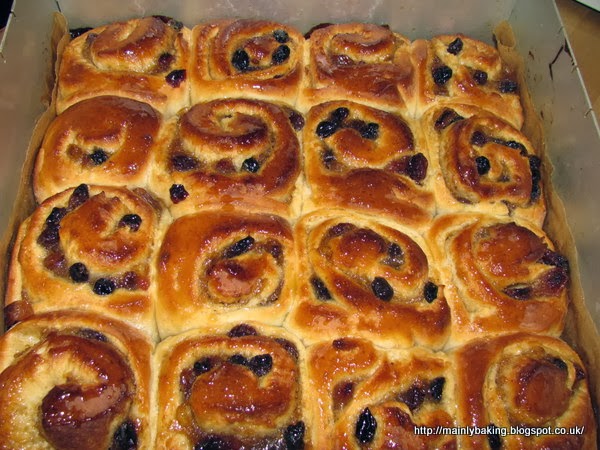
Mincemeat Chelsea Buns and a Bread and Butter Pudding

I've been determined to give my new food mixer a good work out, to test it's capabilities and to see if it's a worthwhile addition to the kitchen. After making pastry and cake batter, the next thing to try was yeast dough. This is something that I don't have consistent success with - a recipe which works well once can fail miserably the second time round. I've also been a fan of Dan Lepard's breadmaking method, which advocates a few, very brief, kneading periods before leaving the dough to rise, not least because I know my hands are not strong enough to knead dough for up to ten minutes.

I chose an enriched dough for Chelsea Buns, from the recipe book that came with the food mixer. It didn't look a lot different to many other recipes I could find online and in my cookery books. The dough was made from 500g strong white flour, salt and dried yeast, enriched with one egg, a little butter and sugar, and mixed to a soft dough with warm milk. After mixing with the dough hook for 4 minutes, the dough was left to rise in the mixer bowl, with the hook left in place. I am lucky that my oven has a dough proving setting, to ensure a constant warmth, as my kitchen can be quite cold - this is a new feature for me, as the oven is only a few months old. When the dough had doubled in size the mixer was used to knock back the dough, and it was then ready for shaping.

Instead of following the recipe and making 12 large buns, with the traditional filling of sugar, butter, spices and dried fruit, I rolled the dough out to make a longer thinner roll which could be cut into 16 smaller pieces and filled it with 200g mincemeat. These were placed in a 10" cake tin which had been greased and base lined with parchment. After the second rising the buns were baked at 200c for 20 minutes, then glazed with honey as soon as they came out of the oven.

I was really pleased with the texture of the buns, although I'm not sure how much was down to using the food mixer and how much was due to being able to prove the dough in a warm enclosure. I used a really basic marmalade which just tasted of vine fruit and spice, so the buns weren't much different to traditional Chelsea Buns in flavour.

Despite freezing 6 of the buns, we couldn't eat them fast enough, and those leftover were stale by the second day after baking. I used them in this 'light' Bread and Butter Pudding recipe from the BBC Good Food website. I used the custard part of the recipe, along with a handful of chopped apricots and some gooseberry jam, with the sliced Chelsea buns replacing the bread and the other dried fruit. I didn't use any brandy in the recipe, either. I really loved the addition of lemon zest to the custard, and wouldn't have guessed it was a low-fat recipe, but in future I would make it in a deeper smaller dish to get a softer centred pudding..