Showing posts with label small cakes. Show all posts

Thursday, 6 March 2014

Upside-down Toffee Apple Squares

Alphabakes, a monthly challenge to bake something based on a randomly chosen letter of the alphabet, has reached the end of it's first run through the alphabet. This month's letter is U, and although I've managed some imaginative entries for other difficult letters, I can't come up with anything better than 'Upside-down' cake this time.

However, I have found a recipe which is a departure from the more common pineapple cake, although my very favourite upside-down cake is Dan Lepard's 'Stone fruit yogurt cake'. This recipe, for upside-down toffee apple squares, appears in my recipe book as a brownie recipe, but I can't bring myself to call something without chocolate, a Brownie! There is a mistake in the ingredients list of the linked recipe - it should read 175g light muscovado sugar for the cake batter, not 15g. I used 1 1/2 teaspoons mixed spice instead of the spices listed there, and also added 85g chopped hazelnuts, as per my recipe.

Containing two grated apples, this cake batter makes a moist light cake and is chock full of chopped hazelnuts for added flavour and texture. The fact that the squares of cake are so light also mitigates against calling these brownies. I really liked the cake on it's own, but the topping (base, before baking) of slices of apple and a butter and sugar mixture, which set as a really good toffee mixture after baking, made it even more special. I had a problem cutting through the cooked slices of apple neatly, which spoiled the appearance of some of the squares, but that's just a small niggle.

AlphaBakes (rules here) is a challenge based on a randomly chosen letter of the alphabet. The dish made must feature something beginning with that letter as one of the main ingredients or part of the name. It is hosted jointly by Ros at The More Than Occasional Baker and Caroline at Caroline MakesRos is this month's host with the letter U, and will feature a round-up of entries at the end of the month.

Tuesday, 21 January 2014

Congress Tarts

 What is it about the combination of desiccated coconut and raspberry jam? I think it's a bit of national nostalgia for times past which sends so many people into a drooling tizzy when it's mentioned! Just as Proust had his madeleine moments, the British have the raspberry and coconut combination to take them back to a childhood of school dinner jam tarts sprinkled with coconut and sponge castles baked in dariole moulds (also called madeleines in some regions).

Whatever the reason the combination is loved, this recipe for Congress Tarts leapt out of the book at me (in my case, I found the recipe in a book called 'The Book of Old Tarts', by Elizabeth Hodder), as I was searching for a recipe for this month's Tea Time Treats challenge. The brief this month, set by Jane at The Hedge Combers blog is to make something for the tea table in which eggs play a role. To me, that meant that eggs ought to play a dominant role, as in meringues, custards, quiches, mousses and similar products. My problem was finding something which would fit into my normal baking programme, which is restricted at the moment due to a need to lose weight, and remaining Christmas treats still in the store cupboard. I needed something small, as well as tasty, and this recipe fitted the bill, as it looked possible to scale it down a bit without any problems

A Congress Tart is a cross between a British Macaroon and a Bakewell tart - raspberry jam is spread into the bottom of a pastry case and a macaroon mixture of egg whites, sugar, ground almonds and coconut is placed on top before baking. I had to replace about a third of the ground almonds with ground hazelnuts, as I didn't check my storecupboard properly before starting the recipe, but I don't think this was detrimental to the overall flavour - it was the coconut flavour which was dominant, despite adding a little almond extract and lemon zest to the macaroon mixture. The recipe in my book (as opposed to the online recipe, made in a jam tart mould) made eight 8cm tarts and was easily reduced by 1/3, so that in the end I only made six slightly smaller tarts.

As you can see from the photo below, the excess pastry was made into a raspberry jam and coconut turnover, to make the most of the delicious raspberry/coconut combination. The turnover was filled with 3 heaped teaspoons of raspberry jam and a tablespoon of desiccated coconut, and was sprinkled with a little more coconut before baking.

Tea Time Treats


Tea Time Treats (click here to see the rules) is a monthly challenge to bake for a good old-fashioned tea table, following the theme set by that month's host. It is hosted alternately by Karen at Lavender and Lovage, and a new host, Jane at The Hedge Combers. Jane chose the theme of eggs, and will be posting a round up of entries at the end of the month.

If it's not obvious from my description of Congress Tarts, I feel they are a good entry for TTT because the filling uses egg whites to bind and raise the macaroon mixture.


Sunday, 29 December 2013

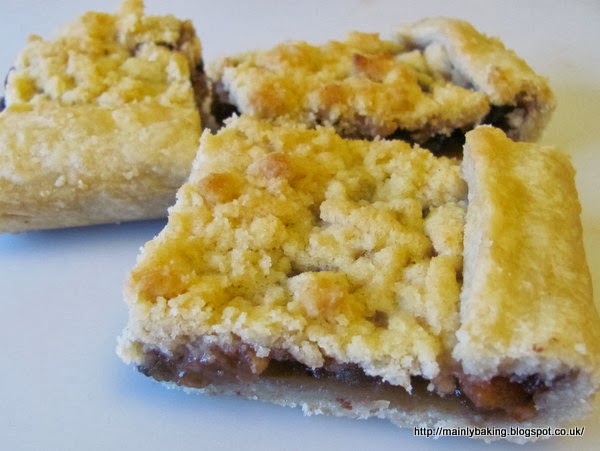
Mincemeat Streusel Slice

This is the last of my festive baking; after this there are bought Christmas goodies which must be eaten before I do any more baking.

I based this Mincemeat Streusel Slice on this recipe from Mary Berry, shown on this year's Great British Bake Off Christmas Special. The only part of the recipe I took exactly was the streusel topping - I used my own sweet shortcrust pastry recipe and used 500g bought mincemeat with 100g chopped apricots and a grated eating apple added to it.


Once I had lined the baking tray and spread the mincemeat over the pastry, I decided not to waste the excess pastry at the sides of the tin, so folded it down over the filling. This worked very well as it gave most of the slices a solid edge to hold onto after they were cut.


I liked Mary's recipe for the streusel topping - I often similar topping from Martha Stewart, I think, which first brought the tip of using melted butter to my attention. Using melted butter and bringing the ingredients together into a dough, for later crumbling, makes the topping less powdery. The semolina in this recipe adds a little extra crispness. I found that the streusel dough couldn't be grated as Mary suggested, but crumbling it evenly over the mincemeat was just as effective, and probably quicker than grating.


HAPPY NEW YEAR to YOU ALL!

Tuesday, 17 December 2013

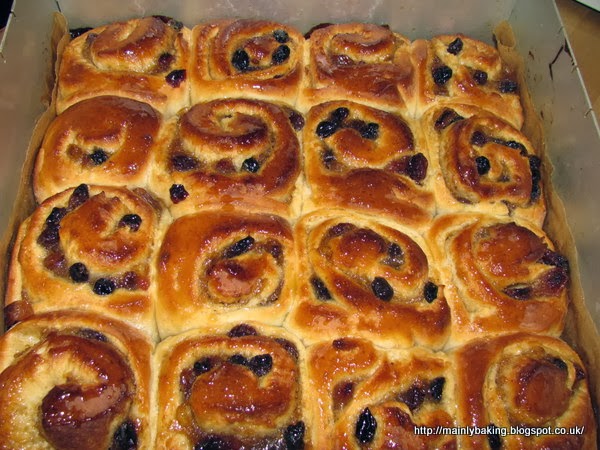
Mincemeat Chelsea Buns and a Bread and Butter Pudding

I've been determined to give my new food mixer a good work out, to test it's capabilities and to see if it's a worthwhile addition to the kitchen. After making pastry and cake batter, the next thing to try was yeast dough. This is something that I don't have consistent success with - a recipe which works well once can fail miserably the second time round. I've also been a fan of Dan Lepard's breadmaking method, which advocates a few, very brief, kneading periods before leaving the dough to rise, not least because I know my hands are not strong enough to knead dough for up to ten minutes.

I chose an enriched dough for Chelsea Buns, from the recipe book that came with the food mixer. It didn't look a lot different to many other recipes I could find online and in my cookery books. The dough was made from 500g strong white flour, salt and dried yeast, enriched with one egg, a little butter and sugar, and mixed to a soft dough with warm milk. After mixing with the dough hook for 4 minutes, the dough was left to rise in the mixer bowl, with the hook left in place. I am lucky that my oven has a dough proving setting, to ensure a constant warmth, as my kitchen can be quite cold - this is a new feature for me, as the oven is only a few months old. When the dough had doubled in size the mixer was used to knock back the dough, and it was then ready for shaping.

Instead of following the recipe and making 12 large buns, with the traditional filling of sugar, butter, spices and dried fruit, I rolled the dough out to make a longer thinner roll which could be cut into 16 smaller pieces and filled it with 200g mincemeat. These were placed in a 10" cake tin which had been greased and base lined with parchment. After the second rising the buns were baked at 200c for 20 minutes, then glazed with honey as soon as they came out of the oven.

I was really pleased with the texture of the buns, although I'm not sure how much was down to using the food mixer and how much was due to being able to prove the dough in a warm enclosure. I used a really basic marmalade which just tasted of vine fruit and spice, so the buns weren't much different to traditional Chelsea Buns in flavour.

Despite freezing 6 of the buns, we couldn't eat them fast enough, and those leftover were stale by the second day after baking. I used them in this 'light' Bread and Butter Pudding recipe from the BBC Good Food website. I used the custard part of the recipe, along with a handful of chopped apricots and some gooseberry jam, with the sliced Chelsea buns replacing the bread and the other dried fruit. I didn't use any brandy in the recipe, either. I really loved the addition of lemon zest to the custard, and wouldn't have guessed it was a low-fat recipe, but in future I would make it in a deeper smaller dish to get a softer centred pudding..


Monday, 15 October 2012

Gingerbread Rock Cakes - Dan Lepard

Serendipity is the "the accident of finding something good or useful while not specifically searching for it" according to Wikipedia. Finding this Dan Lepard recipe in my weekend newspaper magazine was certainly a happy accident. Just the day before, FB had been asking if it was possible to put the flavours of lebkucken into a cake, and here was Dan, claiming that his ginger rock cakes would be reminiscent of lebkucken! In yet another touch of serendipity, or maybe just good luck, I had all the ingredients to hand, so that was my weekend baking sorted!

This is a simple recipe to follow, yet still raised a question - the dough needs to hold it's shape, but how wet does it need to be? I added an extra tablespoon of milk to the 25mls added to the mix, which made quite a sticky dough, but without it, I couldn't incorporate all the flour. These blobs of dough don't change shape as they bake - any crags or outcrops of dough will still be there after baking, so don't expect uniformity unless you shape the dough beforehand. My rock cakes - I made 14 from the dough - baked in 15 minutes, the shortest time suggested.

To enhance the expected lebkuchen flavour I drizzled the buns with a very dark chocolate (85%), but I think this was too bitter as the rock cakes themselves weren't very sweet. In fact, the other suggestion of a lemon glacé icing might have been nicer as it would have added a sharp note to lift and brighten the flavour. Don't get me wrong, these little cakes were dense, dark and delicious, and full of the spicy flavours of autumn and winter, but the flavour overwhelmed the chocolate I used, and the addition of a lighter flavour would have been an improvement.

As for the flavours of lebkuchen - well, just about, but FB felt that the ginger was the overriding flavour, whereas ginger has been more muted in the lebkuchen we've eaten. I think these would also have been good baked as smaller cakes and perhaps half dipped in chocolate, but then I suppose I might just as well look out a lebkuchen recipe as do that! All in all - a quick bake packed with spicy flavour, although I think children might prefer a less sophisticated rock cake - perhaps the basic recipe Dan gives, enriched with a little spice and dried fruit.

I think FB would have preferred the lebkuchen flavours in a lighter cake, so I've got more work to do there, but this recipe has given me an idea of the flavours to look for in my search for a recipe to bake or adapt.