Showing posts with label yeast dough. Show all posts

Thursday, 13 August 2015

Zwetschgendatschi

or, to put it more simply, plum tart.

This German speciality should be made with a type of plum (the 'zwetschgen' part of the recipe name) which is similar to a damson, but is often made with other varieties of plums, particularly if the cook doesn't live in Germany! The pastry is made from an enriched yeast dough, the plums are arranged neatly on top  and the whole thing is baked in a hot oven. What could be simpler?

I found many variations when trying to decide on a recipe - shortcrust pastry is an option, rather than yeast dough; a streusel topping can be added; some recipes sweeten the fruit before baking, some sprinkle on sugar afterwards; some recipes use breadcrumbs on the dough, before arranging the fruit, to soak up any excess fruit juice. In the end, I decided to be guided by the one recipe I had in my cookery books - this was a dairy-free Jewish recipe, but I adapted it to use dairy products.

The dough was made from a teaspoon of easy-bake yeast stirred into 250g plain flour. To this was added 1/2 egg, a tablespoon of honey, a pinch of salt, 50g melted butter and enough warm milk to make a soft but not sticky dough (I used about 100mls of the 125mls recommended in the recipe). After kneading for 10 minutes the dough was left, covered, to rise until doubled in size. The risen dough was knocked back and rolled out to about 1/2 cm in thickness. There should be enough dough to line a 25cm diameter, loose-bottomed tart case, but I wanted to use my new rectangular tart case, so was left with enough dough to also line a 15cm diameter cast iron skillet,

Quartered pitted plums were arranged in neat rows in the rectangular case and the tart was left to prove again for 20 minutes. Then the tart was baked at 190C for about 25 - 30 minutes, until the pastry was golden. As soon as the tart was out of the oven it was sprinkled with cinnamon flavoured sugar.

Before arranging the plums on the small round base, I rolled out 80g of marzipan to fit the case, and laid this on top of the dough. I also cut the plums into 1/8ths for this smaller tart - it helped get a tighter fit  of fruit in the small space. After the second proving, this was baked for the same time as the large tart and also sprinkled with cinnamon sugar while hot (4 tablespoons of caster sugar with 1 teaspoon of cinnamon was enough for both tarts, with some left over).

I bought a kilo of plums and used roughly 600g for these two tarts. My recipe recommended 750g for one large 25cm tart.

The oblong tart was elegant in it's simplicity, and very tasty. The light sprinkling of sugar added enough sweetness to the plums, and I liked the way the plums held their shape; they were just cooked through but still looked fresh. The yeast dough pastry was light and made a nice change from shortcrust. Yeast dough could be considered  'healthier' too (or at least, less calorific) as it contains a much lower proportion of fat compared to pastry. I think I could have left the pastry a little thicker, and next time I will bake on a pre-heated baking sheet to try and get a crisper bottom.

The pastry was thicker on the small round tart, and this made it soft rather than crisp - reminiscent of eating a danish pastry. The sweetness of the marzipan, together with the almond flavour, made this tart much richer than the plainer one.

Both tarts are best eaten fresh as the sugar topping draws juices out of the fruit over time.

I didn't choose this recipe at random - this month's AlphaBakes challenge is the letter Z! This challenge is hosted alternately by Caroline, at Caroline Makes (who is the host this month), and Ros at The More Than Occasional Baker. The randomly chosen letter must be used as part of the name of the dish or as the start letter of a main ingredient - full rules here. I'm entering the oblong plum tart into the challenge; the round one isn't a traditional Zwetschgendatschi.

While thinking about the challenge I picked up several interesting recipes for various types of zucchini cake, so there might be a second entry this month, if I don't run out of time!

Tuesday, 17 December 2013

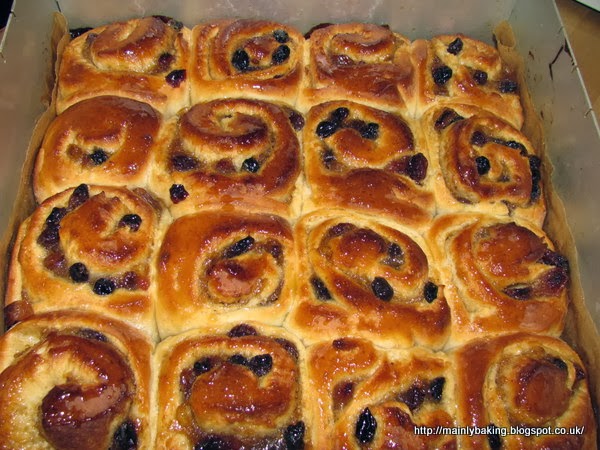
Mincemeat Chelsea Buns and a Bread and Butter Pudding

I've been determined to give my new food mixer a good work out, to test it's capabilities and to see if it's a worthwhile addition to the kitchen. After making pastry and cake batter, the next thing to try was yeast dough. This is something that I don't have consistent success with - a recipe which works well once can fail miserably the second time round. I've also been a fan of Dan Lepard's breadmaking method, which advocates a few, very brief, kneading periods before leaving the dough to rise, not least because I know my hands are not strong enough to knead dough for up to ten minutes.

I chose an enriched dough for Chelsea Buns, from the recipe book that came with the food mixer. It didn't look a lot different to many other recipes I could find online and in my cookery books. The dough was made from 500g strong white flour, salt and dried yeast, enriched with one egg, a little butter and sugar, and mixed to a soft dough with warm milk. After mixing with the dough hook for 4 minutes, the dough was left to rise in the mixer bowl, with the hook left in place. I am lucky that my oven has a dough proving setting, to ensure a constant warmth, as my kitchen can be quite cold - this is a new feature for me, as the oven is only a few months old. When the dough had doubled in size the mixer was used to knock back the dough, and it was then ready for shaping.

Instead of following the recipe and making 12 large buns, with the traditional filling of sugar, butter, spices and dried fruit, I rolled the dough out to make a longer thinner roll which could be cut into 16 smaller pieces and filled it with 200g mincemeat. These were placed in a 10" cake tin which had been greased and base lined with parchment. After the second rising the buns were baked at 200c for 20 minutes, then glazed with honey as soon as they came out of the oven.

I was really pleased with the texture of the buns, although I'm not sure how much was down to using the food mixer and how much was due to being able to prove the dough in a warm enclosure. I used a really basic marmalade which just tasted of vine fruit and spice, so the buns weren't much different to traditional Chelsea Buns in flavour.

Despite freezing 6 of the buns, we couldn't eat them fast enough, and those leftover were stale by the second day after baking. I used them in this 'light' Bread and Butter Pudding recipe from the BBC Good Food website. I used the custard part of the recipe, along with a handful of chopped apricots and some gooseberry jam, with the sliced Chelsea buns replacing the bread and the other dried fruit. I didn't use any brandy in the recipe, either. I really loved the addition of lemon zest to the custard, and wouldn't have guessed it was a low-fat recipe, but in future I would make it in a deeper smaller dish to get a softer centred pudding..