Showing posts with label orange. Show all posts

Monday, 19 July 2021

Marbled Bundt Cake (Chocolate, Orange and Chilli)

I returned to another old favourite for my son's 40th birthday cake. Both he and I have birthdays in the first half of July, so in truth, it was a shared cake, and he expressed no preference as to what I baked.

The recipe originally came from Alice Medrich,  but over the years I've made a few tweaks. Most importantly I've reduced the size of the cake to fit the only bundt tin I have and converted the American cup measurements to metric weights and volumes. I've also replaced the pepper in the recipe with cayenne pepper, and added the finely grated zest of an orange.

The cake is made with oil (olive or sunflower, depending on whether or not you want the extra flavour of olive oil) and cold milk and eggs, so is quick to make without needing to wait for ingredients to get to room temperature. The two batters are just layered into the pan and the marbling is formed by the movement of the batters in the tin as the cake cooks.

I was a little disappointed with the frosting - it didn't flow as far as I'd hoped, and then didn't set as firmly as I expected either - but that might have been due to the temperature in the kitchen - it was the hottest day of the year! I wouldn't usually frost this cake, but it was for a celebration!

I used another favourite - a Mary Berry recipe - for the frosting. Melt 90g of dark chocolate and 30g of butter together, then beat in 1 tablespoon of golden syrup and 1 1/2 tablespoons of milk. If used straight away, it should be a glaze, although I usually wait until it's cooler before spreading it on top of a cake to give a fudgy frosting. This time I wanted a flowing glaze, but it was too thick to cooperate! 

The revised recipe for the cake is written out in full in this post here on my blog, so there's no need to repeat it here. I will add that I now prepare bundt tins with a homemade lining paste, following Nancy Birtwhistle's recipe, which you can find in this recipe on her website. Once made, the paste (equal quantities of oil, flour and Trex cooking fat) keeps for many months in the fridge, in an airtight jar, and just needs bringing up to room temperature before use. I've used it for a few years now and it's never failed - the cakes have always released from the bundt tin perfectly.

Wednesday, 23 December 2020

The Triennial Chocolate, Fig and Ginger Panforte

For some reason, I have made this Panforte, for Christmas, at three year intervals - 2014, 2017 and again this year. Perhaps it's going to be a tradition!


Panforte is a particularly suitable Christmas treat this year, when, if we are meeting friends and family at all, it's on a very restricted schedule with regards to both numbers and time. It keeps for weeks after making, so however few of you there are to eat it, you'll get through it without any waste. 

This year, this panforte will almost be all mine! Apart from a brief visit from both my children on Christmas Day for an exchange of presents and a meal together, the Covid restrictions mean, like many others, I'll be alone most of the time. That doesn't bother me - all I need is a good book to keep me happy, and it will only be a few days before we're all back into the routines of our lives. For me that can be quite hectic, as I volunteer at the local Food Bank, which has been very busy since the start of the pandemic.

I followed my original recipe from 2014, which was a compilation of several other recipes, in a quest for perfection. I could vary the flavours by changing the fruit, or leaving out the ginger, but this particular combination of chocolate, figs and ginger, together with the spices and hint of orange, works so well that I'm reluctant to make changes.

Here's wishing you the best 

for this Festive Season, 

with hopes that 2021 

will be better for all of us!

Friday, 27 March 2020

Chocolate Chip and Orange Loaves

I baked two loaves to take one to each of my children, just before the Covid-19 lockdown measures became more stringent. At the time the food panic buying was at it's height and the supermarket shelves were empty of almost all baking ingredients, so I was relying on my store cupboard.


I wasn't sure when supplies would get back to normal so although I would usually use 4 eggs in this amount of cake batter, I decided to cut down to 3 and use the juice of the orange that I was zesting, in place of the 4th egg. That way none of the orange was left over either.

Ingredients
200g caster sugar
200g butter, softened
3 large eggs
250g SR flour
zest and juice of 1 orange
100 - 150g chocolate chips (I used about 30g milk chocolate chips and 100g of chopped plain chocolate)

Method
Preheat the oven to 180C (160C, fan) and line 2 x 450g (1lb) loaf tins (I use the pre-formed liners for loaves).
This cake is made by the all-in-one method, so put everything, except the orange juice and chocolate, into a bowl and beat with a hand-held mixer until smooth, adding enough orange juice to give a dropping consistency. (I needed all the juice from the small orange I was using, but if more liquid is needed a little milk or water can be used too.)
Use a large spoon to fold in the chocolate, then divide the batter equally between the two tins and level the surface.
Bake for 60 minutes, or until a test probe comes out clean.
Cool in tin for about 10 minutes, then move to a wire rack.


I didn't get to see the insides of these cakes, or to taste them to see if the lack of egg was detrimental to the texture, but there were no complaints from the recipients. I asked my daughter if the cake was dry and she said that it wasn't, so I'm pleased about that.

Unfortunately I didn't get any good photos either, although you can see the bulging top!

Saturday, 14 March 2020

Fruited Banana Loaf

After deciding to leave two bananas to ripen enough to use in a cake, I realised that I've never made a basic simple banana bread/cake in the 10 years I've been writing this blog. It was definitely time to remedy that situation, even though I don't regularly have bananas available.

Of the two simplest recipes I could find, I decided to go with Mary Berry's, as she appeared to be cutting down on the fat and sugar content to compensate for adding the bananas rather than just putting bananas into a standard sponge cake recipe, as here. The other advantages of Mary Berry's recipe were that it was an all-in-one mixture, so really quick to put together and get into the oven, and would freeze well. Being able to freeze slices of cake is always a bonus for me!

After saying I wanted simple, I then changed my mind a little and decided that I would like some extra flavour, so I added the zest of a small orange, 70g of a mixture of sultanas and dried cranberries, and I used 2 tablespoons of orange juice instead of the milk in the recipe.

I folded the fruit into the batter after it had been mixed, rather than include it at the all-in-one mixing stage.

None of these changes affected the baking time - the cake was still cooked in the time suggested in the recipe.

The cake had a lovely texture, moist but not too heavy, and the extra ingredients boosted the flavour without masking the taste of the banana.

This is definitely a cake to remember when I'm baking for coffee mornings, and I can imagine other additions that would work well - chopped dates, for instance, or nuts and a little mixed spice.

I'd even go so far as to say it's a cake worth buying bananas for, if you can plan far enough ahead to let them ripen!


Friday, 3 May 2019

Chocolate Orange Cheesecake

This is a really good cheesecake recipe, in so many respects, that it's a pity the topping lets it down a little. The base has just the right proportions of plain chocolate digestive biscuits and butter, so that it isn't too crumbly nor does it set too hard to cut. The cheesecake mixture is light and delicate in texture and flavour, and doesn't crack while cooling (although I did run a knife around the edge as soon as it came out of the oven to help prevent that).

The idea of the topping, which is a mixture of orange flavoured chocolate, and chocolate with almonds in it, is lovely, and it tasted delicious, but the chopped (or grated) chocolate melted on the hot cheesecake, then set to a crisp brittle layer, which made it difficult to cut and serve neatly. What is even more annoying, is that this didn't happen the first time I made the cheesecake - then the tiny pieces of chopped chocolate stayed as a 'rubble' across the top and didn't hamper cutting it at all. I suppose I must have used a different brand of chocolate this time.

I didn't experience any problems with the recipe for this Chocolate and Orange Cheesecake, apart from the issue with the topping. I don't have a large food processor, so mixed with a hand-held electric beater, on a slow setting, after the eggs has been whisked thoroughly. As usual, even a double layer of foil failed to prevent a little water getting between the foil and the springform tin - perhaps it was condensation, as I was using extra-strong foil, which shouldn't have got holes in it with my careful handling.

I've been trying to think of a different way to top the cheesecake. Piped and set chocolate shapes or a thin layer of ganache, left to drip down the sides, are two options to keep the chocolate flavour. Another possibility is orange curd swirled into lightly whipped double cream or mascarpone. Overall, though, this is a recipe worth repeating.

Tuesday, 5 March 2019

Date and Apricot Cookies

I didn't intend to bake last weekend, but I had an online discussion with friends about whether a weird sounding recipe that we'd all noticed would actually work. The recipe in question was this one, from former GBBO contestant Tamal Ray, in the Guardian Feast magazine. Not only did the recipe sound strange - so much liquid! - the accompanying picture didn't look particularly attractive either - should a baked cookie still look shiny? As I had all the ingredients to hand, including date syrup, one of my favourite sweeteners, I decided to set my doubts aside and give it a go.

The result was a delicious soft cookie, strongly date flavoured, with nuggets of sweet dried fruit. I can't say the recipe was entirely successful, as the cookie dough was too soft to shape initially, and had to be chilled for 90 minutes before I could roll it into balls. And my cookies didn't look much like the picture in the magazine, either, but for my personal taste, that was an improvement.

Because the dough had been chilled I allowed an extra 3 minutes baking, but otherwise followed the recipe exactly (apart from needing to chill the dough, of course). I didn't have medjool dates, but did have some large soft dates to use instead, and I used the zest of two tangerines instead of an orange - but neither of these changes substantially altered the recipe.

The cookies were quite large - if I make them again I think I would make them a little smaller - and very soft, and both the orange and almond flavours were overwhelmed by the date syrup, but I'm still glad I decided to risk the experiment, and that the recipe worked (with just a little adjustment!).


Friday, 1 February 2019

Mincemeat and Orange Cake

With this cake I surprised myself by finishing off my mincemeat before the end of January; it's not unusual for me to be baking with the remnants from a jar at Easter. I've used this recipe before, adding my own touches to the ingredients, as you can see here.

As I had two jars of mincemeat open, one of which had orange flavour notes, I added the zest of an orange to the cake, and soaked the rather wizened sultanas I was using in the juice of the orange for a couple of hours, before draining off the excess. I was lucky that there was just about 400g of mincemeat when the contents of both jars were combined. I also added a sprinkling of demerara sugar as a topping, before baking.

I cooked the cake in a smaller tin - 20cm in diameter - as I prefer a deeper cake, but this didn't affect the cooking time, it was still done in 75 minutes.

It looks, in the photo as if the fruit sank, but that's just the randomness of that particular slice - it was  much more evenly distributed in reality! Adding the orange definitely perked up the cake - the usual spiciness and tartness of mincemeat is muted when it's spread though cake batter, giving a much more gentle flavour.

Wednesday, 19 December 2018

Brownies with Almond and Orange Chocolate Chips

After deciding to make brownies, I realised I didn't have enough butter, so went back to the oil-based recipe I used to use frequently when my son was on a low saturated fat diet. It's not as rich as a butter-based recipe, but it's not bad at all. I added 100g of  dark chocolate with orange and almond pieces to give more interest to both the flavour and texture.

The recipe is based on this one, from Cookie Madness, although I make it half as big again to make deeper brownies, and use sunflower oil rather than olive oil, as well as changing the add-ins. I have tried olive oil, and although it adds an interesting dimension, it's not a flavour I want every time I bake them, so I find a more neutral oil is better on most occasions.

Ingredients
150g plain chocolate (about 70% cocoa solids)
120mls sunflower oil
3 large eggs
130g caster sugar
100g dark muscovado sugar
1 teaspoon vanilla extract
105g plain flour
100g chopped chocolate of choice (I used a dark chocolate with almond pieces and orange flavour)

Method
Pre-heat the oven to 180C and line a 20cm square baking tin with parchment.
Melt the chocolate in a bowl over simmering water, then remove from the heat and whisk in the oil.
In a large bowl, whisk the eggs, sugars and vanilla for 5 minutes, then fold in the chocolate and oil mixture.
Sift the flour over the batter, and fold in, followed by the chopped chocolate.
Transfer the batter to the baking tin, then bake for 25 minutes.
Cool in the tin, then cut into squares or bars.

Friday, 2 November 2018

Almond and Orange Cake, with Chocolate Chips

At the moment, I'm baking more frequently; my son is staying with me for a few weeks, as he had to sell his flat before he could complete on his new purchase, so that he didn't lose his buyer. He could eat cake several times a day, and not have to worry about putting on weight.

This recipe is based on the proportions of a Madeira Cake - more flour than butter and sugar - which makes a sturdier but more satisfying cake, which keeps well. I added ground almonds for moistness, and a little almond extract to make sure there was a good almond flavour. Classic flavours which work well together!

Ingredients
175g softened butter
175g caster sugar
3 large eggs
a few drops of almond extract
finely grated zest of 1 large orange
200g SR flour
50g ground almonds
a little milk, if necessary
100g dark chocolate chips or 70% cocoa solids chocolate, roughly chopped*
a sprinkling of flaked almonds for topping, optional

* I prefer to chop a bar of chocolate as I like the mix of large and small pieces of chocolate, plus the tiny speckles which splinter off, in this type of cake

Method
Preheat the oven to 170C, and prepare a 20cm(8") round deep cake tin. I use non-stick springform tins with a parchment base liner.
Cream together the butter and sugar until light and fluffy.
Add the eggs, one at a time, with a spoonful of the weighed amount of flour. Beat in on a slower speed, if you are using a hand-held mixer.
Fold in the flour, almonds, almond extract and orange zest, adding a little milk, if needed, to give a soft dropping consistency. Finally, fold in the chocolate.
Transfer the batter to the prepared tin, level the top, and sprinkle over the flaked almonds, if using.
Bake for about 60-70 minutes, or until a test probe comes out clean and dry.
Cool for 15 minutes in the tin, then transfer to a wire rack to complete the cooling.

This cake would be easy to remove from the base of the cake tin, as it's quite sturdy. I just leave it on the base for convenience - it makes it easy to move in and out of the storage container.

Friday, 10 August 2018

Tropicana Banana Cake

This banana cake with tropical flavours is another Dan Lepard recipe which I've used, and written about, before. As the years go by, the flavour of this cake varies according to whatever semi-dried exotic fruits I can get hold of - this year I used apricots, pineapple and mango - as fashion in dried fruit seems to change quite quickly. I bought dried mandarins, intending to add them too, but although I loved the taste, their texture didn't seem right for a cake.

As well as exotic fruit, the other flavours added to this cake are coconut and orange, and some ground  almonds are used too, to keep the cake moist. The method for making the cake is a little tricky, and this is one time when it pays off to be well organised and have all the ingredients prepared and laid out in a logical arrangement before you start mixing.

As I've noted previously, the cake takes quite a bit longer to bake than suggested in the recipe - I added at least another 20 minutes before I was happy that the cake was fully cooked. The raw batter also almost fills a standard 2lb (900g) loaf tin, so if you've something slightly larger, it might be less worrisome to use that - I kept checking the oven, expecting to see the rising batter overflowing the tin.

Because I was taking this cake to a meeting of my local Cake Club (a replacement for the active branch of the Clandestine Cake Club, which now only exists on Facebook) I decided to pretty it up with a very light drizzle of orange glacé icing, made with icing sugar and some of the juice from the orange which provided the zest for the cake.

Everyone loved this cake - the blend of flavours worked really well with the dominant flavour being the coconut (although it wasn't overwhelming), the fruit was soft and chewy and the texture of the crumb was tender and moist.

There was one other banana loaf cake at the cake club - this one had added raspberries and chocolate chunks - along with several cakes based on lemon, a chocolate and vanilla marble cake, a custard slice and an apple and pecan cake. Now that the rules of the Clandestine Cake club don't apply, and we're not limited to large cakes, we hope to get more variety at future meetings, as pastries, biscuits and small cakes can be made - anything edible really!


Wednesday, 19 July 2017

Chocolate Chip and Orange Cookie Bars

 Despite knowing that recipes existed for baking cookie dough in a tray, it seemed quite difficult to find a suitable recipe, even on blogs and websites well-known for cookie recipes. Perhaps I was using the wrong search words, as it wasn't until I looked at Fig Jam and Lime Cordial that the word 'slab' cropped up! Or perhaps I was just being fussy - I needed a recipe to suit my store-cupboard ingredients, as I didn't have an opportunity to shop.

I used half quantities of Celia's recipe, (also here for ingredients, and method for making individual cookies) and baked in a 20cm(8") square tin. I made a couple of minor changes - I used 180g plain chocolate, roughly chopped, and added the finely grated zest of an orange. A classic flavour combination that's hard to beat!

Cookie Bars don't have the aesthetic appeal of individually baked cookies, but, boy, are they quicker to make! These were particularly tender, with a 'melt-in-the mouth' texture, so I'm sure I'll be using the recipe again.

Ingredients
200g plain flour
1/4 teaspoon bicarbonate of soda
large pinch of salt
finely grated zest of 1 orange
110g light muscovado sugar
50g caster sugar
125g softened butter
1 large egg
1 teaspoon vanilla extract
180g 70% chocolate, roughly chopped

Method
Preheat the oven to 150C fan setting, and line a 20cm (8") square baking tin with parchment.
Whisk flour, bicarbonate of soda, salt and orange zest together in a medium bowl.
In a large bowl cream the sugars and butter together, then add the vanilla extract, egg and a tablespoon of flour (to prevent curdling) and mix until just combined.
With the mixer on a low speed, add the rest of the flour mix, and beat until just combined. Stir in the chocolate pieces by hand.
Transfer the dough to the baking tin and spread evenly, using damp fingers, or the back of a large metal spoon.
Bake for 25 minutes, until firm and just beginning to colour. Cool in the tin, then cut into bars.

Sunday, 9 July 2017

Red Gooseberry and Orange Crumble

I wouldn't normally add a post about what is essentially my usual crumble recipe, but I haven't baked anything for over two months now, so need to keep the blog alive! 'Not-baking' started with a need for both of us to lose a little weight before going away to France, so that the inevitable excesses of holiday eating didn't have too great an impact. Unfortunately, we then returned from holiday to face a family health crisis, which hasn't left me with any time to bake.

But, however little time you have, the garden continues to demand attention - this weekend it was the red gooseberries which needed harvesting. There was only 300g of fruit on  the bush, not quite the amount I usually use, so I added a chopped up orange segments to the gooseberries, and the zest of the orange to the crumble mix. It added an interesting dimension to the flavour.

Ingredients
80g plain flour
80g porridge oats
80g light muscovado sugar
80g butter, in small cubes
1 orange
300g prepared gooseberries
50g caster sugar
2 teaspoons ground rice (to thicken the fruit juices)

Method
Put the flour, oats, muscovado sugar and butter into a large bowl, and add the finely grated zest of the orange. Rub in the butter to make the crumble mix.
Cut the peel and pith from the orange, over the dish in which you are going to bake the crumble to save any juice. Cut the orange into small pieces, then mix with the gooseberries, caster sugar and ground rice, in the baking dish.
Scatter over the crumble mix and press down lightly.
Bake at 200C (180C fan), for about 45 minutes, until the crumble is golden brown and the fruit juices are bubbling.

Thursday, 11 May 2017

Rhubarb Vanilla Yogurt Cake

I happened upon this recipe, on the Riverford Organic Farmers website, by chance, while looking for new recipe for a rhubarb cake. I wanted one which didn't use a lot of fruit, as my crowns aren't doing well this year (I think it was the lack of a prolonged cold spell during last winter).

All I can say is that I'm thrilled to have found this recipe; it made a perfect cake! As an added bonus, it couldn't be simpler to make - dry ingredients in one bowl, wet in another then combine the two and mix briefly. The rhubarb was even mixed with the dry ingredients, reducing the steps needed to mix the batter even more, as fruit is often folded in separately at the end. I think it's probably quite important to keep the rhubarb pieces small, so that they don't sink through the cake during baking, but the raw cake batter was thicker than normal, which also helps.

I did make one change to the recipe - I only had vanilla yogurt available, rather than plain, but as I wasn't adding an additional flavour, only a little more sugar, I decided to go ahead anyway. The resulting cake was light but moist, with a really tender crumb, and it wasn't too sweet either (even when using a sweetened yogurt), allowing the tart flavours of the rhubarb and orange zest to show through. It was fantastic while still warm, as a dessert, and almost as good when it was completely cold, eaten as a cake. This is definitely a cake to make again!

Friday, 21 April 2017

Mincemeat and Apple Cake

Another outing for the cake I often make when I want a dessert with fresh fruit, but can't be bothered to fuss around with pastry. Because I hadn't checked supplies and found myself short of flour, I used a proportion of spelt flour in the recipe this time - it seemed to make the cake a little more crumbly.

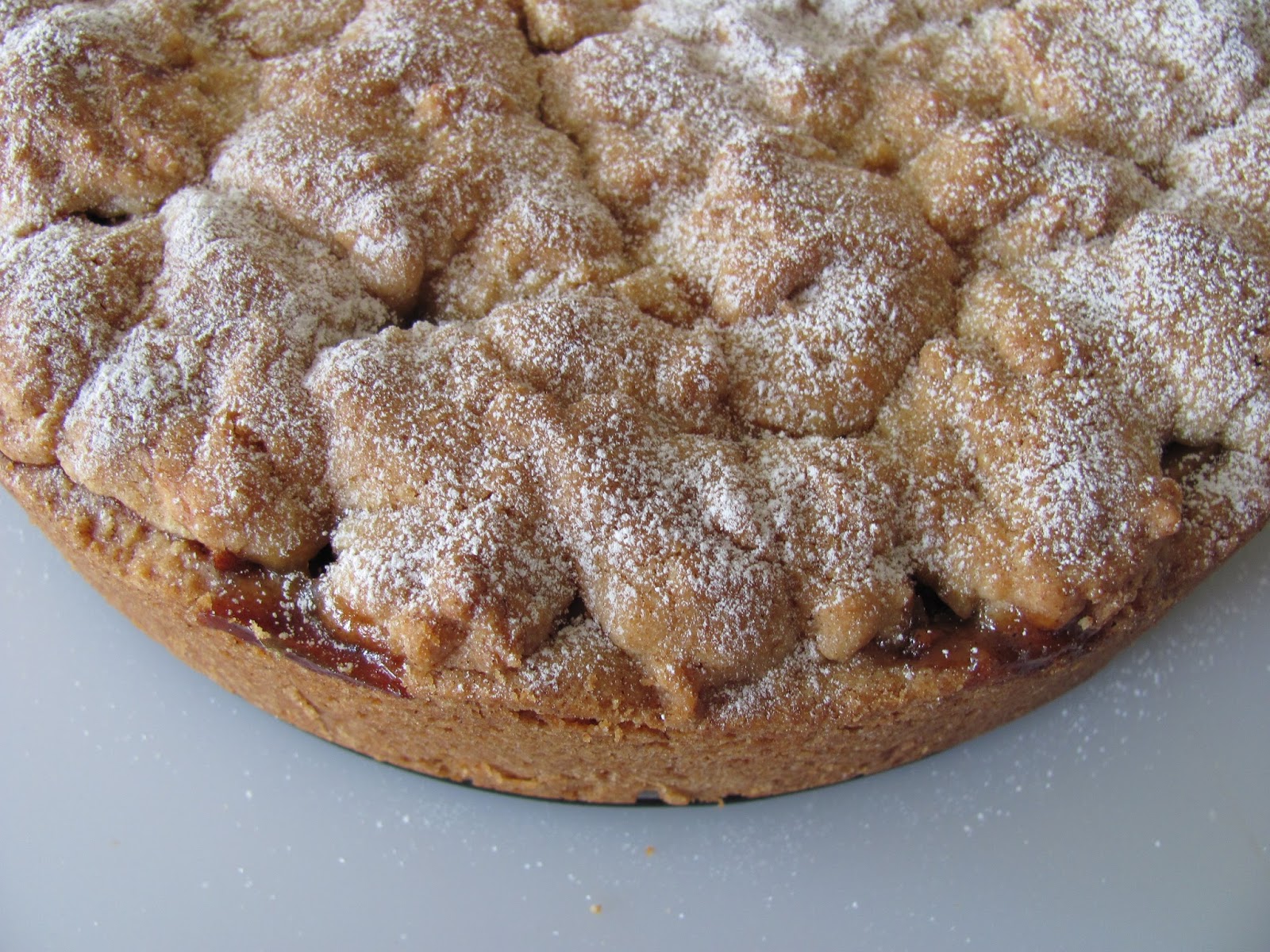
Anything with mincemeat in it smells wonderful when it is baking; in this case the flavour was pretty good too. Adding the apples and orange zest cut back on the sweetness of the filling a little without changing the flavour much, as the mincemeat had it's own citrus notes. The dough has a texture somewhere between pastry and scone - what I imagine the old-fashioned American shortbread cakes to be like.

I'm pleased to say that this cake used the last of my winter mincemeat stocks!

Ingredients
150g butter
150g caster sugar
1 large egg
*100g SR flour
*200g white spelt flour
*1 teaspoon baking powder
250g mincemeat
2 eating apples, peeled, cored and chopped into small pieces
grated zest of 1 orange

* you can use 300g SR flour, in which case you won't need the baking powder

Method
Preheat oven to 180C. Grease and base-line a 20cm (8") springform cake tin.
Melt the butter in a large bowl in the microwave - it doesn't need to be very hot, just liquid. Stir in the sugar, then beat in the egg.
Add both flours and the baking powder and mix to a soft dough. Put 2/3 of the dough into the baking tin and spread out into an even layer with your fingers, building up a little wall around the sides of the tin.
Mix together the mincemeat, chopped apples and orange zest and spread onto the cake base.
Crumble the remaining dough evenly over the filling and press down lightly, spreading the dough as you do - it should more or less cover the top, but any small gaps will fill as the dough rises and spreads during baking.
Bake for 50-60 minutes until the top is firm and golden. Cool for about 15 minutes, then run a knife between the cake and the tin, in case any fruit juices have leaked from the cake and are sticking to the sides of the tin - this can sometimes happen with mincemeat.
Dust with icing sugar before serving, either warm or at room temperature. This cake can be quite fragile, so I always leave it on the springform base.

Monday, 17 April 2017

Golden Simnel Cake

My family's festive celebrations have never included traditional fruit cakes - we're more of a mini chocolate appreciation society -  so I was surprised when my daughter asked me to make a Simnel Cake for Easter this year. I'm not averse to traditional recipes but I still wanted to put a spin on this cake to make it more personal, so I decided to make a golden fruit cake.

After looking at several recipes, I thought that Felicity Cloake's recipe from her 'How to Cook the Perfect.....' series in The Guardian would be the best one to adapt to what I wanted. I particularly liked the idea of adding saffron to help the golden colour of the cake I was planning.

I used the same quantities of all ingredients, although I used caster sugar instead of light brown sugar, to keep the crumb colour as pale as possible. Instead of using 400g of the fruit Felicity suggested (sultanas, currants and glacé cherries) I used 115g of each of sultanas, golden raisins and chopped apricots and 55g chopped dried peaches. I left the mixed peel in the recipe but took out the chopped almonds, as my daughter doesn't always like chewing on pieces of nuts, even though she loves the flavour of almonds. I used shop-bought white marzipan instead of yellow - just a personal preference!

It's a pity I didn't cross reference Felicity's decision making processes with the sources she used, or I would have discovered that her oven temperature was for a fan setting, not a conventional oven - after 2 hours at the quoted temperature the cake batter was still raw. It took another hour with the oven turned up another 20C for the cake to cook. Anyone with any experience of fruit cakes would have noticed the error straight away, but I've hardly ever made a rich fruit cake, even in 40 + years of cooking!

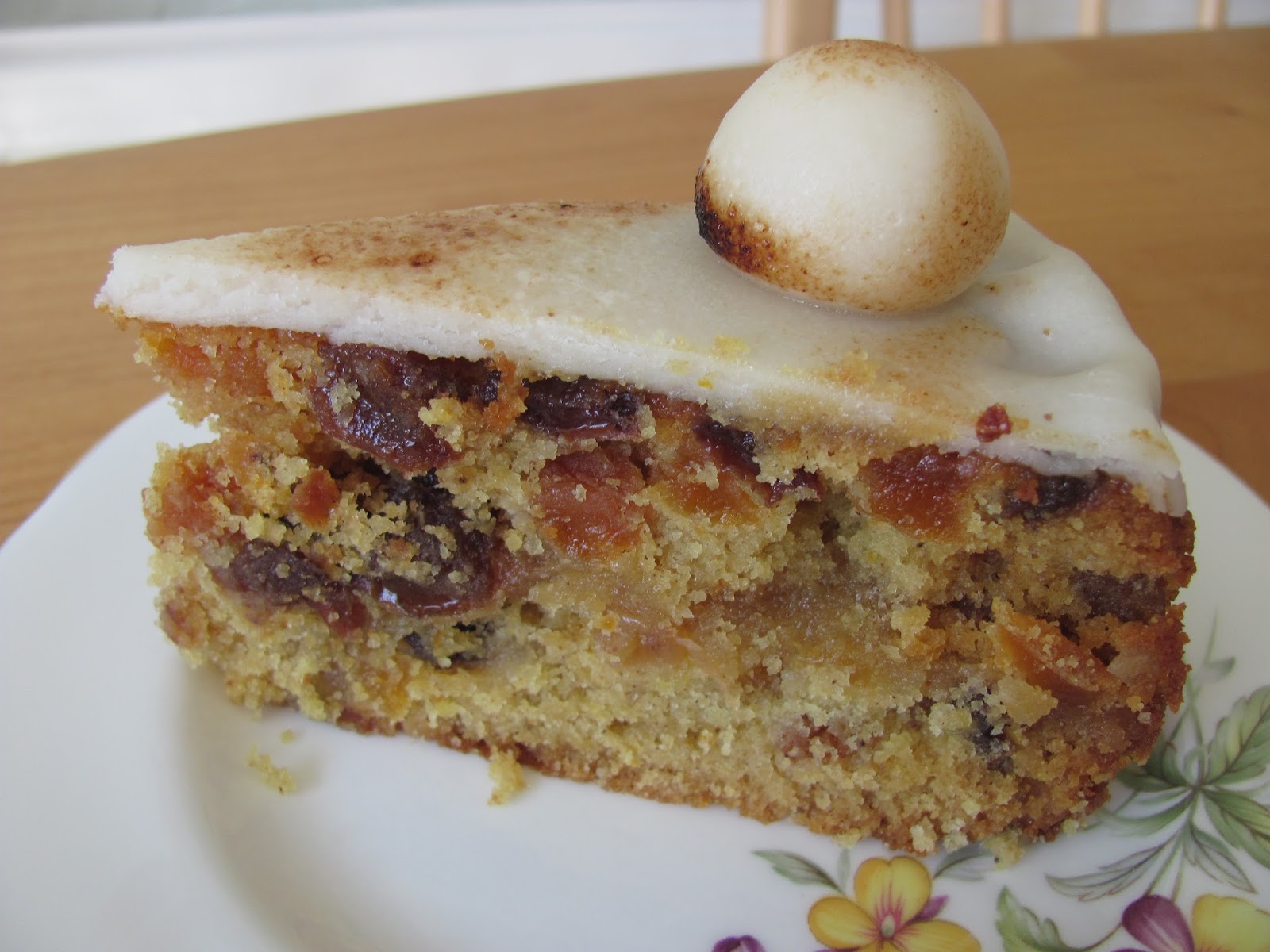
I was quite impressed with the look of the finished cake, although if I ever make another I will use more marzipan so that I can put thicker layers inside and on the top. The size of the 11 decorative balls, at 15g each, was about right, however. When cut, the colour of the crumb was just right for a golden cake.

I liked the flavour of the cake - a delicious subtle balance between spice and citrus, with all the fruits working in harmony, so that none stood out more than others. The soft inner layer of melted marzipan added a note of bitter almonds to the cake, although it hadn't stayed level in the cake, possibly a result of the error in cooking temperature.

There were other faults too, which might have been caused by the same error - the fruit wasn't evenly distributed in each layer, and although the cake was really moist, it was also crumbly and didn't cut cleanly. However, these faults were outweighed by the lovely flavour; all it really meant was that it was difficult to get a good photograph. I will have to try the recipe again, and cook it properly next time!


Thursday, 13 April 2017

Rhubarb, Marzipan and Citrus Cake

I've been harvesting our homegrown rhubarb since the middle of March, and this traybake recipe is perfect for the beginning of the season when there are some thin stalks to pick. If you can only get thick sticks, then I suggest you cut them into fairly thin slices, both to distribute the rhubarb evenly through the cake, and make sure it cooks properly.

I picked this Rhubarb, Marzipan and Citrus Cake recipe because I wanted something portable to take to my daughter, who was cooking a Mother's Day dinner, and also because I know she loves marzipan.

I followed the recipe exactly, although I used the zest from the whole lemon and orange, as I didn't see the point of leaving half grated fruit - this turned out to be a good move, as the citrus flavour wasn't very pronounced, even with the extra zest. I also used fine cornmeal rather than polenta, as I can only get the quick-cook sort which is relatively coarse.

What the recipe doesn't mention is that initially the cake batter seems too stiff, and although it does slacken a little when the fruit is added, it never gets to the 'dropping' stage. Resist the temptation to add more liquid -  more juices will be released from the fruit during baking.

We all loved this dessert - there were subtle citrus notes amongst the tang of the rhubarb, and the marzipan gave concentrated pockets of the sort of almond flavour you don't get from ground almonds alone. My husband reckoned it would come a close second to rhubarb crumble in his 'favourites' list!

Sunday, 26 March 2017

Mincemeat Flapjacks

I'd planned to make mincemeat shortbread from Sue Lawrence's book 'On Baking', but we were suffering from an unscheduled cut in our water supply, which meant I couldn't do anything which was going to make my hands really sticky - such as rubbing fat into flour, or handling biscuit dough. Luckily I found a recipe for mincemeat flapjacks a bit further on in the book, and decided I could make the recipe without touching any of the ingredients in a way which would need me to wash my hands. Just a quick wipe with a hand sanitiser afterwards and all was well. The flapjacks were made in one saucepan too, which minimised the washing up - useful when you can't actually wash-up at all!

Ingredients
225g mincemeat
170g butter
285g golden syrup
the grated zest of 1 orange
425g porridge oats

Method
Pre-heat oven to 180C and line a baking tin roughly 20 x 30cm (8 x 12") with baking parchment, using one piece big enough to come up the sides of the tin too.
Melt the mincemeat, butter and golden syrup together in a large pan, over a low heat, stirring often.
When the butter has melted remove the pan from the heat and add the orange zest and oats. Mix everything together thoroughly.
Transfer the oat mixture to the baking tin and spread evenly, pressing down firmly. Bake for 25-30 minutes until golden brown.
Mark into pieces while still warm, but cool completely before removing from tin.

The smell while these flapjacks were baking was fantastic, and they tasted pretty good too. There wasn't a large amount of mincemeat in the recipe but it was enough to give quite a strong flavour. The mincemeat I used was quite citrussy, so it was complemented by the added orange zest. My usual flapjack recipe uses more sugar than golden syrup, whereas this recipe uses mainly golden syrup plus the sugar in the mincemeat. The end result was very similar, as these flapjacks were also nice and chewy - they were perhaps just a little softer than those I usually make.


Friday, 24 February 2017

Date, Orange and Cardamom Cake

dairy-free

This is a recipe from one of Waitrose's monthly recipe cards  (also online here). I didn't pick it because it was dairy-free, but because I liked the sound of the other ingredients when put together - dates, orange, almonds and cardamom. I just happened to have some dairy-free spread to use up too, which was an added bonus. It's a strange recipe - it uses only bicarbonate of soda as a raising agent and is cooked at a very low temperature; the dates, sugar and orange are all acidic, so I presumed these ingredients would interact enough with the bicarbonate to raise the cake.

I had to use a slightly smaller baking tin, 20cm in diameter rather than 21cm, but the cake still cooked in the time given in the recipe. There was a slight dip in the centre, which spoiled the appearance of the cake a little - no idea why that happened, unless it was using the smaller tin! This time I added the drizzle of orange frosting suggested, just to alleviate the brownness of the cake, but it wasn't really necessary for flavour.

The cake was, surprisingly, as it contained wholemeal spelt flour, very light and moist. Both the orange and cardamom flavours were quite subtle, but I don't think that's always a bad thing - sometimes you just want all the ingredients to blend into something unique which is delicious but unidentifiable. You don't always want to be hit over the head with several, or even just one, big flavour, and that's what happened here. Because of this, and because the cake wasn't too sweet, I think this was a cake where the flavour of the spelt flour was noticeable too.

This is definitely a recipe to put in the 'repeat' file.

Thursday, 29 December 2016

Carrot and Ginger Loaf Cake

I loved this cake! It was lighter in texture than the gingerbread recipe I usually use, but the carrot added moistness and texture, and the cake was delicious. I can only find one criticism to make, and that was that it needed a little more ground ginger for my tastes. I found the recipe, on the Good Food site, when I was looking for something to make from storecupboard ingredients, so while I could rustle up some carrots, I didn't have any oranges or lemons in the house. I almost left out the two citrus elements altogether, but in the end used the zest of a clementine and a few drops of lemon extract. I'm glad I did add them, as the freshness of the citrus really lifted the flavour.


Another bonus point was that the cake was really quick and easy to make, using only a saucepan, a spoon and two bowls to weigh the flour and carrots. I think it was in the oven within 10 minutes of starting to assemble the ingredients.

As usual, I didn't add the frosting - it probably would have added a tasty extra citrus note to the cake, but it was fine without it, in my opinion.

Saturday, 17 December 2016

Orange and Cranberry Cake

with apricots and macadamia nuts

This loaf cake is based on the proportions of a madeira cake, rather than a sponge - equal quantities of butter, sugar and eggs, but a larger amount of flour. This makes the cake softer and richer than the more basic fruit loaf recipe I sometimes use, and the extra flour helps prevent any added fruits and nuts from sinking. I usually make these little loaves as an all-in-one mixture, to save time. For this cake, I was using up oddments from the storecupboard, including the remnanats of a pack of mixed macadamia nuts and dried cranberries, plus some extra cranberries from another pack, so I'm not sure of the exact weight of each individual ingredient, although there were more cranberries than anything else - as long as the total weight is around 150g the cake will be OK

Ingredients
100g softened butter
100g caster sugar
2 large eggs
150g SR flour
zest of an orange, finely grated
milk to mix, if needed
150g of a mixture of dried cranberries, dried apricots and macadamia nuts

Method
Preheat the oven to 180C and line a small (450g/1lb) loaf tin.
Put the butter, sugar, eggs, flour and orange zest into a mixing bowl and beat with an electric mixer until the batter is well blended and smooth. Add a little milk if necessary to give a dropping consistency.
Fold in the dried fruit and nuts with a spoon, then transfer the mixture to the prepared tin.
Bake for about 50 minutes, or until a test probe comes out clean.

As I said a few posts back, cranberries and apricots is one of my favourite combinations of dried fruits. Here, the orange zest adds a freshness to the cake and the macadamia nuts give a contrasting texture.