Showing posts with label sultanas. Show all posts

Monday, 30 August 2021

Sultana and Lemon Buckwheat Flapjacks

For some long forgotten reason, I have buckwheat flakes in my store of baking ingredients and they need using soon. They look like rolled oats, so I wondered if they would make good flapjacks. I was relying on them having the same sort of absorbency as rolled oats, but in case they hadn't, I decided to use them 50:50 with oats for the first trial, and take a tip from Lynn Hill at Traditional Home Baking, and add 50g of plain flour to my usual recipe. This makes the flapjacks softer and less sticky, so if absorbency was a problem, extra flour would help.

In case the flapjacks didn't work well, I used some of the cheapest add-ins that I had - sultanas. I also had a couple of lemons in the fridge which really needed using up, so added the zest of both of them to the mix. This turned out to be a flavour combination which worked really well.

I needn't have worried. Although the flapjack mixture initially looked wetter than usual, everything was absorbed during baking and the flapjacks emerged from the oven looking as good as ever! 

I tasted both the buckwheat flakes and oats raw, and although some online sources describe buckwheat as nutty and slightly bitter, I thought they were both equally bland and tasteless. So although buckwheat probably isn't something one would use to add flavour to anything, it does have nutritional benefits. It is gluten-free, high in fibre and magnesium and relatively high in protein.

The recipe is very simple: 

Melt together 160g butter, 70g golden syrup and 100g sugar. (I usually use light muscovado, but only had soft brown sugar in stock - even white would do!) This can be done in a bowl in the microwave, or a pan on the hob. Only heat until the butter has melted; don't let the mixture boil. To this mixture add 120g rolled oats, 120g buckwheat flakes (or use all oats), 50g plain flour, 100g sultanas and the finely grated zest of 2 lemons. Mix well until everything is combined evenly. Tip into a 20cm square shallow baking tray, lined with baking paper, spread evenly, then press down firmly. Bake at 180C/160C fan for 25 minutes, until golden brown. 

Rest for 5 minutes, then mark into bars or squares with a sharp knife. Leave in the tin until cold - they may crumble if lifted while warm

This gives soft, chewy flapjacks - if you like them crisper, bake for a few minutes longer. If you like sticky flapjacks, leave out the flour.


Sunday, 24 May 2020

Malty Prune Flapjacks

In line with government recommendations, I'm trying to shop as infrequently as possible. Where I live, supermarket shopping is the least safe activity - I have plenty of open spaces and wide pavements when I go out for exercise, but I can't avoid needing food.

I'm fit and healthy, and don't yet fit any of the categories of people who should be taking extra precautions, so haven't tried to get any supermarket delivery slots, preferring to leave those for the more vulnerable members of the community. It's taken a while, but I've now figured out the quietest times to shop, so I take a list and shop as quickly as possible.

This is a big change for me, as I loved to browse the shelves, looking for bargains, new products or just what looked good that day. I used to go out almost every day and just buy a few bits and pieces, as I needed them. As I don't drive and have to carry my shopping a mile back home, what it also means is that, for the moment, I'm only buying the basic essentials, as fruit and vegetables and other necessary fresh foods are quite heavy when you're buying everything at once instead of spreading it out over several trips.

This is starting to impact on my baking (even though I'm not baking very frequently) - aside from what seems like a permanent lack of flour, there aren't always eggs or sugar available, and I'm running low on things like dried fruits and nuts. So wanting to bake means looking through the cupboard and seeing what's there before making decisions.

This time I found some 'out of date' prunes which still tasted OK and the scrapings from a jar of malt extract which could replace golden syrup if I made flapjacks. I'd been looking at malt loaf recipes but didn't have enough malt extract, so the idea of something malt-flavoured was still niggling away at me.

I followed my usual recipe, just substituting 50g of the golden syrup with malt extract, although I'd hoped to have enough malt extract to replace all the golden syrup.

First, melt together 160g butter, 50g malt extract, 20g golden syrup, and 100g caster sugar. This can be done in a saucepan, or in a large bowl in the microwave. Try not to let the mixture boil - it just needs to melt the butter completely. Then stir in 240g of porridge oats, 50g sultanas, 70g soft prunes (cut into pieces the same size as the sultanas) and 1 teaspoon of mixed spice. Mix thoroughly.

Tip this mixture into a 20cm square cake tin, lined with baking parchment. Level the mixture and press down firmly, then bake at 180C for 25 minutes. Cool for 5 minutes then mark into squares or bars while still hot. Leave to cool completely before removing from the tin.

I like flapjacks to be chewy, and these were gloriously chewy! More so than when I make the recipe with golden syrup. Additionally, the slight bitter edge to the malt extract cuts the sweetness a bit - you're not reducing the sugar you consume, but it tastes as if you are! The prunes worked well here too - they have a strong enough flavour to be tasted over the maltiness.

Monday, 6 April 2020

Fruited Banana Loaf (2)

"If it ain't broke, don't fix it" is a refrain often heard, and this time I decided to take heed. Through some unexpected changes in plans (mostly involving social distancing) I once again found myself with too many bananas. Up until recently this has happened about once every 5 years, but this year, twice so far!

So I used Mary Berry's tasty, quick recipe again; this time I added the scrapings from a jar of mincemeat (roughly 70g) and 50g sultanas. Using the mincemeat meant that I didn't need to use the 2 tablespoons of milk in the recipe - there was enough moisture in the mincemeat - but otherwise I followed the recipe and made the whole batter, including the extra additions, as an all-in-one mix.

Once again, this was delicious. The mincemeat added a little spiciness to the show, but the banana still came  across as the dominant flavour.

This time I didn't freeze any of the loaf, and I was really surprised at how well it kept - the last slice was almost a week old, and as good as the first.

Saturday, 14 March 2020

Fruited Banana Loaf

After deciding to leave two bananas to ripen enough to use in a cake, I realised that I've never made a basic simple banana bread/cake in the 10 years I've been writing this blog. It was definitely time to remedy that situation, even though I don't regularly have bananas available.

Of the two simplest recipes I could find, I decided to go with Mary Berry's, as she appeared to be cutting down on the fat and sugar content to compensate for adding the bananas rather than just putting bananas into a standard sponge cake recipe, as here. The other advantages of Mary Berry's recipe were that it was an all-in-one mixture, so really quick to put together and get into the oven, and would freeze well. Being able to freeze slices of cake is always a bonus for me!

After saying I wanted simple, I then changed my mind a little and decided that I would like some extra flavour, so I added the zest of a small orange, 70g of a mixture of sultanas and dried cranberries, and I used 2 tablespoons of orange juice instead of the milk in the recipe.

I folded the fruit into the batter after it had been mixed, rather than include it at the all-in-one mixing stage.

None of these changes affected the baking time - the cake was still cooked in the time suggested in the recipe.

The cake had a lovely texture, moist but not too heavy, and the extra ingredients boosted the flavour without masking the taste of the banana.

This is definitely a cake to remember when I'm baking for coffee mornings, and I can imagine other additions that would work well - chopped dates, for instance, or nuts and a little mixed spice.

I'd even go so far as to say it's a cake worth buying bananas for, if you can plan far enough ahead to let them ripen!


Wednesday, 26 February 2020

Mincemeat Loaf Cakes

It seems quite a long time since I tried a new recipe; I have a lot of favourites that I keep returning to at the moment, either because they are reliable (if I'm baking for someone else), or I know they freeze well.

I knew I wanted to make a mincemeat cake to use some of the Christmas excess,  so decided this might be the time to try a new recipe. Mary Berry's recipe appealed because it made two small loaves and she says they freeze well.

It's a straightforward recipe to follow - it's an all-in-one mixture, so you just need to make sure you have well softened butter before you start. I didn't have currants, so used dried cranberries instead, and topped the cakes with flaked almonds rather than split nuts.

The cake batter was very stiff, and with the benefit of hindsight, now that I've cut the cakes, I think I should have added a couple of tablespoons of milk to loosen it a little. The cakes were a little dry and crumbly, and didn't compare favourably, in that respect, to the recipe I usually use. They rose well during cooking, in terms of increased volume, but there was a definite dip in the middle of each one. I think I might have been guilty of not mixing well enough, as the batter was so stiff.

As always with this  sort of cake, the final flavour relies heavily on any added ingredients in the mincemeat. I used a Waitrose brand with their 'Christmas 2019 special' ingredients of plum, honey and ginger. Even after being diluted into the cake mixture, the plum flavour (provided by prunes and plum juice) was still evident.

I think this is a recipe to use again, as it uses mincemeat leftovers, rather than a whole jar, but I'll be more careful next time, and make sure the batter has a 'dropping' consistency, and is well mixed.

Friday, 1 February 2019

Mincemeat and Orange Cake

With this cake I surprised myself by finishing off my mincemeat before the end of January; it's not unusual for me to be baking with the remnants from a jar at Easter. I've used this recipe before, adding my own touches to the ingredients, as you can see here.

As I had two jars of mincemeat open, one of which had orange flavour notes, I added the zest of an orange to the cake, and soaked the rather wizened sultanas I was using in the juice of the orange for a couple of hours, before draining off the excess. I was lucky that there was just about 400g of mincemeat when the contents of both jars were combined. I also added a sprinkling of demerara sugar as a topping, before baking.

I cooked the cake in a smaller tin - 20cm in diameter - as I prefer a deeper cake, but this didn't affect the cooking time, it was still done in 75 minutes.

It looks, in the photo as if the fruit sank, but that's just the randomness of that particular slice - it was  much more evenly distributed in reality! Adding the orange definitely perked up the cake - the usual spiciness and tartness of mincemeat is muted when it's spread though cake batter, giving a much more gentle flavour.

Monday, 17 April 2017

Golden Simnel Cake

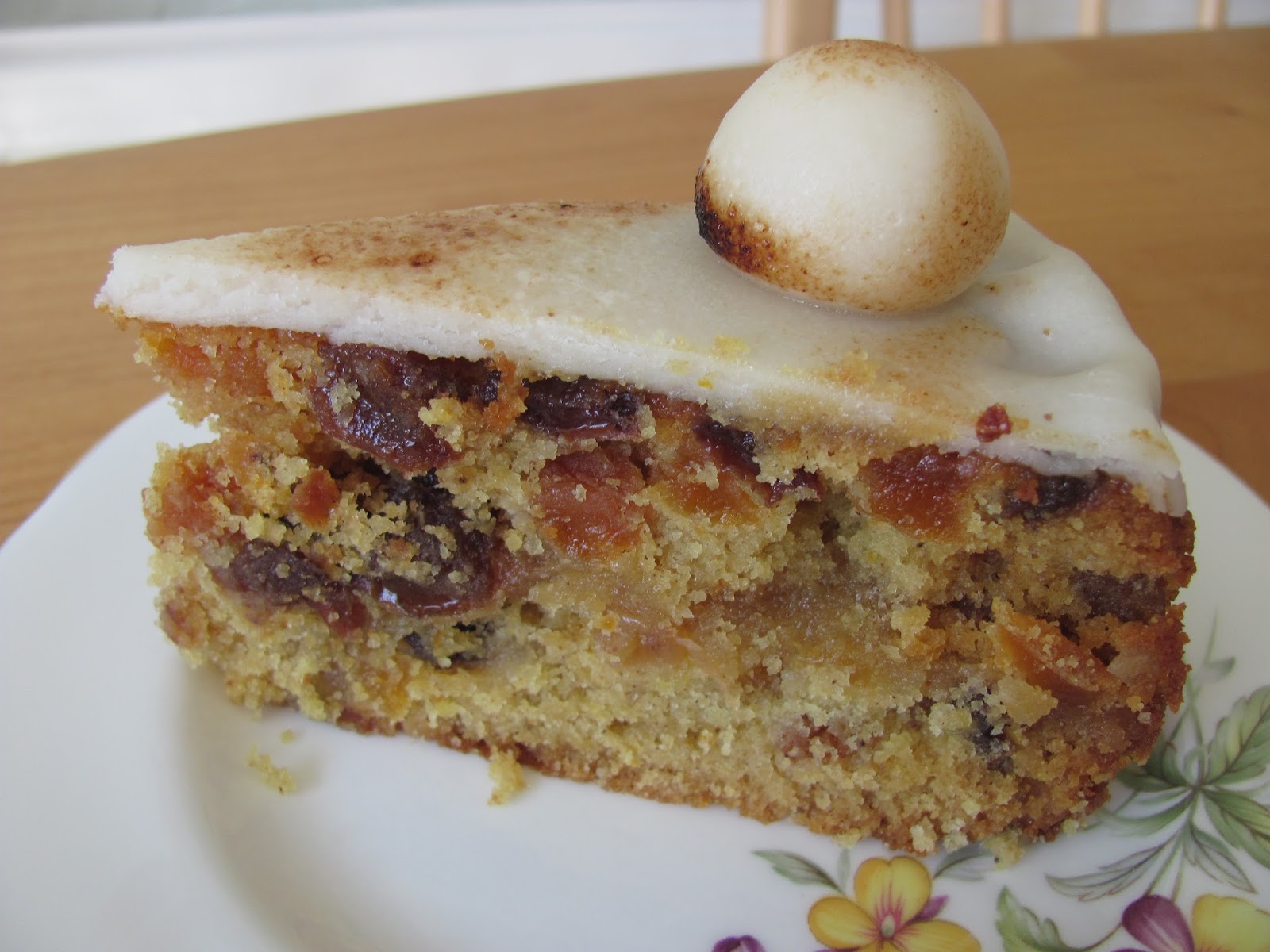
My family's festive celebrations have never included traditional fruit cakes - we're more of a mini chocolate appreciation society -  so I was surprised when my daughter asked me to make a Simnel Cake for Easter this year. I'm not averse to traditional recipes but I still wanted to put a spin on this cake to make it more personal, so I decided to make a golden fruit cake.

After looking at several recipes, I thought that Felicity Cloake's recipe from her 'How to Cook the Perfect.....' series in The Guardian would be the best one to adapt to what I wanted. I particularly liked the idea of adding saffron to help the golden colour of the cake I was planning.

I used the same quantities of all ingredients, although I used caster sugar instead of light brown sugar, to keep the crumb colour as pale as possible. Instead of using 400g of the fruit Felicity suggested (sultanas, currants and glacé cherries) I used 115g of each of sultanas, golden raisins and chopped apricots and 55g chopped dried peaches. I left the mixed peel in the recipe but took out the chopped almonds, as my daughter doesn't always like chewing on pieces of nuts, even though she loves the flavour of almonds. I used shop-bought white marzipan instead of yellow - just a personal preference!

It's a pity I didn't cross reference Felicity's decision making processes with the sources she used, or I would have discovered that her oven temperature was for a fan setting, not a conventional oven - after 2 hours at the quoted temperature the cake batter was still raw. It took another hour with the oven turned up another 20C for the cake to cook. Anyone with any experience of fruit cakes would have noticed the error straight away, but I've hardly ever made a rich fruit cake, even in 40 + years of cooking!

I was quite impressed with the look of the finished cake, although if I ever make another I will use more marzipan so that I can put thicker layers inside and on the top. The size of the 11 decorative balls, at 15g each, was about right, however. When cut, the colour of the crumb was just right for a golden cake.

I liked the flavour of the cake - a delicious subtle balance between spice and citrus, with all the fruits working in harmony, so that none stood out more than others. The soft inner layer of melted marzipan added a note of bitter almonds to the cake, although it hadn't stayed level in the cake, possibly a result of the error in cooking temperature.

There were other faults too, which might have been caused by the same error - the fruit wasn't evenly distributed in each layer, and although the cake was really moist, it was also crumbly and didn't cut cleanly. However, these faults were outweighed by the lovely flavour; all it really meant was that it was difficult to get a good photograph. I will have to try the recipe again, and cook it properly next time!


Sunday, 7 August 2016

Courgette Cake

There was nothing really wrong with this cake - it had a pleasant flavour and contained sultanas and pecans for variations of texture (chewiness and crunchiness) - but there was nothing there that excited me! It was just 'pleasant', which is low down on my judgement scale for cakes!

I used this recipe from Nigel Slater. The recipe was easy to follow, although my loaf took a few minutes longer to cook than the time suggested in the recipe.

I think the basic problem is that I want courgette cakes to be light and fluffy, like many carrot cakes I've tried, including my favourite from Good Food, but because there is so much more moisture in a courgette, even after squeezing out as much as possible, this just isn't going to happen. Adding apple probably only makes things worse, in this respect. If anyone has a recipe which does make a light sponge-like cake, please let me know!

Sunday, 24 July 2016

Two 'Everyday' Fruit Loaves

(i) Sultana and Orange and (ii) Coconut and Cranberry

Here are two quick mid-week cakes I've made recently, using mostly storecupboard ingredients, and the same basic recipe.

Sultana and Orange Loaf
Ingredients
225g SR flour
110g butter
85g caster sugar
1 egg
milk to mix - up to 6 tablespoons

demerara sugar to top (optional)

Sultana and Orange - add the grated zest of a large orange and 150g sultanas.

Coconut and Cranberry - reduce the flour by 25g, and add 50g desiccated coconut, 75g dried cranberries and a teaspoon of vanilla extract.

Coconut and Cranberry Loaf
Method
Preheat the oven to 175C and line a small (1lb/450g) loaf tin.
Rub the butter into the flour until it resembles breadcrumbs. Mix in the sugar and the dry ingredients of your choice.
Add the egg, vanilla extract (if using) and enough milk to give a soft dropping consistency.
Transfer the batter to the loaf tin, level the top and sprinkle with a tablespoon or so of demerara sugar, if liked.
Bake for 50-60 minutes, until a test probe comes out clean.
Cool in the tin for 15 minutes, then transfer to a wire rack to finish cooling.


Sunday, 1 May 2016

Date, Banana and Rum Loaf

Gluten-free and dairy-free.

This Date, Banana and Rum Loaf, found on the BBC Good Food website, could be considered a healthy cake, as it has no added fat or sugar. The natural sweetness comes from almost 800g of fresh and dried fruit packed into the loaf, and the only significant fat is that which is contained in the nuts - 100g of pecans.

I was a little worried about making the cake, as some of the comments on the Good Food website said the cake was quite crumbly, but I needn't have worried. I followed the basic cake recipe closely and made a dense, very moist fruit cake, which even survived being dropped (in it's cake box); quite frankly I was amazed that just the puréed fruit, 100g of fine cornmeal and 2 egg whites made a batter that actually held everything together! In a slight departure from the recipe, I added 1/2 teaspoon of xanthan gum, as it's easy to get hold of now, although it wasn't when this recipe first appeared in 2008; I don't know if it made any difference but it couldn't have done any harm!

One other thing I did, not mentioned in the recipe, was to cut each date in half, cross-ways, before cooking them. I found two stones while doing this, so it's well worth the extra time spent, as unnoticed stones could damage food processor blades.  When I drained the cooked dates I didn't get enough liquid, so I added water to get to the 100mls needed for the recipe. I varied the topping, as I don't really like banana chips - I used the remaining pecans, chopped coarsely, and 4 crushed brown sugar cubes (optional if you don't want to add sugar).

I really enjoyed this cake, but I would leave the sugar off the topping next time. It only added a crunch when the cake was fresh, and quickly dissolved in the moisture from the cake. Unlike a lot of other recipes that rely on the natural sweetness of the ingredients, rather than adding any additional sugar, this cake did taste sweet enough. This is definitely a recipe I'll be using again!

One small criticism - sultanas and raisins are very similar in looks and taste; the cake might have been more attractive and even tastier if a different mix of dried fruit was used. Cranberries, cherries, chopped apricots and/or golden raisins could be used to replace some of the 400g of raisins and sultanas used in the loaf.

Friday, 15 April 2016

Cauliflower and Apple Cake

If your first thought on reading this post title is 'Why?', then I have to say that was my reaction too! Why use cauliflower in a cake?  The recipe featured in April's edition of Waitrose Food magazine as 'Dish of the Month' and comes from award-winning patissier and chocolatier Will Torrent. The introduction says that although baking with cauliflower may seem unusual, it works well with the flavours of apple, white chocolate and coconut. I discussed the recipe with a group of internet friends and the general opinion was that, although the photo of the cake looked attractive, using cauliflower in a sweet cake didn't sound very pleasant. I decided to take up the challenge!

The recipe is based on using a food processor, which I don't have, so I had to adapt the method a little. I also didn't want a layer cake, so baked the cake in a larger tin, and used 2/3 of the buttercream in the recipe, just as a topping

Ingredients
150g unsalted butter, softened, plus a little extra for greasing
150g cauliflower, in small florets
150g caster sugar
2 small braeburn apples, grated (I used 1 1/2 large apples and peeled and cored them, although the recipe doesn't specify peeling.)
2 eggs (mine were large)
175g plain flour
1 teaspoon cinnamon
1 teaspoon baking powder
1/2 teaspoon bicarbonate of soda
50g sultanas
50g desiccated coconut

*Buttercream (the amounts I used):
50g white chocolate, chopped
100g unsalted butter, softened
110g icing sugar, sifted
1 tablespoon milk
1/2 teaspoon vanilla extract
extra cinnamon (optional)
25g toasted desiccated coconut optional)

**My Method
Grease and base line a 20cm springform tin.
Simmer the cauliflower in boiling water for 16 minutes until very soft, cool under a running tap then drain, and dry on layers of kitchen towel.
Pre-heat oven to 180C, gas 4.
Sift together the flour, baking powder, bicarbonate of soda and cinnamon.
Process the cauliflower and grated apple in a small food processor to make a purée.
In a large bowl, using an electric mixer, beat the butter and sugar until well combined, then beat in the eggs, one at a time, with a tablespoonful of the flour mixture.
On the slowest mixer speed (or by hand) mix in the cauliflower and apple purée and the rest of the flour mixture.
Lastly, fold in the sultanas and coconut by hand.
Transfer the batter to the baking tin, level the surface and bake for about 45 minutes, until a test probe comes out clean. Cover after 35 minutes if it's getting too brown.
Cool in the tin for 15 minutes then transfer to a wire rack.
For the buttercream, melt the white chocolate with 25g of the butter and the milk, in a bowl over a pan of barely simmering water, stirring occasionally until smooth, then cool slightly. Meanwhile beat the rest of the butter, the icing sugar and the vanilla extract together until light and fluffy. Beat in the chocolate mixture, then spread the frosting over the cake. Decorate, if desired, with a light dusting of cinnamon and some toasted coconut.

**The food processor method was to first chop the cauliflower into small pieces, then pulse in the butter, sugar and apple. Gradually add the beaten eggs before sifting in the flour, cinnamon and raising agents. Pulse to combine, then fold in the sultanas and coconut. 
The original cake was baked in a 18cm tin for 45-55 minutes, then split in half when cooled. 

*A larger amount of frosting was made by melting the 75g white chocolate on it's own and stirring it into a buttercream made from 150g butter, 175g icing sugar, 1 1/2 tablespoons milk and 1/2 teaspoon vanilla extract, and used to sandwich and top the cake layers. I couldn't bring myself to melt the chocolate on it's own as I always have trouble melting white chocolate - hence my method of adding some of the butter and the milk to stop it getting too hot and seizing.


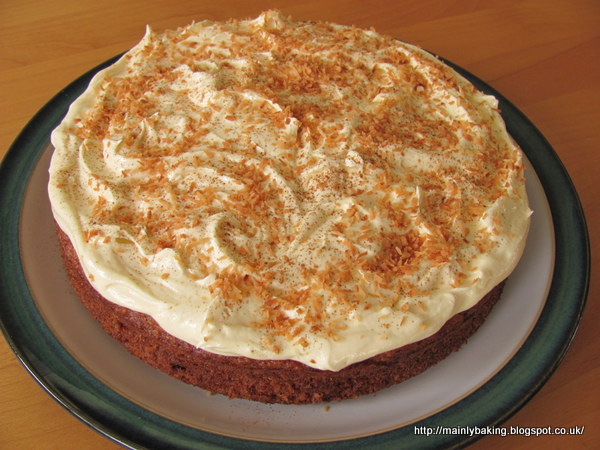
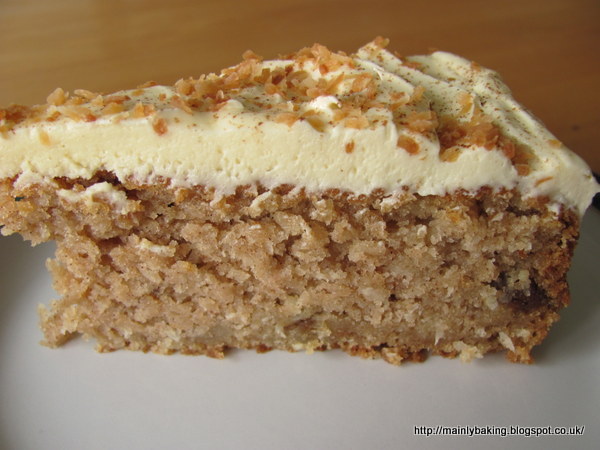
The result really surprised me! This odd assortment of ingredients produced a delicious, moist and incredibly light textured cake with a delicate cinnamon flavour. I couldn't taste either the apples or the cauliflower at all (fortunately, perhaps!) and even the coconut didn't come through strongly. The cake wasn't over-sweet, which meant that the very sweet white chocolate and vanilla frosting was a nice counterbalance to the cake. The one disconcerting note about the cake was that although I couldn't taste it in the raw batter or finished cake, there was a strong smell of cauliflower while the cake was baking!

Perhaps it was the subtle blending of all the ingredients which produced such a surprisingly tasty cake, but I think I'm still asking the question of why the cauliflower was used at all? Apart from the novelty value of telling people that there's cauliflower in the cake (and I didn't tell my husband until after he'd eaten it) the only reason I can come up with it that the apples and cauliflower add bulk, and perhaps moisture, but not so many calories. A similar sized cake would normally use more sugar, butter and egg.


Thursday, 7 April 2016

Courgette, Sultana and Pistachio Loaf

I managed to make one more recipe from Honey and Co: The Baking Book, before the library demanded it back from me. It was down to a choice between this courgette loaf and a carrot cake, and the courgette loaf won because I had all the ingredients already (allowing for a couple of substitutions).

I used sultanas instead of golden raisins, and orange zest instead of lemon, neither of which were going to have a major affect on the flavour of the cake. I also chopped the pistachios roughly, as I dislike whole nuts in cakes.

I didn't really encounter any problems while making the cake, although both the loaf recipes I've made from the book have almost filled my 2lb loaf tin, leaving me worried (needlessly, fortunately) about cake batter ending up on the floor of the oven.

This cake was moist and dense but not too heavy. The pistachios, sultanas and flecks of green from the courgettes made it quite colourful, and the chewy sultanas and crunchy pistachios gave some variations in texture while eating. However, once again, it was the spices used that made this cake something special - star anise and ginger, combined with the citrus zest, gave a really unusual sharp and peppery flavour, which was balanced nicely by the sweetness of the sultanas.

Saturday, 6 February 2016

Morning Glory Yogurt Loaf

an Anna Olson recipe

I'd never heard of Morning Glory Bread, until I started looking for a recipe for a loaf-shaped cake using yogurt in the batter. It seems that it's a quick breakfast 'bread', of the type popular in America and Canada - the sort of thing that's often called a tea-bread over here, as we haven't really embraced the habit of eating what seems like cake for breakfast, yet! It's raised with baking powder rather than yeast, and is packed full of whatever the cook has available in the way of fruit and nuts. This Anna Olson recipe adds tinned pineapple (or fresh peaches), raisins, coconut and orange zest, but on further investigation I found recipes adding things such as bananas, walnuts and even grated carrots too.

I had already decided to make a coconut flavoured loaf, as that was just about all I had in my store of cake 'add-ins', and had found a couple of possible recipes, but when I came across this recipe, with it's extra flavour elements, I knew I had to try it. Luckily I also had the remains of a bag of sultanas, that I could use instead of raisins, and there was a tin of pineapple rings in the larder, which I could blitz to turn into crushed pineapple. I used unsweetened desiccated coconut; I didn't think it would make too much difference as there was quite a lot of sugar in the loaf.

Most yogurt cakes use oil instead of butter, so are made by simply mixing wet ingredients in one bowl, dry in another and combining the two. Because this recipe used butter there was the added stage of creaming it with the sugar before adding the wet ingredients,  but it was still an easy recipe to follow.

The only problem I had was one of baking time - I've no idea how long the loaf spent in the oven, as I gave up keeping note after 90 minutes. I eventually took it out when my digital thermometer read 94C as I thought that was as near to 100C as the cake was going to get, and I needed the oven at a different temperature by then! The huge discrepancy between the recipe and my experience may have been down to a differently proportioned loaf tin (mine was short and deep), or the moisture in the tinned pineapple.

This was a very moist, close-textured loaf, because of the juicy pineapple. Although it was packed with fruit, and hadn't risen much it still seemed quite a light cake. The flavours of the pineapple and coconut were the most dominant, with the orange and touch of cinnamon providing subtle background notes. I treated this loaf as a cake, but it would also have made a good dessert, perhaps heating slices in a griddle pan and serving with poached fruit and yogurt.

The reason I wanted to bake a cake containing yogurt was that this month's AlphaBakes challenge is the letter Y. My imagination failed to come up with anything out of the ordinary for either an ingredient or a recipe name beginning with Y, so yogurt will have to do! AlphaBakes is hosted by Caroline, at Caroline Makes, and Ros, at The More Than Occasional Baker, and it is Caroline who is hosting this month's challenge.


Monday, 1 February 2016

Beetroot Cake

It's a measure of changing tastes that it's almost impossible to find a reliable recipe for a simple beetroot cake; the first 16 pages of Google search  results showed almost exclusively chocolate and beetroot cake recipes, and most of those without chocolate were paleo or so-called  'healthy'! I knew Nigel Slater had a recipe, but didn't want that one. In the end I searched through my store of pages torn from food magazines to go back to Nigella Lawson's recipe for 'Ruby Red Loaf Cake' and adapted it to suit the ingredients I wanted to use; the biggest adaptation, and worry about how well it would work, was using cooked beetroot instead of raw.

The recipe was published in Sainsbury's magazine in 2001, but I have no idea which book it was published in. My recollection of it was that the cake batter stayed pink when it baked, but I didn't manage to achieve that this time - possibly because I cut out the juice of half a lemon, or because I used already cooked beet rather than raw. I really should do some scientific research into this, to find out what keeps the colour in the beet as it cooks - a pink cake is so much more attractive!

Ingredients
200g cooked beetroot
250g butter at room temperature
200g light brown sugar
the zest of an orange, finely grated
3 large eggs
150g dried fruit (I used 40g dried sour cherries cut in half, 60g dried cranberries and 50g sultanas)
1 teaspoon cinnamon or mixed spice
150g SR flour
150g spelt flour
60 mls milk, to mix, plus more if necessary

50g icing sugar
1 tablespoon lemon juice
the liquid from the drained beetroot - see method

Method
Finely grate the beetroot and leave in a sieve over a bowl for 30 minutes, to allow excess liquid to drain off. Reserve this liquid if you want to frost the cake.
Pre-heat the oven to 180C and prepare a deep 8" square cake tin.
Beat the butter sugar and orange zest together until light and fluffy, then slowly beat in the eggs, one at a time, with a tablespoon of the flour each time.
Fold in the dried fruit, grated beetroot and spice, followed by half the flour, the milk, then the rest of the flour. If necessary add a little more milk to give a soft dropping consistency.
Transfer the batter to the cake tin and spread evenly. Bake for 45-50 minutes, until a test probe comes out cleanly.
Cool in the tin, on a wire rack, for at least 30 minutes before taking the cake out of the tin.

If desired, frost the cold cake using the sifted icing sugar mixed with the lemon juice and enough of the drained-off beet liquid to give a deep pink colour. I put the glacé icing into a plastic bag and snipped off the corner so that I could drizzle just a little icing over the cake.

This was a pleasant cake, very similar to a carrot cake. The beetroot couldn't be tasted, so the flavour was from the orange zest, spice and dried fruit. I'd have been happier with the cake if the beetroot had been more visible, but even the flecks of grated beet seemed to lose the pink colour during baking.

Friday, 20 November 2015

Buttermilk Fruit Cake

When I decided to make a chocolate and banana cake, and was looking for recipes, I initially decided on a chocolate chip cake using buttermilk. When I changed my mind, I was left with a carton of buttermilk which needed using quite quickly, as it didn't have a long 'use-by' date. Another search for a recipe was on! This time I wanted something seasonal, not too big, and not too fancy.

This fruit cake recipe, found on Joy of Baking, which adds dates, spices and other dried fruit to a buttermilk cake batter, fit the bill perfectly. The recipe didn't need any eggs, which was quite intriguing, just relying on the action of bicarbonate of soda with buttermilk to raise the cake. I didn't have currants or raisins needed to follow the recipe exactly, but used 100g sultanas and 100g of a mix of chopped dried apricots, sour cherries and crystallised ginger instead.

Making the cake was straightforward - just mix wet ingredients into dry ingredients, then stir in the dry fruit, so only a saucepan, a couple of bowls and a spoon was needed. As my buttermilk was cold, I melted the butter in a saucepan, then added the buttermilk and just warmed it slightly. I also dropped my dates into the measured flour, then cut them into small pieces with scissors, rather than chopping them on a board - much easier.

The thing I really enjoyed about this cake was the spice mix; allspice isn't something I use often but it really worked well with cinnamon and nutmeg to give a warm and peppery background flavour to the dried fruit. Overall the cake was moist and well textured - the absence of eggs wasn't obvious.

Baking the cake in a 9" x 5" tin made what my mother would have called a 'slab cake' - something deeper than a traybake but shallower than normal for a cake. I think a smaller baking tin would have made a cake with better proportions, but it may not have cooked as well; I'm sure there was a good reason for that sized tin being used.

Monday, 2 March 2015

Jammy Bread and Butter Pudding

As a cake and dessert maker, a lot of what I make contains eggs - cakes, tray bakes, brownies, cookies, mousses and cheesecakes. They are indispensable for perfect results, and often the most nutritious part of many recipes. So I'm happy to join in with Belleau Kitchen's new blogger link-up - Simply Eggcellent - which celebrates the versatility of eggs.

Bread and Butter Pudding is made from bread soaked in a simple egg custard - usually just eggs and milk or cream, and maybe some sugar. The fun comes with the extras that can be added - dried and fresh fruit, chocolate, alcohol, preserves, nuts and spices.

This Jammy Bread and Butter Pudding was a spur of the moment dessert, to use up the end of a stonebaked sourdough baguette and the last of a carton of sour cream. I decided to keep things simple and use gooseberry jam to provide the main flavour, some sultanas for juicy fruit chewiness and a little nutmeg to spice it up a little.

I sliced the bread thinly and made jam sandwiches, which I fitted into a small ovenproof dish, interspersed with a handful of sultanas. The baguette was quite thin, making it impossible to remove the crusts, so I arranged the bread with the crusts uppermost, so that they would make a crisp topping after cooking.

I was only making two portions, with about 100g of bread, so a custard made from one large free-range egg, 50ml sour cream and 150g milk was sufficient. I didn't add any extra sugar to the custard as the jam was going to provide a lot of sweetness.

I poured the egg mixture over the bread and left the dish to stand for about an hour before baking, to allow the custard to soak into the bread. Before baking I sprinkled the top of the pudding with Demerara sugar and a grating of nutmeg. I baked the pudding in a bain marie, at 180C for 45 minutes.

Using jam to flavour this bread and butter pudding worked very well; together with the sultanas and sugar topping it was plenty sweet enough. The custard soaked bread was light and moist, with a lovely crisp crunchy topping made from the crusts on the slices of bread and the sugar.

As usual, it isn't good for food photography to take something out of the oven at 6pm, and need to get it photographed before it's eaten a few minutes later, so I apologise for the strange colour!

You can read all about Simply Eggcellent on the link above. I look forward to seeing how Dom, at Belleau Kitchen, develops the core theme of eggs over the coming months.

Wednesday, 19 November 2014

Honey Breakfast Fruit Cake

 - from a recipe by Harry Eastwood.

This cake was made specifically for the AlphaBakes challenge, where this month's randomly chosen letter is H.

My baking books were surprisingly short of recipes containing ingredients beginning with H - hazelnuts featured heavily, but I've used them a lot lately, and wanted to avoid them if possible. Honey was the only other frequently used ingredient, so I set myself the task of finding a recipe for a fruit cake sweetened only by honey.  So many recipes are called 'honey (something or other)', only to feature a tablespoon or two of honey, supposedly added for flavour, in addition to the usual high amount of sugar found in most cakes and biscuits.

I'm not going down the route of claiming that a cake sweetened with honey is any healthier than a cake sweetened by standard sugar (they are both types of carbohydrates not really needed for nutrition), but I do think that if you are using honey for it's flavour, you need a fair amount of it in a cake!

However, Harry Eastwood's baking recipes (ooooh! an extra H there!) are special for being a little bit healthier than most. She uses added vegetables a lot, and tries to cut down on the amount of sugar and fat in her recipes. This cake, called a Honey Breakfast Fruit Cake, uses finely grated butternut squash to replace much of the fat  - the only fat comes from nuts and eggs - and the squash also has a natural sweetness which means less needs to be added in the form of honey. The cake batter is made from half flour and half ground almonds and is packed with dried fruit and chopped nuts. In fact, for the size of cake made, it's really fruit and nuts held together with a little cake batter!

I followed the basic recipe, but as I'm trying to finish some of the half-used packets of dried fruits and nuts in the storecupboard, I altered what I used from what was suggested in the recipe. Instead of raisins and cranberries, I used sultanas, cranberries and sour cherries, and instead of chopped almonds I used a mixture of almonds, walnuts, macadamia nuts and peanuts. I also sprinkled some flaked almonds on top of the cake before baking.

This was a really delicious cake; the almond flavour was predominant, as you'd expect with the use of almond extract, but the lemon zest and the honey both made a noticeable contribution. Obviously, the cake will vary in flavour depending on what type of honey is used - I used a Fairtrade Guatemalan honey which wasn't produced from any specific flowers, and was just a generic 'honey' flavour.

The big surprise was that the absence of fat wasn't noticed, nor was the addition of  quite a large amount of grated butternut squash. The recipe stated to grate the squash finely, so I used a finer grater than I would have used if grating carrots for a carrot cake, and this made the vegetable vanish into the cake batter, only adding moisture to the texture.

I'm not sure this would convince me that it's good to eat cake for breakfast, but it is certainly a cake that's good to eat, and will go on my list of things worth repeating.

AlphaBakes (rules here) is a blogging challenge hosted on alternate months by Ros from The More Than Occasional Baker and Caroline from Caroline Makes. This month's randomly chosen letter H was picked by Ros, who will post a roundup of entries at the end of the month.

Tuesday, 2 September 2014

Courgette and Hazelnut Loaf

This is another recipe suitable for the unseasonable dull weather that has characterised most of August - this cake, from the BBC Good Food website, made from an over-grown courgette and some foraged fresh hazelnuts, has warmth from nutmeg and cinnamon, and sweetness from sultanas rather than a lot of sugar.

I haven't had a particularly good year in the vegetable garden. What was once a triangle of land which received sunlight in the afternoon is now a dark and cold corner of the garden which receives much less light, as our neighbours trees are getting so large. However, the courgettes have produced enough fruit to keep us well supplied, although it's nowhere near the excess we've had in previous years. The courgette I used for this recipe is one which hid under a leaf until it was too big to be called a courgette. After taking out the seeds and wringing out any excess moisture in a tea-towel there was just the right amount needed for the recipe (350g).

Fresh Cobnuts

Hazelnut Thief!
Although I moan about the shade from our neighbours trees, and blame them for our poor harvest, they have provided some of the hazelnuts used in this recipe. We also managed to get a few from the small twisted hazel tree in our garden, before this squirrel took them all, and my husband has been coming back from his morning walk with pockets full of what look like cobnuts, found in a local park.

Shelled Fresh Nuts
One advantage of really fresh hazelnuts is that they don't have the thick brown skin which needs removing before use. Once I'd shelled the nuts for the recipe, I chopped them roughly, then roasted them for 10 minutes to accentuate the flavour. I then used them in place of the walnuts in the recipe. This was the only change I made, apart from squeezing out some of the moisture from the coarsely grated courgettes. Even after this, I found the cake took 75 minutes to cook, rather than the hour suggested in the recipe.

Any cake containing grated fresh fruit or vegetables runs the risk of turning out too dense and very close-textured because of the extra moisture, but this cake turned out very well. It wasn't as light as the Courgette and Lemon Cake I made back in May, but I think it's the next best attempt at getting a light-textured cake, so far. The cake crumb still had a springy texture, and the fruit and nuts were well dispersed. Green flecks from the courgette skin could still be seen in places, which I always like to see! I also liked the large pieces of hazelnut - I usually chop nuts a little finer than this, but here the crunch was a good contrast to the chewy sultanas.

Thursday, 26 December 2013

Orange Marzipan Cake

My Alternative Xmas Cake

I've wanted to make this cake for years - ever since I bought Annie Bell's book 'Gorgeous Cakes' - but every Christmas something has happened to stop me making it. This year nothing interfered, not even the thought that I'd got for too much food already, and a cake wasn't really even necessary!

The cake consists of a shortbread layer, a madeira style cake flavoured with rum and dried fruit, and sandwiched between the two are layers of marzipan and marmalade. All this is topped of with a sprinkling of flaked almonds and pine nuts. It's always sounded a really delicious cake to me, perfect for those who don't like or want a traditional rich fruit cake at this time of year.

It was a delicious cake, but not perfect! One fault was mine, but if I was going to bake it again, I would make some changes to produce something even more delicious. My fault was being too enthusiastic with my new Kenwood Chef mixer, and believing the recipe book, which said that beating the eggs into the creamed sugar and butter at maximum speed would lessen the likelihood of curdling! I now know that you still need to go the traditional route of adding a little flour with each egg! The bad curdling resulted in a slightly stodgy texture, rather than the sponge-like appearance I had been expecting.

The recipe's problems, to my taste, were two-fold - firstly, there was not enough marzipan (although you could taste the marzipan, you couldn't really see it as a separate layer). I think the layer either needs to be thicker or it needs to be made from a better quality marzipan. I usually use Anton Berg marzipan which is 60% almonds, but it has disappeared off the shelves this year, possibly due to the much publicised almond shortage. Using a standard supermarket marzipan which was only 25% almonds might explain why it seemed to melt into the cake mixture. I guess a good alternative would be a homemade marzipan, although most of the recipes I've seen are less than 50% almonds when the sugar and binder are factored in

The second problem was not enough orange flavour. I think the cake needs at least the zest of an orange in the cake batter, and I would probably replace the rum with orange juice, as the rum flavour wasn't very noticeable. I used sultanas and dried cranberries in the cake, and these could be plumped up first in orange juice, if you wanted to keep the rum.

Apart from those problems, it was a really good cake. Having a crisp shortbread layer, and the marzipan only at the bottom of the cake, and pieces of nuts only at the top, made it interesting to eat, as there was a variety of textures and flavours depending on where you took a bite. Definitely a good alternative to a rich fruit cake - even FB, who avoids most dried fruit, liked it!

A few recipe details, to make a cake in a deep 20cm tin with a loose bottom - the shortbread layer was made from 90g butter, 40g golden caster sugar, 75g plain flour and 50g ground almonds. This was pressed into the cake tin and chilled. A circle made from 200g marzipan, spread with 75g coarse-cut marmalade was placed on top of the shortbread before the cake batter was added. The cake batter was made from 225g golden caster sugar and 225g unsalted butter, creamed together. 4 whole eggs and one egg yolk were added next, followed by 90mls rum. 225g SR flour plus 1 teaspoon baking powder was folded in, then 75g each of sultanas and dried cranberries (raisins in the original recipe) was stirred in gently. After this was transferred to the cake tin and spread evenly, 20g each of flaked almonds and pine nuts were scattered on top. The cake took around 70 minutes to bake at 170C, and was cooled in the tin.

AlphaBakes, a monthly baking challenge based on a randomly chosen letter of the alphabet is running out of easy letters. Providentially, December's letter is X, and X-mas is considered an acceptable choice of word to use as part of the name of what we produce. Hence I am entering this as my alternative X-mas cake! AlphaBakes is jointly hosted by Caroline of Caroline Makes, and Ros of The More Than Occasional Baker. The rules can be found here, and Ros is the host this month. There will be a festive round up at the end of the month, although I wonder if there will be any entries that found an alternative to X-mas!