Showing posts with label cake. Show all posts

Sunday, 26 September 2021

Instant Coffee Banana Bread

Faced with over-ripe bananas, yet again, but wanting to try something different, I came across this recipe from Matt Tebbutt and BBC's Saturday Kitchen. It adds coffee and (optional) chopped chocolate to banana bread  - of course I added the chocolate! This was a straightforward recipe to follow, and didn't give me any problems.


This made a pleasant enough loaf cake, but didn't convince me that any of the added flavours - chocolate, coffee and nutmeg - actually improved the basic premise of banana bread, which is that you want it to taste mostly of bananas. 

I've just noticed that when I used chocolate in a banana cake once before, I didn't really like the result that time either, but thought the issue was too much chocolate. I'll be sticking to adding dried fruit and/or nuts in future.

Monday, 19 July 2021

Marbled Bundt Cake (Chocolate, Orange and Chilli)

I returned to another old favourite for my son's 40th birthday cake. Both he and I have birthdays in the first half of July, so in truth, it was a shared cake, and he expressed no preference as to what I baked.

The recipe originally came from Alice Medrich,  but over the years I've made a few tweaks. Most importantly I've reduced the size of the cake to fit the only bundt tin I have and converted the American cup measurements to metric weights and volumes. I've also replaced the pepper in the recipe with cayenne pepper, and added the finely grated zest of an orange.

The cake is made with oil (olive or sunflower, depending on whether or not you want the extra flavour of olive oil) and cold milk and eggs, so is quick to make without needing to wait for ingredients to get to room temperature. The two batters are just layered into the pan and the marbling is formed by the movement of the batters in the tin as the cake cooks.

I was a little disappointed with the frosting - it didn't flow as far as I'd hoped, and then didn't set as firmly as I expected either - but that might have been due to the temperature in the kitchen - it was the hottest day of the year! I wouldn't usually frost this cake, but it was for a celebration!

I used another favourite - a Mary Berry recipe - for the frosting. Melt 90g of dark chocolate and 30g of butter together, then beat in 1 tablespoon of golden syrup and 1 1/2 tablespoons of milk. If used straight away, it should be a glaze, although I usually wait until it's cooler before spreading it on top of a cake to give a fudgy frosting. This time I wanted a flowing glaze, but it was too thick to cooperate! 

The revised recipe for the cake is written out in full in this post here on my blog, so there's no need to repeat it here. I will add that I now prepare bundt tins with a homemade lining paste, following Nancy Birtwhistle's recipe, which you can find in this recipe on her website. Once made, the paste (equal quantities of oil, flour and Trex cooking fat) keeps for many months in the fridge, in an airtight jar, and just needs bringing up to room temperature before use. I've used it for a few years now and it's never failed - the cakes have always released from the bundt tin perfectly.

Sunday, 13 June 2021

Date and Lemon Banana Loaf

Another outing for Mary Berry's Banana Loaf recipe, which is so quick and simple to make. This time I added 100g chopped dried dates and the zest and juice of a lemon. Because of the lemon juice I left the milk out of the recipe.

I only used lemon as a flavouring because I had some lemons to use up, but, in all honesty I think orange would have been a better addition to use. The lemon gave an odd tang to the flavour - not enough to spoil the cake, but just enough to know something wasn't quite right.

Apart from that, the cake was as good as usual - moist, with a well-textured crumb - and it's a cake which keeps well for a few days.

Saturday, 8 May 2021

Helen Goh's Anzac Cake

I'm not sure what to think about Helen Goh's Anzac cake (from the Australian Good Food site), which is inspired by the ingredients of the traditional ANZAC biscuit. It's a lovely close-textured, moist cake, but without the topping, the flavour really wasn't anything special. The coconut milk used in the cake batter wasn't enough on it's own to give a really strong coconut flavour.

The problem was, the topping didn't work well for me! In fact, most of it ended up on the floor of the oven as it ran off the cake. The flavour was fine - a sort of caramelised coconut macaroon - but as well as just sliding off the cake, what was left didn't stick well, making the cake difficult to cut and serve.

I think part of the problem may be that UK baking tins are different in size to Australian tins - the recipe states using a 1kg capacity tin, whereas standard UK loaf tins are 450g or 900g. The difference didn't seem enough to matter to me, and indeed, it didn't for the cake itself. However, the cake rose above the top of the tin, and domed in the middle, meaning there was nothing to stop the topping sliding off as it warmed up again in the oven.

I'd  like to repeat this cake, with either something extra in the cake, such as a spice, or some dried fruit, to make it better to eat without the topping, or with a different sort of topping. This could be a coconut frosting put onto the cooled cake, but I also wondered if a more traditional macaroon topping, adding egg, would stay in place better, both during and after cooking.

Sunday, 25 April 2021

Biscoff Spread and Chocolate Chip Loaves

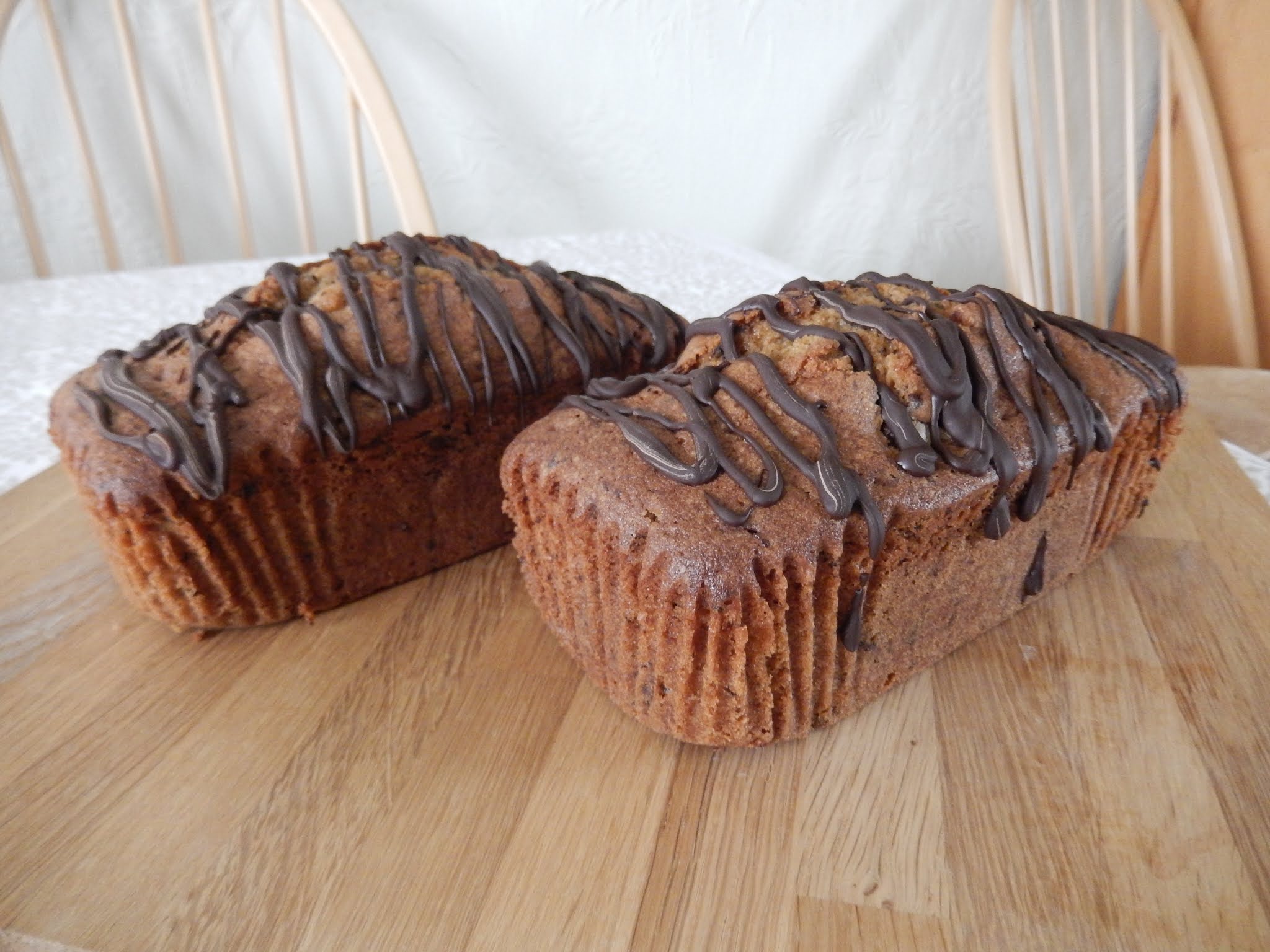
My second Easter bake, for my son, who would rather eat chocolate than dried fruit, was a variation on this recipe from The Baking Explorer. At the end stage of making the batter, I stirred in 150g of chopped plain (70%) chocolate.

In order to share the cake with him, I decided to bake it in two 1lb loaf tins, and guesstimated that this would reduce the cooking time by 15 minutes, which turned out to be correct!

As I would be wrapping the cake to take it to him, adding a buttercream topping didn't seem a good idea, so I just dribbled some more melted chocolate over the cooled cakes.

As usual, I was disappointed that the Biscoff flavour wasn't stronger, but even though I anticipated this, I decided not to add any extra spices to the cake, as I didn't want the flavour to fight with the chocolate. In the end it was a good balance  between the very subtle spices and chocolate. A little vanilla extract might have been an improvement!

Wednesday, 7 April 2021

Mincemeat and Marzipan Teabread

I can't say that I haven't eaten anything sweet for the last 10 weeks, but less activity during winter lockdown, coupled with a bit of over-eating around the New Year has meant I've been struggling with my weight again. It's easier not to bake and buy the occasional treat than to have home-made cakes and other goodies tempting me all the time.

However, Easter is a time of celebration, and even though the cold weather meant I wouldn't be meeting my children, I still felt we all deserved a treat. I delivered cake and Easter Eggs to them both, and put most of what I kept for myself into the freezer, to be rationed out.

I shared this Mincemeat and Marzipan Teabread with my daughter; the flavour of the spiced fruit in the mincemeat, together with marzipan, is reminiscent of the traditional Simnel Cake. The flavour obviously depends on the mincemeat ingredients.


Ingredients:

200g SR flour
100g cold butter, cut into small cubes
85g light muscovado sugar
110g marzipan, cut into small cubes
3 eggs* 
300g mincemeat
6 crushed brown sugar cubes to sprinkle on top, or a couple of tablespoons of demerara sugar

*the eggs were mixed sizes - medium or smaller; 2 large eggs are usually enough, if the mincemeat isn't too dry

Method
Line a 2lb loaf tin with parchment, pre-heat oven to 180C (fan 160C).
In a large bowl, rub the butter into the flour, then stir in the  muscovado sugar and marzipan cubes.
In a small bowl, lightly beat the eggs, then mix in the mincemeat to loosen it.
When the mincemeat is well distributed into the eggs, add this mixture to the flour mix and stir until evenly combined.
Transfer to the loaf tin and sprinkle generously with sugar.
Bake for 60-75 minutes**, or until a probe comes out clean. You may need to cover the top with foil towards the end of the baking time, if it's browning too much.
Cool in the tin for 10 minutes, then transfer to a wire rack to finish cooling.

** the cooking time depends on how sloppy the cake batter is - a stiff batter will cook faster than a very loose one

Sunday, 6 December 2020

The 'Perfect' Malt Loaf?

Ten years ago, I made Dan Lepard's Malt Loaf and although it was tasty, it didn't bear much resemblance to the squidgy, moist Soreen Malt Loaves found in most supermarkets. 

Considering how long it is since I made that loaf, I can't help wondering why I haven't made one since, or why it's been on my mind so much, lately.

Anyway, putting those questions aside, I thought I'd try Felicity Cloake's 'Perfect' recipe this time, as she does a lot of the leg work by comparing, and trying, available recipes from reliable sources, and taking the best elements from each. The only unknown factor is whether her tastes coincide with mine, but in this case, they fortunately did.

I followed the recipe exactly (the suggested size of loaf tin is a standard 2lb tin) and it really couldn't have been simpler - mix the sugar, syrups, liquid (tea) and fruit together, leave to soak a while, then stir in the dry ingredients, transfer to the prepared loaf tin and bake. 

9 tablespoons of malt extract is 135mls, which was conveniently measured out by filling a 1/2 cup (125mls) to the point of overflowing. Lightly coating the measuring cup with oil ensured the malt extract flowed out easily too - no scraping out needed. 

I also followed the suggestion to wrap the cake in baking paper and leave for at least 2 days before cutting it, difficult though that was. Knowing cake is in the house is such a temptation, but it was worth the wait!

The loaf was everything I'd expected - strongly flavoured with malt, moist, sticky and stodgy. It wasn't quite as squidgy as a Soreen loaf, but that was actually a point in it's favour for me. Much as I like Soreen, I don't like how a slice can be squeezed into a gummy ball about half it's size.

So, was it 'perfect'? Very nearly!

My only slight criticism was that the flavours of the prunes and the malt blended so well together that the prunes were only detectable as a change in texture. I think next time I will try making the loaf with a proportion of sultanas too, so that the fruit adds more flavour contrast.

Thursday, 26 November 2020

Apple and Cranberry Cake

I usually make this cake, which is two layers of a scone-like dough sandwiching a layer of fresh and/or dried fruit, as a dessert. I often make it when I haven't got time to fuss around with pastry, as the result is very similar to a pie, but much easier to make. 
This time, I wanted to capture some of the essential flavours of Autumn, which is one of my favourite times of the year for seasonal baking. So I used eating apples, dried cranberries and cinnamon in the filling, and some flaked almonds in the topping.

Ingredients

150g butter
150g caster sugar
1 large egg
300g SR flour
3 eating apples, peeled, cored and sliced* 
80g dried cranberries
1 teaspoon cinnamon
30g flaked almonds
icing sugar to dust
* I usually slice the apples into water to which I've added a little lemon juice or vinegar, to stop the fruit discolouring. When I'm ready to use the slices, I drain them well and pat dry on a clean tea towel. 

Method
Preheat the oven to 180C, and line the base of a 20cm (8") springform tin with baking parchment; grease the sides with a little butter if your tin needs it.
Melt the butter in a large mixing bowl, in the microwave, or in a saucepan on the hob - if you do this in a large pan you can mix the dough in it too. The butter doesn't need to be really hot - just completely melted.
Stir in the sugar, then beat in the egg.
Add the flour and mix in thoroughly - it should give a soft crumbly dough.

Put 2/3 of the dough into the cake tin, and spread evenly with your fingers, building up a little wall of dough around the edge of the tin, to contain any excess fruit juices.**
Mix the flaked almonds into the remaining dough.
Mix the prepared apples, dried cranberries and cinnamon together and spread over the dough base.
Crumble the rest of the dough over the top, then press down lightly, spreading the dough a little to give good coverage over the top. The dough will spread more during baking, so don't try to fill all the gaps.
Bake for 50-60 minutes until the top is firm and golden. Cool for about 10 minutes, then run a knife between the cake and the edge of the tin, to stop and leakages of fruit juice sticking to the sides.
Dust with icing sugar before serving; I like this at room temperature, and I usually leave it on the springform base as it's quite fragile, but  it can be moved to a serving plate if you have a large cake lifter.
** There's a photograph here which shows how the cake is assembled.

Saturday, 31 October 2020

Chai Swirl Loaf Cake

I've made this cake a couple of times before, with no problems, but this time the cake sank towards the end of the baking time - the only explanation I can give is that I may have been a touch heavy-handed with the baking powder. It did mean that the whole cake didn't make a very good photograph.

This time I was making the cake for a Halloween celebration virtual Cake Club meeting, so used a couple of props in the photograph. As I would be freezing most of the cake, I didn't want to use frostings or icing to give a Halloween look.


This Chai Swirl Loaf Cake is a Ruby Tandoh recipe, and the mix of spices used is delicious - none of them stand out individually, although the pepper gives quite a warming sensation!

The only thing I do differently to what's stated in the recipe is to layer the two different batters and allow them to marble naturally during baking, due to the convection currents within the heating cake batter. I think this gives a much smarter appearance than random dollops, and it looks as if the cake in the photograph with the newspaper article was made that way too.

Tuesday, 21 July 2020

Spiced Chocolate Bundt Cake

I last made this cake, from Sainsbury's website at the end of 2014, as a pre-Christmas treat. This time I made it for a birthday tea for myself and my two children, held in the garden to comply with Covid-19 guidelines. Both my son and I have July birthdays, close together, so usually share a cake. The three of us enjoyed the cake, and the warm sunny afternoon - until the flying ants came out! 

As before, I didn't top with the ganache from the recipe, but with Mary Berry's fudgy chocolate frosting. You can see the details here - nothing has changed. The cake was a little crumblier than I remembered, but that might have been because not all of my eggs were large. The flavour was still very good.


Wednesday, 24 June 2020

Date and Coffee Loaf

This post should really be called Date and Coffee Loaves, as the recipe makes 2 x 1lb loaves. One loaf was sliced and frozen for future use, the other eaten over the course of a few days.

The recipe comes from Lynn Hill, the founder of the Clandestine Cake Club, who has recently renamed her website Traditional Home Baking. I've been a member of CCC and a follower of Lynn's work for several years, but this is the first time I've made one of her recipes.

The recipe was straightforward to follow, although the instructions regarding the dates are a little confusing. I didn't have Medjool dates so used Deglet Nour dates instead. These were already quite soft and didn't absorb all the coffee when the two were heated together. I added the dates and the residual liquid to the cake mix, but later found out from Lynn that all the liquid should have been absorbed, so I either should have simmered the dates for longer to evaporate excess liquid, or discarded the excess. 

As it didn't spoil the cake (although too much liquid might have done so) it wasn't a problem in this case, but the written instructions might have mentioned that there shouldn't have been any residual liquid after cooking the dates, rather than just say the liquid should be reduced (by how much?).

This cake was delicious; both the dates and the coffee could be tasted and the flavour combination was very good. The loaf was quite light too; I had expected something like a tea loaf in texture but this was more like a sponge cake.

Saturday, 9 May 2020

Dairy-free Gingerbread

The only time I get to make a large cake these days is if I can bake for someone else. At the end of last year I joined the Friends of my local Library, and had been baking for their monthly coffee mornings. That's all on hold for the moment, of course, with Libraries closed and no mass gatherings taking place because of the Covid-19 pandemic.

Because so little is known about this particular virus, or what are the most effective ways of staying safe, I've been sewing face-masks for me and my two children, in case they are eventually needed (even though I don't really think much of the efficiency of home made ones). I decided that when I delivered their masks to them, I could include some cake, to cheer them up a bit in their isolation.

It was hard to decide what to make, as the three of us have very different tastes, but eventually I decided on gingerbread.

I used this oil-based gingerbread recipe, rather than the best traditional recipe I have, because I didn't want to open a litre of milk just for the small amount that was needed for the cake. The oil-based recipe is very similar to the traditional recipe - it gets a nice sticky top after a few days - but isn't quite as rich as it has less fat and fewer eggs. Using oil, and water instead of milk, has the added advantage of making the cake dairy-free too.

The bottom photo shows the 20cm square cake divided for sharing. As you can see, the three of us vary in how much cake we can eat over a few days; the biggest portion was for my son and the smallest (missing) portion was for my daughter. I was left with the long narrow piece - it  made a delicious dessert when reheated and served with rhubarb roasted with ginger, and natural yogurt.

Monday, 6 April 2020

Fruited Banana Loaf (2)

"If it ain't broke, don't fix it" is a refrain often heard, and this time I decided to take heed. Through some unexpected changes in plans (mostly involving social distancing) I once again found myself with too many bananas. Up until recently this has happened about once every 5 years, but this year, twice so far!

So I used Mary Berry's tasty, quick recipe again; this time I added the scrapings from a jar of mincemeat (roughly 70g) and 50g sultanas. Using the mincemeat meant that I didn't need to use the 2 tablespoons of milk in the recipe - there was enough moisture in the mincemeat - but otherwise I followed the recipe and made the whole batter, including the extra additions, as an all-in-one mix.

Once again, this was delicious. The mincemeat added a little spiciness to the show, but the banana still came  across as the dominant flavour.

This time I didn't freeze any of the loaf, and I was really surprised at how well it kept - the last slice was almost a week old, and as good as the first.

Friday, 27 March 2020

Chocolate Chip and Orange Loaves

I baked two loaves to take one to each of my children, just before the Covid-19 lockdown measures became more stringent. At the time the food panic buying was at it's height and the supermarket shelves were empty of almost all baking ingredients, so I was relying on my store cupboard.


I wasn't sure when supplies would get back to normal so although I would usually use 4 eggs in this amount of cake batter, I decided to cut down to 3 and use the juice of the orange that I was zesting, in place of the 4th egg. That way none of the orange was left over either.

Ingredients
200g caster sugar
200g butter, softened
3 large eggs
250g SR flour
zest and juice of 1 orange
100 - 150g chocolate chips (I used about 30g milk chocolate chips and 100g of chopped plain chocolate)

Method
Preheat the oven to 180C (160C, fan) and line 2 x 450g (1lb) loaf tins (I use the pre-formed liners for loaves).
This cake is made by the all-in-one method, so put everything, except the orange juice and chocolate, into a bowl and beat with a hand-held mixer until smooth, adding enough orange juice to give a dropping consistency. (I needed all the juice from the small orange I was using, but if more liquid is needed a little milk or water can be used too.)
Use a large spoon to fold in the chocolate, then divide the batter equally between the two tins and level the surface.
Bake for 60 minutes, or until a test probe comes out clean.
Cool in tin for about 10 minutes, then move to a wire rack.


I didn't get to see the insides of these cakes, or to taste them to see if the lack of egg was detrimental to the texture, but there were no complaints from the recipients. I asked my daughter if the cake was dry and she said that it wasn't, so I'm pleased about that.

Unfortunately I didn't get any good photos either, although you can see the bulging top!

Saturday, 14 March 2020

Fruited Banana Loaf

After deciding to leave two bananas to ripen enough to use in a cake, I realised that I've never made a basic simple banana bread/cake in the 10 years I've been writing this blog. It was definitely time to remedy that situation, even though I don't regularly have bananas available.

Of the two simplest recipes I could find, I decided to go with Mary Berry's, as she appeared to be cutting down on the fat and sugar content to compensate for adding the bananas rather than just putting bananas into a standard sponge cake recipe, as here. The other advantages of Mary Berry's recipe were that it was an all-in-one mixture, so really quick to put together and get into the oven, and would freeze well. Being able to freeze slices of cake is always a bonus for me!

After saying I wanted simple, I then changed my mind a little and decided that I would like some extra flavour, so I added the zest of a small orange, 70g of a mixture of sultanas and dried cranberries, and I used 2 tablespoons of orange juice instead of the milk in the recipe.

I folded the fruit into the batter after it had been mixed, rather than include it at the all-in-one mixing stage.

None of these changes affected the baking time - the cake was still cooked in the time suggested in the recipe.

The cake had a lovely texture, moist but not too heavy, and the extra ingredients boosted the flavour without masking the taste of the banana.

This is definitely a cake to remember when I'm baking for coffee mornings, and I can imagine other additions that would work well - chopped dates, for instance, or nuts and a little mixed spice.

I'd even go so far as to say it's a cake worth buying bananas for, if you can plan far enough ahead to let them ripen!


Wednesday, 26 February 2020

Mincemeat Loaf Cakes

It seems quite a long time since I tried a new recipe; I have a lot of favourites that I keep returning to at the moment, either because they are reliable (if I'm baking for someone else), or I know they freeze well.

I knew I wanted to make a mincemeat cake to use some of the Christmas excess,  so decided this might be the time to try a new recipe. Mary Berry's recipe appealed because it made two small loaves and she says they freeze well.

It's a straightforward recipe to follow - it's an all-in-one mixture, so you just need to make sure you have well softened butter before you start. I didn't have currants, so used dried cranberries instead, and topped the cakes with flaked almonds rather than split nuts.

The cake batter was very stiff, and with the benefit of hindsight, now that I've cut the cakes, I think I should have added a couple of tablespoons of milk to loosen it a little. The cakes were a little dry and crumbly, and didn't compare favourably, in that respect, to the recipe I usually use. They rose well during cooking, in terms of increased volume, but there was a definite dip in the middle of each one. I think I might have been guilty of not mixing well enough, as the batter was so stiff.

As always with this  sort of cake, the final flavour relies heavily on any added ingredients in the mincemeat. I used a Waitrose brand with their 'Christmas 2019 special' ingredients of plum, honey and ginger. Even after being diluted into the cake mixture, the plum flavour (provided by prunes and plum juice) was still evident.

I think this is a recipe to use again, as it uses mincemeat leftovers, rather than a whole jar, but I'll be more careful next time, and make sure the batter has a 'dropping' consistency, and is well mixed.

Sunday, 26 January 2020

Cider and 5-Spice Bundt Cake

Wow! I wish I'd tried this Nigella Lawson recipe for a Cider and 5-Spice Bundt cake years ago.  It was superb!

I tried a scaled down version of the recipe, one Christmas a few years ago, but used a different spice mix and ginger wine instead of cider. So I knew the recipe worked, but had no idea what the impact of using 5-Spice would be.

Nigella originally called this a Cider and 5-Spice Gingerbread, but changed the name because the ginger element (fresh root ginger) isn't particularly strong. The method of making the cake is essentially that of a gingerbread - combine sugar with the wet ingredients, then mix in the remaining dry ingredients - but because oil is used rather than butter, there's no melting or other heating involved.

Once the ingredients were weighed and measured out, the cake was really quick to put together. The most time consuming operation was grating the lump of root ginger!

Instead of buying cake release spray to use to prepare a bundt tin, I've started using a home-made version. This is partly because the Dr Oetker brand of cake release spray is no longer on the market, and none of the supermarkets stock a replacement product, but partly because it's cheaper.

The recipe I have seems to have originated from the 2014 GBBO winner, Nancy Birtwhistle. However I can't find it on her website, only on a few twitter videos.  There is something about it here, but basically, it's equal parts of Trex (white hard vegetable fat), plain flour and vegetable oil. I made up a small batch, using 50g of each of Trex and flour, and 50mls of sunflower oil, which is going to be enough for several cakes. It keeps in a jar in the fridge until the shortest 'best before' date of the products you've used (or use your nose - fat that has gone rancid won't smell very good).

I allowed it to warm up a little before use, and it was then easy to brush onto the bundt tin with a pastry brush. I think it works better than the commercial spray, probably because you can easily see if you've missed any areas, and can also put on a thicker layer if you've any doubts. My cake just plopped out without any assistance from me, after about 15 minutes cooling in the tin.

Because I was taking the cake to my local Cake Club (a legacy from the now defunct Clandestine Cake Club meetings), and the theme was Festive/New Year, I prettied up the cake with a lemon glacé icing and some sparkly sprinkles on top, but I wouldn't usually bother with anything more than a dusting of icing sugar.

The cake had a lovely close-textured but light crumb and  the 5-spice gave a unique flavour which emphasised the aniseed elements of the mixture - I used Bart brand which contained, in decreasing order, star anise, cassia, fennel,cloves and ginger - and the nutmeg. It was a very tasty alternative to a traditional gingerbread. Although it was an optional extra, the lemon glacé icing was a good contrast to the spice - Nigella says she likes this cake with a salted caramel sauce, but I think that would be too rich, and sweet, for me.

Monday, 18 November 2019

Lemon Loaf Cake

Every time I need a lemon I fall into the trap of buying a bag of them - partly because unwaxed lemons don't seem to be sold singly, and partly because each lemon works out cheaper.

However, if I don't use the lemons fairly quickly, it's a false economy, but that's not difficult to do as I love a lemon cake.

Dan Lepard calls this recipe a lemon drizzle cake, but whenever I make it the drizzle sets to a proper glacé icing. This doesn't bother me, as I don't like too much drizzle, but I don't feel happy calling it a drizzle cake, either.

This recipe really is delicious; there's the zest of 2 lemons and 75mls of juice to make it really lemony. Additionally, ground almonds keeps the cake moist and the addition of a little cornflour keeps the crumb really tender and delicate.

I don't deviate from the recipe in any way, but after adding up the weight of the ingredients, I bake it in a 2lb (900g) loaf tin, even though the recipe suggests a small tin should be used.

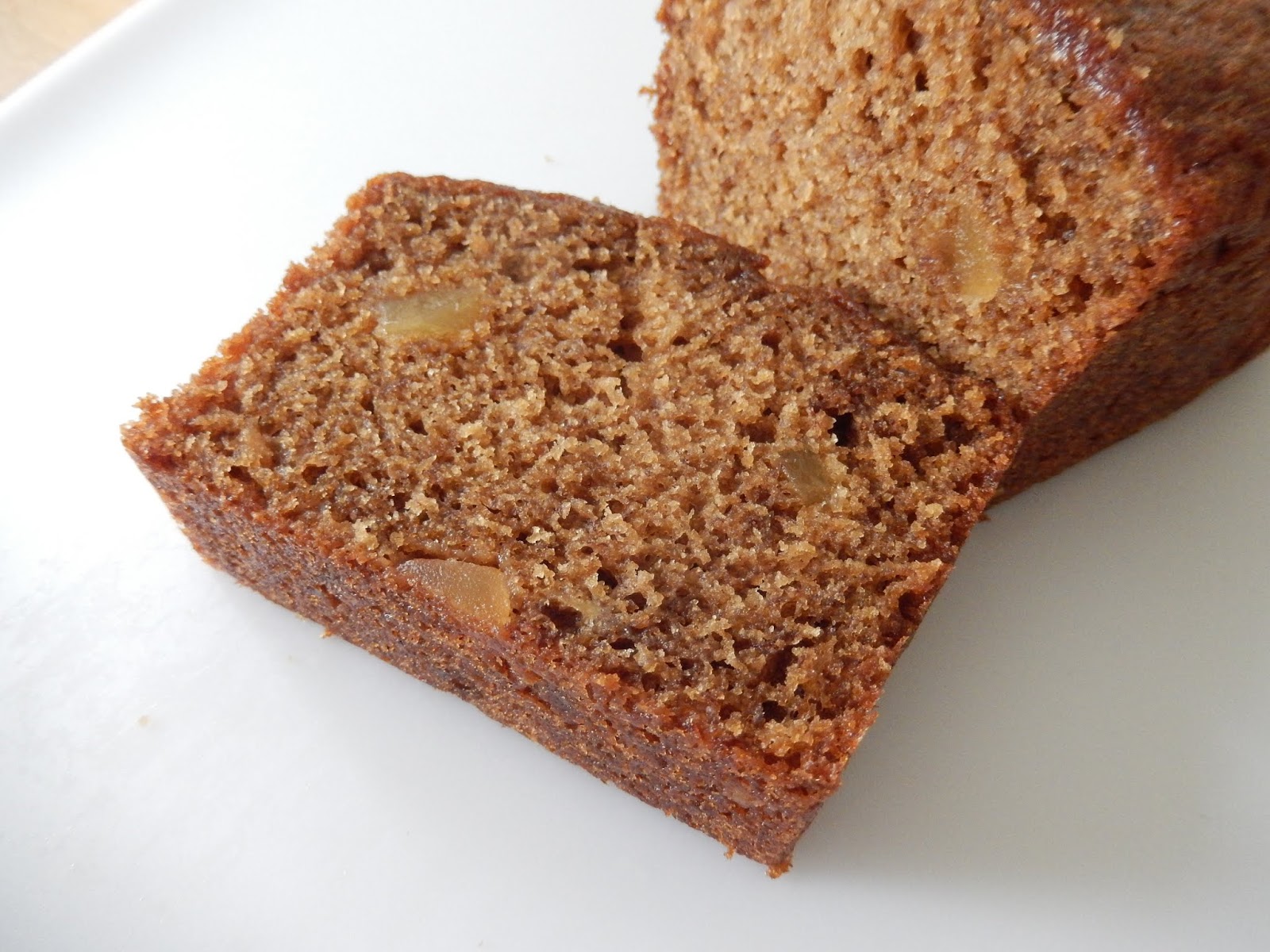
I'm still using the whole almonds, which were ground with the skins on (which explains the speckly appearance of the cake).

Wednesday, 7 August 2019

Dark Banana Ginger Cake

I feel as if I should apologise for three consecutive posts featuring loaves, but they are so practical now that I'm only baking for myself. Even with a small loaf cake, I often freeze part of it - mainly to save my waistline, not because I couldn't eat it all. Loaf shaped cakes are easy to portion and stack tidily in the freezer. In this case, I was able to bake this full-sized recipe (the second on the page) from the ever reliable Dan Lepard, but split it between two small loaf tins rather than bake it as one large 20cm (8") square cake. The cooking time for the smaller loaves was still 50 minutes.

I made a few changes to the recipe, some of which seemed inconsequential to how well the recipe worked - I used white bread flour, crystallised ginger instead of glacé, and added some ground spices to the recipe (1 teaspoon ginger and 1/2 teaspoon mixed spice). The final change was a bit more worrying - I only had two large bananas, which I was reasonably sure would weigh enough, but when the peel was off there was only 200g of flesh, not the 300g asked for in the recipe.

It was too late to back out at that stage so I went ahead, wondering if I needed to add anything to replace the missing 100g of banana. If the batter had been really thick, I might have added a tablespoon or two of natural yogurt, but it was very liquid, so I decided to go ahead with nothing else added.  I noticed afterwards that Dan says in the introduction to the recipe that the bran in wholemeal flour soaks up the liquid from the mashed banana, so maybe losing the bran and using less banana cancelled each other out!

I really liked this cake, it was firm and close textured but not heavy, and it still smelled and tasted of banana. I think adding a little extra spice was a good idea as even though I was using fiery crystallised ginger pieces it was nice to have some spice flavour in the cake crumb too.


Tuesday, 23 July 2019

Chocolate Chip Loaf Cake, with Hazelnuts, Raspberries and Lime

Although chocolate, raspberries, hazelnuts and lime sounded a very tasty combination of ingredients, this was a case where the sum total was less than its parts. I think the problem was that none of the ingredients stood out, so that, although these were pleasant cakes, overall the flavour was too non-descript. This could probably be easily remedied by more lime zest, more raspberries, a chocolate with more cocoa solids, or some chopped hazelnuts as well as the ground nuts, depending on which added ingredient you wanted to accentuate.

It was a double disappointment as these two cakes were to mark my and my son's birthdays in the middle of July, and I would have liked to make something a bit more memorable.

I made a double batch of what has become my 'go to' recipe for small loaf cakes, and divided it between two tins. This time, instead of chopping a bar of chocolate I bought dark chocolate chips as I thought the regularity would look better - perhaps it did, but I think the flavour would have been better with a bar of chocolate, as I usually use one with higher cocoa solids than in the bought chips.

Ingredients
220g caster sugar
220g softened butter
4 eggs
230g SR flour
50g ground hazelnuts
zest of 2 limes (reserve juice for icing)
10g dried raspberry pieces
100g dark chocolate chips
a little milk if necessary

Topping -  50g icing sugar, lime juice

Method
Put all the cake ingredients except the raspberry pieces and chocolate chips into a large bowl and beat until smooth and fluffy, adding a little milk if necessary to give a dropping consistency. Fold in the raspberries and chocolate. Divide the mixture between two small (1lb) loaf tins, lined with parchment or a pre-formed liner, and bake at 180C (160C fan) for about 60 minutes, or until a test probe comes out clean and dry.

When cool, make the icing by sifting the sugar and adding the lime juice a teaspoon at a time to give a thick, just-pourable consistency. I find it easiest to drizzle this over a cake by putting the icing into a small freezer bag, and snipping off one corner.

When the first slice was cut from the cake I thought the chocolate chips had sunk, but this was just the bad luck of random distribution - I took this photo of a slice further into the cake, just to prove they hadn't!