I made this 2-portion pudding in individual dishes, but if it was made in one dish it could easily feed three people; I was a little too greedy! The ingredients list is a bit vague, because the only thing I measured accurately was the milk.
Ingredients
*4 thick slices of brioche, each about 10cm square
butter, softened
apricot jam
a handful of soft dried apricots, chopped
a small chunk of glacé lemon peel chopped finely (optional)
2 medium eggs
225mls semi-skimmed milk
zest of half a lemon
1 tablespoon caster sugar, plus a little more for sprinkling on top
freshly grated nutmeg
*or use plain white bread from a small loaf - slightly stale bread can be used for this sort of pudding
Method
Thickly butter two individual baking dishes, which have roughly 350mls capacity each (or use one larger dish).
Mix the apricots and peel together, if using.
Use more butter and some apricot jam (fairly thinly spread), to make two sandwiches with the brioche.
Cut the sandwiches into suitably sized pieces to fit into your chosen dishes - I cut mine into 8 tiny triangles to get a tight fit.
Share half the pieces of sandwich between each dish and sprinkle with 2/3 of the fruit.
Arrange the rest of sandwiches on top, trying to keep the top fairly level and sprinkle over the rest of the fruit.
Mix the eggs, milk, lemon zest and caster sugar together in a jug and divide equally between the two dishes. Leave to stand for up to an hour to allow the custard mixture to soak into the bread.
When ready to cook, preheat the oven to 180C (160 fan). Sprinkle a little more sugar over each pudding and then grate over some nutmeg.
Cook for 25-30 minutes, until golden brown and crisp on top. One large pudding might take a few minutes longer.
This was a tasty version of the standard B & B pudding - the touch of lemon, and the tartness of the dried apricots, cut through the sweetness added by the jam.
I apologise for the awful photo - I wanted to get the puddings fresh from the oven, as they deflate as they cool and don't look so attractive, so had to use flash.
Showing posts with label candied peel. Show all posts
Wednesday, 22 November 2017
Monday, 17 April 2017
Golden Simnel Cake
My family's festive celebrations have never included traditional fruit cakes - we're more of a mini chocolate appreciation society - so I was surprised when my daughter asked me to make a Simnel Cake for Easter this year. I'm not averse to traditional recipes but I still wanted to put a spin on this cake to make it more personal, so I decided to make a golden fruit cake.
After looking at several recipes, I thought that Felicity Cloake's recipe from her 'How to Cook the Perfect.....' series in The Guardian would be the best one to adapt to what I wanted. I particularly liked the idea of adding saffron to help the golden colour of the cake I was planning.
I used the same quantities of all ingredients, although I used caster sugar instead of light brown sugar, to keep the crumb colour as pale as possible. Instead of using 400g of the fruit Felicity suggested (sultanas, currants and glacé cherries) I used 115g of each of sultanas, golden raisins and chopped apricots and 55g chopped dried peaches. I left the mixed peel in the recipe but took out the chopped almonds, as my daughter doesn't always like chewing on pieces of nuts, even though she loves the flavour of almonds. I used shop-bought white marzipan instead of yellow - just a personal preference!
It's a pity I didn't cross reference Felicity's decision making processes with the sources she used, or I would have discovered that her oven temperature was for a fan setting, not a conventional oven - after 2 hours at the quoted temperature the cake batter was still raw. It took another hour with the oven turned up another 20C for the cake to cook. Anyone with any experience of fruit cakes would have noticed the error straight away, but I've hardly ever made a rich fruit cake, even in 40 + years of cooking!
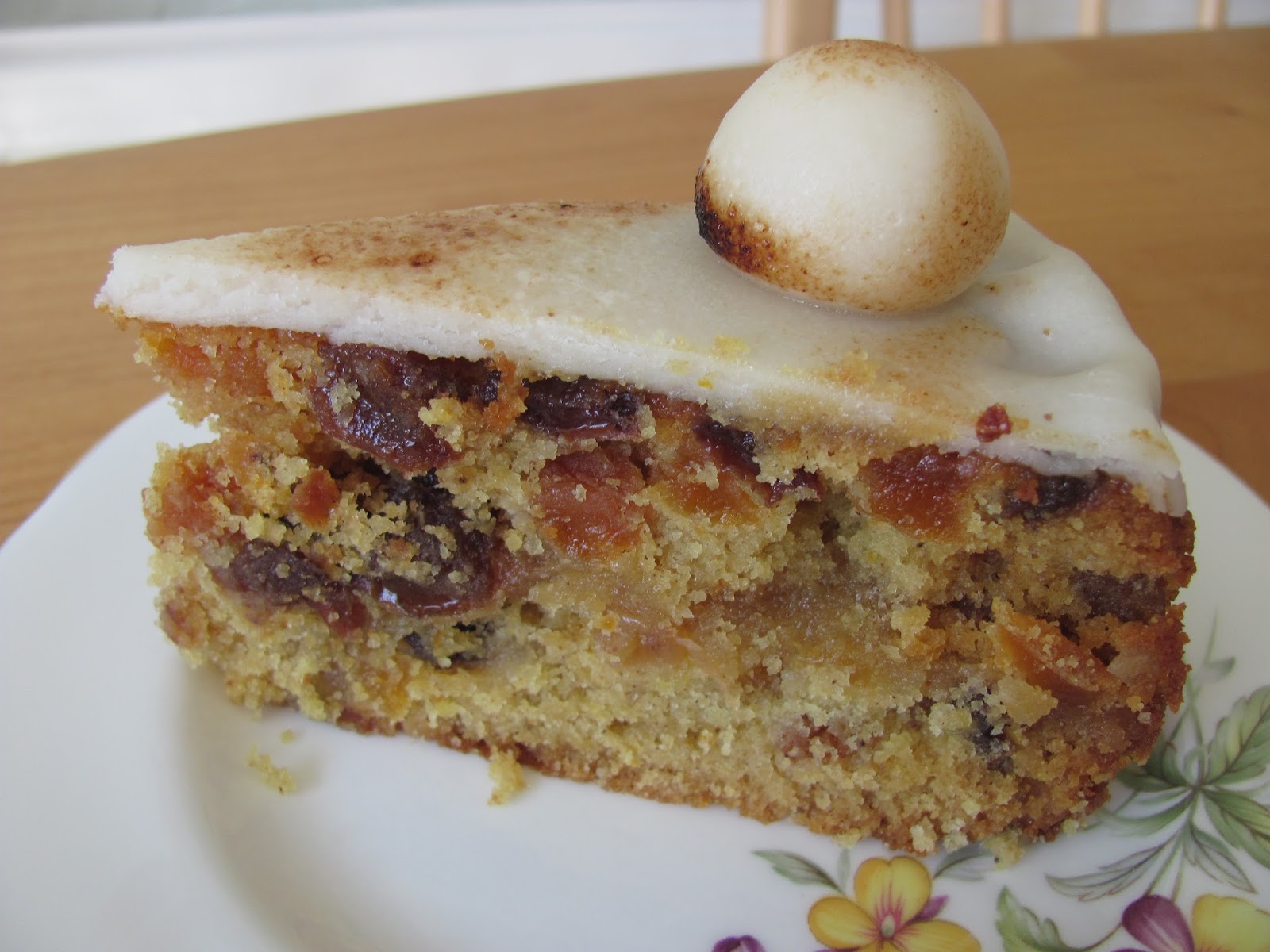
I was quite impressed with the look of the finished cake, although if I ever make another I will use more marzipan so that I can put thicker layers inside and on the top. The size of the 11 decorative balls, at 15g each, was about right, however. When cut, the colour of the crumb was just right for a golden cake.
I liked the flavour of the cake - a delicious subtle balance between spice and citrus, with all the fruits working in harmony, so that none stood out more than others. The soft inner layer of melted marzipan added a note of bitter almonds to the cake, although it hadn't stayed level in the cake, possibly a result of the error in cooking temperature.
There were other faults too, which might have been caused by the same error - the fruit wasn't evenly distributed in each layer, and although the cake was really moist, it was also crumbly and didn't cut cleanly. However, these faults were outweighed by the lovely flavour; all it really meant was that it was difficult to get a good photograph. I will have to try the recipe again, and cook it properly next time!
I was quite impressed with the look of the finished cake, although if I ever make another I will use more marzipan so that I can put thicker layers inside and on the top. The size of the 11 decorative balls, at 15g each, was about right, however. When cut, the colour of the crumb was just right for a golden cake.
I liked the flavour of the cake - a delicious subtle balance between spice and citrus, with all the fruits working in harmony, so that none stood out more than others. The soft inner layer of melted marzipan added a note of bitter almonds to the cake, although it hadn't stayed level in the cake, possibly a result of the error in cooking temperature.
There were other faults too, which might have been caused by the same error - the fruit wasn't evenly distributed in each layer, and although the cake was really moist, it was also crumbly and didn't cut cleanly. However, these faults were outweighed by the lovely flavour; all it really meant was that it was difficult to get a good photograph. I will have to try the recipe again, and cook it properly next time!
Labels:
almonds,
cake,
candied peel,
dried apricots,
dried peaches,
lemon,
marzipan,
mixed spice,
orange,
raisins,
rum,
saffron,
sultanas
Friday, 17 June 2016
Berry and Cherry Cake
This was a hastily thrown together cake, using what was available in my storecupboard, just to make sure there was something in the cake tin, to get us through to the weekend. I used a pack of mixed dried fruit - cranberries, flame raisins, golden raisins, inca berries, tart cherries, bing cherries and blueberries - and added the last of a tub of candied peel and a few drops of lemon extract for a light citrus note.
Ingredients
225g SR flour
110g butter
85g caster sugar
100g mixed dried fruit
2 tablespoons candied peel, finely chopped
1 teaspoon vanilla extract
few drops lemon extract,
1 egg
milk to mix - about 100mls
2 tablespoons demerara sugar for topping (optional)
Method
Preheat the oven to 175C and line a small (1lb/450g) loaf tin.
Rub the butter into the flour, then stir in the sugar, dried fruit and candied peel.
Add the egg, vanilla and lemon extracts and 3 tablespoons of milk. Mix to a smooth batter, adding more milk, as necessary, to give a dropping consistency.
Transfer the batter to the loaf tin, level the top and sprinkle with demerara sugar, if using.
Bake for about 60 minutes, until a test probe comes out clean and dry.
Cool on a wire rack
Because this is a rubbed-in cake, rather than starting with a creamed mixture of fat and sugar, there isn't a really fine crumb, and small holes can often be seen, but for a quickly put together fruit cake, I think this is acceptable. The unusual combination of dried fruits in the mixture, together with the background citrus flavour, made a really tasty cake.
Ingredients
225g SR flour
110g butter
85g caster sugar
100g mixed dried fruit
2 tablespoons candied peel, finely chopped
1 teaspoon vanilla extract
few drops lemon extract,
1 egg
milk to mix - about 100mls
2 tablespoons demerara sugar for topping (optional)
Method
Preheat the oven to 175C and line a small (1lb/450g) loaf tin.
Rub the butter into the flour, then stir in the sugar, dried fruit and candied peel.
Add the egg, vanilla and lemon extracts and 3 tablespoons of milk. Mix to a smooth batter, adding more milk, as necessary, to give a dropping consistency.
Transfer the batter to the loaf tin, level the top and sprinkle with demerara sugar, if using.
Bake for about 60 minutes, until a test probe comes out clean and dry.
Cool on a wire rack
Because this is a rubbed-in cake, rather than starting with a creamed mixture of fat and sugar, there isn't a really fine crumb, and small holes can often be seen, but for a quickly put together fruit cake, I think this is acceptable. The unusual combination of dried fruits in the mixture, together with the background citrus flavour, made a really tasty cake.
Labels:
cake,
candied peel,
lemon extract,
mixed dried fruit,
vanilla
Thursday, 3 December 2015
Marmalade and Hazelnut Cake
I'm trying to keep my baking light in the lead up to the festive 'eating season', and this subtly flavoured cake was made using the odds and ends of store-cupboard ingredients which inevitably accumulate during the year. The marmalade and candied peel gave just a hint of citrus flavour and the nuts added texture. The batter is a little heavier than a traditional sponge cake, but not as dense as a Madeira cake.
Ingredients
175g softened butter
150g caster sugar
1 teaspoon vanilla extract
3 eggs
5 tablespoons coarse-cut orange marmalade
200g SR flour
1/2 teaspoon baking powder
50g toasted chopped hazelnuts
50g candied citrus peel, finely chopped (optional)
optional - extra tablespoon of chopped hazelnuts for topping
Method
Preheat oven to 160C and prepare a round 20cm(8") cake tin. Sift the flour and baking powder together.
In a large bowl, beat butter and sugar together until pale and well mixed.
Beat in the eggs, one at a time, with a spoonful of the flour. Add the vanilla extract with the first egg.
With the electric mixer (if using) on minimum, mix in the marmalade, then fold in the rest of the flour.
Fold in the nuts and citrus peel, if using.
Transfer the batter to the cake tin, level the top and sprinkle on the extra chopped nuts, if desired (sugar nibs or demerara sugar would make a good alternative topping). Bake for 50-60 minutes, until a test probe comes out clean.
Cool in the tin for 15 minutes, then transfer to a wire rack to cool completely
Ingredients
175g softened butter
150g caster sugar
1 teaspoon vanilla extract
3 eggs
5 tablespoons coarse-cut orange marmalade
200g SR flour
1/2 teaspoon baking powder
50g toasted chopped hazelnuts
50g candied citrus peel, finely chopped (optional)
optional - extra tablespoon of chopped hazelnuts for topping
Method
Preheat oven to 160C and prepare a round 20cm(8") cake tin. Sift the flour and baking powder together.
In a large bowl, beat butter and sugar together until pale and well mixed.
Beat in the eggs, one at a time, with a spoonful of the flour. Add the vanilla extract with the first egg.
With the electric mixer (if using) on minimum, mix in the marmalade, then fold in the rest of the flour.
Fold in the nuts and citrus peel, if using.
Transfer the batter to the cake tin, level the top and sprinkle on the extra chopped nuts, if desired (sugar nibs or demerara sugar would make a good alternative topping). Bake for 50-60 minutes, until a test probe comes out clean.
Cool in the tin for 15 minutes, then transfer to a wire rack to cool completely
Friday, 18 September 2015
Wholemeal Apple Cake with Orange and Cranberries
- an Au-tummy cake for my second Clandestine Cake Club meeting.
My local branch of the Clandestine Cake Club has a new organiser, so I didn't want to miss the first event that she arranged, with the theme of 'Au-tummy cakes' (Autumn/tummy filling - geddit?). Unfortunately the date of the meeting was the day after I would be arriving home from our Spanish holiday, after 14 hours of travelling up through France, then through the Channel Tunnel, on trains and coaches. I knew I would probably be tired, and wouldn't have time for shopping before cooking, so I chose a foolproof recipe from my list of favorites, which can be made with just storecupboard ingredients plus fresh apples, and made sure I left apples in the fridge before going away.
This cake is a slight adaptation of this Nigel Slater recipe, (also published in 'Tender - Volume II') substituting 75g dried orange-flavoured cranberries, and 25g diced candied citrus peel for the sultanas or raisins suggested in the recipe. I happened to arrive home with a mandarin orange left over from our travelling rations, so a little fresh zest gave the cake a nice boost, but I was prepared to just leave out the zest, as the cranberries were orange-flavoured (left over from last Christmas's festive goodies from Aldi), and the marmalade had a high fruit content too.
I really like this cake, because it is moist and unexpectedly light, considering it's made with wholemeal flour. Many apple cakes are too dense and stodgy, because of the moisture from the fruit, but this cake is perfect! It can also be varied by changing the dried fruits used, and also swapping the marmalade for different flavoured jams or jellies (I have used smooth cranberry sauce quite successfully). Pears also work well instead of apples, as in this pear and ginger preserve variation.
With a theme of Autumn, there were several other apple-based cakes brought along to the Cake Club meeting, along with cakes containing plums, pears and blackberries. My cake was a little crumbly when cut - in an ideal world it would have been made the day before, so that it had time to rest properly - but so were some of the others, so I didn't feel too bad about it! I'm really happy to be moving into Autumn - possibly my favorite season for baking.
I really like this cake, because it is moist and unexpectedly light, considering it's made with wholemeal flour. Many apple cakes are too dense and stodgy, because of the moisture from the fruit, but this cake is perfect! It can also be varied by changing the dried fruits used, and also swapping the marmalade for different flavoured jams or jellies (I have used smooth cranberry sauce quite successfully). Pears also work well instead of apples, as in this pear and ginger preserve variation.
Labels:
apple,
cake,
candied peel,
cinnamon,
Clandestine Cake Club,
dried cranberries,
marmalade,
orange
Sunday, 2 August 2015
Fig Flapjacks
Isn't it strange that sometimes you spend ages thinking about flavour combinations before you cook, and still things don't work out well, and at other times you throw things together with almost no thought, and make something really delicious? The latter scenario is what happened with this batch of flapjacks.
I wanted to use a pack of partially re-hydrated figs, which was getting near the use-by date. The figs were really soft and sticky and when I looked through my 'add-ins' storage box to find something else to use, to balance both their sweetness and softness, I came across a tub of candied citrus peel. Then I opened a cupboard to get out the golden syrup and had to move a bottle of pomegranate molasses, and thought 'why not?'
The slightly sour note from the pomegranate molasses and the citrus notes really worked well to offset the sweetness of the figs and sugars, and this was one of the tastiest batches of flapjacks I've ever made.
Melt together 160g butter, 40g golden syrup, 30g pomegranate molasses and 100g light muscovado sugar. This can be done in a pan on the hob or in a large bowl in the microwave. It doesn't need to get very hot - you just want the butter to melt. Stir to blend everything together then mix in 230g rolled oats, 70g chopped dried figs and 30g candied citrus peel. Tip the mixture into a 20 x 20cm (8" x 8") baking tin, lined with baking parchment, spread and level, and press down firmly. Bake at 180C for 30 minutes. Mark into bars while still warm, but cool completely before removing from the tin.
I wanted to use a pack of partially re-hydrated figs, which was getting near the use-by date. The figs were really soft and sticky and when I looked through my 'add-ins' storage box to find something else to use, to balance both their sweetness and softness, I came across a tub of candied citrus peel. Then I opened a cupboard to get out the golden syrup and had to move a bottle of pomegranate molasses, and thought 'why not?'
The slightly sour note from the pomegranate molasses and the citrus notes really worked well to offset the sweetness of the figs and sugars, and this was one of the tastiest batches of flapjacks I've ever made.
Melt together 160g butter, 40g golden syrup, 30g pomegranate molasses and 100g light muscovado sugar. This can be done in a pan on the hob or in a large bowl in the microwave. It doesn't need to get very hot - you just want the butter to melt. Stir to blend everything together then mix in 230g rolled oats, 70g chopped dried figs and 30g candied citrus peel. Tip the mixture into a 20 x 20cm (8" x 8") baking tin, lined with baking parchment, spread and level, and press down firmly. Bake at 180C for 30 minutes. Mark into bars while still warm, but cool completely before removing from the tin.
Labels:
biscuits and bars,
candied peel,
figs,
oats,
pomegranate molasses
Sunday, 3 May 2015
Blueberry and Citrus Flapjack
I was looking for something quick and easy to make, which would just fill the gap until the bank holiday dessert was made - so nothing too large. Rootling through the storecupboard - in reality a large plastic box - I found dried blueberries and mixed peel which needed using. They seemed ideal additions to a chewy flapjack, and 2/3 of my usual recipe was perfect in size.
Ingredients
100g dried blueberries
finely grated zest and juice of 1 mandarin orange
1 tablespoon boiling water
1 tablespoon limoncello (optional)
50g diced candied mixed peel
160g unsalted butter
65g golden syrup
100g light muscovado sugar
240g rolled oats

Method
Line a 8"(20cm) square baking tin with parchment, and preheat the oven to 180C.
Soak the blueberries and zest in the juice of the mandarin, the boiling water and the limoncello (if using) for a few minutes to plump up the fruit.
Melt the butter, sugar and syrup together, in a saucepan, stirring until the sugar has dissolved.
Put the oats, blueberries and mixed peel into a large bowl and stir in the butter mixture.
Spread the mixture evenly in the baking tin and press down firmly.
Bake for 25 minutes for a chewy flapjack, or a little longer if you prefer the flapjack to be crisp.
Mark into 16 squares while still warm, but cool completely before removing from tin.
These were delicious. The blueberries and mixed citrus flavours went really well together, and both the berries and the peel were soft and chewy.
100g dried blueberries
finely grated zest and juice of 1 mandarin orange
1 tablespoon boiling water
1 tablespoon limoncello (optional)
50g diced candied mixed peel
160g unsalted butter
65g golden syrup
100g light muscovado sugar
240g rolled oats
Method
Line a 8"(20cm) square baking tin with parchment, and preheat the oven to 180C.
Soak the blueberries and zest in the juice of the mandarin, the boiling water and the limoncello (if using) for a few minutes to plump up the fruit.
Melt the butter, sugar and syrup together, in a saucepan, stirring until the sugar has dissolved.
Put the oats, blueberries and mixed peel into a large bowl and stir in the butter mixture.
Spread the mixture evenly in the baking tin and press down firmly.
Bake for 25 minutes for a chewy flapjack, or a little longer if you prefer the flapjack to be crisp.
Mark into 16 squares while still warm, but cool completely before removing from tin.
These were delicious. The blueberries and mixed citrus flavours went really well together, and both the berries and the peel were soft and chewy.
Labels:
candied peel,
dried blueberries,
limoncello,
mandarin orange,
oats
Friday, 15 November 2013
Apple Cake with an 'Eccles' filling
However, despite my misgivings over the name, this recipe made an exceedingly good cake - two layers of apple-studded cake enclosing a spicy
layer of dried fruits (sultanas, currants and candied peel). The cake layers were moist, but tender and light, and tasting slightly of caramel due to the use of brown sugar. The apple pieces kept their shape during cooking, adding to the range of textures in the whole cake. The dried fruit layer was spicy, sweet and buttery, with the flavour of the ground cloves and candied peel really standing out. Having said that, I know that many people do not like these particular flavours, but I think the cake would be just as good without them - perhaps adding something like cranberries instead of the peel, to keep the weight of filling correct.
The only changes I made to the cake recipe was to use sultanas instead of raisins, and to bake the cake in a 23cm tin rather than a 20cm one - the comments on the website, about the cake, suggested a larger tin would make a better proportioned cake - and I think I agree with them. The use of sultanas was purely to take advantage of what was in the storecupboard, but I did buy the currants especially for the recipe - currants are essential for a real Eccles Cake filling. I simplified the decoration by just using a drizzle of lemon glacé icing, although I have to confess that this was partly due to not reading the recipe properly, and having neither sugar cubes to crush nor an extra lemon to take zest from!.
I am entering this recipe into this month's Tea Time Treats baking challenge. The remit this month, in the run-up to Christmas, is to use dried fruits when producing something suitable for the tea table. This cake fits the bill quite nicely, as it is full of seasonal flavours and ingredients, and I think it would make a lovely Christmas cake for anyone not completely sold on the idea of a traditional fruit cake. Tea Time Treats is hosted alternately by Karen at Lavender and Lovage, and Kate at What Kate Baked - Karen is hosting this month and, as usual, will present a round-up post at the end of the month.
Labels:
apple,
cake,
candied peel,
currants,
spices,
sultanas,
Tea Time Treat
Monday, 26 March 2012
Blueberry Traybake with Lemon Streusel
I didn't really follow the recipe at all, except as a guide to quantities, but this cake was inspired by this recipe on the King Arthur Flour website. I just loved the idea of candied lemon pieces in the Streusel topping, and blueberries and lemon are a classic combination.
To keep the cake low(ish) in saturated fat, I used my standard recipe for a yogurt and oil cake, although I did keep the butter in the streusel topping. I read on one of the blogs featuring the same cake that there was an awful lot of streusel crumbs, so I reduced it to a half quantitiy, then wished I hadn't, as it didn't cover the blueberries well enough and the cake rose around the little lumps of streusel. I also made the streusel by my favoured method of melting the butter and mixing it with the other ingredients - this ensures the streusel isn't powdery at all.
Cake - 200g plain flour
2 teaspoons baking powder
115g sunflower oil
3 eggs
1 teaspoon vanilla extract
Method
Pre-heat oven to 180C and line a 12 x 8" (30 x 20cm) shallow baking tin with parchment.
Make the streusel by mixing the melted butter into the other ingredients and leaving to cool. It will be one big lump at this stage, but will crumble nicely when it's cool.
Make the cake by mixing the flour, baking powder and sugar in a large bowl. In a smaller bowl, whisk the yogurt, sunflower oil, eggs and vanilla together until emulsified, then mix into the flour. Don't overmix - just stir briskly until there are no signs of dry flour.
Transfer the batter to the baking tin, then scatter the frozen blueberries evenly over the surface.
Crumble the streusel topping evenly over the surface, then bake for 35-40 minutes, or until a test probe comes out clean. Cool in the tin
To keep the cake low(ish) in saturated fat, I used my standard recipe for a yogurt and oil cake, although I did keep the butter in the streusel topping. I read on one of the blogs featuring the same cake that there was an awful lot of streusel crumbs, so I reduced it to a half quantitiy, then wished I hadn't, as it didn't cover the blueberries well enough and the cake rose around the little lumps of streusel. I also made the streusel by my favoured method of melting the butter and mixing it with the other ingredients - this ensures the streusel isn't powdery at all.
This was a really good cake, and it would also make a tasty dessert if served still warm. It was very moist from the blueberry juice and the little pockets of crunchy lemon streusel gave a lovely contrast in flavour and texture. What started off as a potential problem - not enough streusel - ended up being a positive feature of the cake! It was also just the right size for the four of us to eat in two days - one problem with fresh fruit cakes is that they don't keep long, especially in the sort of unexpectedly hot weather we're having at the moment.
Ingredients
Streusel - 75g plain flour
50g light muscovado sugar (or demerara for more crunch)
2 tablespoons finely chopped candied lemon peel
a few drops lemon extract
grated zest of half a lemon
75g butter, meltedCake - 200g plain flour
2 teaspoons baking powder
200g caster sugar
250g low fat natural yogurt115g sunflower oil
3 eggs
1 teaspoon vanilla extract
200g frozen blueberries
Method
Pre-heat oven to 180C and line a 12 x 8" (30 x 20cm) shallow baking tin with parchment.
Make the streusel by mixing the melted butter into the other ingredients and leaving to cool. It will be one big lump at this stage, but will crumble nicely when it's cool.
Make the cake by mixing the flour, baking powder and sugar in a large bowl. In a smaller bowl, whisk the yogurt, sunflower oil, eggs and vanilla together until emulsified, then mix into the flour. Don't overmix - just stir briskly until there are no signs of dry flour.
Transfer the batter to the baking tin, then scatter the frozen blueberries evenly over the surface.
Crumble the streusel topping evenly over the surface, then bake for 35-40 minutes, or until a test probe comes out clean. Cool in the tin
Labels:
blueberries,
cake,
candied peel,
dessert,
lemon,
low saturated fat
Sunday, 13 November 2011
Orange and Pinenut Frangipane Tart
We've been having a bit of an Italian themed weekend, as far as eating goes. Tonight's meal is the star of the show, as we are using some pretty striped sombrero pasta and extra virgin olive oil brought back from FB's recent working holiday in Italy. She spent two weeks helping with the olive harvest and learning about olive oil production; the oil she brought back was produced by the organic farm where she was picking.
Tonight we'll be eating the pasta dressed with the oil and parmesan and bruschetta made with the oil and garlic, followed by roast chicken.
The dessert, which was made yesterday, and eaten after salmon coated with pesto breadcrumbs and Nigella's Rapid Roastini, will be the rest of this Orange and Pinenut Frangipane Tart from Giorgio Locatelli.
I followed the filling recipe and the baking method exactly, but used my own sweet shortcrust pastry recipe, which isn't quite as sweet as the pastry used in the recipe (200g plain flour, 110g butter, 30g icing sugar, 1 egg yolk + water as necessary). The recipe was quite straightforward to follow; I chopped the candied peel really small (smaller than the pinenuts) because I wasn't really sure how the rest of the family like it as it's not something I use very often. The only snag was that it took about 25 minutes before I was satisfied that the filling was set, but I turned down the heat to 150C after 15 minutes as the tart was already quite brown.
The tart was delicious - the flavour of both the pinenuts and the candied peel was very subtle and neither overwhelmed the delicate flavour of the frangipane. I served it with Chantilly Cream or vanilla pouring yogurt for those watching the calories. I'm sure the cream would have been tastier!
Tonight we'll be eating the pasta dressed with the oil and parmesan and bruschetta made with the oil and garlic, followed by roast chicken.
The dessert, which was made yesterday, and eaten after salmon coated with pesto breadcrumbs and Nigella's Rapid Roastini, will be the rest of this Orange and Pinenut Frangipane Tart from Giorgio Locatelli.
I followed the filling recipe and the baking method exactly, but used my own sweet shortcrust pastry recipe, which isn't quite as sweet as the pastry used in the recipe (200g plain flour, 110g butter, 30g icing sugar, 1 egg yolk + water as necessary). The recipe was quite straightforward to follow; I chopped the candied peel really small (smaller than the pinenuts) because I wasn't really sure how the rest of the family like it as it's not something I use very often. The only snag was that it took about 25 minutes before I was satisfied that the filling was set, but I turned down the heat to 150C after 15 minutes as the tart was already quite brown.Saturday, 28 May 2011
Honey and Treacle Cake
Three of the four of us looked at this Dan Lepard recipe for a loaf cake full of spices and glacé peel, in last week's Guardian Weekend magazine, and said, without prompting from others, that it looked a really good cake. So what could I do, except bake it as soon as possible?
I followed the recipe quite closely, using large pieces of glacé peel which I chopped myself - there was more lemon and citron peel than orange - and making only one minor change. I reduced the amount of ground cloves to 1/4 teaspoon, as I find it quite overwhelming in large amounts.
There is one small point to note - Dan says to use a 'small' loaf tin, but the uncooked cake batter more than half filled my 2lb loaf tin (which was 17cm long, as stipulated); I would call a 2lb tin a large one! You can see from these photos that although the cake doesn't rise a huge amount, using a smaller tin could possibly have been a mistake.
I followed the recipe quite closely, using large pieces of glacé peel which I chopped myself - there was more lemon and citron peel than orange - and making only one minor change. I reduced the amount of ground cloves to 1/4 teaspoon, as I find it quite overwhelming in large amounts.
There is one small point to note - Dan says to use a 'small' loaf tin, but the uncooked cake batter more than half filled my 2lb loaf tin (which was 17cm long, as stipulated); I would call a 2lb tin a large one! You can see from these photos that although the cake doesn't rise a huge amount, using a smaller tin could possibly have been a mistake.
The finished cake was a sturdy but moist loaf, with subtle flavours. None of the wide range of flavours - honey, treacle, spices, orange, glacé peel - were predominant, but blended together to give a very unusual, but delicious, spicy flavour to the cake. Although Dan suggests varying the spices to suit your preferences, I'd say definitely leave in the black pepper, as this gave a suggestion of heat which you wouldn't get from the other spices.
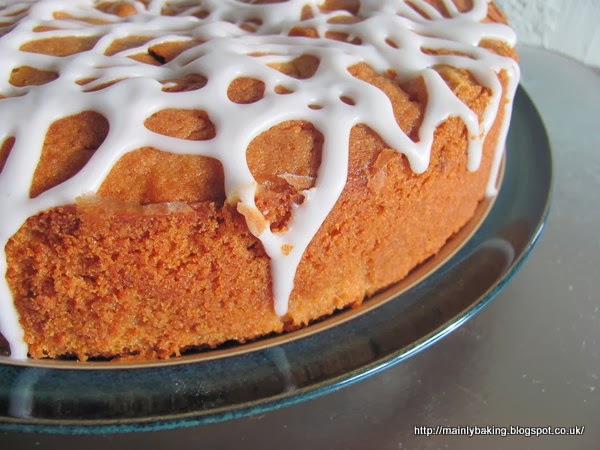
Even the glacé peel, which some people find a difficult ingredient to like, didn't stand out as a particularly strong flavour, adding more to the texture than the taste. The sweetness of the peel and honey was balanced by the bitter edge to the treacle and muscovado sugar. The orange flavoured glacé icing added a burst of fresh flavour, but wasn't really necessary, especially if you wanted to use the cake in a lunchbox, or other situation where the icing might spoiled while travelling.
All in all, this is a really delicious cake, whose flavour is difficult to describe - you'll have to try it for yourself!
Tuesday, 10 May 2011
Golden Gingerbread
I've found another good recipe using oil instead of butter, which is just as well, as CT's diet is working really well at reducing his cholesterol - but that means he's got to stick to it!
I've called this golden gingerbread to distinguish it from the darker cakes which include black treacle - there was only light muscovado sugar and golden syrup in this recipe. I used this recipe, but made a few changes, because I didn't want to add a frosting. I included the zest of a large orange in the cake, and added 4 nuggets of stem ginger and about 50g of candied orange peel, both finely chopped. These changes were good for the flavour, but the pieces of ginger and peel mostly sank to the bottom, so were not such a good idea!
Translating the recipe from cups to weights gave me - 180g plain flour, 90g SR flour, 200g brown sugar, 180mls olive oil and milk, and 300g golden syrup. That's 500g sugar in one small cake - it sounds much less as 2 cups!!
I baked the cake in a 10" (25cm) square tin but think it would have been nicer as a deeper cake in a smaller tin. This was a pleasantly flavoured cake, with the right amount of ginger, but I think I still prefer the dark gingerbreads, where the black treacle adds a bitter edge to the sweetness.
I've called this golden gingerbread to distinguish it from the darker cakes which include black treacle - there was only light muscovado sugar and golden syrup in this recipe. I used this recipe, but made a few changes, because I didn't want to add a frosting. I included the zest of a large orange in the cake, and added 4 nuggets of stem ginger and about 50g of candied orange peel, both finely chopped. These changes were good for the flavour, but the pieces of ginger and peel mostly sank to the bottom, so were not such a good idea!
Translating the recipe from cups to weights gave me - 180g plain flour, 90g SR flour, 200g brown sugar, 180mls olive oil and milk, and 300g golden syrup. That's 500g sugar in one small cake - it sounds much less as 2 cups!!
I baked the cake in a 10" (25cm) square tin but think it would have been nicer as a deeper cake in a smaller tin. This was a pleasantly flavoured cake, with the right amount of ginger, but I think I still prefer the dark gingerbreads, where the black treacle adds a bitter edge to the sweetness.
Labels:
cake,
candied peel,
ginger,
low saturated fat,
orange,
spices
Subscribe to:
Posts (Atom)