Showing posts with label almonds. Show all posts

Saturday, 16 January 2021

Cranberry and Hazelnut Frangipane Tart

Just before Christmas, I bought a jar of Christmas Cranberry Curd; just after Christmas I bought another - 'reduced to clear' so that the supermarket could get rid of unsold Christmas stock. I didn't have a clear idea of what to do with them at the time, but the idea of using some in a Bakewell tart type of thing slowly took shape. So, in my first baking session since Christmas, that's what I made.

I didn't have enough ground almonds, but I did have ground hazelnuts which needed using. I thought the hazelnut flavour might be better with cranberry, as it's much stronger than the flavour of almonds (in fact, you really need to add almond extract if you want a strong almond flavour in anything).

I also had some Trex cooking fat in the fridge, which needed using up too. I've never used Trex in baking (it was bought to make a lining paste for bundt tins) but it was past it's BBE date, so needed to be used. I did taste it to make sure it wasn't rancid, and it was fine. I substituted 1/4 of the butter in the pastry with Trex and just that amount was enough to make the pastry shorter than usual. The pastry dough seemed a little more difficult to work with, but it was worth it for the result, and didn't seem to affect the flavour greatly.

Ingredients

  • Shallow 24cm tart/flan tin lined with chilled raw shortcrust pastry - no need to bake blind.*
  • 200g of cranberry curd (lemon curd or a jam of your choice can be used instead)
  • Frangipane - 100g softened butter, 100g caster sugar, 2 large eggs, 50g ground roasted hazelnuts, 25g ground almonds, 25g flour (I used SR flour, but think plain flour, or more nuts would be better **).
  • 2 tablespoon of chopped roasted hazelnuts.

Method

Spread the cranberry curd over the base of the pastry case and return to the fridge while the frangipane is made.
Pre-heat oven to 200C/180C fan-assisted. Put a baking sheet in to heat up.
Make the frangipane by putting all the ingredients, except the chopped hazelnuts, into a bowl and beating until the mixture is light and fluffy and no specks of butter can be seen. Spread carefully over into the pastry case - I spoon small amounts of batter around the edge of the case then spread it inwards, so as not to move the curd or jam towards the edges of the pastry case, where it might erupt out of  any gaps between the frangipane and pastry. 
Use a teaspoon or a damp finger to try and seal the frangipane batter against the pastry sides, level the surface, then sprinkle over the chopped hazelnuts.
Transfer the tart to the heated baking sheet and bake at 200C for 10 minutes. Reduce the heat to 170C and bake for roughly another 25 minutes, until the frangipane isn't wobbling, and is golden brown in colour.

* I made shortcrust pastry using 300g flour, 150g butter and Trex and water to mix to a dough. I wanted some pastry for something else, so made more than necessary for one tart case. I'm guessing starting with 200g flour would be enough for just the tart case, and you could make a sweet shortcrust (adding sugar and egg) if preferred.

** The tart puffed up while baking, which I expected, as I'd added some SR flour, but it didn't sink evenly when it cooled, leaving a puffy rim around the edge of the tart and a fragile crust on the frangipane. This hasn't happened to me before, but I'm now rethinking the use of SR flour in frangipane. I'll try plain flour next time, but all ground nuts can be used too; I like a little flour as it makes the frangipane lighter and more cakey than when just nuts are used, but that's a personal preference.

This tart was absolutely delicious. The tartness of the cranberry curd stood up well to the flavour of the hazelnuts. My only disappointment was that the curd seemed to be absorbed into the bottom of the frangipane mixture, so that there wasn't a well defined layer of curd left after baking, as there usually is with jam. When I checked the curd ingredients, I noticed that it contained agar as a gelling agent, which gave it a strange gloopy consistency, but may also explain the way it behaved in the tart, when heated. Fortunately, this didn't affect the flavour, only the looks.

Wednesday, 23 December 2020

The Triennial Chocolate, Fig and Ginger Panforte

For some reason, I have made this Panforte, for Christmas, at three year intervals - 2014, 2017 and again this year. Perhaps it's going to be a tradition!


Panforte is a particularly suitable Christmas treat this year, when, if we are meeting friends and family at all, it's on a very restricted schedule with regards to both numbers and time. It keeps for weeks after making, so however few of you there are to eat it, you'll get through it without any waste. 

This year, this panforte will almost be all mine! Apart from a brief visit from both my children on Christmas Day for an exchange of presents and a meal together, the Covid restrictions mean, like many others, I'll be alone most of the time. That doesn't bother me - all I need is a good book to keep me happy, and it will only be a few days before we're all back into the routines of our lives. For me that can be quite hectic, as I volunteer at the local Food Bank, which has been very busy since the start of the pandemic.

I followed my original recipe from 2014, which was a compilation of several other recipes, in a quest for perfection. I could vary the flavours by changing the fruit, or leaving out the ginger, but this particular combination of chocolate, figs and ginger, together with the spices and hint of orange, works so well that I'm reluctant to make changes.

Here's wishing you the best 

for this Festive Season, 

with hopes that 2021 

will be better for all of us!

Wednesday, 26 February 2020

Mincemeat Loaf Cakes

It seems quite a long time since I tried a new recipe; I have a lot of favourites that I keep returning to at the moment, either because they are reliable (if I'm baking for someone else), or I know they freeze well.

I knew I wanted to make a mincemeat cake to use some of the Christmas excess,  so decided this might be the time to try a new recipe. Mary Berry's recipe appealed because it made two small loaves and she says they freeze well.

It's a straightforward recipe to follow - it's an all-in-one mixture, so you just need to make sure you have well softened butter before you start. I didn't have currants, so used dried cranberries instead, and topped the cakes with flaked almonds rather than split nuts.

The cake batter was very stiff, and with the benefit of hindsight, now that I've cut the cakes, I think I should have added a couple of tablespoons of milk to loosen it a little. The cakes were a little dry and crumbly, and didn't compare favourably, in that respect, to the recipe I usually use. They rose well during cooking, in terms of increased volume, but there was a definite dip in the middle of each one. I think I might have been guilty of not mixing well enough, as the batter was so stiff.

As always with this  sort of cake, the final flavour relies heavily on any added ingredients in the mincemeat. I used a Waitrose brand with their 'Christmas 2019 special' ingredients of plum, honey and ginger. Even after being diluted into the cake mixture, the plum flavour (provided by prunes and plum juice) was still evident.

I think this is a recipe to use again, as it uses mincemeat leftovers, rather than a whole jar, but I'll be more careful next time, and make sure the batter has a 'dropping' consistency, and is well mixed.

Monday, 13 January 2020

Lemon Curd 'Bakewell' Bars

I've recently started to donate baked goods to a monthly Coffee Morning run by the Friends of my local library. Not only is it giving me a much needed excuse to bake, but it's helping a good cause too. This month I made some date shortbread squares and these lemon and almond bars - similar to a Bakewell tart, but with lemon curd instead of raspberry jam.

Because the tart was going to be cut into individual portions before being put out for sale, I made it in a narrow rectangular tart tin, measuring 36 x 11.5cm. That way it could be cut into bars which would be easier to eat with fingers than a wedge from a round tart. Having a border of pastry on both short edges looked quite attractive too.


After lining the tart tin with sweet shortcrust pastry, I spread about 200g of lemon curd over the base - there's no need to blind-bake the pastry for this recipe. I used this BBC Good Food recipe for the frangipane mixture. It was exactly the right amount to fill the tart! The only changes I made to the recipe was to only use the zest of 1 lemon, and to add a few drops of almond extract, as I wanted the frangipane to taste more of almonds than lemon.

I baked the tart for 15 minutes at 200C, then lowered the temperature to 180C and continued baking until the frangipane was cooked to a golden brown colour - about another 25 minutes. When cool, I cut into bars about 3cm wide, although I discarded the first centimetre at each end, with the extra pastry (cook's treat!).


Monday, 18 November 2019

Lemon Loaf Cake

Every time I need a lemon I fall into the trap of buying a bag of them - partly because unwaxed lemons don't seem to be sold singly, and partly because each lemon works out cheaper.

However, if I don't use the lemons fairly quickly, it's a false economy, but that's not difficult to do as I love a lemon cake.

Dan Lepard calls this recipe a lemon drizzle cake, but whenever I make it the drizzle sets to a proper glacé icing. This doesn't bother me, as I don't like too much drizzle, but I don't feel happy calling it a drizzle cake, either.

This recipe really is delicious; there's the zest of 2 lemons and 75mls of juice to make it really lemony. Additionally, ground almonds keeps the cake moist and the addition of a little cornflour keeps the crumb really tender and delicate.

I don't deviate from the recipe in any way, but after adding up the weight of the ingredients, I bake it in a 2lb (900g) loaf tin, even though the recipe suggests a small tin should be used.

I'm still using the whole almonds, which were ground with the skins on (which explains the speckly appearance of the cake).

Tuesday, 1 October 2019

Autumn Fruit Frangipane Tarts

It's a measure of how little baking I do these days, that it's over three weeks since I last posted. When I do bake anything, however small, half of it usually ends up in the freezer, meaning there's always cake there if needed, but as a result I don't need to bake as often. My waistline doesn't need cake every day, either!

When making this tart I realised that I hadn't made any pastry since the festive baking at the end of 2018 - an indication that calorific desserts are also becoming something for special occasions; I usually just have fresh fruit and yogurt!

These Autumn Fruit Frangipane Tarts had plum jam in the base and fresh blackberries and pieces of eating apple embedded in the frangipane mixture. I made two small tarts instead of one big one, as I was taking one to my local Cake Club. The frangipane comes from this Jamie Oliver recipe, but I made half as much again, after seeing the amount the original ingredients gave.

I made sweet shortcrust pastry to this recipe, but this made enough for the two tart cases with quite a lot leftover: 300g plain flour, 1/2 teaspoon baking powder, 150g butter, 50g icing sugar, 1 medium egg, water as necessary to bind. If you reduce the quantities you could use just an egg yolk instead of a whole egg.

Once the pastry is mixed, rest in the fridge for 20 minutes, then roll out as thinly as possible to line 2 x  20cm (8") tart tins (or one 23cm tin if you're following the recipe). Refrigerate again while you make the filling - there's no need to blind bake with a frangipane.

Preheat the oven to 180C (160 fan) and put a baking sheet in to heat up too.

Put all the frangipane ingredients into a bowl and beat until well combined. I added just a few drops of almond extract, to give a better flavour, instead of the lemon zest in the recipe. Then prepare the fruit.

(I used one large eating apple, which I peeled and chopped into quite thin pieces, about 1cm square, and put into acidulated water so that the pieces didn't turn brown. I also used fresh blackberries, as I was worried that frozen would release too much juice and spoil the colour of the frangipane - I didn't weigh the amount I used but the quantity give in Jamie's recipe sounds about right.)

Spread a couple of tablespoons of plum jam (or whatever red jam you prefer) into the base of each pastry case. Divide the frangipane mixture between the two tarts, working from the edge inwards, and trying to get a good seal between the frangipane and the pastry, so that the jam doesn't boil out around the edge. Spread evenly and then dot the drained and dried apple pieces and blackberries over the surface, pressing down gently to embed them in the frangipane. Sprinkle over a handful of flaked almonds, then a little extra caster sugar.

Transfer to the heated baking sheet and bake for about 45 minutes until the frangipane is a good golden colour and feels firm. Cool on a wire rack.

I decorated the tart which I was taking to Cake Club with a drizzle of glacé icing, but it's not really necessary, and the icing soon dissolved where it was in contact with the pieces of fruit, so didn't really give the desired effect by the time it was eaten.

Adding fruit to a frangipane tart is a tasty bonus, although in this case the plum jam had a stronger flavour than the apples and blackberries - I should have looked for a blackberry jam, I think.

My tart looks darker than most frangipane because I was using almonds which had been ground with the skins still on; the jury is still out on whether this really gives a good look.

Thursday, 4 July 2019

Coconut and Lime Drizzle Cake

Another small loaf cake, inspired by this recipe on the Waitrose website. I intended to make the large cake but forgot to buy the extra eggs I needed, so had to aim for a half-sized loaf. I also increased the proportion of flour in the recipe to give a slightly sturdier cake - more like a Madeira than a sponge cake.

Ingredients
Cake:
100g softened butter
100g caster sugar
80g SR flour
40g desiccated cocomut
30g ground almonds/almond flour*
1/2 teaspoon baking powder
zest of 2 limes
2 large eggs
a little milk, if necessary
Topping:
30g caster sugar
juice of 2 limes
2 tablespoons demerara sugar

* I used a USA brand of superfine almond flour made from almonds ground with the skins still on, which explains why the cake is slightly darker in colour than you might expect.

Method
I made the cake by the all-in-one method, so all the cake ingredients, except the milk, were put into a large bowl and beaten until well mixed and fluffy. I needed to add about 1 tablespoon of milk to give a dropping consistency. The batter was transferred to a small (1lb) loaf tin lined with a pre-formed liner, levelled off, and baked at 180C for 55-60 minutes, or until a test probe came out clean and dry.
When the cake was almost ready I heated the lime juice and caster sugar together to dissolve the sugar. After taking the cake out of the oven, while it was still in the tin, I used a cake tester to pierce holes all over the cake. I drizzled over half the lime syrup, then sprinkled the demerara sugar over the top of the cake before adding the rest of the syrup - this ensured that the sugar stuck to the top of the cake and gave a crunchy topping.

The cake tasted as expected - a tangy mix of lime and coconut, with the almonds keeping the crumb of the cake moist and tender. The amount of lime juice from two limes gave just the right amount of drizzle for my tastes - I don't like drizzle cakes to be too wet!

Friday, 3 May 2019

Chocolate Orange Cheesecake

This is a really good cheesecake recipe, in so many respects, that it's a pity the topping lets it down a little. The base has just the right proportions of plain chocolate digestive biscuits and butter, so that it isn't too crumbly nor does it set too hard to cut. The cheesecake mixture is light and delicate in texture and flavour, and doesn't crack while cooling (although I did run a knife around the edge as soon as it came out of the oven to help prevent that).

The idea of the topping, which is a mixture of orange flavoured chocolate, and chocolate with almonds in it, is lovely, and it tasted delicious, but the chopped (or grated) chocolate melted on the hot cheesecake, then set to a crisp brittle layer, which made it difficult to cut and serve neatly. What is even more annoying, is that this didn't happen the first time I made the cheesecake - then the tiny pieces of chopped chocolate stayed as a 'rubble' across the top and didn't hamper cutting it at all. I suppose I must have used a different brand of chocolate this time.

I didn't experience any problems with the recipe for this Chocolate and Orange Cheesecake, apart from the issue with the topping. I don't have a large food processor, so mixed with a hand-held electric beater, on a slow setting, after the eggs has been whisked thoroughly. As usual, even a double layer of foil failed to prevent a little water getting between the foil and the springform tin - perhaps it was condensation, as I was using extra-strong foil, which shouldn't have got holes in it with my careful handling.

I've been trying to think of a different way to top the cheesecake. Piped and set chocolate shapes or a thin layer of ganache, left to drip down the sides, are two options to keep the chocolate flavour. Another possibility is orange curd swirled into lightly whipped double cream or mascarpone. Overall, though, this is a recipe worth repeating.

Friday, 12 April 2019

Apricot, Prune and Almond Cake

This was a small loaf cake, using just store-cupboard ingredients. I've been trying to avoid home-baking as there's so much pressure to 'eat up' before the cake gets stale, but if there's no cake I find myself eating chocolate and biscuits anyway!

A friend gave me a pack of ground whole almonds, which hadn't had the skins removed before they were ground. They were much darker in colour, but not much different in flavour, so I still added a few drops of almond extract, to make sure the almond flavour came through properly. I also had the remains of a bag of dried apricots, and some prunes bought for breakfast when my sister was staying a while back.

I used the 'all-in-one' method, which is absolutely fine for even these type of loaves, which have a higher proportion of flour than sponge cakes. For speed, the butter can be softened (gently) in the microwave, or you can use baking spread.

Ingredients
100g softened butter
100g caster sugar
100g SR flour
50g ground almonds
2 large eggs
a few drops almond extract
1/2 teaspoon baking powder
50g soft dried apricots, *chopped into small pieces
50g soft dried prunes, *chopped into small pieces
2 tablespoons flaked almonds

*easiest to do with scissors

Method
Preheat oven to 180C and prepare a small (1lb, 450ml) loaf tin - I used a pre-formed non-stick liner.
Put all the ingredients, except the dried fruit and flaked almonds, into a bowl and beat until well mixed and smooth. You may need to add a tablespoon or so of milk or water to get a dropping consistency.
Stir in the dried fruit and transfer the batter to the prepared loaf tin.
Level the top and sprinkle over the flaked almonds.
Bake for 50-60 minutes, or until a test probe comes out clean
Cool in the tin for 10 minutes, then transfer to a wire rack. Store in an airtight container when completely cold.

The ground whole almonds made the cake much darker in colour, and to be honest, I didn't find that very attractive - I think the rest of the almonds will be saved for things like gingerbread and chocolate cakes, where the colour doesn't matter. The cake tasted fine, though - the little pieces of dried fruit kept the cake moist, and gave a good blend of flavours with the almonds.

Tuesday, 5 March 2019

Date and Apricot Cookies

I didn't intend to bake last weekend, but I had an online discussion with friends about whether a weird sounding recipe that we'd all noticed would actually work. The recipe in question was this one, from former GBBO contestant Tamal Ray, in the Guardian Feast magazine. Not only did the recipe sound strange - so much liquid! - the accompanying picture didn't look particularly attractive either - should a baked cookie still look shiny? As I had all the ingredients to hand, including date syrup, one of my favourite sweeteners, I decided to set my doubts aside and give it a go.

The result was a delicious soft cookie, strongly date flavoured, with nuggets of sweet dried fruit. I can't say the recipe was entirely successful, as the cookie dough was too soft to shape initially, and had to be chilled for 90 minutes before I could roll it into balls. And my cookies didn't look much like the picture in the magazine, either, but for my personal taste, that was an improvement.

Because the dough had been chilled I allowed an extra 3 minutes baking, but otherwise followed the recipe exactly (apart from needing to chill the dough, of course). I didn't have medjool dates, but did have some large soft dates to use instead, and I used the zest of two tangerines instead of an orange - but neither of these changes substantially altered the recipe.

The cookies were quite large - if I make them again I think I would make them a little smaller - and very soft, and both the orange and almond flavours were overwhelmed by the date syrup, but I'm still glad I decided to risk the experiment, and that the recipe worked (with just a little adjustment!).


Wednesday, 19 December 2018

Brownies with Almond and Orange Chocolate Chips

After deciding to make brownies, I realised I didn't have enough butter, so went back to the oil-based recipe I used to use frequently when my son was on a low saturated fat diet. It's not as rich as a butter-based recipe, but it's not bad at all. I added 100g of  dark chocolate with orange and almond pieces to give more interest to both the flavour and texture.

The recipe is based on this one, from Cookie Madness, although I make it half as big again to make deeper brownies, and use sunflower oil rather than olive oil, as well as changing the add-ins. I have tried olive oil, and although it adds an interesting dimension, it's not a flavour I want every time I bake them, so I find a more neutral oil is better on most occasions.

Ingredients
150g plain chocolate (about 70% cocoa solids)
120mls sunflower oil
3 large eggs
130g caster sugar
100g dark muscovado sugar
1 teaspoon vanilla extract
105g plain flour
100g chopped chocolate of choice (I used a dark chocolate with almond pieces and orange flavour)

Method
Pre-heat the oven to 180C and line a 20cm square baking tin with parchment.
Melt the chocolate in a bowl over simmering water, then remove from the heat and whisk in the oil.
In a large bowl, whisk the eggs, sugars and vanilla for 5 minutes, then fold in the chocolate and oil mixture.
Sift the flour over the batter, and fold in, followed by the chopped chocolate.
Transfer the batter to the baking tin, then bake for 25 minutes.
Cool in the tin, then cut into squares or bars.

Friday, 2 November 2018

Almond and Orange Cake, with Chocolate Chips

At the moment, I'm baking more frequently; my son is staying with me for a few weeks, as he had to sell his flat before he could complete on his new purchase, so that he didn't lose his buyer. He could eat cake several times a day, and not have to worry about putting on weight.

This recipe is based on the proportions of a Madeira Cake - more flour than butter and sugar - which makes a sturdier but more satisfying cake, which keeps well. I added ground almonds for moistness, and a little almond extract to make sure there was a good almond flavour. Classic flavours which work well together!

Ingredients
175g softened butter
175g caster sugar
3 large eggs
a few drops of almond extract
finely grated zest of 1 large orange
200g SR flour
50g ground almonds
a little milk, if necessary
100g dark chocolate chips or 70% cocoa solids chocolate, roughly chopped*
a sprinkling of flaked almonds for topping, optional

* I prefer to chop a bar of chocolate as I like the mix of large and small pieces of chocolate, plus the tiny speckles which splinter off, in this type of cake

Method
Preheat the oven to 170C, and prepare a 20cm(8") round deep cake tin. I use non-stick springform tins with a parchment base liner.
Cream together the butter and sugar until light and fluffy.
Add the eggs, one at a time, with a spoonful of the weighed amount of flour. Beat in on a slower speed, if you are using a hand-held mixer.
Fold in the flour, almonds, almond extract and orange zest, adding a little milk, if needed, to give a soft dropping consistency. Finally, fold in the chocolate.
Transfer the batter to the prepared tin, level the top, and sprinkle over the flaked almonds, if using.
Bake for about 60-70 minutes, or until a test probe comes out clean and dry.
Cool for 15 minutes in the tin, then transfer to a wire rack to complete the cooling.

This cake would be easy to remove from the base of the cake tin, as it's quite sturdy. I just leave it on the base for convenience - it makes it easy to move in and out of the storage container.

Friday, 10 August 2018

Tropicana Banana Cake

This banana cake with tropical flavours is another Dan Lepard recipe which I've used, and written about, before. As the years go by, the flavour of this cake varies according to whatever semi-dried exotic fruits I can get hold of - this year I used apricots, pineapple and mango - as fashion in dried fruit seems to change quite quickly. I bought dried mandarins, intending to add them too, but although I loved the taste, their texture didn't seem right for a cake.

As well as exotic fruit, the other flavours added to this cake are coconut and orange, and some ground  almonds are used too, to keep the cake moist. The method for making the cake is a little tricky, and this is one time when it pays off to be well organised and have all the ingredients prepared and laid out in a logical arrangement before you start mixing.

As I've noted previously, the cake takes quite a bit longer to bake than suggested in the recipe - I added at least another 20 minutes before I was happy that the cake was fully cooked. The raw batter also almost fills a standard 2lb (900g) loaf tin, so if you've something slightly larger, it might be less worrisome to use that - I kept checking the oven, expecting to see the rising batter overflowing the tin.

Because I was taking this cake to a meeting of my local Cake Club (a replacement for the active branch of the Clandestine Cake Club, which now only exists on Facebook) I decided to pretty it up with a very light drizzle of orange glacé icing, made with icing sugar and some of the juice from the orange which provided the zest for the cake.

Everyone loved this cake - the blend of flavours worked really well with the dominant flavour being the coconut (although it wasn't overwhelming), the fruit was soft and chewy and the texture of the crumb was tender and moist.

There was one other banana loaf cake at the cake club - this one had added raspberries and chocolate chunks - along with several cakes based on lemon, a chocolate and vanilla marble cake, a custard slice and an apple and pecan cake. Now that the rules of the Clandestine Cake club don't apply, and we're not limited to large cakes, we hope to get more variety at future meetings, as pastries, biscuits and small cakes can be made - anything edible really!


Saturday, 23 December 2017

Fig, Chocolate and Ginger Panforte

This is a repeat of the recipe for Fig, Chocolate and Ginger Panforte that I made three years ago. This year I used gluten free flour and divided the mixture between two 6" (15cm) foil pie cases for baking, as I wanted to take one as a gift to friends, where I knew that some of the other guests required gluten free food. I also left out the orange zest, although, after tasting, my memory of the first one tells me that that it's better left in! I kept the baking time the same, as the smaller panforte were similar in depth to one large one.

Panforte is ideal for this time of year, as it is more like a confection than a cake, and seems to keep for ever once it is baked. I cut the cake that I kept for myself today, over three weeks after making it and it tasted just as good as the when first made. It's very rich, so best cut into small slivers for serving.


HAPPY CHRISTMAS 
TO YOU ALL!


Tuesday, 29 August 2017

Raisin and Coconut Flapjack

Various family issues have meant that baking time has gone out of the window at the moment. I haven't really baked much since sometime in Spring, when Hubby said he wanted to cut down on cakes and puddings to lose a bit of weight. Nearly all my posts since April have been clearing a backlog of things which hadn't been written about. However, I did want to make something for the Bank Holiday weekend, as a little indulgence seemed acceptable.

I've said before that flapjacks are a really good way of using up ends of packets in the baking storecupboard, and this sometimes leads to exciting flavour combinations that work really well. This time I also had a pack of granola breakfast cereal that needed using up - it was just a basic granola containing raisins and almonds, so I added some golden raisins and desiccated coconut to up the flavour a bit. Granola already contains quite a lot of sugar, and often some fat too, so my basic flapjack recipe had to be adjusted a little to compensate for this.

Ingredients
140g butter
50g golden syrup
80g light muscovado sugar
165g granola breakfast cereal
100g porridge oats
35g golden raisins
35g desiccated coconut

Method
Line a 20cm (8") square shallow baking tin with parchment, folding it so that the sides of the tin are lined too. Preheat the oven to 180C.
Melt the butter, syrup and sugar together. I usually do this in a large mixing bowl in the microwave, but a saucepan on the hob is fine too. The mixture doesn't have to boil, just get hot enough for the sugar to dissolve.
Stir in the other ingredients and mix thoroughly.
Transfer to the baking tin, spread evenly and press down firmly.
Bake for 25 minutes, until just turning golden brown. This timing gives a chewy flapjack - if you like it crunchy, then bake for a little longer.
Cool for a few minutes, then cut into fingers or squares, but don't remove from the tin until completely cold.
 

Saturday, 5 August 2017

Blueberry and Lemon Polenta Cake

gluten-free

We planted two blueberry bushes earlier this year, but we weren't sure whether or not they would bear fruit straight away. Fortunately they did, although the fruit doesn't all ripen at once, so I'm picking 100-150g every five days or so. I've also found out that I really prefer cooked blueberries to raw, so I've made blueberry sauce for some cheesecake pots, and added some to baked rhubarb.

I decided to put the latest pickings into a cake, but had to find a recipe using a small amount. I also had some lemons that needed using, so a blueberry and lemon cake seemed in order. I soon found this Sainsbury's recipe for a lemon and blueberry polenta cake, which only used 100g of fruit. I had to adapt the recipe a little, using vanilla yogurt instead of natural. As I was using a yogurt with a separate topping of toasted oat flakes (about a tablespoonful), I sprinkled them on top of the cake too.

This was a deliciously light cake, although I think it could have taken another 50g of fruit, as the blueberries were very thinly spread. The zest of another lemon would have improved the flavour from my point of view but I do like a tart lemon cake - others might appreciate the subtlety of a milder flavour.

It's also nice to add another gluten-free cake to my repertoire.

Monday, 17 April 2017

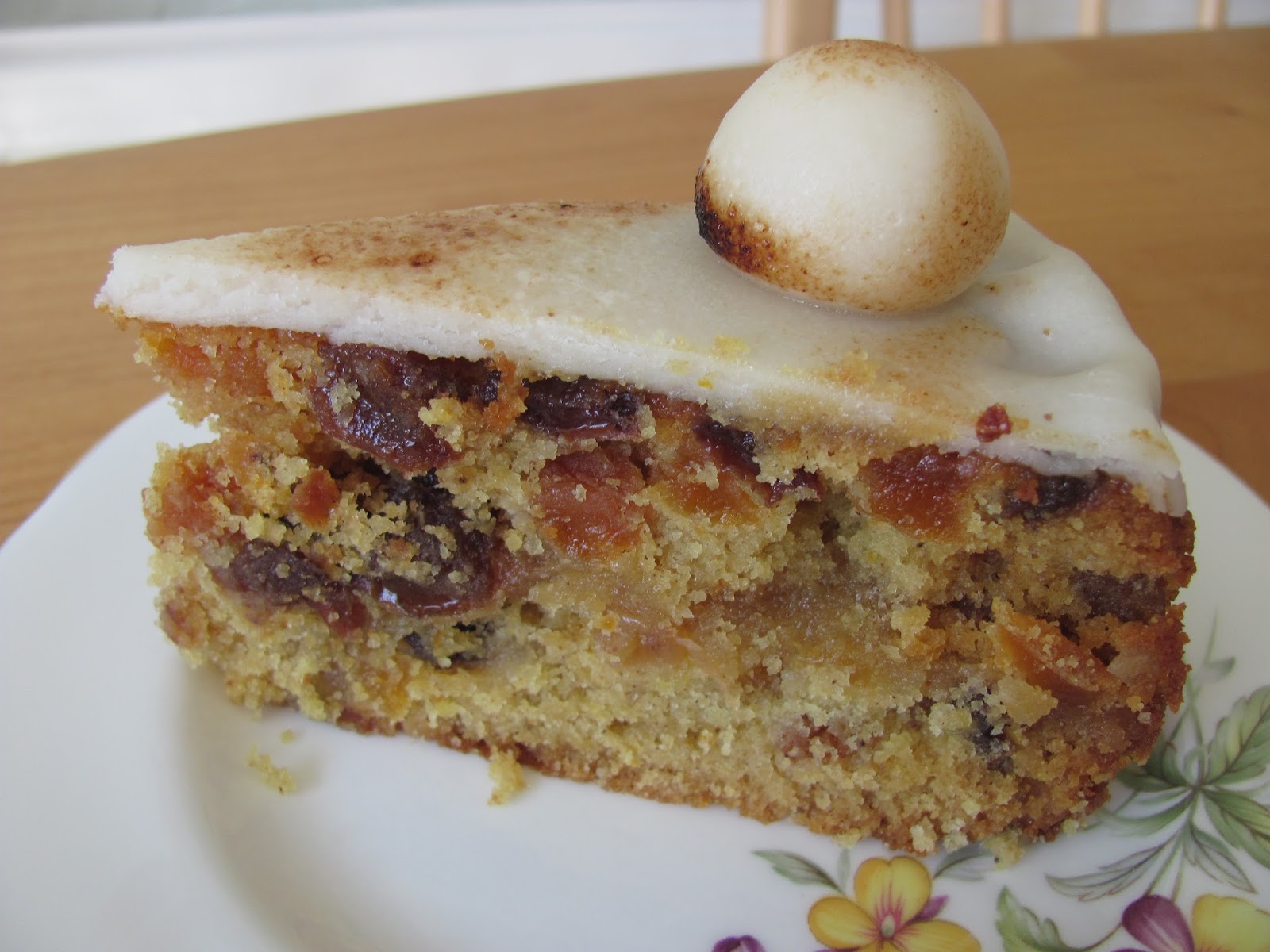
Golden Simnel Cake

My family's festive celebrations have never included traditional fruit cakes - we're more of a mini chocolate appreciation society -  so I was surprised when my daughter asked me to make a Simnel Cake for Easter this year. I'm not averse to traditional recipes but I still wanted to put a spin on this cake to make it more personal, so I decided to make a golden fruit cake.

After looking at several recipes, I thought that Felicity Cloake's recipe from her 'How to Cook the Perfect.....' series in The Guardian would be the best one to adapt to what I wanted. I particularly liked the idea of adding saffron to help the golden colour of the cake I was planning.

I used the same quantities of all ingredients, although I used caster sugar instead of light brown sugar, to keep the crumb colour as pale as possible. Instead of using 400g of the fruit Felicity suggested (sultanas, currants and glacé cherries) I used 115g of each of sultanas, golden raisins and chopped apricots and 55g chopped dried peaches. I left the mixed peel in the recipe but took out the chopped almonds, as my daughter doesn't always like chewing on pieces of nuts, even though she loves the flavour of almonds. I used shop-bought white marzipan instead of yellow - just a personal preference!

It's a pity I didn't cross reference Felicity's decision making processes with the sources she used, or I would have discovered that her oven temperature was for a fan setting, not a conventional oven - after 2 hours at the quoted temperature the cake batter was still raw. It took another hour with the oven turned up another 20C for the cake to cook. Anyone with any experience of fruit cakes would have noticed the error straight away, but I've hardly ever made a rich fruit cake, even in 40 + years of cooking!

I was quite impressed with the look of the finished cake, although if I ever make another I will use more marzipan so that I can put thicker layers inside and on the top. The size of the 11 decorative balls, at 15g each, was about right, however. When cut, the colour of the crumb was just right for a golden cake.

I liked the flavour of the cake - a delicious subtle balance between spice and citrus, with all the fruits working in harmony, so that none stood out more than others. The soft inner layer of melted marzipan added a note of bitter almonds to the cake, although it hadn't stayed level in the cake, possibly a result of the error in cooking temperature.

There were other faults too, which might have been caused by the same error - the fruit wasn't evenly distributed in each layer, and although the cake was really moist, it was also crumbly and didn't cut cleanly. However, these faults were outweighed by the lovely flavour; all it really meant was that it was difficult to get a good photograph. I will have to try the recipe again, and cook it properly next time!


Thursday, 13 April 2017

Rhubarb, Marzipan and Citrus Cake

I've been harvesting our homegrown rhubarb since the middle of March, and this traybake recipe is perfect for the beginning of the season when there are some thin stalks to pick. If you can only get thick sticks, then I suggest you cut them into fairly thin slices, both to distribute the rhubarb evenly through the cake, and make sure it cooks properly.

I picked this Rhubarb, Marzipan and Citrus Cake recipe because I wanted something portable to take to my daughter, who was cooking a Mother's Day dinner, and also because I know she loves marzipan.

I followed the recipe exactly, although I used the zest from the whole lemon and orange, as I didn't see the point of leaving half grated fruit - this turned out to be a good move, as the citrus flavour wasn't very pronounced, even with the extra zest. I also used fine cornmeal rather than polenta, as I can only get the quick-cook sort which is relatively coarse.

What the recipe doesn't mention is that initially the cake batter seems too stiff, and although it does slacken a little when the fruit is added, it never gets to the 'dropping' stage. Resist the temptation to add more liquid -  more juices will be released from the fruit during baking.

We all loved this dessert - there were subtle citrus notes amongst the tang of the rhubarb, and the marzipan gave concentrated pockets of the sort of almond flavour you don't get from ground almonds alone. My husband reckoned it would come a close second to rhubarb crumble in his 'favourites' list!

Friday, 24 February 2017

Date, Orange and Cardamom Cake

dairy-free

This is a recipe from one of Waitrose's monthly recipe cards  (also online here). I didn't pick it because it was dairy-free, but because I liked the sound of the other ingredients when put together - dates, orange, almonds and cardamom. I just happened to have some dairy-free spread to use up too, which was an added bonus. It's a strange recipe - it uses only bicarbonate of soda as a raising agent and is cooked at a very low temperature; the dates, sugar and orange are all acidic, so I presumed these ingredients would interact enough with the bicarbonate to raise the cake.

I had to use a slightly smaller baking tin, 20cm in diameter rather than 21cm, but the cake still cooked in the time given in the recipe. There was a slight dip in the centre, which spoiled the appearance of the cake a little - no idea why that happened, unless it was using the smaller tin! This time I added the drizzle of orange frosting suggested, just to alleviate the brownness of the cake, but it wasn't really necessary for flavour.

The cake was, surprisingly, as it contained wholemeal spelt flour, very light and moist. Both the orange and cardamom flavours were quite subtle, but I don't think that's always a bad thing - sometimes you just want all the ingredients to blend into something unique which is delicious but unidentifiable. You don't always want to be hit over the head with several, or even just one, big flavour, and that's what happened here. Because of this, and because the cake wasn't too sweet, I think this was a cake where the flavour of the spelt flour was noticeable too.

This is definitely a recipe to put in the 'repeat' file.

Friday, 23 December 2016

Mincemeat Frangipane Tart

gluten- and dairy-free

The highlight of this recipe, for me, was making a really good gluten- and dairy-free pastry. I'd read that it wasn't easy, so it felt quite an achievement  to come up with a recipe which worked well first time (and was repeatable - I made this dessert twice!). After looking at many recipes and reading about gluten-free pastry, I based this recipe on my usual wheatflour sweet shortcrust pastry recipe, but added both a little xanthan gum for strength and baking powder for lightness. I'd read that gluten-free pastry needs more liquid than wheatflour pastry, so I made the dough wetter than usual.

There are reservations about this apparent success though - the pastry dough was very sticky and hard to handle, and I'm not sure I would have had as much success in other situations, for instance if the pastry needed baking blind, or if I was trying to make a pastry top crust too. This may have only worked because the filling was put straight onto raw chilled pastry, and the mincemeat and frangipane layers completely filled the pastry case, holding the sides in place until the pastry had set during baking and leaving no chance of any collapse. Obviously I need to try out the pastry in other situations before declaring it a total success.

Ingredients:
Sweet shortcrust pastry:
200g Dove's gluten-free plain flour
1/8 teaspoon xanthan gum
1/4 teaspoon baking powder
100g hard dairy-free baking fat (eg Stork)
50g icing sugar
1 large egg
2 tablespoons water

250g mincemeat (check it's gluten- and dairy-free, if this is important)

Frangipane:
100g caster sugar
100g ground almonds
100g dairy-free baking spread
1 tablespoon ground rice
2 large eggs
a few drops almond extract
flaked almonds for topping

Method
Sift the flour and icing sugar into a bowl and add the xanthan gum and baking powder.
Cut the baking fat into small cubes and add to the bowl. I find that Stork is not as hard as cold butter, so can usually be used straight from the fridge.
Rub or cut the fat into the flour mixture until the mixture resembles breadcrumbs, then mix in the egg and water to make a smooth sticky dough. Only knead enough to incorporate everything into an even dough. Put the ball of dough onto a large piece of clingfilm, wrap loosely and flatten the dough into a 3cm thick disc. Chill for 20 minutes.
Unwrap the dough, but leave it in the centre of the clingfilm, then cover with another large piece of film. Roll out the dough evenly, between the pieces of film, until it is about 30cm (12") in diameter and will fit into a shallow fluted flan tin, about 23cm (9") in diameter.
Remove the top piece of clingfilm carefully - the dough will still be sticky - and invert the circle of dough into the flan tin, so that the bottom piece of film is now on top. While this piece of clingfilm is still in place, ease the dough into place in the corners and flutes of the tin. Chill the pastry case again.
Remove the pastry case from the fridge, gently ease off the clingfilm and trim the dough around the top of the tin to give a neat edge. Any small holes can now be patched with small pieces of the dough trimmings, if necessary - just smooth a small piece into place with your finger.
Pre-heat the oven to 180C, and put a baking tray onto a middle shelf to heat.
Spread the mincemeat into the base of the pastry case.
Put all the ingredients for the frangipane, except the flaked almonds, into a bowl and beat until the mixture is smooth. This is easily done with a spoon, but you can use a hand-held mixer too, if you prefer.
Pour the frangipane over the mincemeat to fill the pastry case, and sprinkle with flaked almonds. Put onto the baking tray and cook for 40-45 minutes until frangipane is firm and golden brown.
Cool in the tin.

I was really pleased with this. I've made frangipane mincemeat tarts before, but never a gluten-and dairy-free version. I doubt anyone would be able to tell the difference as the strong flavours of mincemeat (I used a gluten-free variety with added cranberries) and almonds covers any deficiencies through not using butter in the pastry. The pastry was light and crisp too, and kept well over the three days it took to eat the tart.

I think this will be my last post before Christmas, so I'm fortunate it's a festive one. I'm not planning to cook anything new over the Christmas period, just old favourites. It's also hard to get photographs in the chaos of cooking and the bad light at this time of year, so I'll be back soon with something new.

Season's Greetings to you all!