Showing posts with label lemon curd. Show all posts

Wednesday, 12 February 2020

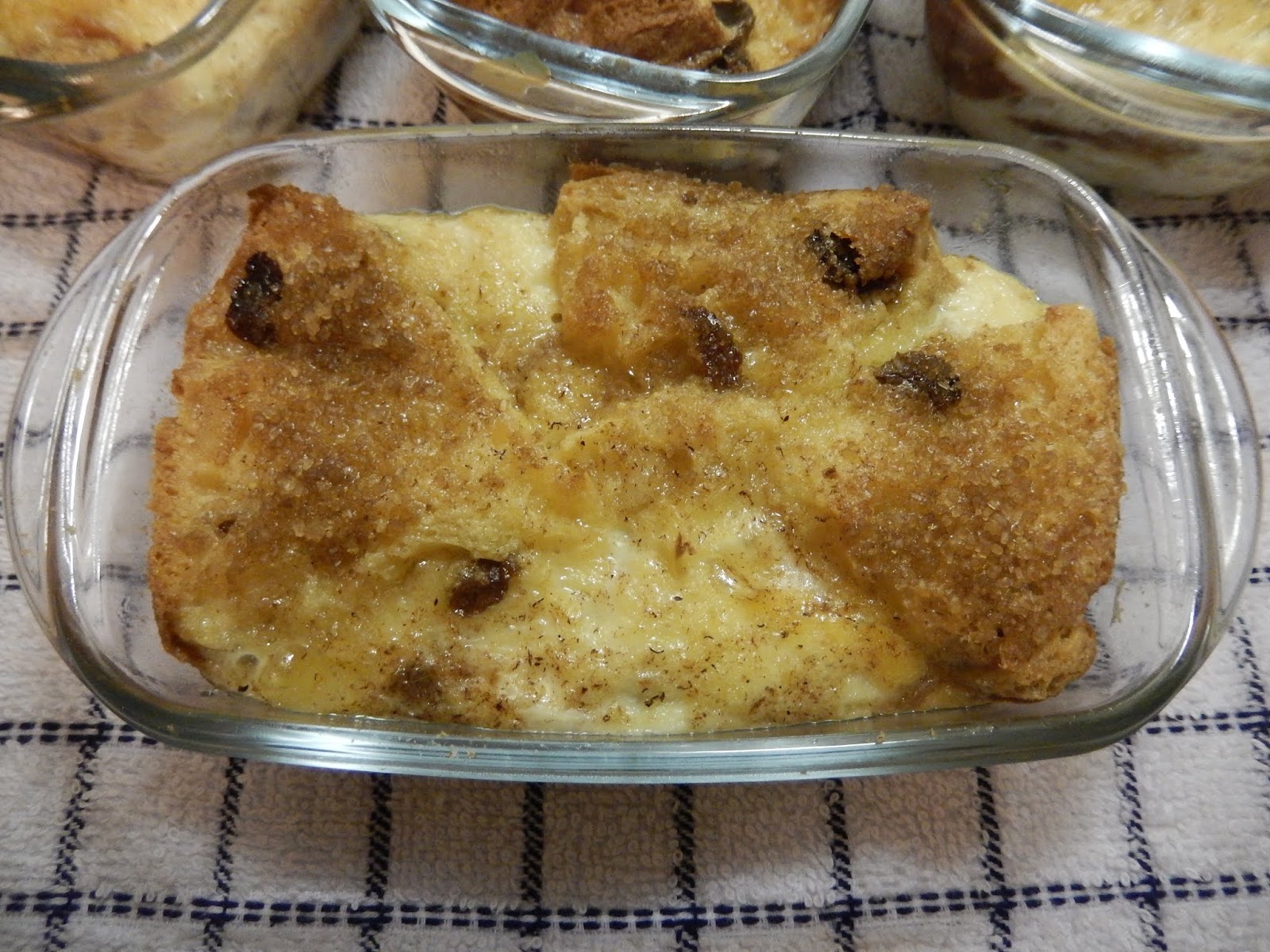
Lemon Bread and Butter Pudding

This dessert used up a panettone  bought for Christmas, in case of an unexpected need which didn't arise. I also had fresh lemons and an opened jar of lemon curd to use up, so as the panettone contained mixed peel, a lemon B & B pudding seemed the way to go.

I decided to make 4 individual puddings so that 2 could be frozen. I'm not sure how well they'll freeze, but I thought it was worth a try, rather than eating  a calorific dessert for 4 days running. I'd eaten one portion of the panettone, so I estimate there was about 425-450g left of the loaf.

I halved the loaf from top to bottom and sliced one portion into thin semicircular slices, which I sandwiched in pairs, spread with lemon curd. The rest of the panettone was cut into 4 slices to fit in the bottom of the dishes - I spread these with lemon curd too, and put into thickly buttered dishes curd side uppermost. Any trimmings and leftover pieces of panettone were crumbled and divided between the 4 dishes, then the semicircular sandwiches were cut and arranged neatly on top. I brushed the top of each pudding with more melted butter to help it crisp in the oven.

I hadn't realised until I started comparing recipes the wide range of egg:milk ratios used, as well as various baking times and temperatures, so the rest of the preparation went on a kind of average of the recipes I looked at.

I whisked together 3 large eggs, 50g caster sugar, the zest of 1 lemon and 500mls of semi-skimmed milk, and divided it between the 4 dishes. These were left standing for 30 minutes before baking, to allow the liquid to be absorbed into the bread - I pressed down with a fork occasionally to make sure the top pieces of panettone soaked up the custard mixture.

I added a little grated nutmeg and a sprinkling of demerara sugar to the top of each pudding, before baking at 160C (fan assisted) for 35 minutes. I intended to bake until the puddings were set, but still wobbling a little in the middle, but I think I baked for about 5 minutes too long.

These were lovely little puddings; adding lemon curd boosted the flavour nicely. I think adding some more dried fruit (such as a handful of sultanas) would have been an improvement and using a little more milk - another 100ml, perhaps - would have made the puddings softer and lighter, but I was pleased with them as they were.

As usual, with things that look their best straight from the oven, I didn't manage to get very good photographs of these. Not only were the light conditions far from perfect, they were visibly deflating as I watched them!

Monday, 13 January 2020

Lemon Curd 'Bakewell' Bars

I've recently started to donate baked goods to a monthly Coffee Morning run by the Friends of my local library. Not only is it giving me a much needed excuse to bake, but it's helping a good cause too. This month I made some date shortbread squares and these lemon and almond bars - similar to a Bakewell tart, but with lemon curd instead of raspberry jam.

Because the tart was going to be cut into individual portions before being put out for sale, I made it in a narrow rectangular tart tin, measuring 36 x 11.5cm. That way it could be cut into bars which would be easier to eat with fingers than a wedge from a round tart. Having a border of pastry on both short edges looked quite attractive too.


After lining the tart tin with sweet shortcrust pastry, I spread about 200g of lemon curd over the base - there's no need to blind-bake the pastry for this recipe. I used this BBC Good Food recipe for the frangipane mixture. It was exactly the right amount to fill the tart! The only changes I made to the recipe was to only use the zest of 1 lemon, and to add a few drops of almond extract, as I wanted the frangipane to taste more of almonds than lemon.

I baked the tart for 15 minutes at 200C, then lowered the temperature to 180C and continued baking until the frangipane was cooked to a golden brown colour - about another 25 minutes. When cool, I cut into bars about 3cm wide, although I discarded the first centimetre at each end, with the extra pastry (cook's treat!).


Saturday, 29 December 2018

Lemon Curd and Hazelnut Tart

This was one of my Christmas desserts - not very festive, but I'd just made 2 large jars of lemon curd with some excess lemons, and needed to find ways of using it. I used this recipe for my curd, but this time added the zest of all 5 lemons. Lemon curd makes a tasty dessert, swirled into natural yogurt and topped with a sprinkle of plain granola, but it takes a long time to get through a whole jar that way, let alone two. This recipe used around 200g - I didn't weigh it, just spooned out about half a jar.

I made a sweet shortcrust pastry, using 200g plain flour, 1/4 teaspoon baking powder, a pinch of salt, 100g of butter, 50g of icing sugar, an egg and enough water to make a soft dough. After resting in the fridge I lined a shallow fluted flan tin with the pastry (the recipe won't use all the pastry, if you can roll it out really thinly - I made mince pies with the leftovers). I spooned 200g lemon curd onto the raw pastry, spread it evenly and refrigerated again while I made the hazelnut frangipane. I did this by putting 100g softened butter,
100g caster sugar, 50g SR flour, 50g ground roasted hazelnuts, half a teaspoon of vanilla extract and two eggs into a bowl and beating until well combined. The frangipane was spread gently over the lemon curd, working from the edges inwards, and being careful to get the batter to seal against the pastry edges, to minimise the chance of any lemon curd bubbling out. I sprinkled a handful of finely chopped roasted hazelnuts over the frangipane, then decorated the top with a few pastry shapes cut out from the excess pastry - they're supposed to be snowflakes but look more like stars. The tart was baked, on a pre-heated baking sheet, at 200C for 15 minutes, then the heat was lowered to 170C and baking continued until the frangipane was golden and firm - about another 20 minutes. The frangipane rose quite a lot while cooking, but thankfully sank back to give a level surface as it cooled - I think perhaps SR flour was unnecessary, but it does give a lighter texture to the tart.

The combination of lemon and hazelnuts was delicious, and the frangipane had the lightness of a sponge rather than being stodgy, as is sometimes the case when no raising agent, or all nuts, rather than a mixture of nuts and flour is used. I chose to use hazelnuts as they have a much stronger flavour than almonds, and because I thought they would work better with the tanginess of the lemon curd. I think the lemon curd would have overwhelmed the nut flavour if almonds were used, but this way the hazelnut flavour won.

Monday, 30 July 2018

Lemon Meringue Ice Cream Cake

To be honest, this Lemon Meringue Ice Cream Cake is nothing more than an assembly job, consisting of just creme fraiche, bought meringues and lemon curd on a sponge cake base.  However, it's been a useful dessert to have in the freezer, especially during the sort of summer we're having at the moment. It slices easily from frozen, and only needs a few minutes to soften enough to eat. I found that the meringue pieces become less noticeable with time, but it still tastes good.


If you want to make it more complicated, you can make your own cake layer for the base - and I have done this in the past - but a good bought madeira (or even ginger) cake is perfectly acceptable. Another good addition, if you're only feeding adults, is a little limoncello sprinkled on the base, and stirred into the lemon curd. Homemade lemon curd would, of course, vastly improve the dessert too!


Sunday, 6 January 2013

Dan Lepard's Lemon Curd Cookies

I don't usually bake two things in a row with the same flavour, but the lemon-lime curd I made before Christmas was reaching the end of it's storage life in the fridge. We've also had lots of chocolate and other goodies such as stollen to eat over the Christmas and New Year period, so lemon is still a welcome flavour for a refreshing change.

This Dan Lepard recipe has been published both in his book Short and Sweet, and in his weekly Guardian column. The lemon flavoured biscuits are spread with a mixture of cream, rolled oats and lemon curd, which gives a rich, chewy topping when baked - a lovely contrast to the crisp shortbread. Both the biscuit base and the topping have quite a delicate flavour, but the topping lifts the biscuits out of being plain or ordinary, without having to do anything too fiddly, or adding decorations after baking. Although my curd was made using both lemons and limes, the lemon flavour was predominant, so I have no hesitation in keeping the original name.

Another advantage is that it's not a huge recipe either - very important at this time of year, when we often feel as if we have over-eaten, and don't need the pressure of a huge cake or batch of brownies to finish within a few days. The recipe makes 10 cookies, which isn't an unrealistic amount for three people to eat over a weekend.

The top photo was taken in fading light, so I apologise for the bad quality, although the colour looks more realistic than in the second photo!.

The first challenge of the year for Tea Time Treats, is to wake up our jaded taste buds with a burst of citrus flavour on the tea-table, so I'm entering these cookies. Tea Time Treats is hosted alternately by Karen from Lavender and Lovage and Kate from What Kate Baked. Karen is the host for January, and is accepting entries via a linky on her website. She will also write a round-up post at the end of the month.

Tuesday, 30 October 2012

Lemon-Vanilla Dream Bars

The first recipe I tried from Pure Vanilla, by Shauna Sever, was one of the simplest in the book - Lemon-Vanilla Dream Bars. Shauna describes these as a 'less messy and more portable' version of lemon bars, which are one of the classic American baked treats. This recipe is essentially a white chocolate blondie rippled with lemon curd, and flavoured with both vanilla extract and vanilla bean paste. I used Green and Black's White Chocolate which contains vanilla seeds(caviar), so adding another dimension of vanilla flavouring.

The recipe seemed straightforward, but I had a typical heart-stopping moment that always seems to happen when I work with white chocolate. The first stage of the recipe is to melt white chocolate and butter together over simmering water, and I just couldn't get the two to combine smoothly. In fact I thought the white chocolate had seized completely, and it wasn't until I whisked in the eggs that I realised the mixture was going to come together smoothly.

After that it was plain sailing, although I forgot to fold in the chocolate chunks and had to sprinkle them over the surface of the batter after it had been in the oven a few minutes. Fortunately, the bars seemed none the worse for this!

This recipe is reproduced with permission from the publishers, and I have included the metric weights I used, where appropriate:

Ingredients:
10oz (300g) white chocolate, 50g chopped into chip-sized pieces
6 tablespoons (150g) butter
1/4 cup (50g) granulated sugar (I used caster sugar)
1/2 teaspoon salt
2 large eggs at room temperature
1 teaspoon vanilla extract
1 teaspoon vanilla bean paste
1 cup (130g) all purpose (plain) flour
1/2 cup (125g) lemon curd

Method
Pre-heat the oven to 350F (180C) and line a 8" (20cm) square tin with baking parchment.
Melt the butter and 250g of the white chocolate together in a large bowl, over a pan of simmering water.
Remove the bowl from the heat and stir in the sugar and salt.
Whisk in the eggs, one at a time, then whisk in both the vanilla extract and bean paste.
Gently fold in the flour, followed by the chopped chocolate, and put the batter into the baking tin.
Dollop the lemon curd onto the batter in 5 or 6 equal portions, and swirl into the batter using a knife and a figure of 8 movement.
Bake for around 25 minutes, until a tester comes out clean.
Cool on a wire rack, then cut into 12 bars when completely cold.

These were really delicious! The batter gave the perfect dense texture of a fudgy blondie, and the lemon curd was partly absorbed by the batter and partly remaining in little pockets that were intensely lemony. This lemon note really contrasted well with the sweet base, but still allowed the vanilla flavours to shine through.

My bars don't look perfect, because of sprinkling the chocolate chunks over the batter instead of folding them in. This caused little hollows to form as the larger chunks sank, although these hollows seemed to happen where lemon curd was left on the surface too.

This recipe is worth repeating just for the blondie base, if I can face the trauma of working with white chocolate again, perhaps with dark chocolate or fudge chips added, and Shauna also suggests replacing the lemon curd with any good quality low-sugar jam with a tart flavour, to ring the changes.

I'm so pleased my first recipe from this book was a success; it gives me confidence to tackle some of the more complicated recipes, and endorses my positive review of the book given from the first reading. Although I received a free copy of this book, I was not required to give a positive review of either the book, or the recipes I tried, in return.

Sunday, 9 May 2010

Lemon Curd and Pistachio Ripple Cake - Take 2

The second attempt at this recipe was much more successful. I altered the recipe by adding the zest of a lemon to the whole cake batter, as well as the vanilla extract, and a few drops of green colouring to the pistachio and lemon curd part of the batter. Other than that, I followed the same recipe as before. Once again, I made the lemon curd myself, to this recipe but using more lemon zest; I looked at commercial lemon curd but even the most expensive brands had added gelling agents and I wasn't sure how they would react to heat.


This time the lemon flavour was stronger and adding some food colouring showed up the ripple effect much better, as well as proving that the lemon curd portion of the batter had stayed separate. I'm a little dubious about the green colouring; it used to be said that people didn't like to eat food which had been artificially coloured blue or green, because those colours are associated with mould, but I'm not sure that's true these days.

Friday, 19 March 2010

White Chocolate Bars with Nuts and Lemon

This will be the last lemon recipe for a while, to the relief of others, as it used the last of the lemon curd I made just over two weeks ago.

This was based on this recipe for White Chocolate and Macadamia Nut Brownies, which I've used before, but I made quite a few changes, including inadvertently increasing the sugar by 50%! I intended to use only walnuts, but didn't have enough in stock, so had to change my plans here too.

The result was a dense, moist chewy bar which tasted quite nutty, but surprisingly the lemon flavour was very mild. I wonder if the white chocolate somehow masked the flavour of the lemon?

Ingredients

60g butter
150g caster sugar
2 tablespoons water
180g white chocolate - chopped into small pieces
2 large eggs
150g plain flour
3/4 teaspoon baking powder
large pinch salt
finely grated zest 1 lemon
80g approx lemon curd
90g finely chopped nuts - I used equal amounts of walnuts and hazelnuts

Method

Pre-heat the oven to 160C, and line a 8" square shallow tin with baking paper.

Mix the lemon zest, baking powder and salt into the flour.

Heat the water, butter and sugar together in a medium saucepan until the butter has melted, then remove from the heat, add the white chocolate and stir until it has melted.

Beat in the eggs, one at a time, then stir in the flour mix, followed by the nuts and lemon curd. Stir until evenly mixed.

Pour into the prepared tin and spread evenly. Bake for about 40 minutes, until a tester comes out with a few moist crumbs still clinging.

Cool in the tin, then cut into 16 portions when completely cold.

Monday, 15 March 2010

Lemon Tart 'Amandin'

This is similar to a Bakewell Tart - pastry case, frangipane topping - but I used lemon curd instead of jam. The name comes from the mix of ground nuts I used in the frangipane - a mix of 44% almonds, 44% apricot kernels and 12% hazelnuts, produced by Vahiné and sold in France under the name 'Amandin'. It's said to give a more intense flavour than using almonds alone, and although it's very subtle, I think it does make a difference - many desserts made with ground almonds do not actually taste nutty unless some almond essence is used.


I was so pleased with the way the pastry for Raymond Blanc's Apple Tart turned out that I used the same recipe and method here. Again, it worked beautifully, with crisp pastry and no shrinkage - why has it taken over 30 years of cooking to discover this method?
So - I lined a 23cm(9") diameter fluted flan tin with pastry (following the instructions in the recipe), and chilled until I was ready to cook. Then I covered the base with a generous layer of lemon curd. I didn't weigh this, but estimate I used at least 100g.
I made the frangipane by beating together 100g softened unsalted butter, 150g caster sugar, 100g Amandin mix ground nuts, 50g SR flour and three large eggs.
(I thought about not using any flour, but decided in the end to add a little SR flour to lighten the mixture.)
The frangipane was spread over the lemon curd, then I sprinkled a handful of flaked almonds over the top. The tart was put onto a pre-heated baking sheet and cooked at 200C for 20 minutes, then the heat was lowered to 180C and the tart baked until it was deep golden in colour and firm to the touch. I got distracted with other kitchen chores, but I estimate this took about another 30 minutes! The frangipane puffed up as it cooked, but sank down again as it cooled.
Serve at room temperature with whipped cream, custard or whatever you fancy!

Thursday, 11 March 2010

Lemon Curd and Pistachio Ripple Cake

There are occasions when I wish I had the time and money to work more intensely on recipe development. This cake has the potential to be something really special but it needs a lot more work, and yet I know my family won't want to eat slightly varied versions of the same cake for the next few weeks (particularly as it isn't chocolate!). It might be several weeks before I feel I can have a second attempt at this recipe.

The intention was to layer vanilla madeira cake batter (is this the same as what is known as pound cake in the US?) with more of the cake batter flavoured with pistachios and lemon curd. I expected the lemon curd to change the consistency of the cake batter and thought that it might form moist, gooey layers within the cake. I hoped the pistachios would colour this layer green, so that it would stand out as a differentiated layer, and I could see how it spread while the cake was baking. This didn't happen, because I didn't grind the pistachios to meal, just chopped them in a mini-processor to give a mix of coarse and fine lumps - there wasn't enough fine meal to colour the lemon layer, but I was worried that nut meal would make the lemon ripple too dry.

The finished cake was delicate in flavour, but rich and moist in texture, with a tender, close crumb. It was too difficult, for the most part, to differentiate between the vanilla and lemon/pistachio areas. I have a suspicion that, apart from a patch at the bottom of the cake, the lemony layers blended with the vanilla as the cake cooked, but I won't know this for sure unless I colour the lemon layer. The rich, even moistness of the cake is what suggests to me that the layers merged during cooking.

There wasn't enough lemon flavour from the lemon curd alone, so this is another area which needs work. The next step would probably be colouring the lemon/pistachio layer with added food colour, to see if it stays separate, and adding some lemon zest to boost the flavour.


Ingredients
225g unsalted butter, softened
225g caster sugar
4 eggs
275g SR flour
1 teaspoon vanilla extract
milk, as necessary
75g pistachio nuts, divided, see note
100g lemon curd
note - chop the pistachios to give a mixture of fine and coarse pieces, then remove about 25g of the larger pieces to top the cake.

Method
Pre-heat the oven to 170C, and prepare your cake tin. I used a 30cm long, narrow loaf tin with the same capacity as a 2lb loaf tin. This is roughly the same volume as a round 8"(20cm) diameter tin. I used a sling of baking parchment covering the base and the long sides of the tin.

Cream the butter and sugar until light and fluffy, then beat in the eggs one at a time, with a tespoon of the flour, to prevent curdling. Fold in the rest of the flour with the vanilla extract and enough milk to give a dropping consistency.

Weigh 250g of the batter into a small bowl and stir the 50g portion of nuts and the lemon curd into this smaller amount of batter.

Layer the two batters into the prepared tin in this order, spreading each one to make an even layer before adding the next: 1/3 of the vanilla; 1/2 the lemon; 1/3 vanilla, rest of the lemon, rest of the vanilla.

Sprinkle the remaing nuts evenly over the top and press them lightly into the batter. Bake the cake for about 70 minutes until a tester is clean. You may need to cover the cake for the last 20minutes or so, if it is browning too fast. Cool in the tin for 15 minutes, then move to a wire rack.

Thursday, 4 March 2010

When You've Got Too Many Lemons......

make lemon curd!

This is the first time for many, many years that I've made lemon curd, but it was well worth the 20 minutes at the stove, stirring a gently heating bowl.

Searching for a recipe, I was amazed at all the variations of what should be a simple recipe. I was using the remains of a bag of 7 lemons bought 'reduced to clear', when I just had only needed the zest of 2, so didn't want to use any recipes using just egg yolks - there's no point making leftovers when you're using up leftovers! I finally decided that the crucial part of the recipe was enough eggs to set the lemon juice, and the butter and sugar was more arbitrary, so I started with the simplest recipe I found - one egg, one ounce (28g) of butter, and 4 ounces (110g) of sugar to every lemon. I had found recipes using double that amount of butter, but that seems excessive to me.

My lemons were quite small, but my eggs were large, so I used 5 lemons, only two of which still had their zest. I only had 350g sugar left in the bag, so decided this would be enough, as I like my lemon products quite tart. Then I just chopped a block of butter in half, giving me roughly 125g.

So, 125g butter was cut into small pieces and put into a large bowl with the finely grated zest of 2 lemons and the juice of 5, 350g caster sugar and 4 eggs. The bowl was placed over a pan of simmering water and whisked constantly until the contents had thickened enough to coat the back of a spoon.

This took about 20 minutes, but would have possibly been quicker if I had used a larger pan, so that the bowl sat deeper into it and was nearer the simmering water. I didn't get any of the possible problems - curdling or threads of egg white setting quicker than the yolks. I put this down to the very slow heating and the fact that I was using a balloon whisk and not a spoon.

The curd was then poured into sterilised jars and sealed with screw-top lids while still hot. Stored in the fridge these should keep for a couple of weeks.

I liked the texture and taste of the curd - smooth, just holding it's shape, not too rich and buttery, but felt it wouldn't have hurt it to be a little tarter - next time I will use more zest.

As you can see, I tried a little for breakfast this morning, but I don't usually eat much bread, so don't want to succumb to this temptation too often. If any of you can recommend baking recipes to use up the lemon curd, that would be fantastic. I would like to be able to incorporate it into something baked, such as a cake or cookie bar, rather than use it as a filling for a layer cake or pie, as the Chief Tester isn't very fond of sharply lemon flavours, even though I am.