Showing posts with label walnuts. Show all posts

Thursday, 12 October 2017

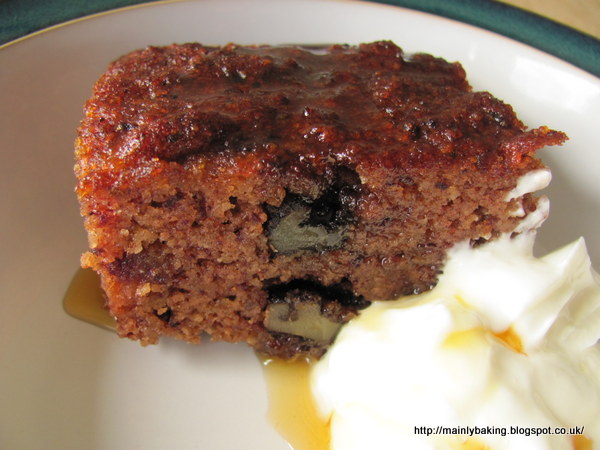
Date, Apple and Walnut Cake

I bought walnuts for my last bake - Nigella's Emergency Brownies - and I know that they don't keep fresh for long, so decided to use them in this cake too. I added a twist to the traditional British autumnal flavours of dates, apples and walnuts by using date syrup in place of some of the sugar and adding a little rosewater too.

Ingredients
100g softened butter
75g caster sugar
3 tablespoons date syrup
*1 teaspoon rosewater
2 large eggs
150g SR flour
50g chopped soft dates
50g chopped walnuts
1 small eating apple, peeled cored and chopped
a sprinkle of demerara sugar for topping (optional)

*or to taste, depending on the strength of the brand you are using

Method
Preheat oven to 180C (fan 160C) and line a small 450g (1lb) loaf tin. I used a loaf tin liner, but baking parchment can be used too.
Put the butter, sugar, syrup, rosewater, eggs and flour into a large bowl and beat together until the mixture is smooth and light. If the batter seems too thick, add a little milk or water to give a dropping consistency.
Stir in the dates, walnuts and apple pieces.
Transfer the batter to the prepared tin, level the surface and sprinkle on the demerara sugar, if using.
Bake for about 60 minutes, until a test probe comes out clean.
Cool in the tin for a few minutes, then transfer to a wire rack to cool completely.

Using the date syrup intensified the date flavour, and deepened the colour of the cake crumb, which I was pleased about. I liked the flavour combination of dates, apples and walnuts with rosewater, but it became a summery cake rather than an autumnal one. Probably fitting, as we seem to be having a bit of an Indian summer at the moment, but for a really seasonal cake a little cinnamon or other spice would have been better than the rosewater.


Wednesday, 4 October 2017

Nigella Lawson's Emergency Brownies

Many people I know are at a stage of their lives where they don't need to cook for large numbers; for whatever reason most of their cooking is done for only one or two people. This is something that makes baking particularly difficult, at least for me - a standard sized cake can take 4 or 5 days for 2 people to eat. I could freeze slices of cake, but my freezer organisation is notoriously bad so I'm sure I'd end up with a drawer full of slices that had dried out and grown ice crystals, so would have to be thrown away in the end.

It seems that Nigella Lawson may have found herself in the position of craving cake and/or chocolate, but being unwilling to bake something large, as her new book, At My Table, contains a recipe for these Emergency Brownies - a recipe based on one egg and making only 4 generously sized brownies (or even fewer if your craving is really strong!).

I can't link to the recipe as it's not online anywhere yet, but I'm sure it will be soon appear once the TV series accompanying the book is shown, and the book is being more vigourously promoted. Suffice to say that butter, sugar and syrup (I used Maple) are melted together gently to dissolve the sugar. Then a mixture of plain flour and cocoa is beaten in, an egg and vanilla extract added, and finally chopped walnuts and chocolate chips added (I used chopped plain chocolate with orange pieces). The batter is baked in a foil tray which is approximately 18 x 11cm (I couldn't find that exact size, but it's roughly the same as a 1lb loaf tin, or this size of container from Lakeland).

20 minutes baking left these brownies still slightly gooey in the centre even when completely cold. They were very rich - I ate two pieces and felt I had reached my limit - and quite heavy; not the best brownies I've ever eaten but a really good small-scale recipe. I'll certainly be using it again. The orange flavour from the chocolate I used was a nice note alongside the walnuts, but I can see this recipe working well with all the flavour variations I use in brownies - different nuts, spices etc

Thursday, 27 April 2017

Chocolate Marmalade Brownies

When I first made this recipe, for Chocolate Marmalade Brownies, almost seven years ago, I thought the recipe was a keeper. Making them again, only recently, I'm not quite sure what I saw in them in the first place. They were pleasant enough, but more like cake than a brownie, and the one word in their name that is meant to describe the added flavour is the thing I couldn't taste at all! The walnuts, cayenne and ginger (an extra addition, part of the chocolate used) were all much more prominent flavours than the marmalade.

The only changes I made to the recipe were to bake in a slightly smaller tin (20 x 30cm), which added five minutes to the baking time, and to use chopped dark chocolate containing crystallised ginger instead of plain chocolate chips.

Really, the only thing to recommend this recipe is that the brownie batter is made with cocoa rather than chocolate, which could be useful if you were short of chocolate. However, if you're the sort of person who regularly bakes brownies, I can't see you being the sort of person who runs short of chocolate - I get twitchy if there's ever less than 500g in the house!

Wednesday, 7 December 2016

Date and Walnut Squares

The recipe for the base and topping layers of these squares is perfect - the top is crisp, the bottom layer holds together well but is still very light, and it's really quick to make as the butter and sugar are melted together before being poured onto the flour mixture.

I've used the recipe before, for these Date and Ginger Squares, but wasn't entirely happy with the filling that time. This time, I used just dates, leaving out the currants, and added finely chopped walnuts instead of ginger. This combination was really tasty, but this is one of those recipes where I can imagine a wide variety of fillings working as well - at this time of year, mincemeat springs to mind, but dried apricots cooked in orange juice, or even a thick apple purée would be worth trying too!

Ingredients
250g pack of chopped dates
2 tablespoons honey
3 tablespoons water
1/2 teaspoon ground cinnamon
75g finely chopped walnuts
170g SR flour
170g semolina (I used 50:50 mix of semolina and ground rice, as I didn't have enough semolina)
170g butter
85g caster sugar

Method
Preheat the oven to 190C, and line a 20cm(8") square baking tin with parchment.
Put the dates into a small saucepan with the honey, water and cinnamon. Bring to the boil, cover the pan, then lower the heat and simmer until the liquid is absorbed - 10 minutes at the most, so keep an eye on it! Turn off the heat.

In another small pan, melt the butter and sugar together and stir until the sugar has mostly dissolved. Tip this onto the flour and semolina mix and stir in with a spoon. It will make a crumbly mixture which looks as if it might hold together if you kneaded it, but there's no need to do this!
Put 2/3 of the dough mix into the baking tin, spread evenly and press down firmly.
Spread the date filling on top of the dough base, leaving a very small margin around the edge of the tin.
Crumble the remaining dough over the top, as evenly as possible, and press down lightly with your hand. Don't worry if there are gaps where the filling shows through.
Bake for 25-30 minutes until the top is golden brown. Mark into squares or fingers as soon as the bake is removed from the oven, but leave in the tin until completely cold - they are very fragile while warm.

Saturday, 19 November 2016

Chocolate, Date and Walnut Bars

 Looking back over my blog posts I can see that it's been well over six years since I last made these. For me, that's one of the downsides of blogging - if you're usually trying to bake something new to write about, a lot of very good things often fall by the wayside.

These bars fit somewhere between a brownie and a cake; they are dense and chewy, but with a lot of the bulk being provided by dates, rather than butter and sugar, they are not as rich and guilt-inducing as brownies. The recipe comes from 'Wicked Chocolate' by Jane Suthering, and originally used 50:50 orange juice and water to soften the dates, but I couldn't taste the orange in the final cake, so decided it was a waste to use it. There is also a chocolate and yogurt frosting in the recipe (see my original post), but I'm not keen on the extra calories in frostings on things that are perfectly good enough without.

Ingredients

225g stoneless dates (chopped in halves widthways to check for stones - I always find at least one!)
250mls water
170g plain chocolate, around 70%, chopped roughly
115g softened butter
115g light muscovado sugar
2 large eggs
170g SR flour
115g walnuts, coarsely chopped

Method

Pre-heat the oven to 190C/170C fan. Line a 30 x 20cm(12 x 8") baking tin with baking parchment.
Put the dates and water into a small pan and bring to the boil. Simmer gently for 5 minutes to soften the dates, then remove from the heat and add the chocolate. (Note - not all the water is absorbed during the softening process.) Stir until the chocolate has melted.
Cream the butter and sugar together, then beat in the eggs, one at a time, with a tablespoon of the weighed flour.
Fold in the rest of the flour, followed by the chocolate mixture and lastly, the nuts.
Transfer the batter to the baking tin and spread evenly, then bake for around 20 minutes, until risen and firm.
Cool in the tin.
Cut into bars when cold. The original recipe suggests 24 pieces but I cut the cake into 18 bars.

Leaving the dates in quite large pieces means that there are noticeable chunks of them in the bars. If you wanted the bulk of the dates without the texture and flavour, I'd suggest chopping them more finely before cooking them, to make a coarse purée which then 'disappears' into the cake batter, as in a sticky toffee pudding.

As this is the only chocolate recipe I've made this month, I'm sending this to November's We Should Cocoa link-up at Tin and Thyme. Choclette has changed We Should Cocoa recently, so that any recipes including chocolate can be added; there is no longer a theme to follow.

Tuesday, 18 October 2016

Apple Pie Flapjacks

Although these flapjacks, containing fresh apple, certainly filled the kitchen with the smell of apple pie while they were baking, to me, with the texture given by the oats, they were more evocative of apple crumble, as I always use oats in my crumble mixes.

I have to admit that I was dubious about this recipe. Would adding such a large amount of grated apple put too much moisture into the mix? Would it hold together? Would the flapjacks be crisp, chewy or just a soggy mess? The oat mixture made a good thick layer in the baking tin, which was a promising start, as thin flapjacks can become too crisp.

In fact, the flapjacks were fine, while they were fresh, but they didn't keep that well, becoming progressively more moist until they were much too soft for my taste. I like my flapjacks chewy, rather than biscuit-crisp, but I don't like them flabby. The flavour was excellent though, so if the flapjacks are going to be eaten all in one go, soon after baking - at a Hallowe'en or Bonfire party, for instance - then I'd say go for it!

Adding fresh apple reduced the 'almost too much' sweetness that you can get with flapjacks too, as well as making them seem more healthy, and the flavour of apples and cinnamon came through well. If there was any criticism it would be that 50g of walnuts wasn't enough to make a real impact.

Monday, 10 October 2016

Apple and Orange Fruit Loaf

When I'm short of inspiration, I sometimes look back over my blog posts to find cakes I thought were worth making again. I first tried this recipe back in October 2012, so it's taken me a while to get back to it, but it was worth making again!

When I originally made this Orange Frosted Apple Cake, I left out the nuts and just used an orange glacé icing on top. This time I made a few more changes: I used spelt flour instead of wholemeal, sunflower oil rather than rapeseed, walnuts instead of pecans, and a mix of dried vine fruits, berries and cherries. Instead of frosting the cooked cake, I sprinkled some crushed raw sugar cubes over the batter before baking to give a crunchy topping - I find the extra fat and sugar in frostings unnecessary in many cases, unless the cake is for a special occasion.

The grated apple and yogurt used in the cake add moistness, and mean that less fat - in this case, sunflower oil - can be used. Adding the apple also cuts down on the sugar needed, so this is a relatively healthy cake, especially without the frosting! The apple doesn't add much to the flavour of the cake, so in this case the walnuts and spices were the predominant flavours, with a subtle orange background note.

I really don't know why I waited so long to make this cake again, as it's a really good light fruit cake and can be varied according to which dried fruits and nuts are available.

Wednesday, 24 February 2016

Coffee, Walnut and Chocolate Chip Cake

I've had a high proportion of baking failures recently, as well as cakes I wasn't entirely happy with. I think I've pinned it down to changing to a discount supermarket brand of baking powder, as all the bakes using my usual brand of SR flour have been fine, but those using plain flour and baking powder have been more problematic, although not all have been failures, oddly!

Anyway, to avoid another failure, as I was trying out a base recipe for a cake to take to a Clandestine Cake Club meeting in early March, I used SR flour in this cake. I used a cake batter with a slightly higher proportion of flour than a sponge cake - more like a Madeira Cake - and included some ground almonds for moistness and a little cornflour for a more tender crumb.

Ingredients
225g SR flour
25g cornflour
50g ground almonds
250g unsalted butter
250g caster sugar
4 large eggs
2 teaspoons instant coffee, dissolved in 3 tablespoons milk
100g chopped walnuts
100g plain chocolate, finely chopped

Method
Preheat oven to 170C (150C fan). Prepare a 20cm (8") round cake tin.
Sift flours together, then mix in the ground almonds.
Cream butter and sugar until light and fluffy.
Beat in the eggs, one at a time, along with a tablespoon of the measured flour mixture, each time.
Fold in the rest of the flour and the coffee-flavoured milk. When the batter is well mixed, fold in the chopped nuts and chocolate.
Transfer the batter to the baking tin, smooth the top, then bake for around 65 minutes, until a test probe comes out clean and dry.
Cool the cake in the tin for 20 minutes, before transferring to a wire rack to finish cooling.

This cake tasted exactly as you'd expect - coffee and walnut with the added bonus of chocolate chips. The crumb was moist and tender, with a close texture. The batter recipe looks good enough to use for my CCC cake next week, which was my main purpose in making this cake; it will have different 'add-ins' obviously, but that will be revealed in the future. Meanwhile, I'm out to buy some better baking powder!

Sunday, 17 January 2016

Honey Nut Tart

I think this tart must be very similar to a Pecan Pie; it uses sugars, butter and eggs to make the filling, but here the pecans are replaced by hazelnuts and walnuts, and the syrup (corn or maple) used in most recipes is replaced by honey - you could call it an Anglicised version of the classic American dessert.

I saw the recipe in the latest National Trust newsletter, following an article about all that the National Trust is doing to help the plight of the honeybee, including supporting the National Pollinator Strategy. I can't find the recipe (Sissinghurst Honey, Walnut and Cobnut Tart) online, except as a .pdf file, but it's very simple  - the first thing you need is a 9" (22 - 23cm) shallow sweetened shortcrust pastry flan case, baked blind. For the filling, scatter 100g each of roughly chopped toasted hazelnuts (or fresh cobnuts. in season) and walnut pieces over the pastry case then pour over the sticky filling. This is made by melting 85g of butter, then stirring in
100g of set honey. This mixture is blended with 4 medium-sized beaten eggs and 175g of light brown sugar (the recipe used demerara, which I didn't have). When the mixture feels smooth and the sugar has dissolved, pour over the nuts to fill the pastry case as much as possible (I had a little of the filling left over). Bake for 30 - 40 minutes at 190C, until the filling is firm. I found the filling baked in 25 minutes, so it might be an idea to use a slightly lower temperature than that used to bake the pastry case - I suspect a misprint in the recipe! Serve at room temperature.

This was a gloriously indulgent, sweet and sticky tart, with the flavours of both nuts still identifiable. I was a little disappointed that the honey was lost amongst all the sweetness and nuttiness, but perhaps that was down to my choice of honey. A really strongly flavoured one might have stood up better, although I'm always wary of recipes which use a lot of sugar as well as honey - there's often not enough honey to give a strong flavour.

Wednesday, 25 November 2015

Cherry and Walnut Flapjack

This was a quick mid-week bake, just to keep us supplied with sweet treats. I rummaged through my box of goodies to see what needed using up and found a pack of dried cherries and 50g of walnut pieces left over from something else. I added the last two tablespoons of desiccated coconut from a packet and made this delicious flapjack, which was in the oven within a few minutes of deciding to bake.

Melt 160g butter, 70g golden syrup and 100g light muscovado sugar together, either in a large bowl in the microwave (my preference) or in a saucepan on the hob. It doesn't need to boil, just melt together. Stir in 240g rolled oats, 50g dried cherries (chopped if large), 50g walnut pieces and 2 tablespoons desiccated coconut. Tip the mixture into a 20cm(8") square baking tin, lined with baking parchment. Spread evenly, press down firmly and bake at 180C for 25-30 minutes. Mark into squares or bars while still warm, but cool completely before removing from  the tin.

Wednesday, 21 October 2015

Date and Walnut Sponge Pudding

Dairy-free and gluten-free

The recipe I adapted for this gluten- and dairy-free  dessert calls itself a healthier version of a sticky toffee pudding. It comes from the Hemsley sisters who are well known for healthy eating recipes and I found it on the Vogue website. That's not a website that I would think to look at for recipes but it came up in a Google search for recipes using coconut flour.

While I'm all for healthy eating, that wasn't the aspect of the recipe that really interested me. What I wanted was a gluten-free recipe that could be adapted to be dairy-free as well. In this recipe the flour is replaced by ground almonds and coconut flour. The recipe also cuts out added refined sugar, relying on just the dates for natural sweetness. I wasn't convinced this would be sweet enough for those more used to normal puddings, so I added 75g of light muscovado sugar. I replaced the butter with coconut oil and added 75g chopped walnuts for texture and flavour (and also so that this dessert could be my contribution to this month's AlphaBakes challenge).

Ingredients
250g dried dates, roughly chopped*
1 1/4 teaspoons bicarbonate of soda
200ml boiling water
100g coconut oil
75g light muscovado sugar
3 eggs (mine happened to be large)
200g ground almonds
pinch of ground cloves
20g coconut flour
75g walnut pieces

* I used a semi-dry date which was still quite moist and sticky. I cut each date crossways into three pieces with scissors - this ensures there are no pits left in any of them.

Method
(I don't have a large food processor, so adapted the method in the original recipe to use a hand (stick) blender.)
Soak the dates in the boiling water and bicarbonate of soda for 10 minutes. While still warm, use a hand blender to purée the dates, and their liquid, with the coconut oil. If you can leave a few pieces of dates in the mixture it gives more texture to the pudding, so don't blend too much.
Transfer the date mixture to a large bowl and stir in the sugar, then beat in the eggs, one at a time.
Stir in the ground almonds and cloves, then sift over the coconut flour and fold in quickly. Lastly, fold in the walnut pieces.
Transfer to a baking dish (I used one roughly 20cm square), greased with coconut oil, and bake at 170C for around 45 minutes, until firm. You might need to cover the pudding towards the end of the cooking time, if it's getting too dark.
Cut into portions to serve while still warm - it should serve 8-12 people depending on appetite.

The resulting dessert was delicious but not really dark and sticky enough to call itself a 'sticky toffee' pudding in my opinion, so I've just called it a sponge pudding. It was surprisingly light, considering it was just raised by the bicarbonate of soda. Adding 75g of sugar seemed to make the pudding just about right to me, in terms of sweetness, so I'm not sure how enjoyable the original version would have been. However, it's certainly worth a try if so-called 'sugar-free' baking appeals to you - but remember that dried fruit such as dates contain a lot of natural sugar, so you're not cutting out all sugar!

Adding the walnuts, and leaving some pieces of dates in the blended mixture made the texture of the pudding more interesting - the walnuts added crunch and the pieces of dates added bursts of sweet caramel flavour. If you don't like nuts, adding some plumped up raisins or sultanas would keep some textural variations - I would soak them in orange juice or something similar, so that they didn't absorb too much moisture from the cake batter, as coconut flour needs all the moisture it can get to avoid making things really dry and stodgy. I didn't make the suggested sauce to serve with the dessert, as I needed to stay dairy-free, but it was very good with a little maple syrup poured over it, and served with natural yogurt.


AlphaBakes is a monthly challenge hosted by Caroline, at Caroline Makes, and Ros, at The More Than Occasional Baker. The idea of the challenge is to use a randomly chosen letter of the alphabet as the first letter of a prominent ingredient, or a word in the name of the dish made. This month, Caroline is the host, the letter is W, and I used Walnuts.

Friday, 17 July 2015

Gerbeaud Slices

I know it seems contradictory to say that I don't like layer cakes but that I love layered bars or slices, but there is one big difference between the two. Layer cakes are often assembled with fillings that aren't essential to the flavour of the cake, but just pile on the fat and sugar; with layered slices, the filling between the layers of dough is often where the main flavour lies, and the whole thing is assembled before baking is complete (with the exception of a frosting, if added). With layered slices, the base or layers of biscuit act as a carrier for the main flavour ingredients.

These Gerbeaud Slices (scroll down for a photo of the real thing!) are a typical example - the layers of dough are simple, almost unsweetened, flavoured only with a little lemon zest, whereas all the flavour and sweetness is in the two layers of walnut and apricot jam filling and the chocolate on top. This recipe originated in Hungary, from the famous House of Gerbeaud in Budapest, which now comprises a patisserie, a bistro and a smarter restaurant. The pastry is typical of Eastern European baking, with it's use of yeasted dough, nuts and fruit preserves. There are several, slightly different, recipes online, as you'd expect from something that has become a traditional cake of the country, and has passed from a patisserie into household use. I eventually chose this one, from the Good Things website, because of the detailed instructions and the fact that it was very similar to the recipe in a Hungarian cookery book I have.

I made half the recipe from the Good Things site, as there were only two of us to eat it. This meant I had to adjust the recipe a little - I still added a whole egg yolk (who wants to divide an egg yolk in half?) and used a little less liquid in the dough to compensate. I used natural yogurt instead of sour cream, and found that I didn't need to add more than 1 tablespoon to get a nice soft dough. I baked the slice in a 20cm square cake tin, which was perhaps a fraction too large;  the dough had to be rolled quite thinly to fit the tin, but the rest of the ingredients seemed in the right proportions.

When I first discovered the recipe it was difficult to imagine what the layers of dough were going to be like after baking. The dough contained yeast, but wasn't left to rise as long as most yeast doughs, and also contained a little bicarbonate of soda and acidic sour cream which would also act as a raising agent. Was I making bread or biscuit? The dough had the elasticity of bread dough, which helped when fitting it to the baking tin, but after baking the layers were more like a soft, but firm, biscuit with an open texture.

I thought these bars were really delicious; the sweet nutty filling was balanced by the plainer biscuit layers and both were complimented by the chocolate topping. My husband wasn't as impressed - he said he could only taste the chocolate on top! I suppose that's probably an example of the fact that people's taste buds makes their eating experiences unique!

These bars would look very impressive as part of a special tea, especially when the edges are trimmed off before cutting the main part of the slice into bars. Although they were a little more fiddly to make than some bars, the dough was very easy to work with and the finished slices really made the effort seem worthwhile.

I'm sending these to Caroline Makes, for the Formula 1 Foods Challenge - food inspired by each round of the Formula 1 Grand Prix. I'm a little early with my entry, as the Hungarian Grand Prix isn't until the end of the month, but who knows, I might find something else Hungarian to bake by then!

Thursday, 9 July 2015

Cauliflower, Blue Cheese and Walnut Cake

Last week, the weather suddenly changed from the usual non-descript British summer to a heatwave. A real heatwave too - the temperatures here in East Anglia got over 32C on the hottest day, and there were several days in succession when the temperature was in the high 20s. This played havoc with my eating plans, as we only wanted salad for most of the week, and left me with, amongst other things, a huge cauliflower which wasn't going to last much longer. I needed to make something which would be suitable for hot or cold meals, depending on how the weather changed.

This cauliflower cake was inspired by Yottam Ottolenghi's recipe from Plenty More, which I enjoyed a lot when I made it last year. This time, about the only thing I took from his recipe was the ratio of eggs to flour, and the cooking temperature, but I would never have thought of making this without trying his recipe first.

Ingredients
1 large cauliflower, cut into even sized florets, about 5cm across
120g plain flour
1 1/2 teaspoons baking powder
7 eggs, preferably free-range
3 tablespoons sunflower oil
150g blue cheese (I used Roquefort)
3 spring onions, including green parts - finely chopped
a handful of parsley - finely chopped
50g walnuts - coarsely chopped
1/2 teaspoon salt
black pepper to taste
25g parmesan cheese - finely grated

Method
Cook the cauliflower in boiling salted water, for about 8 minutes, until just tender. Drain well and cool.
Preheat the oven to 180C (160C fan), and line a 20cm diameter springform tin with baking parchment (to save heartache later, line the sides as well as the base, even if your tin is non-stick).
Sift the flour and baking powder into a large bowl, add three of the eggs and mix to a smooth paste, then mix in the other 4 eggs and the sunflower oil. Crumble in the blue cheese, then stir in the walnuts, spring onions, parsley, salt and pepper.
Gently fold in the cooked cauliflower, being careful not to break up the florets too much.
Tip the mixture into the prepared baking tin, trying to get the cauliflower evenly distributed and level in the tin.
Sprinkle the parmesan over the surface, then bake for about 55 minutes, until golden and firm. (If you use a larger tin, as in Ottolenghi's recipe, it takes about 45 minutes to cook, but I liked the idea of a deeper cake)
Best eaten at room temperature, or just a little warmer, but however you intend to eat it, leave it in the tin to cool.

This is more like a tortilla or frittata in texture, than a cake, but the addition of flour and baking powder makes it both lighter and more robust - ideal for food you might want to stand up to the rigours of transporting to a picnic, for example. The addition of blue cheese and walnuts added two strong flavours to the cauliflower, and the walnuts gave a welcome crunch to the texture, The finely chopped spring onions and parsley added attractive flecks of colour to an otherwise plain looking dish.

Over at Belleau Kitchen, this month's theme for Dom's Simply Eggcellent challenge is 'Eggs in the Morning'. While this cauliflower cake might not be most people's idea of a tasty breakfast, it would certainly be good on a brunch menu.

.

Monday, 1 June 2015

Butter Tart Squares

I decided that Butter Tarts would be my contribution to the next Formula 1 Foods challenge. Caroline, at Caroline Makes, has challenged participants to cook something inspired by the location of each race of the F1 Grand Prix season. This year, the Canadian race, held in Montreal, takes place on the first weekend in June.  Having spent a few days in Montreal, at the end of a tour of Nova Scotia and the Eastern Canadian coast, I know that maple syrup is used in many dishes in that region, both sweet and savoury. This is what made me decide on Butter Tarts rather than that other well known Canadian traybake, Nanaimo Bars, which have their origins in Western Canada.

Butter Tarts are traditionally filled with raisins and a butter/egg/corn syrup mixture which sets like a custard when baked, but there are lots of versions of the recipe around using nuts as well as raisins, adding chocolate or coconut, and using maple syrup instead of corn syrup. I was delighted to find, while researching recipes, that Canadian Butter Tarts could be made as a traybake; as one recipe said - all of the flavour with none of the fiddle! That sounded just the sort of recipe for me.

Once I'd decided to use maple syrup, and make a traybake version of butter tarts, it didn't take me long to come across Anna Olson's recipe for Maple Pecan Chocolate Squares. This was fortuitous, as Anna is a Canadian celebrity TV cook, perhaps best known for her baking recipes, so most appropriate for this challenge. I followed her recipe exactly, although I had to use walnuts instead of pecans (showing my support for the British drivers, is one way to look at it!).

I liked the deep filling on these squares, but I thought the base was a little too thin. In places the filling had seeped through the shortbread base, although that might have been because I didn't realise the significance of cooling the cooked base properly before pouring on the filling. If it had been really cold it might have resisted the liquid poured on top. However, if I were to make these again, I would make a thicker base - say half as much again of the shortbread mix. I would also like to try a version without chocolate - the walnuts stood out as a dominant ingredient but the chocolate overwhelmed the flavour of the maple syrup.


These squares need refrigerating, but are best allowed to warm up at room temperature for 20 minutes or so before you eat them, to get the best flavour. More than that and they become too soft and difficult to handle - something else that might be remedied with a thicker base.

Wednesday, 19 November 2014

Honey Breakfast Fruit Cake

 - from a recipe by Harry Eastwood.

This cake was made specifically for the AlphaBakes challenge, where this month's randomly chosen letter is H.

My baking books were surprisingly short of recipes containing ingredients beginning with H - hazelnuts featured heavily, but I've used them a lot lately, and wanted to avoid them if possible. Honey was the only other frequently used ingredient, so I set myself the task of finding a recipe for a fruit cake sweetened only by honey.  So many recipes are called 'honey (something or other)', only to feature a tablespoon or two of honey, supposedly added for flavour, in addition to the usual high amount of sugar found in most cakes and biscuits.

I'm not going down the route of claiming that a cake sweetened with honey is any healthier than a cake sweetened by standard sugar (they are both types of carbohydrates not really needed for nutrition), but I do think that if you are using honey for it's flavour, you need a fair amount of it in a cake!

However, Harry Eastwood's baking recipes (ooooh! an extra H there!) are special for being a little bit healthier than most. She uses added vegetables a lot, and tries to cut down on the amount of sugar and fat in her recipes. This cake, called a Honey Breakfast Fruit Cake, uses finely grated butternut squash to replace much of the fat  - the only fat comes from nuts and eggs - and the squash also has a natural sweetness which means less needs to be added in the form of honey. The cake batter is made from half flour and half ground almonds and is packed with dried fruit and chopped nuts. In fact, for the size of cake made, it's really fruit and nuts held together with a little cake batter!

I followed the basic recipe, but as I'm trying to finish some of the half-used packets of dried fruits and nuts in the storecupboard, I altered what I used from what was suggested in the recipe. Instead of raisins and cranberries, I used sultanas, cranberries and sour cherries, and instead of chopped almonds I used a mixture of almonds, walnuts, macadamia nuts and peanuts. I also sprinkled some flaked almonds on top of the cake before baking.

This was a really delicious cake; the almond flavour was predominant, as you'd expect with the use of almond extract, but the lemon zest and the honey both made a noticeable contribution. Obviously, the cake will vary in flavour depending on what type of honey is used - I used a Fairtrade Guatemalan honey which wasn't produced from any specific flowers, and was just a generic 'honey' flavour.

The big surprise was that the absence of fat wasn't noticed, nor was the addition of  quite a large amount of grated butternut squash. The recipe stated to grate the squash finely, so I used a finer grater than I would have used if grating carrots for a carrot cake, and this made the vegetable vanish into the cake batter, only adding moisture to the texture.

I'm not sure this would convince me that it's good to eat cake for breakfast, but it is certainly a cake that's good to eat, and will go on my list of things worth repeating.

AlphaBakes (rules here) is a blogging challenge hosted on alternate months by Ros from The More Than Occasional Baker and Caroline from Caroline Makes. This month's randomly chosen letter H was picked by Ros, who will post a roundup of entries at the end of the month.

Tuesday, 26 August 2014

Goat's Cheese, Apricot and Walnut Savoury Cake

Now that sugar has been recognised as a bigger threat to health than saturated fats, I'm wondering what implications this will have on the recent surge in home baking. Will we all switch to savoury baking? Make bread, quiches and meat pasties instead of sugar-heavy brownies and cookies? I doubt that sweet baking will be abandoned entirely though - at least with home baking, as with all types of cooking, it's easier to control the amount of sugar that you add. Perhaps the way forward is to re-run our favourite recipes and see how much the sugar can be reduced without spoiling the finished product.

Something I like once in a while are savoury cakes, although they will never replace sweet cakes entirely. There are times when a slice of savoury cake goes down well - early evening, with a glass of wine or with a lunchtime salad, but what you need with your mid-morning cup of tea or evening coffee is normal sweet cake.

I chose this versatile recipe from Hugh Fearnley-Whittingstall (second recipe down), and following his suggestions, changed the raisins and hazelnuts for dried apricots and walnuts, as that was what I had in stock. I also used parmesan instead of hard goat's cheese.

This was a pleasant savoury cake, but I think I would have preferred it to be totally savoury. The dried fruit in this recipe was sweet enough to overwhelm the savoury elements, even the parmesan cheese, resulting in something which didn't fall satisfactorily into either the sweet or savoury camp. In this respect, the other two recipes on the link look more interesting - the ham and olive one in particular, although another recent TV programme has warned of the dangers of processed meats!

Wednesday, 11 June 2014

Derby Squares

I love the challenge that AlphaBakes presents each month. The aim is to bake something that uses a randomly chosen letter of the alphabet for it's name or one of the main ingredients eg A is for apples, B is for bacon, C is for Chelsea Buns etc. What often surprises me most is the letters that prove difficult, especially when looking for ingredients. This month the chosen letter is D, and the indices of my cookery books were decidedly sparse; apart from dates, which I used last time round, and damsons (out of season), everything else consisted of titles such as 'double....' or 'delicious....' or even 'dreamy....'. Not quite what I wanted!

I eventually came across a recipe for Derby Squares, and a bit of research online told me that the recipe is based on Kentucky Derby Pie, which is similar to a pecan pie in structure, but often uses walnuts instead, and adds chocolate too. When made into a traybake, the base is made of either shortbread dough or a biscuit crumb - my recipe used shortbread.

I can't find a recipe exactly the same as the one I used, but that's probably just as well, as mine didn't turn out too well. Here's one of the nearest I found, to give you an idea of the recipe, although there was no alcohol in mine! The recipe I used came from 'Biscuits, Pastries and Cookies of the World' by Australian chef Aaron Maree, which I've used several times in the past with great success.

I made a shortbread dough from 210g plain flour, 60g icing sugar, 120g butter and two egg yolks, which was used to line the base of a 28 x 18cm (11 x 7") baking tin, pressing in by hand rather than rolling out the dough. The filling was made by beating 3 large eggs and 240g of caster sugar until light and fluffy, then folding in 90g plain flour, 120g melted butter, 1 teaspoon vanilla extract, 240g chopped plain chocolate and 90g chopped walnuts. The filling was poured over the biscuit base, and baked at 160C for 40 minutes. When cold, the tray bake was cut into bars and dusted with icing sugar.

The main problem with this recipe was that the top baked to a crisp meringue-like coating. It was only the very top of the filling, but it meant that as soon as a knife was applied, it cracked and looked very unsightly. I don't know whether it was the proportions of the batter ingredients that lead to this, or whether I misinterpreted the instruction to beat the eggs and sugar until light and fluffy, and beat for too long. The batter used little flour in proportion to the other ingredients, so baked to a very light, moist texture, and the added nuts and chocolate sank to give a separate layer between the base and the cake topping. I also thought (and you don't often hear me complain about this) that there was too much chocolate compared to nuts. If I made it again I would reduce the chocolate by about 50g and increase the nuts by the same amount.

Apart from all that, these really were a delicious, indulgent treat! The negatives make it sound as if I didn't like them, but I did - I just though they could be improved upon!

AlphaBakes (rules here) is a challenge based on a randomly chosen letter of the alphabet. The dish made must feature something beginning with that letter as one of the main ingredients or part of the name. It is hosted jointly by Ros at The More Than Occasional Baker and Caroline at Caroline Makes. Caroline is the host this month, with the letter D, and as usual will post a round-up of entries at the end of the month.

Tuesday, 11 February 2014

Cider Crumble Cake

 A strange cake, this! On first appearances, a very plain, almost dry, base topped with a layer of plum jam, then a crumble topping flavoured with cinnamon and walnuts. In fact, all the layers combined together to make eating the cake a very interesting experience. The jam was sweet and sticky, the topping crunchy and spicy and the cake was studded with pieces of chopped date. The use of cider in the cake batter gave the cake a subtle apple-y flavour too.

I choose this cake from 'Cakes and Cake Decorating' by Zoe Leigh, a 1974 publication that used to be one of my 'go-to' books for cake recipes. Despite owning the book for almost 40 years, this is one recipe I hadn't tried before. I was attracted to it now because the cake part was fatless and quite low in sugar - in keeping with my efforts to eat more healthily. As you can see, the recipe is so old it still uses Imperial weights and measures, and oven temperatures in Fahrenheit! According to the blog The Vintage Cake Spot, this was originally one of Marguerite Patten's recipes; this might explain the austerity of the recipe, which uses small quantities of strongly flavoured ingredients in the topping to give most of the flavour and texture.


This was a very quick and easy cake to make - the dry ingredients were mixed together, then the wet ingredients were mixed in. The only complicated bit was measuring 3 tablespoons of black treacle and dissolving it in the cider. The cake was baked to just past the half-way point before the jam layer and the crumble topping were added. This gave the batter time to set so that the jam could be spread easily, although I did warm it in the microwave to make this even easier. The crumble then stuck to the jam when it was sprinkled on. Because the cake batter was set, the jam didn't soak in completely and stayed as a sticky layer between the cake and the crumble, adding to the contrasting textures.

Tuesday, 28 January 2014

Pineapple and Carrot Cake - no added refined sugar

All of a sudden, sugar seems to be a dirty word! It doesn't matter whether we need to lose weight, or are just worried about a healthier lifestyle; either way we shouldn't be eating refined sugar! We're even told that sugar is now thought to be at the root of many illnesses previously thought to be due to eating too much fat.

I'm sure it's a lot more complicated than that, but I do find that the most effective sort of weight loss diet for me involves reducing carbohydrates, and refined carbohydrates such as white sugar are the easiest to cut out (as long as you don't ask me to cut out chocolate!). I lost a lot of weight following the 5:2 diet, where the restricted calorie intake on two days a week meant that there just wasn't room for many carbohydrates in a day's food; I also had to watch the carbs on non fasting days, or I could easily find myself eating too much in compensation for the restricted days. At the moment I'm 'resting' on a reduced carbohydrate diet, until I'm ready to tackle another bout of weight loss; I'm maintaining my weight and even still losing a little.

Anyway, that explains why I was attracted to the recipes in this article in the Daily Mail; although it is part of a series aimed at what it calls a 'sugar detox' for your body, leading to total avoidance of refined carbohydrates, the recipes here aim to sweeten cakes and desserts with only the natural sugars found in fruit and starchy vegetables. I thought the Pineapple and Carrot Cake was the recipe which best fitted in with my current eating style - it would give us something to eat with our evening cup of coffee and could be my only carbohydrate fix of the day, if I was being really strict with myself.

I deviated slightly from the recipe, in that I used sunflower oil, and I also added about three tablespoons of sultanas (one spoonful didn't look worth adding!). I had spelt flour in the store cupboard so used that rather than buckwheat flour. The sweetness in the cake comes from canned pineapple, banana, carrots, sultanas and passion fruit, and some crunchiness is added through the use of walnuts.

I was pleasantly surprised by this cake. The texture was much lighter than I expected and the combination of fruit, vegetable and nuts gave a really good flavour, although I think a little spice (perhaps cinnamon or nutmeg) would be an improvement. On first tasting I thought that the cake was really going to suffer from the lack of sugar, but the reduced sweetness grew on me, and I could see how this would be a good cake to eat if you were really serious about cutting out all refined carbohydrates - the sweetness of a 'normal' cake would tempt you back into eating more sugar. You could add some artificial sweetener to bring the flavour up to the normal levels of sweetness, but I think it's far better to train your taste buds to accept less sweetness as normal.