Showing posts with label pecans. Show all posts

Sunday, 7 August 2016

Courgette Cake

There was nothing really wrong with this cake - it had a pleasant flavour and contained sultanas and pecans for variations of texture (chewiness and crunchiness) - but there was nothing there that excited me! It was just 'pleasant', which is low down on my judgement scale for cakes!

I used this recipe from Nigel Slater. The recipe was easy to follow, although my loaf took a few minutes longer to cook than the time suggested in the recipe.

I think the basic problem is that I want courgette cakes to be light and fluffy, like many carrot cakes I've tried, including my favourite from Good Food, but because there is so much more moisture in a courgette, even after squeezing out as much as possible, this just isn't going to happen. Adding apple probably only makes things worse, in this respect. If anyone has a recipe which does make a light sponge-like cake, please let me know!

Friday, 8 July 2016

Rhubarb and Pecan Crumble Cake

We're coming to the end of the rhubarb season now, and many of the stalks are too tough to use, so I'm always on the lookout for recipes which use smaller quantities of fruit. That means I can pick the few tender stems and leave the rest of the leaves to pass goodness back to the crown, to feed the plant for next year's growth.

This recipe, for a simple rhubarb and crumble topped sponge cake, which I found on the Tesco website, looked easy enough, and only used 250g of fruit,  but I ended up using four mixing bowls, which is more than I like to use unless I'm cooking for a special occasion. I followed the recipe exactly (except for using pecans instead of walnuts), but made the cake in a 22cm (9") springform tin. The only thing that didn't go according to plan was that it took an hour in the oven before I was satisfied that it was properly cooked - that was a bit of a surprise, as it was quite a hot oven too!

The cake was quite tasty  but I didn't think the rhubarb, which should have been the star of the show, really came through in the flavour. The rhubarb was sandwiched between two substantial layers of crumble, and while the bottom layer soaked up the juices from the raw fruit, so that the sponge cake didn't become soggy, the brown sugar in the crumble gave a toffee flavour which overwhelmed the rhubarb.

Overall, probably not worth the effort!

Sunday, 1 May 2016

Date, Banana and Rum Loaf

Gluten-free and dairy-free.

This Date, Banana and Rum Loaf, found on the BBC Good Food website, could be considered a healthy cake, as it has no added fat or sugar. The natural sweetness comes from almost 800g of fresh and dried fruit packed into the loaf, and the only significant fat is that which is contained in the nuts - 100g of pecans.

I was a little worried about making the cake, as some of the comments on the Good Food website said the cake was quite crumbly, but I needn't have worried. I followed the basic cake recipe closely and made a dense, very moist fruit cake, which even survived being dropped (in it's cake box); quite frankly I was amazed that just the puréed fruit, 100g of fine cornmeal and 2 egg whites made a batter that actually held everything together! In a slight departure from the recipe, I added 1/2 teaspoon of xanthan gum, as it's easy to get hold of now, although it wasn't when this recipe first appeared in 2008; I don't know if it made any difference but it couldn't have done any harm!

One other thing I did, not mentioned in the recipe, was to cut each date in half, cross-ways, before cooking them. I found two stones while doing this, so it's well worth the extra time spent, as unnoticed stones could damage food processor blades.  When I drained the cooked dates I didn't get enough liquid, so I added water to get to the 100mls needed for the recipe. I varied the topping, as I don't really like banana chips - I used the remaining pecans, chopped coarsely, and 4 crushed brown sugar cubes (optional if you don't want to add sugar).

I really enjoyed this cake, but I would leave the sugar off the topping next time. It only added a crunch when the cake was fresh, and quickly dissolved in the moisture from the cake. Unlike a lot of other recipes that rely on the natural sweetness of the ingredients, rather than adding any additional sugar, this cake did taste sweet enough. This is definitely a recipe I'll be using again!

One small criticism - sultanas and raisins are very similar in looks and taste; the cake might have been more attractive and even tastier if a different mix of dried fruit was used. Cranberries, cherries, chopped apricots and/or golden raisins could be used to replace some of the 400g of raisins and sultanas used in the loaf.

Sunday, 22 March 2015

Cranberry, Pecan and Orange Loaf

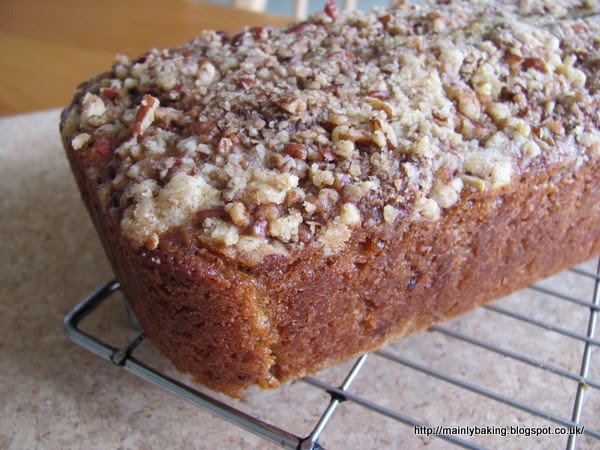
This was a strange recipe! The cake tasted good but managed to be both fragile and too dense at the same time; usually a dense cake holds together like a builder's brick, but every time I handled this cake I expected it to fall into a pile of crumbs. I found the recipe  here, on Sally's Baking Addiction, while looking for recipes using orange and frozen cranberries together. Although I wondered about the advisability of relying on just bicarbonate of soda to raise the mixture, the cake looked very attractive, and a streusel topping adds interest without having to add the optional glazing afterwards.

I followed the cake recipe exactly, but reduced the butter in the streusel topping to 30g and added 35g of finely chopped pecans too.

I had fun chopping frozen cranberries, but my mini-processor just about coped, although it shaved a lot of small flakes of fruit off too, which perhaps accounts for the much darker cake crumb in my loaf, compared to Sally's photos. The cake batter was very wet, and I expected to find that all the fruit and nut pieces had sunk, but they were fairly evenly distributed.

The flavour of this cake was OK, but nothing exceptional. None of the cake flavours really stood out, despite there being strongly flavoured ingredients there. The best part was the crunchy, nutty and spicy streusel topping, which was a good contrast to the rather bland cake. Overall, not a cake I'm likely to repeat.

Thursday, 4 December 2014

Date, Maple and Pecan Loaf

I've talked before about the difficulty of finding recipes which use enough maple syrup to justify putting the ingredient name into the title, especially if you're looking for a plain, everyday kind of cake. There are plenty of gateau-type cakes, with maple flavoured frosting, and plenty of cakes which use only a tablespoon of maple syrup, yet still thinks this is enough to add a maple flavour. It isn't, believe me!

Eventually, I found a suitable looking recipe for a Pecan Maple Loaf, and adapted it a little to make this Date, Maple and Pecan Loaf. I did a very rough conversion of the ingredients to metric weights, then rounded up to produce a recipe which looked right to my experienced eyes. I also added 100g of roughly chopped dried dates.

Ingredients
200g SR flour
180g softened butter or baking spread (see note)
100g caster sugar
3 large eggs
finely grated zest of 1 lemon
75mls maple syrup
100g roughly chopped dried dates
50g roughly chopped pecan nuts

Note - I used non-dairy spread, suitable for baking, as I had a tub to use up. I also left the tablespoon of milk out of the recipe to make this suitable for a dairy-free diet - the batter was very loose, so I couldn't see the point of adding the milk. Interestingly, I watched a TV programme (The Icing on the Cake - Nigel Slater) earlier this week, where the food scientist Peter Barham explained that baking spreads often make better risen cakes than butter because the water content is higher than that of butter. This turns to steam during baking and helps give a bigger rise to the cake, as it is trapped within the setting batter.

Method
Prepare a 2lb loaf tin. (I lined the base and long sides of a non-stick tin with baking parchment). Pre-heat the oven to 160C.
Rub the fat into the flour and stir in the sugar.
Whisk together the eggs, maple syrup and lemon zest. Stir the wet ingredients into the flour mix, but do not over-mix.
Fold in the dates and pecans.
Transfer the batter to the prepared tin and bake for 70 minutes, or until a test probe comes out clean. Cover with foil if the cake seems to be browning too quickly (mine needed covering after 45 minutes).
Cool in the tin for 15 minutes, then transfer to a wire rack.

The optional frosting would probably have been very nice, but I didn't want to add extra sugar to an everyday cake, and it was fine without!

This was a delicious and light-textured cake, although the raw batter was very wet, and I worried needlessly that the dates and nuts would sink during baking. The maple syrup and lemon together gave a lovely flavour and was a good background flavour to the dates and pecans. The crumb texture wasn't super-fine, but I think that came from the rubbing-in method, which left little lumps of fat in the batter. A creaming method might have given a tighter texture.

Wednesday, 18 July 2012

Blackcurrant Jam Cake

with White Chocolate Cream Cheese Frosting

Things are busy at the moment; CT is moving out (eventually) but his new place needs some work on it first, and he's not very practically minded, so needs our help. There are the also the contents of his room, and his new things, to move into his home - although he can carry his own books up two flights of stairs! In addition, my mother is getting old and frail, and needs more help with errands and the increasing number of hospital appointments. Then there's the battle between the garden and the weather - the weeds are growing fast at the moment, so there's always work to do out there. With all this vying for my attention, time is running out to take part in my usual monthly baking challenges.

Luckily, this odd cake fits the brief for two of the challenges that I take part in regularly - We Should Cocoa (using chocolate and blackcurrants together) and AlphaBakes (where W is the randomly generated letter). I was going to include it in the Tea Time Treats challenge, as a traybake suitable for a cake stall, but decided that anything with nuts in carried a risk of triggering an allergy, so was best avoided, even though I do label my cake stall donations with an ingredient list.

Blackcurrants  are a fruit that I've never considered pairing with chocolate before this We Should Cocoa challenge, and even after scouring the internet for ideas, I couldn't come up with anything using dark chocolate that sounded a good way to combine them. White chocolate seemed a much better option. There was also the not inconsiderable problem of not finding any fresh fruit in my usual supermarkets, so having to use a processed version instead - in this case, jam. However, my searches threw up 'jam cakes', a speciality of the southern states of the USA, although I did find one reference to them also being a wartime adaptation to deal with sugar shortages here in the UK - presumably using jam laid down in the years prior to rationing.

After reading a lot of recipes, I decided to use this UK recipe from Annie Bell, as she is a reliable recipe writer, and this cake wasn't as huge as those produced in other recipes. Although this recipe uses a buttercream filling, many of the US recipes use a cream cheese frosting, and it seemed a logical step forward to add white chocolate to a cream cheese frosting, which would fit the challenge brief perfectly. As well as combining chocolate and blackcurrants for We Should Cocoa, white chocolate gave me the W for AlphaBakes

I decided to bake the cake as a traybake, and use a topping instead of a filling - a wise decision, as it turned out, as the cake wasn't really deep enough to split easily. My only adaptations to the recipe were to use blackcurrant jam instead of strawberry (many US recipes specify blackberry jam - a similar dark colour) and to add dried blueberries instead of raisins. I then added a white chocolate cream cheese frosting of my own devising. I intended to bake the cake in a 20 x 30cm tray, but it was clear after making the batter that it wouldn't go that far, so I changed to a 20cm square tin.

While the cake was cooling I tried to make the frosting, which reminded me how much I hate working with melted white chocolate. Melting 100g white chocolate with 20g butter, in a bowl over hot water, left me with a thick paste in the bottom of the bowl. This was made liquid by the addition of a tablespoon of milk. After cooling the mixture a little, I incorporated 100g icing sugar, followed by 150g full fat cream cheese. The sugar made the mixture very stiff, but beating in the cream cheese turned it back to a thinner consistency which needed refrigerating to get it to a spreadable texture - unfortunately it never did set to the firmer consistency that I hoped for.

I called this an odd cake earlier because the outcome didn't really match the ingredients put in - I expected a fruitier flavour, but the spices were predominant, although even there, the flavour was quite delicate. The cake stayed an interesting purply colour and the nuts and dried blueberries added a chewy texture. The frosting was a pleasant vanilla flavour, but didn't really do anything to enhance the cake - it would have been better if had set more firmly. Overall, although we didn't dislike the cake, no-one liked it enough for it to be made again - bland and tasteless was one description, but others might think differently!

PS - July 19th. The flavour of the cake matured overnight! It was a much better flavour the next day, but it still wasn't special enough to make me want to make it again.


The We Should Cocoa Challenge (rules here) is hosted jointly by Chele from Chocolate Teapot and Choclette from Chocolate Log Blog, this month's challenge, to use blackcurrants, was set by Choclette. The round-up of entries will be on Chocolate Log Blog at the end of the month.


The AlphaBakes Challenge (rules here) is a monthly baking challenge to make something  featuring a randomly chosen letter - this can be part of the name of the product or one of the major ingredients. It is hosted jointly by Caroline, from Caroline Makes, and Ros from The More Than Occasional Baker, who take turns to generate a random letter and collate the entries. This month Caroline is the host, and her random letter generator picked W!


Saturday, 31 March 2012

Dan Lepard's Chocolate Passion Cake

If. like me, you haven't had any really good experiences with Vegan cakes, or you are just prejudiced against them for some reason, then I urge you to give Dan Lepard's recipe  for Chocolate Passion Cake a try. It's certainly made me adjust my ideas about baking cakes without eggs; until now I haven't baked anything that I'd really want to make again, and at least one attempt at a  vegan chocolate cake has ended in the bin, with no-one wanting to eat it.

Here, the addition of the other ingredients - date purée, carrots, nuts and spices - hides the blandness that is present in a lot of cakes made using neither eggs nor butter. Both the texture and the flavour is much improved - I would willingly put this cake up against a conventional carrot cake and defy anyone to notice that it was a vegan version!

This is a cake which I would happily make again, even if I didn't need a vegan cake (I didn't need one this time - I was just browsing Dan's book, Short and Sweet, for a cake recipe with either oil, or only a small amount of butter). It was light and moist and packed with a whole bunch of flavours - nuts and spices as well as chocolate. If I have one criticism it's that it's a little on the delicate side - it has a tendency to crumble rather than slice neatly. In addition, I wasn't completely happy with the spice flavour; although it wasn't bad, I think it might be better to use just cinnamon, rather than the stipulated mix of ginger and mixed spice.


Even CT, who has always maintained that he didn't like carrot cake, was happy to eat this! I thought about not telling him there were carrots there, as I had grated them finely, and they couldn't be seen in the dark coloured crumb, but I owned up before he ate any. His acceptance made me wonder if I ought to tell him about the beetroot in the chocolate cake a few weeks ago, which he ate quite happily, if unknowingly, even though he refused to try the Cherries, Berries and  Beetroot cake I made a few days later, because I had to tell him what the pink flecks were!

I didn't change anything in the cake recipe, but I did make a different frosting - my usual fudge frosting (see this recipe) which has less sugar than glacé icing. As I don't have a large food processor, I used a stick blender to purée the dates and blend in the oil and vinegar to make an emulsion. This appears to have been an acceptable way of doing things. I chopped the dates and nuts in a mini processor, but I processed the nuts for slightly too long - I should have stopped while the pieces were a bit larger. The recipe appears complicated on first reading, but the cake was really quick to put together and baked quite fast too.

Apologies for the picture quality - I had the usual problems with making brown cakes look attractive!

Wednesday, 25 January 2012

Pear, Pecan and Ginger Cake

I can't put my finger on what was wrong with this cake, but I didn't really enjoy it. Perhaps there was nothing wrong with it, and it's just my taste buds which weren't satisfied. To me there was strange aftertaste to the cake, but I'm not sure it was because of the pecans or the fresh ginger - perhaps I shouldn't have used the ginger, but it seemed a good flavour combination in my head! On the other hand, the ginger couldn't really be tasted, although I could feel it as a warmth at the back of the mouth. CT didn't realise it was there at all until I told him!

The recipe originates from the Magnolia Bakery cookbook, but I found it here, on Rolling Pin Tales, complete with a translation to British weights and measurements! The only change I made to the cake batter was to add a large 'thumb' of fresh, grated ginger. I didn't add any frosting at all - just a dusting of icing sugar.

The cake was quite dense and heavy, although the pear chunks kept it moist. The crust of the cake was really hard too, and split during baking, so that the cake rose with a peculiar ridge around the top, as if a lid was being opened up. The hard crust made it difficult to slice the cake neatly as it cracked when a knife was inserted. 

I think the cake needed something more than just the pears and pecans, to boost the flavour but perhaps ginger didn't fulfill that need. I have seen versions of this recipe which add lemon zest to the batter, or perhaps some cinnamon would have worked better. I'm not sure this will be a recipe I try again.

Monday, 3 October 2011

Cafe Beaujolais' Buttermilk-Cinnamon Coffeecake

I don't know where Café Beaujolais is, although I guess it's probably in Los Angeles as the original of this recipe, which I found on Food Librarian, is found in the LA Times.

The method for making this coffee cake is slightly unusual to me, as it mixes oil into the dry flour and sugar mix. I haven't seen this in a recipe before, but I've read that cakes made with oil are more tender because the oil coats the grains of flour, preventing gluten forming. This method of adding the oil to the flour certainly seems to bear this out, as the cake was very moist and tender, and very light too.

The only change I made to the recipe was to use chopped pecans in the topping, when I found that both packs of flaked almonds in the storecupboard were so far out of date that they smelled rancid! I liked the combination of pecans and cinnamon, and I'm not sure that almonds would have been better.

Also, I didn't have the right sized baking tin - I used my adjustable square cake tin, set to 11 x 10", which seemed to be the nearest equivalent. Perhaps because of this change, I found the cake took 45 minutes to cook - a little longer than suggested in the recipe.

The cake was a little too sweet for my taste, but that's about the only fault I can find with it, and I'm really pleased to have found a good coffeecake recipe made with oil.

Thursday, 25 November 2010

Maple, Pecan and Cranberry Cookies

Happy Thankgiving to anyone celebrating this holiday. These cookies have what I consider to be some of this season's flavours from the USA - maple, pecan nuts and dried cranberries, so could be considered my virtual contribution to the feasting.

This is another version of the cookie from this Dan Lepard recipe. I used 100g of each of chopped pecans and dried cranberries, and left out the chocolate altogether. For the maple flavouring I replaced 60g of the sugar with the same amount of dried maple syrup flakes which I brought back from my holiday in Canada, and I used two teaspoons of maple syrup instead of almond essence.


Changing the sugar seemed to alter the texture a bit, or perhaps it was removing the chocolate, because these cookies didn't spread much and reamained almost exactly the shape which I put into the oven. If I'd known that I would have flattened them a bit more before baking. Being thicker, they took about 5 minutes longer to cook through. Although they were too thick, they were well flavoured, but a little dry without the chocolate melting in the mouth. Perhaps a change, or two, too far!

Thursday, 21 October 2010

Maple and Pecan Squares

I've said before that Autumnal cooking, with its use of spices, nuts and seasonal fruit such as apples and pears, suits our tastes better than the more delicate flavours of Spring and Summer. This cake is a case in point, even though I'm borrowing flavours from another part of the world, and I'm not sure maple syrup is even Autumnal - don't they harvest as the sap rises? Anyway, it's something that I probably wouldn't think of making in the Spring.

The original recipe for these packed the cake batter with cocoa nibs and butterscotch chips, and called the result Maple Blondies. I replaced these additions with a smaller amount of chopped pecan nuts and am going to call the result a cake, because it was far too light  to fit in with my ideas of what a Blondie should be! The  simple flavours of pecans, maple syrup and vanilla made this cake delicious and somehow pure, for not having a range of competing flavours jostling together.

Ingredients

200g plain flour
3/4 teaspoon baking powder
180g salted butter - softened
150g light muscovado sugar
125mls maple syrup
2 large eggs
1 1/2 teaspoons vanilla extract
150g chopped pecan nuts - a mix of fine and coarse pieces

maple flakes - optional

Method
Preheat the oven to 175C and line a 9" square tin with baking parchment.
Whisk the baking powder into the flour.
Cream the butter and muscovado sugar until light and fluffy, then beat in the maple syrup and vanilla extract.
Beat in the eggs, one at a time, with a tablespoon of the flour.
Fold in the rest of the flour and the chopped nuts. Transfer the batter into the prepared tin and level the surface.
Sprinkle the surface with a thick layer of maple flakes. (Most of these dissolved during cooking to give a crisp sugary topping to the cake.)
Bake for 30-35 minutes or until a test probe comes out with a few moist crumbs still clinging.
Cool in the tin for 30 minutes, then cut into squares and leave to cool completely.

Monday, 30 August 2010

Butterscotch Blondies - Take 3

I'll skip right over the disastrous attempt at making a courgette and pineapple cake - it was too bad to even photograph! Although the flavour was the sort of thing I'd been trying for - delicate and fruity - the texture was awful. Almost inedible - except I don't believe in wasting anything, so we're eating it as a warm pudding, like it or not! Needs more work!

But that disaster left me with a hole to fill, so today, I've been baking again. I think I've cracked the base recipe for blondies at last. Previous efforts have been too light, too thin, too biscuity, too cakey or too sweet, but this was just right. A little on the cakey side but still quite dense and chewy. After one of my previous attempts, I said I'd found a selection of nice looking recipes on Ice Cream Before Dinner which needed further investigation - the recipe I used was based on this recipe, for Sea Salted Blondies,  from there.

I intended to use the basic dough from that recipe without change, but found I only had small/medium eggs. so I used two eggs and increased the flour to the equivalent of 1 1/3 cup. I added 100g chopped 74% plain chocolate, 75g butterscotch chips and 50g chopped pecans.

I've almost finished the butterscotch chips I brought back from Canada, so probably won't make butterscotch blondies again in the near future, but this is the base recipe I'll be using for other types of blondies from now on.

Chocolate Chip Butterscotch Blondies
Ingredients
180g plain flour
1/2 teaspoon baking powder
1/8 teaspoon bicarbonate of soda
200g light muscovado sugar
115g salted butter
2 medium eggs
1/2 teaspoon vanilla extract
100g plain chocolate  - chopped or as chips
75g butterscotch chips
50g chopped pecans

Method

Line a 8" (20cm) square tin with baking paper, pre-heat oven to 170C.
Sift flour, baking powder and bicarbonate of soda into a small bowl.
Melt the butter in a large bowl in the microwave, being careful to just melt it. If it gets too hot, allow to cool a little.
Mix the sugar and vanilla extract into the melted butter, then mix in the eggs until thoroughly blended.
Stir in the flour, then the chopped chocolate, butterscotch chips and the nuts.
Transfer the batter to the baking tin and  spread evenly.
Bake for about 30 minutes, until an inserted probe comes out just clean.
Cool completely before cutting into squares or bars in a size of your choice - I got 16 squares.

Friday, 2 July 2010

Triumph from Disaster? The Tale of a Pecan Clumpy Cake

If you can dream - and not make dreams your master;
If you can think - and not make thoughts your aim;
If you can meet with Triumph and Disaster
And treat those two impostors just the same.......

.......Yours is the Earth and everything that's in it,
And - which is more - you'll be a Man, my son!

Rudyard Kipling

This part of 'If' by Rudyard Kipling often sums up my attitude to baking. It's a fine line between triumph and disaster, and it's not always obvious which way things are going.

Today's cake started off as a bid to use up half a tin of condensed milk lingering in the fridge. I'd seen recipes for condensed milk pound cake on other blogs; they seem to be an Asian speciality. The recipe on Engineer Baker, originally from Pichet Ong’s “The Sweet Spot” seemed a good place to start, although I knew I didn't have enough condensed milk. What I did have though, was Dulce de Leche, which isn't a world away from plain condensed milk - it seemed feasible to make up the weight necessary for the recipe with that.

Next, I wanted to add some flavour - a streusel layer flavoured with pecan nuts and maple syrup soon emerged as a front runner. I chose the maple streusel recipe from these muffins, although I didn't have maple extract. I used brown sugar and added 50g of finely chopped pecan nuts.

I followed the recipe instructions exactly, even though it's counter-intuitive to mix flour into the creamed mixture before the eggs. I assume this helps give the moist, close texture that everyone is so pleased with. I had 180g of condensed milk, so added roughly 60g of Dulce de Leche to make up the weight needed. However, trouble struck as I layered the batter into the loaf tin with the streusel mixture. It should have been obvious after the first half of the cake batter went in, that the tin wasn't going to be big enough, but for some reason I blithely carried on - half the streusel mix, the rest of the cake batter then ........ the tin was full with only a couple of centimetes for expansion, and the top layer of streusel not even all on! Idiot! The worst thing possible for a layered cake. Could I take the risk that the cake wasn't going to rise much? No!

I quickly lined an 8" square tin with baking parchment and lifted the raw cake mix from the loaf tin by grasping the baking parchment liner. I plopped it down into the bigger tin with no batter lost, but it was obvious as I spread the batter that the middle streusel layer was going to be disarranged at best. With no choice left, I scattered on the rest of the top streusel layer and put the cake into the oven.
Watching the cake bake, it was obvious what the next disaster was going to be - the streusel topping was slowly sinking out of sight. At the end of the cooking time, there were only a few indentations in the surface to show where some of the streusel was still near the surface!

When the cake was cold, I cut it into 16 squares. Most of the edge squares looked like this photo, with the clumps of streusel mostly on the bottom but some distributed throughout the cake. In the four centre squares all the streusel had sunk completely.

Fortunately I could still appreciate the fine texture that a condensed milk pound cake has. As others have described, it is firm, moist and close textured without being too dense. It is also not exceptionally sweet, considering the ingredients. I don't think using a little Dulce de Leche affected the flavour much - I certainly couldn't taste any caramel.


In my cake, the little pockets of pecan, maple and cinnamon flavoured crumbs added another dimension to the tasting experience. A subtle variation of texture and flavour which worked really well - although perhaps not as well as a proper streusel topping would have! It only remained to give it a name - the only way to describe the results was to call it a 'clumpy' cake. I probably can't call the results a triumph, but it wasn't a disaster either!
I am now determined to try the condensed milk pound cake as in the original recipe, and not to be so over-confident about altering recipes (for a while).

Thursday, 13 May 2010

Chocolate Marmalade Brownies

During my last baking session, I intended to soften some butter in the microwave, but inattention made me programme minutes, not seconds, into the timer. I ended up with a bowl of melted butter which was no use for that particular cake recipe. Once butter has been melted, it doesn't set into the sort of butter that can be used for creaming in the future (some water separates out), so to use this up I needed a recipe which used melted butter. As I seem to be alternating chocolate and non-chocolate recipes at the moment, brownies were an obvious answer. I also found half a jar of shredless orange marmalade hiding in the fridge, so Chocolate Marmalade Brownies looked like a possibility.

After a bit of searching, and discarding recipes which used much more marmalade than I had, and those which only added a tablespoon or two - how much affect would that have on the flavour? - I decided that this recipe from Best Ever Cookie Collection best suited my purpose. I used the butter I'd already melted, which was a fraction under a cup, and what marmalade was left in the jar, which may have been a tad less than the amount required, but otherwise followed the recipe exactly. No, wait a minute - I used light brown sugar and 100g of chopped pecans, which is more than specified, because the pecans were getting old and the light brown sugar was bought in mistake for muscovado sugar, so I wanted to get rid of it as quickly as possible in recipes where it wouldn't make much difference. I also baked in a 8 x 12" pan lined with baking parchment, as I didn't have the size of pan mentioned, and prefer deeper brownies anyway. The smaller pan did not affect the baking time; in fact 30 minutes was a bit too long, so if you try them, check on yours a few minutes sooner.

For my own records, I'm going to list the metric weights of the ingredients I used - 225g unsalted butter; 300g light brown sugar; 3 eggs; 150g marmalade; 1 teaspoon vanilla extract; 140g plain flour; 75g cocoa; 1 teaspoon baking powder; 1/4 teaspoon salt; 1/4 teaspoon cayenne; 100g plain chocolate chips; 100g chopped pecans.


I liked this recipe a lot, even though the marmalade flavour didn't come through strongly - I think this was down to the mild flavoured marmalade I was using. Using a more strongly flavoured marmalade, or adding the grated zest of an orange to accentuate the orange flavour, would be ways to get round this.

It's nice to have one or two chocolate recipes which just use cocoa powder, rather than a massive amount of melted chocolate, yet still achieve a rich flavour and moist texture. Here, the marmalade gave the moistness, and I think the brownie would have been quite rich in flavour even without the added chocolate chips. These brownies weren't as dense as the best brownies, but reducing the baking powder would remedy that. The small amount of cayenne pepper added gave a gentle warm after-taste which was just noticable.

This recipe will go on my list as a keeper, although I don't seem to get round to repeating recipes often at the moment. It might also be good to try it with jam and a complimentary dried fruit instead of nuts - cherry jam and dried soured cherries, for instance.

Tuesday, 27 April 2010

Tamarind Date Cake

I love Dan Lepard's baking recipes from the Guardian newspaper, but it's not often I get the happy coincidence of him writing a recipe for something the Chief Tester will eat and having all the ingredients in stock, so that I can make it almost before the ink has dried on the newspaper. That came about last weekend (if we don't count using pecans instead of walnuts) with this recipe for a cake packed with dates and walnuts (or pecans) and flavoured with tamarind paste and dark brown sugar.

The recipe itself was plain sailing, even if the method was a little unusual; cakes mixed in a saucepan have the added bonus of reducing the washing up load, which can be considerable after a typical baking session. My only concern was what exactly was meant by Tamarind Paste - the commercial pastes on the market can vary in strength and often have salt and sugar added, so I decided to make a paste from a block of pulp. I weighed 50g of pulp and added 100mls of boiling water. After stirring frequently during cooling to separate out all the fibres and seeds, I passed the mixture through a seive and weighed out 50g of the resulting paste.

My only real problem was the cake tin. When Dan says deep he means really deep! My 18cm (7") tin was 7cm deep but wouldn't take all the batter, so I had to hurriedly line a 20cm tin and transfer over the cake mixture. Even then the batter came to within an inch of the top, so I was anxiously watching it rise in the oven and expecting an overflow (which happily didn't come).

When cut within a few hours of baking the cake was very crumbly, which was a big concern, but it had firmed up a lot by the next day. I'd really recommend leaving the cake a day before even attempting to cut it.

The cake crumb itself was surprisingly light, but managed to hold all the dates and nuts in an even distribution throughout. The flavour of tamarind didn't come through as strongly as I'd expected; I've bake with tamarind before and it's given a lemony note to the cake which wasn't evident here. Here the tamarind seems to counterbalance the sweetness, making the addition of a glacé icing a lovely contrast, not a sickly, unnecessary extra. I didn't think the cardamom in the icing added much to the flavour either, but my pods may have been a little too old! However, the cake was still well flavoured, moist and so much lighter than many similar fruit and nut cakes; I'm sure I'll be making this one again!

After this recipe was published on Dan Lepard's web-site, with a photograph, I've realised that he intended it to be made in a square tin. An 18cm square tin is equivalent in volume to the 20cm round tin which I eventually I used (guided by the photo in the Guardian), so there's no problem with the quantities of ingredients given in the recipe.

Friday, 16 April 2010

Coffee and Pecan Marble Cake

It's so hard trying to think of new flavours that the Chief Tester will like - he was a fussy child, and is still quite fussy compared to his parents and sister. He doesn't like a lot of fresh fruit, either raw, cooked into cakes or as hot desserts such as crumbles and pies. He's just starting (at almost 30 years old!) to accept apples and pears baked into cakes and spongy desserts. He doesn't like dried fruit in huge quantities, although dates in sticky toffee pudding are OK because they are practically a purée, and I can get away with a little dried fruit in things like cookies which also have lots of chocolate and nuts in them.

He likes spices, chocolate, coffee, nuts and citrus flavours (although not the whole fruits). Normally this wouldn't matter too much - I'd bake something he liked, and something different for us - but as we are watching our waistlines expand, I'm trying not to bake anything that he won't eat too.

This marble cake was thought up as a change from chocolate, mainly for us - I don't think it would bother the Chief Tester if all cakes contained chocolate! I used my standard Madeira cake mixture, and baked it in a 25cm ring tin, although the batter would have been just as happy in a smaller tin. I just wanted to try the tin again, as the first time I used it, I broke the cake getting it out of the tin. That's why the slice of cake in the photo looks a peculiar proportion - it is too shallow, as the tin really needs more batter.


Ingredients:
225g softened butter
225g caster sugar
4 large eggs
1 teaspoon vanilla extract
300g SR flour
milk, as necessary (about 5 tablespoons, perhaps)
50g finely chopped pecans
2 teaspoons instant coffee, dissolved in a tablespoon of hot water
1/4 teaspoon each of cinnamon and nutmeg
1/8 teaspoon ground cloves
1 tablespoon pomegranate molasses (to deepen the colour - black treacle or molasses would work as well)
Coffee Glacé Icing:
75-100g icing sugar made into a smooth paste with a heaped teaspoon of instant coffee dissolved in a tablespoon of hot water, plus more water as necessary.

Method
Preheat the oven to 170C, and prepare a tin as usual. (I just greased this ring tin, as it seemed very non-stick the first time I used it.)

Cream the butter and sugar until light and fluffy, then slowly beat in the eggs, one by one, with a little of the weighed flour to prevent curdling. Add the vanilla extract with the first egg.

Fold in the flour, with enough milk to give a soft dropping consistency.

Divide the batter into equal halves, and fold the nuts, spices, coffee and molasses into one half, mixing until evenly blended.

Evenly spread half the plain batter into the base of the prepared tin. Using half the coffee batter and the rest of the plain batter place alternate blobs of mixture round the ring. Use the back of a spoon to squidge down the blobs to make a fairly even layer, then spread the remaining coffee batter on top.

Insert something like a chopstick or teaspoon handle into the batter, not quite to the base, and drag it twice around the circle, making the rings a few centimetres apart, to marble the batter a little.

Bake for 50-60 minutes, or until a tester comes out clean. (A cake baked in a smaller, or a round tin, rather than a ring, might take a little longer.)

Cool the cake in the tin for 15 minutes, then carefully remove onto a wire rack to finish cooling.

When completely cold, decorate as liked with the coffee glacé icing. (I spooned the icing into a small freezer bag, and snipped off a corner to give a simple piping bag, which gives a more controllable drizzle when using glacé icing)


This is a moist, close-textured cake. The molasses and spices added subtle hints of flavour without overwhelming the main coffee and pecan flavours.

Saturday, 3 April 2010

Sour Cream Bundt Cake

with chocolate, pecan and cinnamon streusel layers.

This is a huge cake, just right for Easter celebrations, but it will be the last large cake for quite a while, as our expanding waistlines must be reigned in! Future bakes will be smaller, and aimed at The Chief Tester (my son) rather than being something OH and I want to eat.

If I made this again, I would try to get the two streusel layers further apart. It was something of an experiment, as I was using a crumb cake recipe in a bundt tin, and didn't want a crumb layer as either the first or last layer in the tin.

I used Ina Garten's Sour Cream Coffee Cake as the basic recipe, but used some cocoa in place of some of the flour in the streusel, and added 100g of chocolate chips to a portion of the cake batter, as well as arranging the layers differently. I also used pecans instead of walnuts. As we don't have cake flour available in the UK, I substituted just under half a cup of cornflour (50g) for some of the flour. Once the cake was cool, I added a chocolate glacé icing.

Ingredients
Cake:
175g unsalted butter
300g sugar
3 large eggs
2 teaspoons vanilla extract
300mls soured cream
275g plain flour
50g cornflour
2 tsp baking powder
1/2 tsp bicarbonate of soda
pinch salt
100g plain chocolate chips
Streusel
50g light muscovado sugar
50g plain flour
20g cocoa
1 teaspoon cinnamon
40g cold unsalted butter
50g finely chopped pecans
Glacé Icing
50g icing sugar
1 tablespoon cocoa
warm water as required

Method
Preheat the oven to 170C and butter and flour a 10-cup bundt pan.
Make the streusel by rubbing the butter into the flour, sugar, cocoa and cinnamon, then mixing in the nuts. Set aside.

To make the cake batter, first mix the salt and raising agents into the two flours, then sift together to distribute everything evenly. Cream the softened butter and sugar together until well mixed. Beat in the eggs, one at a time, with a teaspoon of the flour mixture. On a low mixer speed add the soured cream and flour mix in alternate portions, also adding the vanilla extract at this stage. Use a spatula at the end of mixing to make sure everything is well mixed and there are no traces of flour remaining.

To layer the cake: Put roughly a quarter of the batter into the bundt tin, dropping small amounts evenly around the ring, and spreading with the back of a spoon, being careful not to disturb the flour lining the mould. Sprinkle half the streusel mix over the cake batter. Next spread half the remaining cake batter into the tin, followed by the rest of the streusel mixture. Stir the chocolate chips into the remaining portion of batter and spread evenly into the tin.

Bake for 50-60 minutes, until a test probe comes out clean. Cool on a wire rack for 15 minutes before removing the cake from the tin. finish cooling the cake on the rack.

When completely cold, make the chocolate glacé icing by sifting the icing sugar and cocoa together and mixing to a thick paste with warm water. Drizzle this over the cake with a spoon or icing bag, then carefully move the cake to a serving plate. I found it best to build up the icing in layers.


This cake is as delicious as it looks. The sour cream helps to give a moist tender crumb which is not too sweet while the layers of streusel add more sweetness, an intense chocolate flavour, a touch of spice and some crunch from the nuts.

Wednesday, 24 March 2010

Dulce de Leche Brownies

with Pecan Caramel Crumble Topping.

I used this recipe as a guide, but reduced the sugar in the brownie batter a little, as I didn't have unsweetened chocolate, only 85% cocoa solids. I left off the fudge sauce topping, as I wanted a cake, not a sticky dessert. I also took a guess at how much dulce de leche to use, when converting to metric weights. As suggested in the recipe, I needed to add more flour to the crumble topping to get it dry and crumbly enough to scatter. I left out the cinnamon from the brownie batter but put it into the crumble topping.

The crumble topping was very hard after baking, although it seems to have softened a little during storage. The brownies were overbaked when I tested them at the minimum suggested time, so that might have contributed to the crunchiness of the topping too. The brownie part of the recipe was nothing special - it really needs to be richer - but overall these were saved by the nutty caramel crumble topping which gave a good contrast in texture and flavour. With either more chocolate or more dulce de leche in the batter, and a few minutes less cooking, these could become something very good. I guess replacing the reduced sugar would improve the texture too - we live and learn!

Here's my metric weight conversion, if you are interested.

Brownie Mix:
115g 85% plain chocolate
175g butter
200g caster sugar
50g dark muscovado sugar
50g dulce de Leche
3 large eggs
140g plain flour
1 teaspoon vanilla extract

Topping:
80g Dulce de Leche, 60g plain flour, plus more as necessary, 3 tablespoons light muscovado sugar, 1/2 teaspoon cinnamon, 60g pecans, chopped small, 30g melted butter.

Friday, 22 January 2010

Chocolate Chip-Cinnamon Coffee Cake

This does not look pretty, and that's not all down to my non-existent photography skills. The cake turned out too shallow to show properly that it is layered, with a streusel of cinnamon, sugar, chopped pecans and chocolate chips in the middle, as well as liberally sprinkled over the top. It's delicious though, so I'm still including it here!


I made half of this recipe, using an 8" square tin, even though 'scale downs' which end up using fractions of eggs usually annoy me. The cat certainly appreciated half an egg! I felt I couldn't justify using 350g chocolate chips in something which we might not like, and 32 portions sounded enormous - far more than three of us could eat. In the event, I couldn't cut half the cake into 16 portions - I only got 9 pieces of a decent size! What's the point in being unrealistic about how much cake someone is likely to eat?

I made one change to the recipe - I used demerara sugar for the portion of sugar that went into the streusel mix - both for colour and crunch. I would recommend making the streusel in two parts. It was very difficult (nay, impossible!) to mix the sugar and cinnamon thoroughly with the nuts and chocolate, then divide it into two. It would have been easier to manage if the sugar and cinnamon was in one bowl, and the chocolate and pecans in another.

It was very difficult to spread half the batter over the base of the tin, and even more difficult to spread the second half over the streusel layer, as the amount of batter seemed so meagre. I think ideally, halving the streusel, but only reducing the batter by 1/3 would have been better, making a deeper cake which I could have cut into 12 good sized portions.

Saturday, 24 October 2009

Maple Syrup and Pecan Cake

I've spent several hours looking for an interesting cake using maple syrup and pecan nuts, over the last few days. Most seem to rely mainly on their visual appeal - multiple layers of light sponge sandwiched with fluffy billowing frosting; I wasn't convinced there would be much flavour in them, and as a family we're not keen on these types of cakes anyway. Some recipes only used a few tablespoons of maple syrup in the cake batter, others used a whole 350ml bottle, which seemed a bit excessive, not to say confusing. How could I decide what would make a well flavoured cake with so much variation? I even looked for recipes using honey, thinking I could substitute maple syrup for the honey, but still couldn't find anything that appealed.

Lateral thinking was required. Who publishes interesting and unusual recipes? Blindingly obvious answer, of course, at least to British bakers - Dan Lepard! A search of his weekly Guardian recipes came up with this Honey and Walnut Cake - it was a simple step to substitute maple syrup and pecan nuts, and I also added half a teaspoon of ground cinnamon. I wanted a round cake, so used a 19cm diameter springform tin, base lined with baking parchment.

The recipe was simple to follow, albeit a little unorthodox in the method and order of combining the ingredients. My cake, in it's round tin, cooked in the time suggested in the recipe. The result, although not a pretty cake, was a triumph of subtle flavours - apart from the pecan nuts, it wasn't easy to identify any of the other flavours, but they combined to make a delicious cake with a sturdy moist, but not too dense, texture. The addition of coffee cut the expected sweetness of the cake, as Dan explained in his notes about the cake.


If I'd had more syrup available I might have added a maple glacé icing, with a few chopped pecans scattered over, but I had to empty the bottle (and use a tablespoon of honey) to get enough for the cake. Note to self for next time, I think!

So once again, I have Dan Lepard to thank for the inspiration for a really tasty cake - I guess I should try the original version with honey and walnuts sometime, as I'm usually pretty scathing about people who write that they tried a particular recipe, but added this ingredient and changed that ingredient - especially if they are complaining that it didn't work, or they didn't like it! I think it's a mark of respect to the work that recipe creators do, to try the recipe, as it is written, at least once - sorry Dan!