Showing posts with label spices. Show all posts

Wednesday, 23 December 2020

The Triennial Chocolate, Fig and Ginger Panforte

For some reason, I have made this Panforte, for Christmas, at three year intervals - 2014, 2017 and again this year. Perhaps it's going to be a tradition!


Panforte is a particularly suitable Christmas treat this year, when, if we are meeting friends and family at all, it's on a very restricted schedule with regards to both numbers and time. It keeps for weeks after making, so however few of you there are to eat it, you'll get through it without any waste. 

This year, this panforte will almost be all mine! Apart from a brief visit from both my children on Christmas Day for an exchange of presents and a meal together, the Covid restrictions mean, like many others, I'll be alone most of the time. That doesn't bother me - all I need is a good book to keep me happy, and it will only be a few days before we're all back into the routines of our lives. For me that can be quite hectic, as I volunteer at the local Food Bank, which has been very busy since the start of the pandemic.

I followed my original recipe from 2014, which was a compilation of several other recipes, in a quest for perfection. I could vary the flavours by changing the fruit, or leaving out the ginger, but this particular combination of chocolate, figs and ginger, together with the spices and hint of orange, works so well that I'm reluctant to make changes.

Here's wishing you the best 

for this Festive Season, 

with hopes that 2021 

will be better for all of us!

Saturday, 31 October 2020

Chai Swirl Loaf Cake

I've made this cake a couple of times before, with no problems, but this time the cake sank towards the end of the baking time - the only explanation I can give is that I may have been a touch heavy-handed with the baking powder. It did mean that the whole cake didn't make a very good photograph.

This time I was making the cake for a Halloween celebration virtual Cake Club meeting, so used a couple of props in the photograph. As I would be freezing most of the cake, I didn't want to use frostings or icing to give a Halloween look.


This Chai Swirl Loaf Cake is a Ruby Tandoh recipe, and the mix of spices used is delicious - none of them stand out individually, although the pepper gives quite a warming sensation!

The only thing I do differently to what's stated in the recipe is to layer the two different batters and allow them to marble naturally during baking, due to the convection currents within the heating cake batter. I think this gives a much smarter appearance than random dollops, and it looks as if the cake in the photograph with the newspaper article was made that way too.

Tuesday, 21 July 2020

Spiced Chocolate Bundt Cake

I last made this cake, from Sainsbury's website at the end of 2014, as a pre-Christmas treat. This time I made it for a birthday tea for myself and my two children, held in the garden to comply with Covid-19 guidelines. Both my son and I have July birthdays, close together, so usually share a cake. The three of us enjoyed the cake, and the warm sunny afternoon - until the flying ants came out! 

As before, I didn't top with the ganache from the recipe, but with Mary Berry's fudgy chocolate frosting. You can see the details here - nothing has changed. The cake was a little crumblier than I remembered, but that might have been because not all of my eggs were large. The flavour was still very good.


Sunday, 7 June 2020

Flatbreads

Regular readers will know that yeast and I don't get on together well, which makes it all the more surprising that I haven't come across this simple flatbread recipe before.

I guess it's popping up a lot online because strong bread flour and yeast are difficult to get hold of at the moment, although you're lucky if you can find any sort of flour in the supermarkets. Fortunately, I still have half a bag of SR flour, which is the type of flour needed for this recipe.

All you do is mix equal weights of SR flour and Greek-style yogurt (I always have full-fat yogurt in stock) and knead lightly; if the dough is too dry at this stage add more yogurt a teaspoon at a time, if it's too wet sprinkle over a little more flour and knead in.


Then divide into portions (I got 4 individual breads from 200g of flour and 200g yogurt), roll out as thin as you like, brush very lightly with oil (optional), then cook on a hot griddle pan (or in a heavy non-stick frying pan) until golden brown.

I added some flavourings, as I was serving the bread with a curry, and wanted it to taste like a Nan bread. The first time I made the bread, I added salt, pepper and a teaspoon of nigella seeds to 200g of flour. The second time, I added more nigella seeds (a teaspoon to 100g flour) and a 1/4 teaspoon of each of ground cumin and ground coriander, as well as the salt and pepper.

My first attempt tasted fine, but I didn't roll the breads thinly enough. The second attempt, rolling the dough out to around 0.5cm thickness, worked much better, both in terms of flavour and texture. I think it would be difficult to tell that you weren't eating a yeasted bread.


The great thing about this recipe is that it can be made in small quantities, which means I can make just enough for 1 meal, and not be tempted to eat too much. The dough can be mixed and cooked as quickly as you'd cook rice or potatoes, so doesn't mean extra time in the kitchen either.

The top photo shows the four flatbreads made  in the first batch, which were too thick. They were cooked on a cast-iron ridged griddle for about 3 minutes each side. The bottom photo shows the two I made on my second attempt, when the 100g portions of dough were rolled out to twice the size as the first time. These were cooked on a smooth griddle and took less than two minutes on each side.

Saturday, 9 May 2020

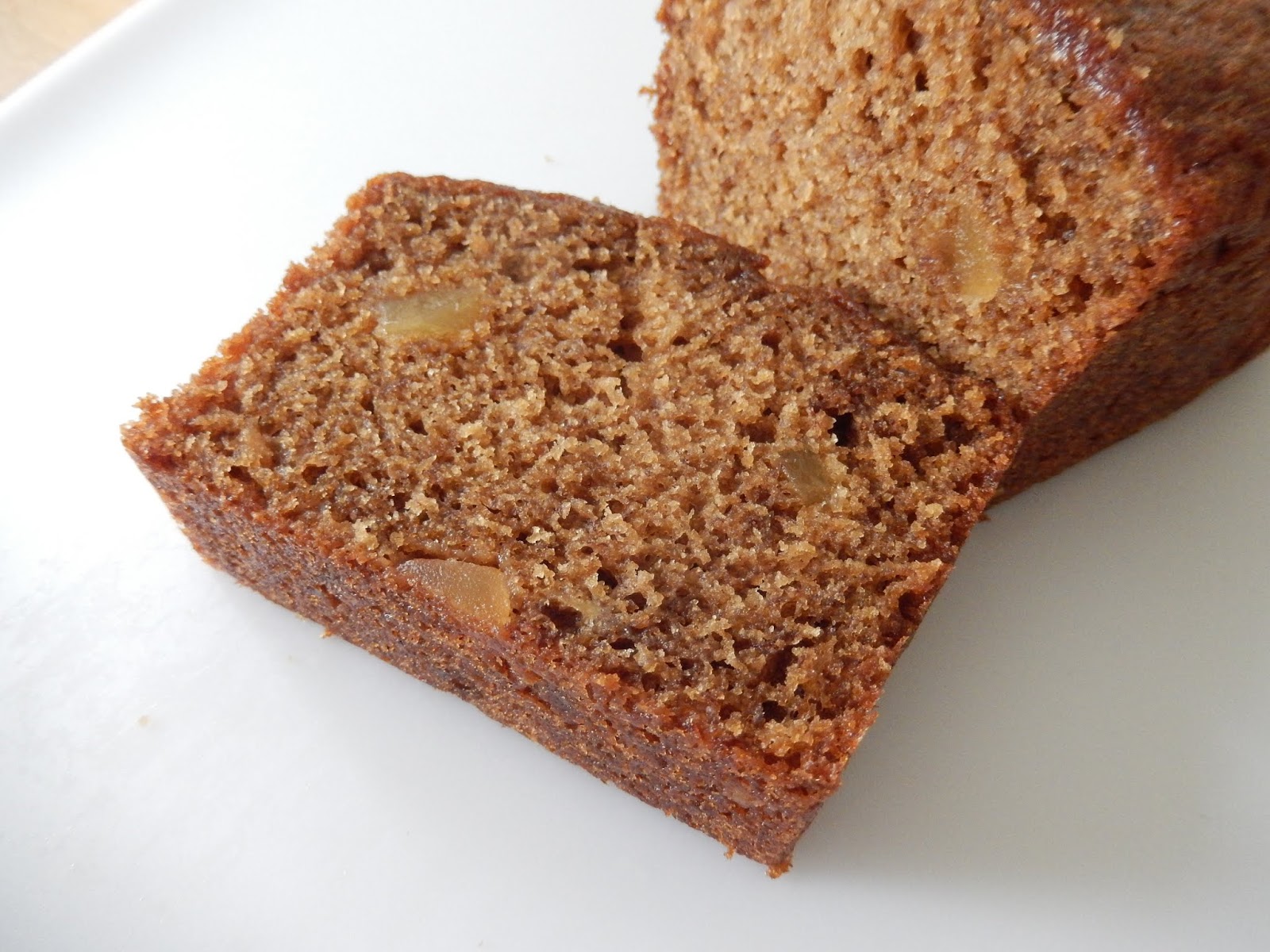
Dairy-free Gingerbread

The only time I get to make a large cake these days is if I can bake for someone else. At the end of last year I joined the Friends of my local Library, and had been baking for their monthly coffee mornings. That's all on hold for the moment, of course, with Libraries closed and no mass gatherings taking place because of the Covid-19 pandemic.

Because so little is known about this particular virus, or what are the most effective ways of staying safe, I've been sewing face-masks for me and my two children, in case they are eventually needed (even though I don't really think much of the efficiency of home made ones). I decided that when I delivered their masks to them, I could include some cake, to cheer them up a bit in their isolation.

It was hard to decide what to make, as the three of us have very different tastes, but eventually I decided on gingerbread.

I used this oil-based gingerbread recipe, rather than the best traditional recipe I have, because I didn't want to open a litre of milk just for the small amount that was needed for the cake. The oil-based recipe is very similar to the traditional recipe - it gets a nice sticky top after a few days - but isn't quite as rich as it has less fat and fewer eggs. Using oil, and water instead of milk, has the added advantage of making the cake dairy-free too.

The bottom photo shows the 20cm square cake divided for sharing. As you can see, the three of us vary in how much cake we can eat over a few days; the biggest portion was for my son and the smallest (missing) portion was for my daughter. I was left with the long narrow piece - it  made a delicious dessert when reheated and served with rhubarb roasted with ginger, and natural yogurt.

Sunday, 26 January 2020

Cider and 5-Spice Bundt Cake

Wow! I wish I'd tried this Nigella Lawson recipe for a Cider and 5-Spice Bundt cake years ago.  It was superb!

I tried a scaled down version of the recipe, one Christmas a few years ago, but used a different spice mix and ginger wine instead of cider. So I knew the recipe worked, but had no idea what the impact of using 5-Spice would be.

Nigella originally called this a Cider and 5-Spice Gingerbread, but changed the name because the ginger element (fresh root ginger) isn't particularly strong. The method of making the cake is essentially that of a gingerbread - combine sugar with the wet ingredients, then mix in the remaining dry ingredients - but because oil is used rather than butter, there's no melting or other heating involved.

Once the ingredients were weighed and measured out, the cake was really quick to put together. The most time consuming operation was grating the lump of root ginger!

Instead of buying cake release spray to use to prepare a bundt tin, I've started using a home-made version. This is partly because the Dr Oetker brand of cake release spray is no longer on the market, and none of the supermarkets stock a replacement product, but partly because it's cheaper.

The recipe I have seems to have originated from the 2014 GBBO winner, Nancy Birtwhistle. However I can't find it on her website, only on a few twitter videos.  There is something about it here, but basically, it's equal parts of Trex (white hard vegetable fat), plain flour and vegetable oil. I made up a small batch, using 50g of each of Trex and flour, and 50mls of sunflower oil, which is going to be enough for several cakes. It keeps in a jar in the fridge until the shortest 'best before' date of the products you've used (or use your nose - fat that has gone rancid won't smell very good).

I allowed it to warm up a little before use, and it was then easy to brush onto the bundt tin with a pastry brush. I think it works better than the commercial spray, probably because you can easily see if you've missed any areas, and can also put on a thicker layer if you've any doubts. My cake just plopped out without any assistance from me, after about 15 minutes cooling in the tin.

Because I was taking the cake to my local Cake Club (a legacy from the now defunct Clandestine Cake Club meetings), and the theme was Festive/New Year, I prettied up the cake with a lemon glacé icing and some sparkly sprinkles on top, but I wouldn't usually bother with anything more than a dusting of icing sugar.

The cake had a lovely close-textured but light crumb and  the 5-spice gave a unique flavour which emphasised the aniseed elements of the mixture - I used Bart brand which contained, in decreasing order, star anise, cassia, fennel,cloves and ginger - and the nutmeg. It was a very tasty alternative to a traditional gingerbread. Although it was an optional extra, the lemon glacé icing was a good contrast to the spice - Nigella says she likes this cake with a salted caramel sauce, but I think that would be too rich, and sweet, for me.

Monday, 9 September 2019

Date and Ginger Flapjacks

Another roll out of an old favourite - flapjacks are really quick to mix and bake so are ideal for occasions when you don't have much time, or just want to make something from store-cupboard ingredients. I think I overdid the ginger here, so the flavour of the dates didn't come through strongly, but their chewiness added to the texture. The recipe is really simple, and can be made in one bowl or saucepan, depending on how you want to melt the butter, syrup and sugar together.

As long as you don't exceed 150g, you can use any combination of dried fruit, nuts or seeds that you have in stock, or know you family likes, adding appropriate spices or other flavouring, such as citrus zest.

For a 20cm (8") square tin, melt together 160g butter, 70g of golden syrup and 100g of light muscovado sugar. I do this in a large bowl in the microwave, but it can also be done in a saucepan on the hob. When all the butter has melted add in 240g porridge oats, 2 teaspoons ground ginger, 1/2 teaspoon of ground cinnamon, 80g of chopped dates and 50g crystallised or glacé ginger,  both chopped quite finely. Mix until well combined then transfer to the baking tin, which should be lined with baking parchment. Press down firmly to give an even layer, then bake at 180C for about 25 minutes, to give a chewy flapjack. If you like a slightly crisper finish, bake for a few minutes longer. Cool in the tin for 5 minutes, then mark into bars or squares, but leave in the tin until completely cold.


Wednesday, 7 August 2019

Dark Banana Ginger Cake

I feel as if I should apologise for three consecutive posts featuring loaves, but they are so practical now that I'm only baking for myself. Even with a small loaf cake, I often freeze part of it - mainly to save my waistline, not because I couldn't eat it all. Loaf shaped cakes are easy to portion and stack tidily in the freezer. In this case, I was able to bake this full-sized recipe (the second on the page) from the ever reliable Dan Lepard, but split it between two small loaf tins rather than bake it as one large 20cm (8") square cake. The cooking time for the smaller loaves was still 50 minutes.

I made a few changes to the recipe, some of which seemed inconsequential to how well the recipe worked - I used white bread flour, crystallised ginger instead of glacé, and added some ground spices to the recipe (1 teaspoon ginger and 1/2 teaspoon mixed spice). The final change was a bit more worrying - I only had two large bananas, which I was reasonably sure would weigh enough, but when the peel was off there was only 200g of flesh, not the 300g asked for in the recipe.

It was too late to back out at that stage so I went ahead, wondering if I needed to add anything to replace the missing 100g of banana. If the batter had been really thick, I might have added a tablespoon or two of natural yogurt, but it was very liquid, so I decided to go ahead with nothing else added.  I noticed afterwards that Dan says in the introduction to the recipe that the bran in wholemeal flour soaks up the liquid from the mashed banana, so maybe losing the bran and using less banana cancelled each other out!

I really liked this cake, it was firm and close textured but not heavy, and it still smelled and tasted of banana. I think adding a little extra spice was a good idea as even though I was using fiery crystallised ginger pieces it was nice to have some spice flavour in the cake crumb too.


Monday, 24 June 2019

Rhubarb Streusel Muffins

This isn't a new recipe to me, but I wanted something quick to put together and bake, to take to the local Cake Club meeting. Whatever I made also needed to fit in with the theme of 'Summer', and as the recent heavy rain has given my rhubarb patch a late surge in growth, using some of that seemed the most obvious way to go.


I followed this recipe from Smitten Kitchen almost to the letter - the only changes I made were to use all white flour, rather than some wholemeal, and just demerara sugar in the crumble topping, for an extra bit of crunch.


The muffins were light, not too sweet and very subtly spiced. I used 200g of diced rhubarb but I think the recipe could have taken a little more, although you do have to be wary of the amount of fruit juice produced when the rhubarb cooks, which could make the muffins too damp and heavy.


Tuesday, 14 May 2019

Date and Banana Loaf

With a wet afternoon ahead of me, and some over-ripe bananas in the kitchen, I was looking for a recipe which I could make using just my storecupboard ingredients. This recipe for Easy Date and Banana Loaf, on the Waitrose website looked promising, and used my favourite storecupboard sweetener - date syrup - which was an added bonus.

Following the recipe exactly didn't quite work out, as I didn't have Medjool dates or enough butter and SR flour, but my substitutes worked well, producing a well-flavoured moist loaf with a firm but not heavy texture. I used cream cheese in place of the missing amount of butter, light spelt flour and some extra baking powder in place of some of the flour, and basic soft dried dates instead of Medjool dates.

Ingredients
100g butter, softened
75g full fat cream cheese, at room temperature
100g SR flour
100g light spelt flour
1 teaspoon baking powder
1 teaspoon ground ginger
1 teaspoon cinnamon
2 eggs
3 tablespoons date syrup (plus extra for drizzling)
2 large ripe bananas, mashed roughly
100g chopped soft dried dates
demerara sugar for topping (optional)

Method
Line a 900g (2lb) loaf tin with baking parchment or a pre-formed liner. Pre-heat oven to 160C.
Put all the ingredients except the bananas, dates and demerara sugar into a large bowl and beat until smooth, then beat in the bananas. Finally, fold in the dates.
Transfer the batter to the loaf tin, level the surface and sprinkle over the demerara sugar, if using.
Bake for about 75 minutes, or until a test probe comes out clean.
Cool in the tin for a few minutes, then transfer to a wire rack and drizzle with a little more date syrup.

The resulting loaf was moist enough to eat as a cake, although butter spread on this sort of loaf is always an option worth considering. The subtle spicing enhanced the overall flavour of the cake, but it was the dates which stood out as the strongest flavour.

Friday, 5 October 2018

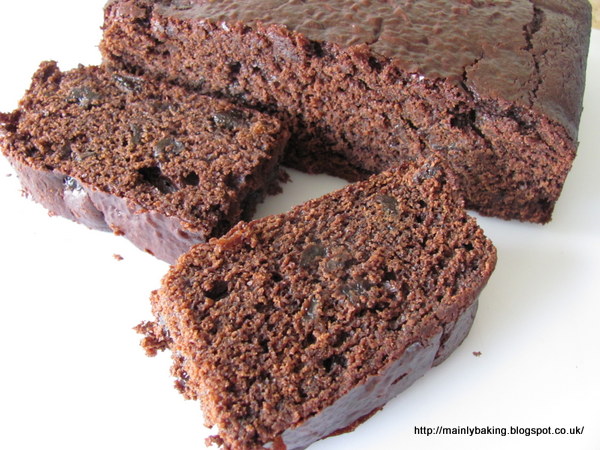
Chocolate Spice Gingerbread

This is a really light gingerbread cake, flavoured with Green and Black's Maya Gold Chocolate, which contains spices, orange and vanilla. More spices and chopped prunes are added, along with more dark chocolate to increase the depth of the chocolate flavour.

Even though other spices are added, the unique taste of Maya Gold is still the predominant flavour. I have tried this recipe with orange zest and extra spice, instead of Maya Gold, and although it's still very good, it's not the same!

I made two of these delicious cakes, one to keep and one to donate to a Macmillan Coffee Morning event. Fortuitously the recipe used half a pack of prunes, half a bar of Maya Gold chocolate, and just a tad over half a pot of buttermilk (I just added a tablespoon of natural yogurt to the second cake to give the right volume) so it was good to make the second cake instead of having leftovers to worry about, particularly as Maya Gold chocolate isn't one of my favourite 'eating' chocolates.

Personally, I prefer a heavier, denser gingerbread (the sort which grows a sticky top over time), but as an amalgamation between gingerbread and chocolate cake, this particular recipe is hard to beat.

Tuesday, 18 September 2018

Wholemeal Pear and Ginger Cake


My local Cake Club (set up following the demise of The Clandestine Cake Club, which now only has a Facebook presence) set the theme of Autumn for the most recent meeting. I was torn between this recipe or a courgette cake, but went with this Pear and Ginger Cake because it has been a more reliable recipe over the years.

This is one of those cakes where the basic recipe can be altered by using different fresh fruit, dried fruit and jam - the original cake, a Nigel Slater recipe (scroll down the page), used apples, sultanas and orange marmalade, and I've also successfully made it with apples, dried cranberries and cranberry jelly and in this version, pears, golden raisins and ginger preserves. There were slight adjustments to the other flavours too - I used lemon zest instead of orange and added extra spice (half a teaspoon of mixed spice and two teaspoons of ground ginger in addition to the cinnamon).

I  don't usually decorate this sort of cake, but because this was for a special occasion, I used poached pear slices and slices of stem ginger on top of the cake, plus a dusting of icing sugar, just to relieve the brownness. I was disappointed that, even with poaching in acidulated water, the pears discoloured so badly!

Despite using wholemeal flour, and adding fresh fruit, this is a very light cake, with a soft texture. The ginger preserves and added spices give a gentle warmth which doesn't overwhelm the delicate flavour of the pear. The photo of the cut cake isn't pretty, but it does show the good texture!

Saturday, 23 December 2017

Fig, Chocolate and Ginger Panforte

This is a repeat of the recipe for Fig, Chocolate and Ginger Panforte that I made three years ago. This year I used gluten free flour and divided the mixture between two 6" (15cm) foil pie cases for baking, as I wanted to take one as a gift to friends, where I knew that some of the other guests required gluten free food. I also left out the orange zest, although, after tasting, my memory of the first one tells me that that it's better left in! I kept the baking time the same, as the smaller panforte were similar in depth to one large one.

Panforte is ideal for this time of year, as it is more like a confection than a cake, and seems to keep for ever once it is baked. I cut the cake that I kept for myself today, over three weeks after making it and it tasted just as good as the when first made. It's very rich, so best cut into small slivers for serving.


HAPPY CHRISTMAS 
TO YOU ALL!


Friday, 19 May 2017

Coconut Chai Traybake

I'd had this recipe, from BBC Good Food, bookmarked to try for quite a while before I finally got round to baking the cake. It was only remembering to put full-fat coconut milk onto the shopping list which stopped me making it sooner, as all the other ingredients are usually in my storecupboard.

I followed the cake recipe exactly, and also added the icing drizzle, which I topped with chopped stem ginger and a little extra desiccated coconut, rather than coconut shreds and pistachios. I thought the recipe made too much icing - by the time I used most of it, there was hardly  any cake showing, which isn't really the point of a drizzled icing! Other than that everything seemed fine.

I really loved this particular combination of spices, which worked very well with the coconut, but the texture of the cake was a bit strange. Although the middle was light, there was a stodgy layer at the bottom which seemed uncooked (or maybe the batter had separated before it was fully cooked), and the top was very moist where the ginger syrup had soaked in. The stodgy bottom made the cake unpleasant to eat, despite the delicious flavours.

I think it's worth remembering this flavour combination, and trying to get it into a cake with a better texture, but I won't be making this recipe again.

Sunday, 30 October 2016

Chai Swirl Loaf Cake


My local branch of The Clandestine Cake Club held it's most recent meeting to coincide with the Great British Bake-Off final. I think it was an inspired idea from our organiser as it was fun to watch the final in the company of other enthusiastic bakers.  A very brief video of our meeting was even shown on the BBC's Victoria Derbyshire show the following day, during her tribute to GBBO and it's demise from the BBC.

For me, the final was a bit of an anti-climax, as it lacked the tensions of the previous weeks. Without an elaborate show-stopper which required assembly, there were no nail-biting moments when collapse looked imminent, and after the picnic finale, it seemed to me that Candice won more because of the others' soggy pastry than anything really outstanding on her part, which isn't how it should be.

Our brief for taking a cake to the Clandestine Cake Club meeting was any recipe from any of the GBBO contestants over the 7 years of competition. I have to admit that I don't own any books by any of the contestants (although I would like Chetna Makan's book), so I had to trawl the internet to see what I could find. I wanted something unusual in flavour, but not so fancy or complicated that I wouldn't enjoy baking it.

Because of her time as a columnist for The Guardian newspaper, there were a lot of Ruby Tandoh's recipes available. I made one of the recipes she published during that time and wasn't very impressed with the result, which rather put me off trying any more, but when I couldn't find anything else suitable from other contestants I had another look and found this recipe for a Chai Swirl Loaf Cake. It's based on the classic sponge cake proportions, and has a swirl of marbling made by adding brown sugar, and the spices traditionally used to flavour chai, to a portion of the batter. The recipe adds a cream cheese frosting, but I didn't use that for the trial bake.

For the trial I simplified the recipe by making an all-in-one sponge with SR flour and an extra half teaspoon of baking powder. Experience has shown that for simple cakes the all-in-one method works as well as the traditional creaming method, as long as the butter is very soft. I decided to add an extra tablespoon of milk to slacken the batter slightly, so that it would spread more easily in the cake tin.

The recipe suggested dolloping alternate spoonfuls of batter into the cake tin, and running a knife through to marble the two mixtures together, but the accompanying photo showed a cake produced by layering the batters alternately and letting the convection currents within the batter swirl the mixture as it cooked. I prefer this method which gives a much smarter appearance. So, starting with the plain batter, I layered up four layers of batter alternately with three layers of flavoured batter. Each layer was roughly two heaped tablespoons of batter, and needed to be eased towards the sides of the tin, although the weight of each successive layer helps spread those beneath.

The spices used in the flavoured portion of batter were cardamom, fennel, cinnamon, ginger and black pepper and they came together with the extra sugar to make a really unique mixture - warm, mellow, and sweet, with a slight mouth-tingling kick. I didn't think the cake really needed any frosting, as it was light and tender, but I did add a cream cheese frosting to the cake I make for the CCC meeting, although not Ruby's recipe, as I have a very reliable recipe from Dan Lepard. As usual, baking a cake for others didn't go as smoothly as the trial bake - for one thing, the cake stuck to my baking parchment liner - how could that have happened? - and the swirls weren't as well defined, but those who tried it really liked the unusual flavour.

This cake may not have been a show-stopper in appearance, but it was certainly a star when it came to flavour!

Monday, 10 October 2016

Apple and Orange Fruit Loaf

When I'm short of inspiration, I sometimes look back over my blog posts to find cakes I thought were worth making again. I first tried this recipe back in October 2012, so it's taken me a while to get back to it, but it was worth making again!

When I originally made this Orange Frosted Apple Cake, I left out the nuts and just used an orange glacé icing on top. This time I made a few more changes: I used spelt flour instead of wholemeal, sunflower oil rather than rapeseed, walnuts instead of pecans, and a mix of dried vine fruits, berries and cherries. Instead of frosting the cooked cake, I sprinkled some crushed raw sugar cubes over the batter before baking to give a crunchy topping - I find the extra fat and sugar in frostings unnecessary in many cases, unless the cake is for a special occasion.

The grated apple and yogurt used in the cake add moistness, and mean that less fat - in this case, sunflower oil - can be used. Adding the apple also cuts down on the sugar needed, so this is a relatively healthy cake, especially without the frosting! The apple doesn't add much to the flavour of the cake, so in this case the walnuts and spices were the predominant flavours, with a subtle orange background note.

I really don't know why I waited so long to make this cake again, as it's a really good light fruit cake and can be varied according to which dried fruits and nuts are available.

Thursday, 22 September 2016

Spiced Chocolate Gingerbread

This Spiced Chocolate Gingerbread made a welcome change from the delicate summer cakes made with seasonal fresh fruit. I always look forward to the more robust flavours of Autumn baking - apples, blackberries, pears and even quince if I'm lucky enough to find any - and the feeling that dried fruit and spices are seasonal ingredients once again.

This gingerbread, an adaptation of this Green and Black's recipe, contains spices and chopped prunes as well as chocolate. I didn't have any Maya Gold chocolate, so used plain dark chocolate and added orange zest and mixed spice, instead of cinnamon to try to replicate the flavour as near as possible.

Although the method followed that of a classic recipe for gingerbread, the flavour of the chocolate was strong, and the use of black treacle gave a good bitter edge to the cake. It made me wonder why the  melting method and similar ingredients (without the spices) is never used to make a plain chocolate cake - it's something I'm going to try soon!


Sunday, 27 December 2015

Gingerbread Cake with Caramel Biscuit Frosting

This was another recipe from the Christmas 2015 (November) issue of Good Food magazine. I wanted a cake which looked good as a centre piece on the Christmas dining table, as well as tasting good. This Gingerbread Cake with Caramel Biscuit Icing certainly looked good on the cover of the magazine, but it was far too big for my needs and the decoration was too elaborate and twee for a group of four adults. Fortunately the recipe was easy to split into thirds, so I made two layers of cake instead of three, and decorated it much more simply, using fondant snowflakes, ginger crunch pieces and gold glitter and just half the quantity of frosting from the recipe.

I was really pleased with the flavour of both the cake and the cream cheese frosting, which used Lotus  caramel biscuit spread to give it a delicate flavour of caramel and cinnamon. The cake had quite a mild  ginger flavour, but anything stronger would have overwhelmed the flavour of the frosting. What didn't turn out so well was the texture of the cake. It was dense and solid, rather than sponge-like, and didn't really rise at all. It was as if the baking powder hadn't worked, although once I realised what the cake was like, I went back and tested it, and it worked OK. I'm sure I remembered put it in (!!??).

Unfortunately I didn't realise how bad the texture of the cake was until it was cut after being decorated. Had I realised earlier I'd have started again and made another cake. It wasn't inedible, but it wasn't what I'd expected, and rather spoiled the overall eating experience, despite the good flavours. I'd definitely use the frosting recipe again - I can think of many cakes which would be enhanced by it.


Sunday, 6 December 2015

Christmas Spice Mini-bundt Cake

When I found a mini-bundt cake tin in one of the local charity shops, I couldn't wait to try it out, even though I didn't really need to bake. Fortunately both children were coming for a family birthday dinner, so I could rely on them to take home some of the leftovers, to make sure we weren't left with too much to eat.

As I already had a chocolate cake I decided to make something spicy, and thought it would be a good opportunity to try out my tub of Waitrose Signature Spice mix - a blend specially made for the supermarket, containing cinnamon, ginger, nutmeg, cardamom, allspice, star anise, black pepper, tangerine oil and cloves. Waitrose is using this spice mix in a lot of it's Christmas products, such as mincemeat, cakes and puddings, as well as selling it as a spice blend for cooking

An online search for something suitable brought me to Nigella Lawson's recipe for a Cider and 5-spice Bundt Cake, which is similar to a gingerbread cake but uses 5-spice powder and fresh ginger. By my calculations, my little bundt tin was a quarter of the volume of the one used in the recipe, but I decided to err on the side of caution and make 1/3 of the recipe quantity (especially as scaled down recipes are simpler if you don't need fractions of eggs).

The scaled down ingredients were: 60mls sunflower oil, 35g light muscovado sugar, 100g black treacle, 1 tablespoon ginger wine, 60mls milk, 1 large egg, 100g plain flour, 2/3 teaspoon baking powder, pinch bicarbonate of soda, 2 teaspons signature spice mix.

The recipe was simply a matter of mixing wet ingredients and sugar together, and combining this with the flour, spice and raising agents - similar to traditional gingerbread cake, but as you're using oil instead of butter, no melting is required. I decided not to open a bottle of cider just for 80mls, so replaced that with a tablespoon of ginger wine and 60mls milk. I left out the fresh ginger and replaced all the ground spices with 2 teaspoons of the Signature Spice mix. My mini version of the cake took 30 minutes to bake at 170C, and was just the right amount of mixture for the tin.

Bundt tins always fill me with trepidation when it comes to turning out the cooked cakes - I think it's recipes that are at fault, rather than my technique, since I work consistently (using cake release spray), yet some recipes always work, and some always fail at turning out cleanly. Fortunately this recipe was one that worked! I contemplated using a lemon glacé icing drizzled over the cake, but realised that I wouldn't get it photographed before it got too dark, if I waited for it to cool, so I dusted with icing sugar instead.

I really liked the Signature Spice mix used in this way. The flavour was still similar to a gingerbread cake, due to the main ingredients being cinnamon and ginger, but the cardamom, allspice, pepper and cloves gave a more complex peppery edge to the flavour, which was almost savoury, and the aroma was quite different too. The cake was moist and close textured without being too dense - and I'm really pleased to have found a good (gingerbread) recipe using oil instead of butter. I'm sure I'll be trying a full sized version of the recipe at some point.

The seasonal theme for Tea Time Treats for December is Sugar and Spice, so I'm entering this cake. Tea Time Treats is co-hosted by Jane at The Hedge Combers and Karen at Lavender and  Lovage, who is this month's host


Friday, 19 December 2014

Spiced Chocolate Bundt Cake

 - with a little pre-Christmas sparkle!

I noticed this cake in the January 2015 issue of Sainsbury's Magazine; the recipe wasn't in the magazine, but the pointer to the online recipe looked quite appealing.

I used the cake recipe exactly as written, even though I knew my bundt tin was too large, because I think a decorated ring cake can look more festive than a round cake. However, I used a different icing recipe, as I didn't have any cream to make a ganache. I used my old standby (from Mary Berry) for a dark fudge frosting; this consists of 175g plain chocolate melted with 30g butter, which is then removed from the heat and 2 tablespoons of syrup and 3 tablespoons of milk beaten in until smooth.  I usually use golden syrup, but for this recipe I used syrup from a jar of stem ginger.

I went to town on the decorations, even though the cake was to be eaten before Christmas, so that I could use this cake as an entry to December's Tea Time Treats challenge, which is for Glitter, Sprinkles, Candles and Shiny Stuff! I used crystallised ginger sprinkles, crunchy chocolate drop sprinkles (dark, milk and white), snowflakes and gold glitter, and I think I succeeded in making something suitably glittery.

The cake, which is a cross between a chocolate cake and gingerbread, is made by melting butter, chocolate, sugar, treacle and golden syrup together, before mixing in eggs and flour. This makes it quick and easy to make with just a bowl and spoon. The cake was very moist, but not too dense with a good crumb texture. The spicing was very subtle and reminiscent of  Lebkuchen, which made the cake very festive and gave the house a lovely smell as it was baking. The addition of tiny pieces of stem ginger, and the slight hint of ginger in the frosting adds an extra note to both the texture and flavour.

I think this cake would make a delicious festive-flavoured alternative to fruit cakes on the Christmas tea-table, particularly if made in the correct sized baking tin, so that it stood higher. Tea Time Treats, hosted jointly by Karen of Lavender and Lovage, and  Jane of The Hedge Combers, is in a suitably festive mood this month, and Karen, as this month's host, will be collating the entries and writing a round up at the end of the month.