Showing posts with label lemon. Show all posts

Monday, 30 August 2021

Sultana and Lemon Buckwheat Flapjacks

For some long forgotten reason, I have buckwheat flakes in my store of baking ingredients and they need using soon. They look like rolled oats, so I wondered if they would make good flapjacks. I was relying on them having the same sort of absorbency as rolled oats, but in case they hadn't, I decided to use them 50:50 with oats for the first trial, and take a tip from Lynn Hill at Traditional Home Baking, and add 50g of plain flour to my usual recipe. This makes the flapjacks softer and less sticky, so if absorbency was a problem, extra flour would help.

In case the flapjacks didn't work well, I used some of the cheapest add-ins that I had - sultanas. I also had a couple of lemons in the fridge which really needed using up, so added the zest of both of them to the mix. This turned out to be a flavour combination which worked really well.

I needn't have worried. Although the flapjack mixture initially looked wetter than usual, everything was absorbed during baking and the flapjacks emerged from the oven looking as good as ever! 

I tasted both the buckwheat flakes and oats raw, and although some online sources describe buckwheat as nutty and slightly bitter, I thought they were both equally bland and tasteless. So although buckwheat probably isn't something one would use to add flavour to anything, it does have nutritional benefits. It is gluten-free, high in fibre and magnesium and relatively high in protein.

The recipe is very simple: 

Melt together 160g butter, 70g golden syrup and 100g sugar. (I usually use light muscovado, but only had soft brown sugar in stock - even white would do!) This can be done in a bowl in the microwave, or a pan on the hob. Only heat until the butter has melted; don't let the mixture boil. To this mixture add 120g rolled oats, 120g buckwheat flakes (or use all oats), 50g plain flour, 100g sultanas and the finely grated zest of 2 lemons. Mix well until everything is combined evenly. Tip into a 20cm square shallow baking tray, lined with baking paper, spread evenly, then press down firmly. Bake at 180C/160C fan for 25 minutes, until golden brown. 

Rest for 5 minutes, then mark into bars or squares with a sharp knife. Leave in the tin until cold - they may crumble if lifted while warm

This gives soft, chewy flapjacks - if you like them crisper, bake for a few minutes longer. If you like sticky flapjacks, leave out the flour.


Sunday, 13 June 2021

Date and Lemon Banana Loaf

Another outing for Mary Berry's Banana Loaf recipe, which is so quick and simple to make. This time I added 100g chopped dried dates and the zest and juice of a lemon. Because of the lemon juice I left the milk out of the recipe.

I only used lemon as a flavouring because I had some lemons to use up, but, in all honesty I think orange would have been a better addition to use. The lemon gave an odd tang to the flavour - not enough to spoil the cake, but just enough to know something wasn't quite right.

Apart from that, the cake was as good as usual - moist, with a well-textured crumb - and it's a cake which keeps well for a few days.

Wednesday, 12 February 2020

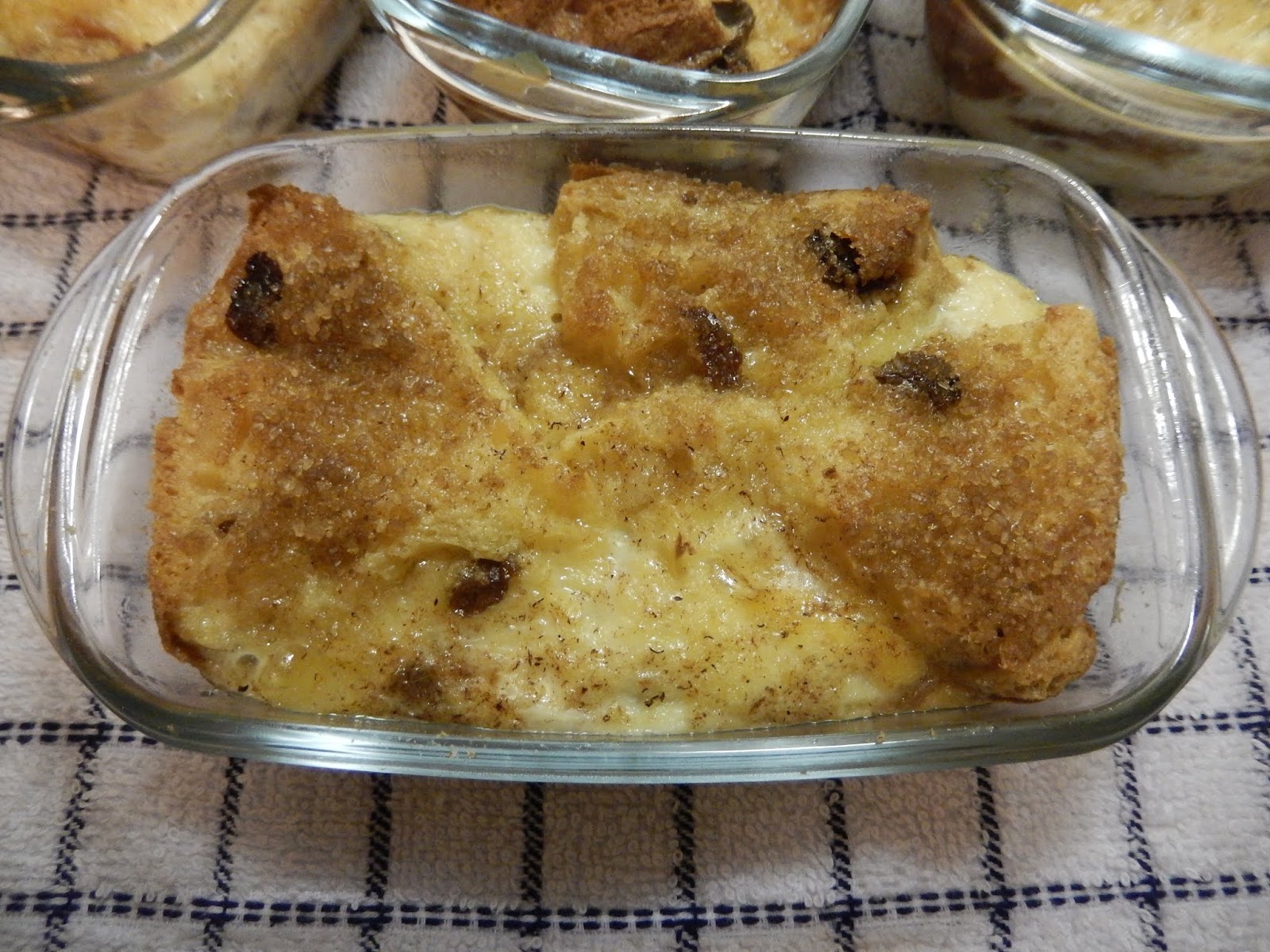
Lemon Bread and Butter Pudding

This dessert used up a panettone  bought for Christmas, in case of an unexpected need which didn't arise. I also had fresh lemons and an opened jar of lemon curd to use up, so as the panettone contained mixed peel, a lemon B & B pudding seemed the way to go.

I decided to make 4 individual puddings so that 2 could be frozen. I'm not sure how well they'll freeze, but I thought it was worth a try, rather than eating  a calorific dessert for 4 days running. I'd eaten one portion of the panettone, so I estimate there was about 425-450g left of the loaf.

I halved the loaf from top to bottom and sliced one portion into thin semicircular slices, which I sandwiched in pairs, spread with lemon curd. The rest of the panettone was cut into 4 slices to fit in the bottom of the dishes - I spread these with lemon curd too, and put into thickly buttered dishes curd side uppermost. Any trimmings and leftover pieces of panettone were crumbled and divided between the 4 dishes, then the semicircular sandwiches were cut and arranged neatly on top. I brushed the top of each pudding with more melted butter to help it crisp in the oven.

I hadn't realised until I started comparing recipes the wide range of egg:milk ratios used, as well as various baking times and temperatures, so the rest of the preparation went on a kind of average of the recipes I looked at.

I whisked together 3 large eggs, 50g caster sugar, the zest of 1 lemon and 500mls of semi-skimmed milk, and divided it between the 4 dishes. These were left standing for 30 minutes before baking, to allow the liquid to be absorbed into the bread - I pressed down with a fork occasionally to make sure the top pieces of panettone soaked up the custard mixture.

I added a little grated nutmeg and a sprinkling of demerara sugar to the top of each pudding, before baking at 160C (fan assisted) for 35 minutes. I intended to bake until the puddings were set, but still wobbling a little in the middle, but I think I baked for about 5 minutes too long.

These were lovely little puddings; adding lemon curd boosted the flavour nicely. I think adding some more dried fruit (such as a handful of sultanas) would have been an improvement and using a little more milk - another 100ml, perhaps - would have made the puddings softer and lighter, but I was pleased with them as they were.

As usual, with things that look their best straight from the oven, I didn't manage to get very good photographs of these. Not only were the light conditions far from perfect, they were visibly deflating as I watched them!

Monday, 13 January 2020

Lemon Curd 'Bakewell' Bars

I've recently started to donate baked goods to a monthly Coffee Morning run by the Friends of my local library. Not only is it giving me a much needed excuse to bake, but it's helping a good cause too. This month I made some date shortbread squares and these lemon and almond bars - similar to a Bakewell tart, but with lemon curd instead of raspberry jam.

Because the tart was going to be cut into individual portions before being put out for sale, I made it in a narrow rectangular tart tin, measuring 36 x 11.5cm. That way it could be cut into bars which would be easier to eat with fingers than a wedge from a round tart. Having a border of pastry on both short edges looked quite attractive too.


After lining the tart tin with sweet shortcrust pastry, I spread about 200g of lemon curd over the base - there's no need to blind-bake the pastry for this recipe. I used this BBC Good Food recipe for the frangipane mixture. It was exactly the right amount to fill the tart! The only changes I made to the recipe was to only use the zest of 1 lemon, and to add a few drops of almond extract, as I wanted the frangipane to taste more of almonds than lemon.

I baked the tart for 15 minutes at 200C, then lowered the temperature to 180C and continued baking until the frangipane was cooked to a golden brown colour - about another 25 minutes. When cool, I cut into bars about 3cm wide, although I discarded the first centimetre at each end, with the extra pastry (cook's treat!).


Monday, 18 November 2019

Lemon Loaf Cake

Every time I need a lemon I fall into the trap of buying a bag of them - partly because unwaxed lemons don't seem to be sold singly, and partly because each lemon works out cheaper.

However, if I don't use the lemons fairly quickly, it's a false economy, but that's not difficult to do as I love a lemon cake.

Dan Lepard calls this recipe a lemon drizzle cake, but whenever I make it the drizzle sets to a proper glacé icing. This doesn't bother me, as I don't like too much drizzle, but I don't feel happy calling it a drizzle cake, either.

This recipe really is delicious; there's the zest of 2 lemons and 75mls of juice to make it really lemony. Additionally, ground almonds keeps the cake moist and the addition of a little cornflour keeps the crumb really tender and delicate.

I don't deviate from the recipe in any way, but after adding up the weight of the ingredients, I bake it in a 2lb (900g) loaf tin, even though the recipe suggests a small tin should be used.

I'm still using the whole almonds, which were ground with the skins on (which explains the speckly appearance of the cake).

Tuesday, 18 September 2018

Wholemeal Pear and Ginger Cake


My local Cake Club (set up following the demise of The Clandestine Cake Club, which now only has a Facebook presence) set the theme of Autumn for the most recent meeting. I was torn between this recipe or a courgette cake, but went with this Pear and Ginger Cake because it has been a more reliable recipe over the years.

This is one of those cakes where the basic recipe can be altered by using different fresh fruit, dried fruit and jam - the original cake, a Nigel Slater recipe (scroll down the page), used apples, sultanas and orange marmalade, and I've also successfully made it with apples, dried cranberries and cranberry jelly and in this version, pears, golden raisins and ginger preserves. There were slight adjustments to the other flavours too - I used lemon zest instead of orange and added extra spice (half a teaspoon of mixed spice and two teaspoons of ground ginger in addition to the cinnamon).

I  don't usually decorate this sort of cake, but because this was for a special occasion, I used poached pear slices and slices of stem ginger on top of the cake, plus a dusting of icing sugar, just to relieve the brownness. I was disappointed that, even with poaching in acidulated water, the pears discoloured so badly!

Despite using wholemeal flour, and adding fresh fruit, this is a very light cake, with a soft texture. The ginger preserves and added spices give a gentle warmth which doesn't overwhelm the delicate flavour of the pear. The photo of the cut cake isn't pretty, but it does show the good texture!

Monday, 28 May 2018

Hazelnut, Lemon and Elderflower Cake

Although I didn't pay much attention to the recent Royal Wedding, I must have been subconsciously influenced by the talk of a lemon and elderflower wedding cake, as I suddenly felt that that was the cake I really I wanted to eat.

Having decided which recipe to use, I realised that I didn't have any ground almonds, so used hazelnuts instead. I love using ground hazelnuts in cakes, as they actually add flavour, as well as keeping the cake moist - so often the flavour of almonds is lost, unless you are using a lot, or add almond extract too.

I chose to adapt this BBC Good Food recipe for a Lighter Lemon Drizzle Cake, as it is a reduced fat recipe, and uses oil instead of butter. I've always found it reliable, producing a light, moist cake with a good crumb texture. As I've mentioned, I used ground hazelnuts instead of almonds, and also used sunflower oil instead of rapeseed, as that's what I always have available. Instead of a lemon drizzle, I reduced 150mls of elderflower cordial by half, and drizzled that over the cooked cake, while still hot, then sprinkled the cake lightly with caster sugar.

This was a subtly flavoured cake - none of the three flavours dominated, although I would have liked to taste more of the elderflower; I think I was just unlucky that the brand of elderflower cordial that I bought was very delicate. Despite that, it was a very good cake for a warm spring weekend.

Wednesday, 22 November 2017

Apricot and Lemon Bread and Butter Pudding

I made this 2-portion pudding in individual dishes, but if it was made in one dish it could easily feed three people; I was a little too greedy! The ingredients list is a bit vague, because the only thing I measured accurately was the milk.

Ingredients
*4 thick slices of brioche, each about 10cm square
butter, softened
apricot jam
a handful of soft dried apricots, chopped
a small chunk of glacé lemon peel chopped finely (optional)
2 medium eggs
225mls semi-skimmed milk
zest of half a lemon
1 tablespoon caster sugar, plus a little more for sprinkling on top
freshly grated nutmeg

*or use plain white bread from a small loaf  - slightly stale bread can be used for this sort of pudding

Method
Thickly butter two individual baking dishes, which have roughly 350mls capacity each (or use one larger dish).
Mix the apricots and peel together, if using.
Use more butter and some apricot jam (fairly thinly spread), to make two sandwiches with the brioche.
Cut the sandwiches into suitably sized pieces to fit into your chosen dishes - I cut mine into 8 tiny triangles to get a tight fit.
Share half the pieces of sandwich between each dish and sprinkle with 2/3 of the fruit.
Arrange the rest of sandwiches on top, trying to keep the top fairly level and sprinkle over the rest of the fruit.
Mix the eggs, milk, lemon zest and caster sugar together in a jug and divide equally between the two dishes. Leave to stand for up to an hour to allow the custard mixture to soak into the bread.
When ready to cook, preheat the oven to 180C (160 fan). Sprinkle a little more sugar over each pudding and then grate over some nutmeg.
Cook for 25-30 minutes, until golden brown and crisp on top. One large pudding might take a few minutes longer.

This was a tasty version of the standard B & B pudding - the touch of lemon, and the tartness of the dried apricots, cut through the sweetness added by the jam.

I apologise for the awful photo - I wanted to get the puddings fresh from the oven, as they deflate as they cool and don't look so attractive, so had to use flash.


Saturday, 5 August 2017

Blueberry and Lemon Polenta Cake

gluten-free

We planted two blueberry bushes earlier this year, but we weren't sure whether or not they would bear fruit straight away. Fortunately they did, although the fruit doesn't all ripen at once, so I'm picking 100-150g every five days or so. I've also found out that I really prefer cooked blueberries to raw, so I've made blueberry sauce for some cheesecake pots, and added some to baked rhubarb.

I decided to put the latest pickings into a cake, but had to find a recipe using a small amount. I also had some lemons that needed using, so a blueberry and lemon cake seemed in order. I soon found this Sainsbury's recipe for a lemon and blueberry polenta cake, which only used 100g of fruit. I had to adapt the recipe a little, using vanilla yogurt instead of natural. As I was using a yogurt with a separate topping of toasted oat flakes (about a tablespoonful), I sprinkled them on top of the cake too.

This was a deliciously light cake, although I think it could have taken another 50g of fruit, as the blueberries were very thinly spread. The zest of another lemon would have improved the flavour from my point of view but I do like a tart lemon cake - others might appreciate the subtlety of a milder flavour.

It's also nice to add another gluten-free cake to my repertoire.

Monday, 17 April 2017

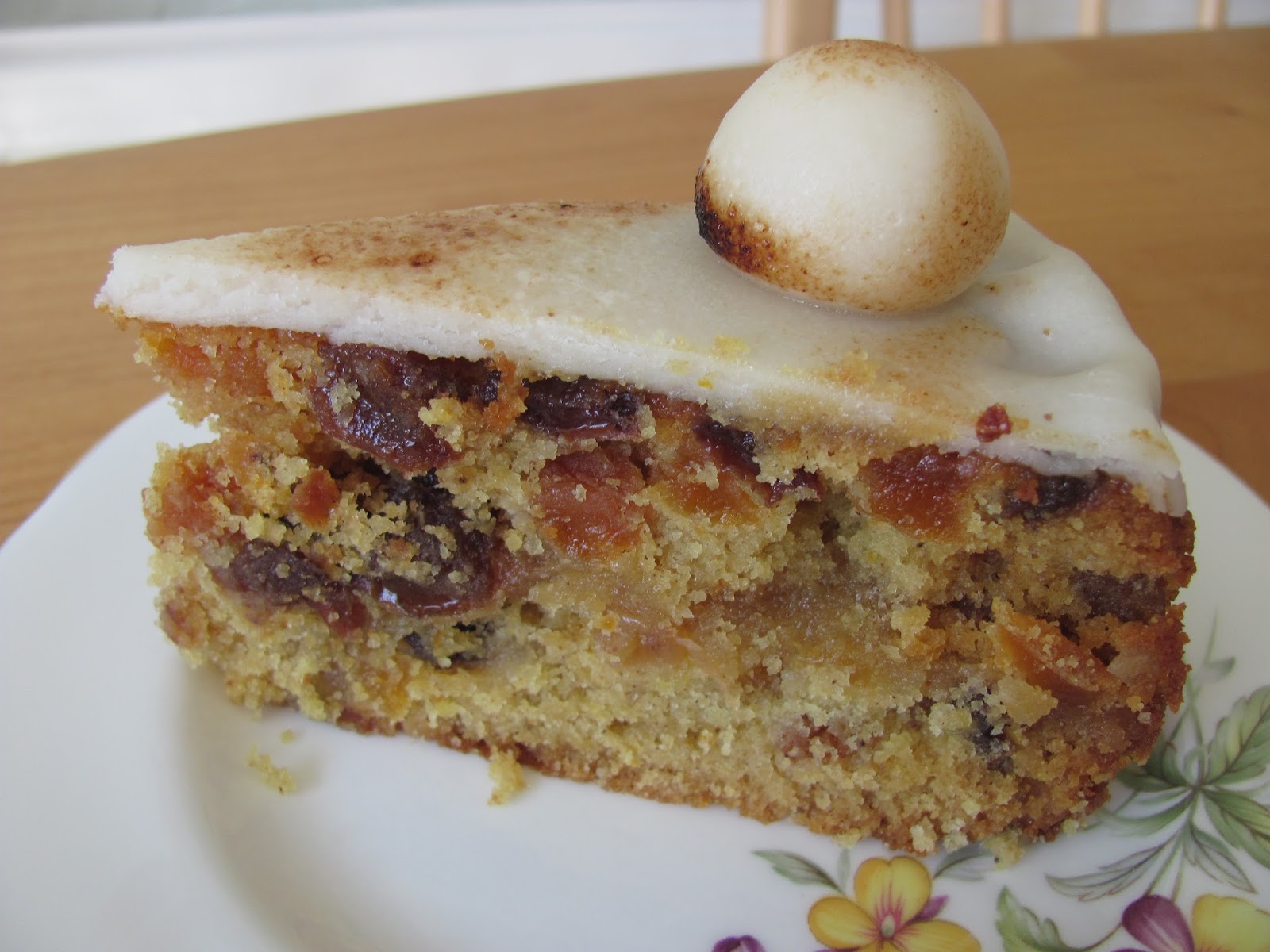
Golden Simnel Cake

My family's festive celebrations have never included traditional fruit cakes - we're more of a mini chocolate appreciation society -  so I was surprised when my daughter asked me to make a Simnel Cake for Easter this year. I'm not averse to traditional recipes but I still wanted to put a spin on this cake to make it more personal, so I decided to make a golden fruit cake.

After looking at several recipes, I thought that Felicity Cloake's recipe from her 'How to Cook the Perfect.....' series in The Guardian would be the best one to adapt to what I wanted. I particularly liked the idea of adding saffron to help the golden colour of the cake I was planning.

I used the same quantities of all ingredients, although I used caster sugar instead of light brown sugar, to keep the crumb colour as pale as possible. Instead of using 400g of the fruit Felicity suggested (sultanas, currants and glacé cherries) I used 115g of each of sultanas, golden raisins and chopped apricots and 55g chopped dried peaches. I left the mixed peel in the recipe but took out the chopped almonds, as my daughter doesn't always like chewing on pieces of nuts, even though she loves the flavour of almonds. I used shop-bought white marzipan instead of yellow - just a personal preference!

It's a pity I didn't cross reference Felicity's decision making processes with the sources she used, or I would have discovered that her oven temperature was for a fan setting, not a conventional oven - after 2 hours at the quoted temperature the cake batter was still raw. It took another hour with the oven turned up another 20C for the cake to cook. Anyone with any experience of fruit cakes would have noticed the error straight away, but I've hardly ever made a rich fruit cake, even in 40 + years of cooking!

I was quite impressed with the look of the finished cake, although if I ever make another I will use more marzipan so that I can put thicker layers inside and on the top. The size of the 11 decorative balls, at 15g each, was about right, however. When cut, the colour of the crumb was just right for a golden cake.

I liked the flavour of the cake - a delicious subtle balance between spice and citrus, with all the fruits working in harmony, so that none stood out more than others. The soft inner layer of melted marzipan added a note of bitter almonds to the cake, although it hadn't stayed level in the cake, possibly a result of the error in cooking temperature.

There were other faults too, which might have been caused by the same error - the fruit wasn't evenly distributed in each layer, and although the cake was really moist, it was also crumbly and didn't cut cleanly. However, these faults were outweighed by the lovely flavour; all it really meant was that it was difficult to get a good photograph. I will have to try the recipe again, and cook it properly next time!


Thursday, 13 April 2017

Rhubarb, Marzipan and Citrus Cake

I've been harvesting our homegrown rhubarb since the middle of March, and this traybake recipe is perfect for the beginning of the season when there are some thin stalks to pick. If you can only get thick sticks, then I suggest you cut them into fairly thin slices, both to distribute the rhubarb evenly through the cake, and make sure it cooks properly.

I picked this Rhubarb, Marzipan and Citrus Cake recipe because I wanted something portable to take to my daughter, who was cooking a Mother's Day dinner, and also because I know she loves marzipan.

I followed the recipe exactly, although I used the zest from the whole lemon and orange, as I didn't see the point of leaving half grated fruit - this turned out to be a good move, as the citrus flavour wasn't very pronounced, even with the extra zest. I also used fine cornmeal rather than polenta, as I can only get the quick-cook sort which is relatively coarse.

What the recipe doesn't mention is that initially the cake batter seems too stiff, and although it does slacken a little when the fruit is added, it never gets to the 'dropping' stage. Resist the temptation to add more liquid -  more juices will be released from the fruit during baking.

We all loved this dessert - there were subtle citrus notes amongst the tang of the rhubarb, and the marzipan gave concentrated pockets of the sort of almond flavour you don't get from ground almonds alone. My husband reckoned it would come a close second to rhubarb crumble in his 'favourites' list!

Tuesday, 31 January 2017

Lemon Tart

I've not been having much luck with lemon recipes recently; after the Spelt, Lemon and Maple Drizzle Cake, which failed twice, I had another technical failure with a Lemon Tart.

I chose this particular Lemon Tart recipe, from Good Food, to see if reducing the fat levels still made an acceptably tasty dessert - this recipe claims to be half the fat of a classic tart.

I liked the reduced fat pastry, which was unexpected, and really loved both the flavour and texture of the filling, which was light and silky smooth and just about sharp enough for my tastes. However, my tart cracked like crazy paving as it cooled. I don't think it was overcooked, as it was still wobbly in the centre, but I did leave it in the oven, with the door slightly open, to cool, so that might have been the problem, although slow cooling is usually advised to avoid cracks. The cracks didn't really spoil the tart from the point of view of eating it, but I usually only make desserts like this on special occasions, and wouldn't want to serve this to guests.

Thursday, 19 January 2017

Spelt, Lemon and Maple Drizzle Cake

This is a recipe from January's Waitrose Food magazine, and can be found online here. There were so many things wrong with this cake that I almost didn't bother doing a post about it! However, it's flavour was wonderful, which almost made up for all the things which went wrong. I say 'almost' because, if  I can't work out what went wrong, I won't be making it again, as it was quite an expensive cake to make.

So, what went wrong?
  • the cake took 10 minutes longer to cook than the longest time that the recipe suggested
  • it didn't rise much
  • although it eventually tested as properly cooked, the cake sank in the middle as it cooled; however the area immediately beneath the dip didn't really look under-baked, just a little moist from the drizzle used
  • the texture was stodgy, rather than just moist, perhaps because the cake hadn't risen properly
  • despite seeming stodgy, the cake was also quite fragile - slices crumbled easily when handled
I have to confess that I made one change to the recipe - I didn't have white spelt flour so used a 50:50 mix of wholemeal spelt and plain wheat flour. 

The cake ingredients were:
190g unsalted butter
190g white spelt flour
2 large eggs
2tsp baking powder
3 lemons - zest of all 3 and juice of 1
180ml maple syrup

After beating the butter until it is soft and creamy, all the other ingredients are beaten in until well blended. The batter is then transferred to a large (900g/2lb) loaf tin and the cake is baked for 35-40 minutes at 180C/Gas 4. (Or 50 minutes, in my case!)

When the cake is cooked, and while it is still hot, it is pricked with a skewer and drizzled with 70g of caster sugar mixed with the juice and zest of 1 lemon. The cake is then cooled completely in the tin. The magazine recipe also makes candied lemon slices to decorate the top, but I didn't get to that stage.

So, why did things go wrong? I'm not sure under-baking was a factor, as the central part of the cake, under the dip, didn't look or taste as if it wasn't cooked. I think what might have happened is that the acidity of the lemon and the maple syrup affected the efficiency of the baking powder, possibly causing the carbon dioxide to be released too quickly. This could perhaps be overcome by adding a little more alkali, in the form of baking soda, to balance the acidity. This theory seems to be borne out by the fact that three recipes I found online, all using a large amount of maple syrup, added half a teaspoon of bicarbonate of soda along with the baking powder.

I'm going to give this cake one more attempt, trying to get hold of white spelt flour and adding bicarbonate of soda, as the combination of lemon and maple syrup gave such a great flavour. If that doesn't solve the problems I'll have to give up - a cake using 180ml maple syrup is too expensive to keep experimenting with!

Thursday, 1 September 2016

Lemon Cake

made with whole lemons

This recipe, from Martha Stewart,  for a lemon cake, starts by slicing two lemons thinly and cooking them in boiling water for 15 minutes. This is certainly speedier than cooking them whole - that can take up to an hour!

Cooking the lemons like this cuts out a lot of the sourness of the fruit and gives the cake a very delicate lemon flavour. For me, this was the sort of lemon flavour that is best in a dessert cake, served with fresh fruit and cream, where you don't want the lemon to overwhelm the flavours of the fruit. Eaten as a cake, the taste was decidedly underwhelming, although it had a good light texture and I liked the little pieces of lemon zest spread through the crumb (my mini-food processor didn't reduce the cooked lemons to a smooth purée).

If I made this again, I would use the zest from the third lemon in the cake too - I thought at the time that it was a shame not to use it. This might boost the lemon flavour to something more in line with my tastes, although if you like a more subtle lemon flavour this recipe is well worth trying as written.

Monday, 22 August 2016

Lemon Coconut Cake

The batter for this Lemon Coconut Cake has to be the quickest to mix, ever! If you start by melting the butter in the microwave, it can take less than 5 minutes to get the cake into the oven and baking, as by the time all the ingredients are weighed into the bowl, the butter is ready to add. The only thing holding you up would be pre-heating the oven, which may not be necessary with a fan-assisted oven.

It has to be said that this isn't the lightest cake ever, but it is tasty and makes a good mid-week 'cake-tin filler'. I decided not to add a frosting, so made a drizzle by dissolving a tablespoon of caster sugar in the juice of a lemon (the one that I'd taken the zest from) by heating them together in the microwave for a few seconds. I pierced the top of the cake using a cocktail stick, as soon as it came out of the oven and spooned the hot lemon syrup over, then sprinkled on a little extra granulated sugar.

Monday, 30 May 2016

Date and Ginger Shortbread Squares

After trying many different recipes for layered bars with a filling of jam or softened dried fruit, I think I've at last found the perfect recipe for the dough layers. This recipe for Date and Ginger Squares, from Sue Lawrence's book 'On Baking' uses an easy shortbread dough made from equal parts of SR flour and semolina, which makes a really crisp, but melt-in-the-mouth biscuit. I adapted the recipe slightly by adding a little lemon zest to the filling, and adding the stem ginger in pieces, rather than blending it with the rest of the filling.

Filling - 175g dates, roughly chopped to check there are no stones left in
60g currants
1 tablespoon of ginger syrup from a jar of stem ginger
1 tablespoon honey
1 tablespoon lemon juice
zest of half a lemon
good pinch of ground cinnamon
3 tablespoons water
2 balls of stem ginger, finely chopped

Dough - 175g SR flour
175g semolina
175g butter
85g caster sugar

For the filling, place all the ingredients except the stem ginger into a small pan and simmer together, for about 10 minutes, until all the liquid is absorbed and the dates soft. Purée with a stick blender or in a food processor, then stir in the chopped stem ginger.

For the shortbread dough, melt the butter and sugar together on a gentle heat until the sugar has dissolved, then  tip it over the flour and semolina, and combine well. The mixture will be crumbly, not a smooth dough. Put 2/3 of this mixture into a 8" square shallow baking tin lined with baking parchment, spread evenly and press down firmly.

Spread the filling over the base, leaving a small margin around the edges. Crumble the rest of the  shortbread mixture over the filling, then press down lightly with the palm of your hand. There may still be a few gaps where the filling shows through, but this is fine!

Bake at 190C for 25 minutes, until the shortbread is golden brown. Cut into 16 squares as soon as the  tin comes out of the oven, but cool completely in the tin before trying to move the squares - they will be too fragile while still warm.

Although the biscuit dough for these squares was perfect, and the filling was very tasty, these squares didn't really live up to the name of 'Date and Ginger'. There certainly wasn't enough ginger in the recipe and I'm not sure the currants added anything to the taste experience. Next time I will try several things to increase the ginger flavour - more stem ginger, some ground ginger as well as cinnamon, and more ginger syrup instead of honey. I will also leave out the currants and increase the amount of dates.

I'll also be using the shortbread recipe in other types of bars - it would be interesting to see how the crisp biscuit stands up to using fresh fruit in the filling, which often produces a 'soggy bottom' result.

Friday, 6 May 2016

Chunky Fig, Apricot and Prune Cake

I know! It's the middle of May; we ought to be well into lighter Spring flavours, but when I made this cake it was snowing in northern England! Anyway, I quite like fruit cakes at any time of the year, as they keep better than sponges and cakes with fresh fruit, which is a good thing when you are only baking for two people.

Ros, at The More Than Occasional Baker, has announced that as AlphaBakes has reached the end of the alphabet again, she and co-host, Caroline, at Caroline Makes, have decided to end the monthly challenge after this month's recipe link-up. It's understandable - life has moved on for both of them and they have different priorities now, but I will miss the monthly ritual of stretching my imagination and/or culinary skills.

As the last AlphaBakes Challenge, and the last letter of this second run through the alphabet, this month's entries  need to feature an ingredient or recipe name beginning with F. I found the recipe for this Chunky Fig, Apricot and Prune Cake, on the River Cottage site, while I was looking for a cake with dried figs in. It sounded ideal - not too heavy with fruit, lightly spiced and flavoured with citrus.

The recipe was simple to follow, although it's slightly unnerving to add large pieces of dried fruit, sticky with a marmalade coating, at the last stage of the recipe. Surely disaster would follow, with sinking fruit? The recipe does warn of the possibility, and I was prepared to add a little extra flour, if necessary, to make sure the batter was quite stiff (especially as I was using large eggs). However, extra flour (I was using spelt) wasn't needed, and the fruit didn't sink, so all was well!

All was well with the flavour too. Because the pieces of dried fruit were larger than usual, each could be individually tasted, and the background flavours of mixed spice and citrus (from both orange and lemon zest, and marmalade) added an extra dimension. The texture of the crumb was moist but not heavy, and sweetness levels were about right too, overall. Definitely one to repeat!

Saturday, 26 March 2016

Apple Cake with Lemon and Chocolate Flecks

After being so impressed with a Honey & Co cake recipe I tried recently, I managed to borrow a copy of their baking book (called Honey & Co. The Baking Book) from the local library. The recipes looked every bit as appetising as I'd expected, and there are quite a lot that I'd like to try, so this book is definitely going onto my wish list.

This cake was first recipe I tried from the book, mainly because I had all the ingredients to hand. It was another amalgamation of flavours that you wouldn't necessarily think to put together  - I've never been convinced that lemon and dark chocolate works well together, let alone with apples in the mix. As before, the clever addition of unusual spices really made the cake something special, although I thought it might have had an even better flavour without the chocolate - and it's not often that I think chocolate is an ingredient too far! Technically, the cake wasn't a complete success either - it was a very liquid batter, which meant the apple pieces sank, and it was just a little too moist. It might have been more successful baked as a more shallow cake and served warm as a dessert!

Ingredients
2 tablespoons whiskey
zest and juice of 1 lemon
2 apples (200g once diced, skin on) - Pink Lady recommended, but I used Jazz, and only needed 1 1/2 apples.
40g plain (70% cocoa solids) chocolate
2 large eggs
160g caster sugar
120g/130ml vegetable oil - I used sunflower
150g plain flour
1 1/2 teaspoons baking powder
1 teaspoon ground nutmeg - about 1/3 of a whole nutmeg
1 teaspoon fennel seeds - ground in a pestle and mortar
a pinch of table salt

Method
Preheat the oven to 180C and prepare a 2lb/900ml loaf tin.
Mix the whiskey with the lemon juice and zest. Cut the apples into 1cm cubes, leaving the skin on, and toss them in the whiskey mixture to stop them discolouring.
Chop the chocolate into slivers - I shaved pieces off the block with a heavy knife to get flecks of chocolate - and put in the fridge to chill.
In a large bowl, whisk the sugar and eggs until light and fluffy, then slowly whisk in the oil to make an emulsion.
Fold in the flour, baking powder, spices and salt with a spoon, then stir in the apple mixture (with the liquid) and finally the chocolate flecks.
Transfer the batter to the loaf tin and bake for about 55 minutes, turning after 35 minutes to give an even bake.
Cool in the tin for 15 minutes before removing.


Wednesday, 16 March 2016

Lemon, Coconut and Cherry Loaf Cake

 - dairy-free!

Butter was on my shopping list; it's not my fault I forgot to pick it up - my husband distracted me by asking if we needed any cheese. By the time I'd explained, as I do every week, that if I needed something, it would be on my list, we had moved away from the butter shelf!

So, I would need to bake a cake with oil. As I also needed a cake to enter into this month's AlphaBakes challenge, which is the letter C, I decided to make a coconut cake, using both desiccated coconut and coconut oil. For added flavour, I decided to use a lemon that was languishing in the fridge, and some dried cherries which were near the 'best-before' date.

Ingredients
100g dried cherries, roughly chopped
2 tablespoons Kirsch (optional)
150g SR flour
1/2 teaspoon baking powder
75g desiccated coconut
200g caster sugar
160g coconut oil
zest of 1 lemon
3 large eggs
lemon juice, as required

Method
Soak the cherries in the Kirsch, if using, for a few hours beforehand, if you are organised enough. If you haven't got much time, or don't want to use alcohol,  soak the cherries in boiling water for a few minutes, then drain well.
Line a 900g (2lb) loaf tin with baking parchment and pre-heat oven to 180C.
Mix the flour, baking powder and desiccated coconut.
Beat the coconut oil, caster sugar and lemon zest until well blended.
Add the eggs one at a time, with a spoonful of the flour mixture, and beat in slowly.
Fold in the rest of the flour mixture, the cherries, and enough lemon juice to give a soft dropping consistency - I only needed a tablespoon of extra liquid.
Transfer the batter to the loaf tin, level the top and bake for about 60 minutes, until a test probe comes out dry and clean. If necessary, cover the cake after 30 minutes to prevent over-browning.
Cool in the tin for 20 minutes, then transfer the cake to a wire rack to finish cooling.

As the cake rose with a fairly flat top, I decided to turn it upside down and top with a lemon glacé icing made with a icing sugar and some of the leftover lemon juice.

You can see from the photos that the cherries sank to the bottom of the cake. To try to prevent this, I should have tossed them with a little of the measured flour. As I had turned the cake upside down to serve, this didn't look as bad as it could have done, but it was a stupid mistake to make! Fortunately it didn't affect the flavour, which was a good balance between the lemon, coconut and cherries. The texture was moist but a little heavy - I think it might have been better to beat the eggs and sugar together, then warm the oil slightly, to add it as a liquid.

AlphaBakes is a monthly challenge co-hosted by Caroline Makes and The More Than Occasional Baker. The idea is to bake something with a randomly chosen letter of the alphabet as the initial letter of either a major ingredient, or the name of the recipe. This month the host is Ros at TMTOB, and the letter chosen is C - in this case there's a double dose of Coconut and Cherries.

PS - this is my 600th blog post. How typical that it should be about something that wasn't entirely successful!

Sunday, 6 March 2016

Lemon and Elderflower Drizzle Cake

Although this household doesn't celebrate Mother's Day, which is a commercialised parody of the true meaning of Mothering Sunday, it's difficult to avoid noticing that the day is upon us again, earlier than usual this year, as it's tied into the date of Easter.

Adverts for ideas on how to treat your mother with a thoughtful gift abound in the weeks leading up to the day itself, although I'm not sure how many mothers would be thrilled with a joint of beef, unless a special meal was also cooked for them by the gift-giver!

So, my concession to the date was to chose a cake for the weekend that I particularly wanted to try, rather than thinking about what anyone else might like. I chose to make a lemon cake drizzled after baking with a lemon and elderflower syrup. I took this recipe as a starting point, but made a few changes. I substituted 50g of the flour with 50g ground almonds, used the zest of two lemons, and baked in a tin which was slightly smaller than 20cm, to make a nice deep cake. The cake took a little longer to bake because of this.

I don't like drizzle cakes which are too wet, but the amount of syrup added to this cake was just right. The flavour of  elderflower cordial and lemon together was pleasant but I think they cancelled each other out a bit - neither flavour came through really strongly, even though I had increased the amount of lemon zest in the cake. The texture of the cake was very good - moist from the syrup and almonds but still light - and the crunchy topping of granulated sugar was a nice finishing touch. This was a simple, plain cake which would also make a good dessert served with cream  or yogurt.