Showing posts with label dried cranberries. Show all posts

Thursday, 26 November 2020

Apple and Cranberry Cake

I usually make this cake, which is two layers of a scone-like dough sandwiching a layer of fresh and/or dried fruit, as a dessert. I often make it when I haven't got time to fuss around with pastry, as the result is very similar to a pie, but much easier to make. 
This time, I wanted to capture some of the essential flavours of Autumn, which is one of my favourite times of the year for seasonal baking. So I used eating apples, dried cranberries and cinnamon in the filling, and some flaked almonds in the topping.

Ingredients

150g butter
150g caster sugar
1 large egg
300g SR flour
3 eating apples, peeled, cored and sliced* 
80g dried cranberries
1 teaspoon cinnamon
30g flaked almonds
icing sugar to dust
* I usually slice the apples into water to which I've added a little lemon juice or vinegar, to stop the fruit discolouring. When I'm ready to use the slices, I drain them well and pat dry on a clean tea towel. 

Method
Preheat the oven to 180C, and line the base of a 20cm (8") springform tin with baking parchment; grease the sides with a little butter if your tin needs it.
Melt the butter in a large mixing bowl, in the microwave, or in a saucepan on the hob - if you do this in a large pan you can mix the dough in it too. The butter doesn't need to be really hot - just completely melted.
Stir in the sugar, then beat in the egg.
Add the flour and mix in thoroughly - it should give a soft crumbly dough.

Put 2/3 of the dough into the cake tin, and spread evenly with your fingers, building up a little wall of dough around the edge of the tin, to contain any excess fruit juices.**
Mix the flaked almonds into the remaining dough.
Mix the prepared apples, dried cranberries and cinnamon together and spread over the dough base.
Crumble the rest of the dough over the top, then press down lightly, spreading the dough a little to give good coverage over the top. The dough will spread more during baking, so don't try to fill all the gaps.
Bake for 50-60 minutes until the top is firm and golden. Cool for about 10 minutes, then run a knife between the cake and the edge of the tin, to stop and leakages of fruit juice sticking to the sides.
Dust with icing sugar before serving; I like this at room temperature, and I usually leave it on the springform base as it's quite fragile, but  it can be moved to a serving plate if you have a large cake lifter.
** There's a photograph here which shows how the cake is assembled.

Wednesday, 11 November 2020

Apricot, Cranberry and Ginger Flapjacks

Up until now, I thought my recipe for flapjacks was perfect. Over the years the ratios of sugar, syrup and butter were tweaked and the quantities adjusted until the flapjacks were thick and chewy.

One thing I have never done is add flour to my flapjacks, so I was intrigued to see that Lynn Hill of Traditional Home Baking is an advocate of doing so, maintaining that it helps to give the flapjacks the desired chewy texture. Although I like the texture of the flapjacks produced by my recipe, I'm not too proud to see if this suggestion is an improvement.

I followed Lynn's recipe for Fruity Flapjack, but rather than the fruits suggested in the recipe, I used 100g of chopped dried apricots, 50g of cranberries and 30g of chopped glacé ginger, which had been rinsed and dried to remove the syrup coating. I also added 2 teaspoons of ground ginger to make sure there was enough ginger to taste. The mix of apricots and cranberries is one of my favourite combinations in baking.

Our recipes are very similar in the quantities of ingredients used (apart from the flour), although Lynn's bakes in a slightly larger tin, so I was interested to see how much difference adding the flour would make. 

It was huge! 

The texture was completely different - much softer as well as chewy. I think adding the flour also helped absorb the butter mixture more completely too - my flourless flapjacks are usually a bit stickier.

Both recipes have their merits so I'll probably use both in future, depending on the result I want. Mine are chewy and sticky, Lynn's are softer and chewy. However, when I do use flour, I think that I will go back to baking in a slightly smaller tin, as I prefer a thicker flapjack.

Friday, 10 July 2020

Flapjacks with Blueberries and Cranberries

A friend gave me a box of 8 sachets of  'Super Goodness' Porridge, with ingredients designed to boost the immune system. As the freeze-dried fruit was only 10% of the porridge, I'm not sure how much effect it would have (3.5g of fruit in each serving), but I suppose if you ate porridge for breakfast every day you're not going to do any harm, and might gain some benefits! There were some added vitamins too, which never hurts!

However, I don't like porridge, but could see the potential for the mixture to be used for flapjacks. The oats in the porridge were wholegrain rolled oats, not instant oats, so I figured they would work as a direct substitute for plain oats. The only adjustment I made to my usual recipe was to reduce the added sugar to compensate for the sugar already in the porridge mix (16%).

Ingredients
160g butter
70g golden syrup
50g caster sugar
280g Quaker Oats 'Super Goodness' Porridge with Blueberries, Cranberries and Guava.


Method
Preheat oven to 180C/160C fan and line a 20cm square shallow cake tin with baking parchment.
Melt the butter, golden syrup and sugar together  - I do it in the microwave, but a saucepan on the hob is fine too. Don't boil the mixture, just heat enough for the butter to completely melt.
Stir in the porridge mixture and mix thoroughly. 
Transfer the mixture to the baking tin, spread evenly and press down firmly.
Bake for 30 minutes until golden brown. Cool for 5 minutes then mark into bars or squares, but allow to cool completely before removing from the tin.

Despite the fruit content of the porridge being only 10% (and 2% of that was guava powder), there was enough to give the flapjacks a strong fruit flavour. I think being freeze-dried makes the fruit lighter than ordinary dried fruit, so there's more volume of fruit in the 28g in the recipe - it certainly looked a lot!  These flapjacks were a little crisper than those made following my basic recipe, but they were still chewy enough!


Saturday, 14 March 2020

Fruited Banana Loaf

After deciding to leave two bananas to ripen enough to use in a cake, I realised that I've never made a basic simple banana bread/cake in the 10 years I've been writing this blog. It was definitely time to remedy that situation, even though I don't regularly have bananas available.

Of the two simplest recipes I could find, I decided to go with Mary Berry's, as she appeared to be cutting down on the fat and sugar content to compensate for adding the bananas rather than just putting bananas into a standard sponge cake recipe, as here. The other advantages of Mary Berry's recipe were that it was an all-in-one mixture, so really quick to put together and get into the oven, and would freeze well. Being able to freeze slices of cake is always a bonus for me!

After saying I wanted simple, I then changed my mind a little and decided that I would like some extra flavour, so I added the zest of a small orange, 70g of a mixture of sultanas and dried cranberries, and I used 2 tablespoons of orange juice instead of the milk in the recipe.

I folded the fruit into the batter after it had been mixed, rather than include it at the all-in-one mixing stage.

None of these changes affected the baking time - the cake was still cooked in the time suggested in the recipe.

The cake had a lovely texture, moist but not too heavy, and the extra ingredients boosted the flavour without masking the taste of the banana.

This is definitely a cake to remember when I'm baking for coffee mornings, and I can imagine other additions that would work well - chopped dates, for instance, or nuts and a little mixed spice.

I'd even go so far as to say it's a cake worth buying bananas for, if you can plan far enough ahead to let them ripen!


Wednesday, 26 February 2020

Mincemeat Loaf Cakes

It seems quite a long time since I tried a new recipe; I have a lot of favourites that I keep returning to at the moment, either because they are reliable (if I'm baking for someone else), or I know they freeze well.

I knew I wanted to make a mincemeat cake to use some of the Christmas excess,  so decided this might be the time to try a new recipe. Mary Berry's recipe appealed because it made two small loaves and she says they freeze well.

It's a straightforward recipe to follow - it's an all-in-one mixture, so you just need to make sure you have well softened butter before you start. I didn't have currants, so used dried cranberries instead, and topped the cakes with flaked almonds rather than split nuts.

The cake batter was very stiff, and with the benefit of hindsight, now that I've cut the cakes, I think I should have added a couple of tablespoons of milk to loosen it a little. The cakes were a little dry and crumbly, and didn't compare favourably, in that respect, to the recipe I usually use. They rose well during cooking, in terms of increased volume, but there was a definite dip in the middle of each one. I think I might have been guilty of not mixing well enough, as the batter was so stiff.

As always with this  sort of cake, the final flavour relies heavily on any added ingredients in the mincemeat. I used a Waitrose brand with their 'Christmas 2019 special' ingredients of plum, honey and ginger. Even after being diluted into the cake mixture, the plum flavour (provided by prunes and plum juice) was still evident.

I think this is a recipe to use again, as it uses mincemeat leftovers, rather than a whole jar, but I'll be more careful next time, and make sure the batter has a 'dropping' consistency, and is well mixed.

Saturday, 17 December 2016

Orange and Cranberry Cake

with apricots and macadamia nuts

This loaf cake is based on the proportions of a madeira cake, rather than a sponge - equal quantities of butter, sugar and eggs, but a larger amount of flour. This makes the cake softer and richer than the more basic fruit loaf recipe I sometimes use, and the extra flour helps prevent any added fruits and nuts from sinking. I usually make these little loaves as an all-in-one mixture, to save time. For this cake, I was using up oddments from the storecupboard, including the remnanats of a pack of mixed macadamia nuts and dried cranberries, plus some extra cranberries from another pack, so I'm not sure of the exact weight of each individual ingredient, although there were more cranberries than anything else - as long as the total weight is around 150g the cake will be OK

Ingredients
100g softened butter
100g caster sugar
2 large eggs
150g SR flour
zest of an orange, finely grated
milk to mix, if needed
150g of a mixture of dried cranberries, dried apricots and macadamia nuts

Method
Preheat the oven to 180C and line a small (450g/1lb) loaf tin.
Put the butter, sugar, eggs, flour and orange zest into a mixing bowl and beat with an electric mixer until the batter is well blended and smooth. Add a little milk if necessary to give a dropping consistency.
Fold in the dried fruit and nuts with a spoon, then transfer the mixture to the prepared tin.
Bake for about 50 minutes, or until a test probe comes out clean.

As I said a few posts back, cranberries and apricots is one of my favourite combinations of dried fruits. Here, the orange zest adds a freshness to the cake and the macadamia nuts give a contrasting texture.

Thursday, 1 December 2016

Gingerbread with Macadamia Nuts and Cranberries

This is a traditional gingerbread recipe - one of those cakes where the top gets sticky over time! I added some chopped macadamia nuts and dried cranberries to use up supplies approaching the 'best-before' date. I'm happy to use dried fruit past it's best, but nuts can go stale quite quickly. I've been using this recipe for over 40 years know, but haven't found anything better. The amount of black treacle can be reduced to make a lighter cake, without the characteristic bitterness, as long as it is replaced by the same weight of golden syrup. The total weight of the two syrups must be 230g

Ingredients
110g butter
60g light muscovado sugar
170g black treacle
60g golden syrup
150mls milk
2 eggs
220g plain flour
1 teaspoon mixed spice
3 teaspoons ground ginger
1 teaspoon bicarbonate of soda
50g macadamia nuts, roughly chopped
50g dried cranberries

Method
Preheat oven to 150C and line a deep 20cm(8") square cake tin with baking parchment.
In a large saucepan, heat the butter, sugar, and syrups until the fat has melted. Remove from the heat, add the milk and cool until lukewarm.
Beat the eggs and blend into the melted mixture.
Sift the flour, spices and bicarbonate of soda into a large bowl and add the liquid. Stir briskly to combine, but do not beat. Lastly stir in the fruit and nuts.
Transfer the batter to the baking tin and bake for about 60 minutes, until a test probe comes out clean.
Cool in the tin and preferably leave for a day before cutting.

I don't think the addition of fruit and nuts contributed much to the flavour, as the spiciness of  the gingerbread and the bitterness of treacle is so strong, but the nuts added a nice crunch to the texture.

Sunday, 24 July 2016

Two 'Everyday' Fruit Loaves

(i) Sultana and Orange and (ii) Coconut and Cranberry

Here are two quick mid-week cakes I've made recently, using mostly storecupboard ingredients, and the same basic recipe.

Sultana and Orange Loaf
Ingredients
225g SR flour
110g butter
85g caster sugar
1 egg
milk to mix - up to 6 tablespoons

demerara sugar to top (optional)

Sultana and Orange - add the grated zest of a large orange and 150g sultanas.

Coconut and Cranberry - reduce the flour by 25g, and add 50g desiccated coconut, 75g dried cranberries and a teaspoon of vanilla extract.

Coconut and Cranberry Loaf
Method
Preheat the oven to 175C and line a small (1lb/450g) loaf tin.
Rub the butter into the flour until it resembles breadcrumbs. Mix in the sugar and the dry ingredients of your choice.
Add the egg, vanilla extract (if using) and enough milk to give a soft dropping consistency.
Transfer the batter to the loaf tin, level the top and sprinkle with a tablespoon or so of demerara sugar, if liked.
Bake for 50-60 minutes, until a test probe comes out clean.
Cool in the tin for 15 minutes, then transfer to a wire rack to finish cooling.


Tuesday, 1 March 2016

Mincemeat Squares

I thought it was about time to use the last of an opened jar of mincemeat, still sitting in the fridge. Hopefully, there will be warmer weather soon, and thoughts will turn to lighter flavours rather than the spices and dried fruits we like so much in winter.

Once the jar was scraped out, I managed to get 200g of mincemeat, so added 25g of dried cranberries to give the amount needed for this Delia Smith recipe.

Even though I made the recipe in a slightly smaller 20cm (8") square baking tin, the  mincemeat squares were very thin. I was hoping for something like a flapjack, but these were really more like biscuits; because they were so thin they really crisped up in the hot oven. (I have a feeling I've used other versions of this recipe before, and have thought the same thing.)

The recipe was very quick and easy to put together and baked quickly too - I think from getting the scales out, to taking the baked squares out of the oven only took 35 minutes. The only changes I made to the recipe was to use half wholemeal flour and half spelt flour, and butter instead of the vegetable margarine that Delia specifies. I also heated the mincemeat in the microwave for a few seconds - just enough to take the chill off,  as it had been in the fridge - this made it easier to spread over the bottom layer of dough.

Wednesday, 17 February 2016

Pistachio and Cranberry Loaf Cake

The first thing I'm going to say about this cake is that the flavour is amazing! I knew it was going to be something special when I scraped the last of the raw batter from the mixing bowl, just to get an idea of what it tasted like. The name of the cake doesn't do enough justice to the flavours within - as well as pistachios and dried cranberries there was lime, fennel seeds, cardamom and vanilla, which combined to make something unlike any of the constituent parts - I love it when that happens!

The recipe wasn't perfect and there are things I would change next time, but I thought I'd get the praise in first, as the nitpicking doesn't detract from what a great cake it was. I didn't realise when I decided to make the cake, that it was a recipe from Honey & Co, who specialise in Middle Eastern cooking. I can't find the recipe anywhere online - although if you have a subscription to the online Financial Times, I believe it was published there - but there is a book 'Honey & Co: The Baking Book', which is now on my 'must have' list, even if it doesn't contain this particular recipe!

Ingredients
200g SR flour
1 teaspoon ground fennel seeds
5 cardamom pods - ground to a powder with the pods
1 teaspoon vanilla extract
pinch of salt
100g whole pistachios, peeled
150g dried cranberries
zest of 2 limes
150g butter
150g caster sugar (the recipe specified golden)
2 eggs (I used large)
100g jam (the recipe specified a red jam such as raspberry or cherry)
the juice of 1 lime
about a tablespoon of demerara sugar to sprinkle on top (I used crushed raw sugar cubes)

The cake is made by the traditional method of creaming the softened butter and sugar together, with the lime zest and vanilla, then slowly adding the eggs. All other dry ingredients are added to the flour, then folded into the batter, then finally the juice of the lime and the jam is folded in. After the batter is levelled in the baking tin, the surface is scattered with demerara sugar, then the cake is baked at 160C in a large (1kg/2lb) loaf tin, for about 60 minutes, turning halfway through cooking so that it bakes evenly. Cool in the tin.

I baked at 160C in a conventional oven, and the cake took over 90 minutes to bake, so I think the temperature given must be for a fan oven ie 180C in a conventional oven. Things I did differently: I used the pistachios as they came from the pack (do they really need peeling?) and chopped them roughly rather than leaving them whole, and because I didn't check my storecupboard properly, I had to use apricot jam. Things I'd do differently next time - take the pods away from the cardamom seeds - they didn't grind to a powder very well in my spice grinder and left little bits of husk in the mixture; add the juice of the second lime, as the batter was quite thick, and the limes were small.

The cake was a little crumbly the first day it was made, but settled down overnight to something a bit firmer. The extra lime juice might have made it a bit less inclined to crumble, and a little more moist - the slight dryness is the only criticism I have (apart from the lack of clarity over the baking temperature).

Monday, 1 February 2016

Beetroot Cake

It's a measure of changing tastes that it's almost impossible to find a reliable recipe for a simple beetroot cake; the first 16 pages of Google search  results showed almost exclusively chocolate and beetroot cake recipes, and most of those without chocolate were paleo or so-called  'healthy'! I knew Nigel Slater had a recipe, but didn't want that one. In the end I searched through my store of pages torn from food magazines to go back to Nigella Lawson's recipe for 'Ruby Red Loaf Cake' and adapted it to suit the ingredients I wanted to use; the biggest adaptation, and worry about how well it would work, was using cooked beetroot instead of raw.

The recipe was published in Sainsbury's magazine in 2001, but I have no idea which book it was published in. My recollection of it was that the cake batter stayed pink when it baked, but I didn't manage to achieve that this time - possibly because I cut out the juice of half a lemon, or because I used already cooked beet rather than raw. I really should do some scientific research into this, to find out what keeps the colour in the beet as it cooks - a pink cake is so much more attractive!

Ingredients
200g cooked beetroot
250g butter at room temperature
200g light brown sugar
the zest of an orange, finely grated
3 large eggs
150g dried fruit (I used 40g dried sour cherries cut in half, 60g dried cranberries and 50g sultanas)
1 teaspoon cinnamon or mixed spice
150g SR flour
150g spelt flour
60 mls milk, to mix, plus more if necessary

50g icing sugar
1 tablespoon lemon juice
the liquid from the drained beetroot - see method

Method
Finely grate the beetroot and leave in a sieve over a bowl for 30 minutes, to allow excess liquid to drain off. Reserve this liquid if you want to frost the cake.
Pre-heat the oven to 180C and prepare a deep 8" square cake tin.
Beat the butter sugar and orange zest together until light and fluffy, then slowly beat in the eggs, one at a time, with a tablespoon of the flour each time.
Fold in the dried fruit, grated beetroot and spice, followed by half the flour, the milk, then the rest of the flour. If necessary add a little more milk to give a soft dropping consistency.
Transfer the batter to the cake tin and spread evenly. Bake for 45-50 minutes, until a test probe comes out cleanly.
Cool in the tin, on a wire rack, for at least 30 minutes before taking the cake out of the tin.

If desired, frost the cold cake using the sifted icing sugar mixed with the lemon juice and enough of the drained-off beet liquid to give a deep pink colour. I put the glacé icing into a plastic bag and snipped off the corner so that I could drizzle just a little icing over the cake.

This was a pleasant cake, very similar to a carrot cake. The beetroot couldn't be tasted, so the flavour was from the orange zest, spice and dried fruit. I'd have been happier with the cake if the beetroot had been more visible, but even the flecks of grated beet seemed to lose the pink colour during baking.

Monday, 14 December 2015

Not so Magic Cake, and other bits and pieces!

There's nothing wrong with the 'tiffin' style dessert pictured at the top of this post. It was made to Delia Smith's recipe for Chocolate-crunch Torte with Pistachios and Sour Cherries, following the recipe exactly, apart from using dried cranberries instead of dried sour cherries.

It was made as an quick replacement for an attempt at a 'magic' cake which I somehow knew had failed before it was even out of the baking tin. Magic cakes are so called because one cake batter separates into three layers during cooking - a thin dense pastry-like layer at the bottom, a custardy layer in the middle and a light sponge on top.

I used the chocolate and hazelnut magic cake recipe featured in this recent newspaper article, and even though I can now see where I might have made a mistake (trying to incorporate the egg whites evenly into the batter, rather than leaving it in clumps) I don't think the finished cake would ever have looked as attractive as the photo in the article, or tasted good either. 100g of Nutella-type chocolate hazelnut spread is not enough to make a cake taste strongly of chocolate, nor give it a good deep colour. This is what mine looked like - you can just about see three layers, but it was a really unattractive shade of beige, the custard was dense and slimy and it didn't really taste of anything definite - certainly not hazelnuts or chocolate. After trying one mouthful, for research, it went into the food waste recycling - and, as I've often said, food has to be really awful for me to throw it away!

I didn't bake a cake last weekend; it was my husband's birthday, and he wanted a stollen, which I buy rather than make as my yeast doughs are very unpredictable. I made a very tasty seasonal fruit crumble though, using 3 eating apples, 100g fresh cranberries, the zest of a clementine and the clementine segments, cut in half, to make 4 portions of dessert. I also added a teaspoon of mixed spice to my usual crumble recipe of equal weights (75g) of butter, brown sugar, plain flour and rolled oats.

I also tried my hand at apple-chilli jelly recently, using the homegrown apples which were too small to peel and use in any other way. The beauty of apple jelly is that the fruit is just roughly chopped - peel, cores and pips included - before cooking with water and adding some vinegar. The cooked fruit is strained, then reboiled with sugar and sliced chillies, until the setting point is reached. I used this recipe from gardener Sarah Raven, using just the regular mixed red and green chillies sold as moderately hot in the supermarket.

After cooking the apples in water and straining the juice I had about 1.5 litres of liquid; I was a little worried, as despite my careful handling of the fruit, the liquid looked cloudy at this point. I needn't have worried though, as soon as it came to the boil with the added sugar it miraculously cleared - I just wish this had been mentioned in any of the recipes I read! I used a sugar thermometer, to be sure that the setting point had been reached. I didn't manage to distribute the chillies very evenly when potting the jelly - the jar in the photo got the most - and it looked as if all the chilli slices were going to float, until I remembered a tip I'd read somewhere about turning the sealed jars upside down for about 10 minutes, then back again, and repeating as the jelly cooled and set. This procedure eventually traps some of the chillies near the bottom, despite their inclination to float! I think the chilli slices are for decoration - there's certainly a lot of heat in the jelly alone, so even the jars without much visible chilli will taste the same.

Friday, 18 September 2015

Wholemeal Apple Cake with Orange and Cranberries

 - an Au-tummy cake for my second Clandestine Cake Club meeting.

My local branch of the Clandestine Cake Club has a new organiser, so I didn't want to miss the first event that she arranged, with the theme of 'Au-tummy cakes' (Autumn/tummy filling - geddit?). Unfortunately the date of the meeting was the day after I would be arriving home from our Spanish holiday, after 14 hours of travelling up through France, then through the Channel Tunnel, on trains and coaches. I knew I would probably be tired, and wouldn't have time for shopping before cooking, so I chose a foolproof recipe from my list of favorites, which can be made with just storecupboard ingredients plus fresh apples, and made sure I left apples in the fridge before going away.

This cake is a slight adaptation of this Nigel Slater recipe, (also published in 'Tender - Volume II') substituting 75g dried orange-flavoured cranberries, and 25g diced candied citrus peel for the sultanas or raisins suggested in the recipe. I happened to arrive home with a mandarin orange left over from our travelling rations, so a little fresh zest gave the cake a nice boost, but I was prepared to just leave out the zest, as the cranberries were orange-flavoured (left over from last Christmas's festive goodies from Aldi), and the marmalade had a high fruit content too.

I really like this cake, because it is moist and unexpectedly light, considering it's made with wholemeal flour. Many apple cakes are too dense and stodgy, because of the moisture from the fruit, but this cake is perfect! It can also be varied by changing the dried fruits used, and also swapping the marmalade for different flavoured jams or jellies (I have used smooth cranberry sauce quite successfully). Pears also work well instead of apples, as in this pear and ginger preserve variation.

With a theme of Autumn, there were several other apple-based cakes brought along to the Cake Club meeting, along with cakes containing plums, pears and blackberries. My cake was a little crumbly when cut - in an ideal world it would have been made the day before, so that it had time to rest properly - but so were some of the others, so I didn't feel too bad about it! I'm really happy to be moving into Autumn - possibly my favorite season for baking.

Wednesday, 19 November 2014

Honey Breakfast Fruit Cake

 - from a recipe by Harry Eastwood.

This cake was made specifically for the AlphaBakes challenge, where this month's randomly chosen letter is H.

My baking books were surprisingly short of recipes containing ingredients beginning with H - hazelnuts featured heavily, but I've used them a lot lately, and wanted to avoid them if possible. Honey was the only other frequently used ingredient, so I set myself the task of finding a recipe for a fruit cake sweetened only by honey.  So many recipes are called 'honey (something or other)', only to feature a tablespoon or two of honey, supposedly added for flavour, in addition to the usual high amount of sugar found in most cakes and biscuits.

I'm not going down the route of claiming that a cake sweetened with honey is any healthier than a cake sweetened by standard sugar (they are both types of carbohydrates not really needed for nutrition), but I do think that if you are using honey for it's flavour, you need a fair amount of it in a cake!

However, Harry Eastwood's baking recipes (ooooh! an extra H there!) are special for being a little bit healthier than most. She uses added vegetables a lot, and tries to cut down on the amount of sugar and fat in her recipes. This cake, called a Honey Breakfast Fruit Cake, uses finely grated butternut squash to replace much of the fat  - the only fat comes from nuts and eggs - and the squash also has a natural sweetness which means less needs to be added in the form of honey. The cake batter is made from half flour and half ground almonds and is packed with dried fruit and chopped nuts. In fact, for the size of cake made, it's really fruit and nuts held together with a little cake batter!

I followed the basic recipe, but as I'm trying to finish some of the half-used packets of dried fruits and nuts in the storecupboard, I altered what I used from what was suggested in the recipe. Instead of raisins and cranberries, I used sultanas, cranberries and sour cherries, and instead of chopped almonds I used a mixture of almonds, walnuts, macadamia nuts and peanuts. I also sprinkled some flaked almonds on top of the cake before baking.

This was a really delicious cake; the almond flavour was predominant, as you'd expect with the use of almond extract, but the lemon zest and the honey both made a noticeable contribution. Obviously, the cake will vary in flavour depending on what type of honey is used - I used a Fairtrade Guatemalan honey which wasn't produced from any specific flowers, and was just a generic 'honey' flavour.

The big surprise was that the absence of fat wasn't noticed, nor was the addition of  quite a large amount of grated butternut squash. The recipe stated to grate the squash finely, so I used a finer grater than I would have used if grating carrots for a carrot cake, and this made the vegetable vanish into the cake batter, only adding moisture to the texture.

I'm not sure this would convince me that it's good to eat cake for breakfast, but it is certainly a cake that's good to eat, and will go on my list of things worth repeating.

AlphaBakes (rules here) is a blogging challenge hosted on alternate months by Ros from The More Than Occasional Baker and Caroline from Caroline Makes. This month's randomly chosen letter H was picked by Ros, who will post a roundup of entries at the end of the month.

Tuesday, 4 November 2014

Wholemeal Apple and Cranberry Cake

It's time for another cake with delicious Autumnal flavours!

This Nigel Slater recipe is proving to be remarkably adaptable. The original, from his weekly Observer column, used marmalade, sultanas and orange zest to add flavour to an apple cake made with wholemeal flour, and I've previously made versions using apples and cranberries and pears and ginger preserves.

This time I kept the apples and added dried cranberries flavoured with orange, and some smooth cranberry jelly instead of marmalade.

This was a really well-flavoured cake - the cranberries flavoured with orange were very intense - and moist yet light in texture. After making so many variations of this cake, I should stop being surprised by how light it is for a wholemeal cake, but I'm not yet!

Thursday, 26 December 2013

Orange Marzipan Cake

My Alternative Xmas Cake

I've wanted to make this cake for years - ever since I bought Annie Bell's book 'Gorgeous Cakes' - but every Christmas something has happened to stop me making it. This year nothing interfered, not even the thought that I'd got for too much food already, and a cake wasn't really even necessary!

The cake consists of a shortbread layer, a madeira style cake flavoured with rum and dried fruit, and sandwiched between the two are layers of marzipan and marmalade. All this is topped of with a sprinkling of flaked almonds and pine nuts. It's always sounded a really delicious cake to me, perfect for those who don't like or want a traditional rich fruit cake at this time of year.

It was a delicious cake, but not perfect! One fault was mine, but if I was going to bake it again, I would make some changes to produce something even more delicious. My fault was being too enthusiastic with my new Kenwood Chef mixer, and believing the recipe book, which said that beating the eggs into the creamed sugar and butter at maximum speed would lessen the likelihood of curdling! I now know that you still need to go the traditional route of adding a little flour with each egg! The bad curdling resulted in a slightly stodgy texture, rather than the sponge-like appearance I had been expecting.

The recipe's problems, to my taste, were two-fold - firstly, there was not enough marzipan (although you could taste the marzipan, you couldn't really see it as a separate layer). I think the layer either needs to be thicker or it needs to be made from a better quality marzipan. I usually use Anton Berg marzipan which is 60% almonds, but it has disappeared off the shelves this year, possibly due to the much publicised almond shortage. Using a standard supermarket marzipan which was only 25% almonds might explain why it seemed to melt into the cake mixture. I guess a good alternative would be a homemade marzipan, although most of the recipes I've seen are less than 50% almonds when the sugar and binder are factored in

The second problem was not enough orange flavour. I think the cake needs at least the zest of an orange in the cake batter, and I would probably replace the rum with orange juice, as the rum flavour wasn't very noticeable. I used sultanas and dried cranberries in the cake, and these could be plumped up first in orange juice, if you wanted to keep the rum.

Apart from those problems, it was a really good cake. Having a crisp shortbread layer, and the marzipan only at the bottom of the cake, and pieces of nuts only at the top, made it interesting to eat, as there was a variety of textures and flavours depending on where you took a bite. Definitely a good alternative to a rich fruit cake - even FB, who avoids most dried fruit, liked it!

A few recipe details, to make a cake in a deep 20cm tin with a loose bottom - the shortbread layer was made from 90g butter, 40g golden caster sugar, 75g plain flour and 50g ground almonds. This was pressed into the cake tin and chilled. A circle made from 200g marzipan, spread with 75g coarse-cut marmalade was placed on top of the shortbread before the cake batter was added. The cake batter was made from 225g golden caster sugar and 225g unsalted butter, creamed together. 4 whole eggs and one egg yolk were added next, followed by 90mls rum. 225g SR flour plus 1 teaspoon baking powder was folded in, then 75g each of sultanas and dried cranberries (raisins in the original recipe) was stirred in gently. After this was transferred to the cake tin and spread evenly, 20g each of flaked almonds and pine nuts were scattered on top. The cake took around 70 minutes to bake at 170C, and was cooled in the tin.

AlphaBakes, a monthly baking challenge based on a randomly chosen letter of the alphabet is running out of easy letters. Providentially, December's letter is X, and X-mas is considered an acceptable choice of word to use as part of the name of what we produce. Hence I am entering this as my alternative X-mas cake! AlphaBakes is jointly hosted by Caroline of Caroline Makes, and Ros of The More Than Occasional Baker. The rules can be found here, and Ros is the host this month. There will be a festive round up at the end of the month, although I wonder if there will be any entries that found an alternative to X-mas!

Tuesday, 15 October 2013

Wholemeal Apple, Marmalade and Cranberry cake

This gorgeous cake is a slight adaptation of a Nigel Slater recipe, taken from his book Tender (Volume 2 - Fruit), but also published here, in his Observer column. I have quite a few tart apples, from my own tree, stored for baking and wanted a cake with autumnal flavours.

I almost made the cake with white flour and sugar, as I didn't want another heavy cake, after the previous bake, but in the end I stuck to the recipe and went with light muscovado sugar and wholemeal flour, and the cake was still really light and tender.

The changes I did make were a) use dried cranberries instead of golden raisins b) leave out the orange zest and c) use orange marmalade flavoured with whisky, which probably made up for having no orange zest. I also sprinkled the cake with crushed raw sugar cubes rather than Demerara, which gave a better finish, as Demerara often dissolves into the surface. This way, there were still small lumps of sugar left on the surface, as well as a crisp crust where some of the sugar had dissolved.
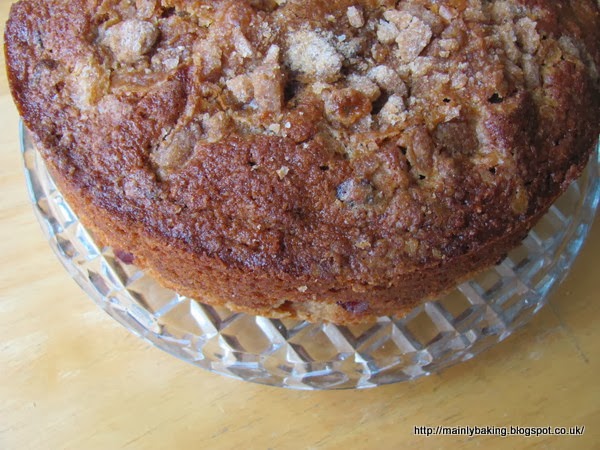
The cake was cut while still warm, and the first slices were rather crumbly, but the cake firmed up as it finished cooling. Both the orange (with whisky) and cinnamon  flavours were quite subtle, bringing out the apple and cranberry flavours, rather than masking them. Although it was a light cake, it was still moist, and the tart fruits stopped the cake from being too sweet with the added marmalade.

Definitely a cake to make again; I'd like to try it with ginger preserves and pears, with perhaps a few nuts thrown in. And, as usual, apologies for rough photos of brown cake!

Sunday, 21 April 2013

Apricot, Marzipan and Cranberry Cake

It wasn't until I started to write about this recipe for an Apricot and Marzipan Cake that I realised the basic cake batter was almost identical to the generic 'quick' cake recipe I've been using for about 30 years.

The part of the cake which makes it quick and easy is that the butter is rubbed into the flour, then the rest of the ingredients are usually simply mixed in. This version was a little different, as the chopped marzipan was sprinkled onto layers of batter in the cake tin, to keep the pieces intact.

As usual, there were a few deviations from the recipe along the way; nothing that drastically changed the cake though. The main change was to substitute the sultanas with dried cranberries, and to add the cranberries into the cake's name  - I really love the combination of apricots and cranberries. The next change was to bake the cake in a round 8"(20cm) diameter tin, and to top with some flaked almonds. Then I glazed the cake with a little honey after baking, rather than apricot jam - simply because I had honey but no jam.

Because the marzipan was chopped into quite large pieces, there was a really intense almond hit when the cake was eaten - I think this is one of the best ways of getting a strong almond flavour into a cake, especially if you can get a marzipan with a high almond content, as this cuts down on the additional sweetness too.

I'm entering this cake into the AlphaBakes challenge this month, as the randomly chosen letter to use in our baking is 'A'. I could have doubled the 'A' ingredients by calling this an apricot and almond cake, but using marzipan gives a different flavour and texture to a cake, and there are some odd people who like almonds, but not marzipan, so I don't want to mislead anyone!

 Alphabakes (rules here) is co-hosted by Caroline from Caroline Makes and Ros from The More Than Occasional Baker. Ros is hosting this month, so she picked the letter 'A' and will be posting the round up at the end of the month.

Monday, 22 October 2012

Orange Frosted Apple Loaf

This is an unusual cake, in that it doesn't taste strongly of it's main named ingredients; in fact it was more reminiscent of my favourite carrot cake recipe, due to the spices and orange zest used. The grated apple really just added sweetness and moisture to the cake, rather than any noticeable flavour, and the spices and dried cranberries were more prominent than the orange zest.

I made a few changes to the recipe for this Orange Frosted Apple Loaf ; firstly I left out the pecans and added 50g more dried fruit, making the fruit a mix of 100g cranberries and 50g sultanas, then I didn't use the low-fat soft cheese frosting, instead just making a glacé icing with icing sugar and some of the juice of the orange from which I'd already taken the zest. Because my loaf tin wasn't quite the same shape and size stipulated in the recipe, the loaf took 55 minutes to bake, rather than 45 minutes, but I'm quite used to loaf cakes having different baking times.

The recipe called for whisking one of the egg whites separately, then folding this into the cake batter at the last stage of mixing; I think this helped with the lightness, as the cake crumb was very close textured but not as dense as many cakes made with a proportion of wholemeal flour. I thought the texture was excellent - many cakes adding grated fruit can be a bit too moist and dense - this was just right!

I really liked this cake, despite my disappointment that it didn't have an apple flavour,  and it seemed almost healthy to eat it - the natural sweetness of the apple and dried fruit meant added sugar could be reduced; oil was used instead of butter, reducing saturated fat levels and the fat was reduced even more by adding some yogurt; the use of wholemeal flour and dried fruit increased the fibre content. This is definitely a cake to put on the 'to be repeated list'!

Tuesday, 2 October 2012

Apple Cobbler

Harvest time again! We have three minarette apple trees in the garden - these are trees which don't grow much more than 2 metres tall and are kept pruned into narrow columns. This makes them ideal for small gardens, but so far only one of them really justifies it's existence with a good crop of apples. The other two have only given a few apples each year, although weather conditions have been very difficult around the time the fruit should be setting, for the past couple of years. The trees aren't fully grown yet, so I'll give them more of a chance to become productive before giving up on them.

One of the trees which only gives a handful of fruit is a dual purpose apple called Broadholm Beauty; this is an apple sweet enough to eat raw, but which also collapses like a Bramley when cooked. As I only had 4 apples this year I wanted to use them in something where the flavour of the apple remained pure, but where I could still add flavour to the dish. I decided to make a Cobbler and add more flavour to the dough topping. To me, a 'cobbler' is cooked fruit with cut out scones on top - I found a lot of recipes going by the name of 'cobbler' with wetter toppings which were scooped onto the fruit, and which then merged together when cooked, not what I wanted.

In the end, I dispensed with recipes and went ahead with a simple scone dough - 160g SR flour, 1/2 teaspoon baking powder, 40g butter, 25g caster sugar, a mixture of sour cream and milk to mix a soft dough - to which I added the grated zest of a small orange and 25g dried cranberries. It's so nice to be using Autumn flavours again! I patted the dough out to a circle to fit my pie dish, and cut it into 8 wedges, rather than cut out circles of dough and have to re-roll trimmings, which are never as good as the first scones cut. I also pre-cooked the apples, as scones cook so quickly; these did not need added sugar but that's a matter of taste and the variety of apples used. I think there were probably around 700g of apples before peeling and coring, and these quantities of ingredients made 4 portions.

I arranged 7 of the wedges on top of the cooked apples, brushed them with milk and sprinkled with a little demerara sugar, then baked at 200C for about 20 minutes, until the cobblers were risen and golden brown. I left out one scone wedge to make sure there was space between them after cooking - this was cooked separately as a cook's treat!

This is a dessert to eat warm, with custard or cream (although I ate my portion with low-fat yogurt!). It was really good to be able to taste the apple properly, while the added cranberries and orange gave the topping a more interesting flavour and texture. In an ideal world, I would have used more apples, but I didn't want to adulterate our harvested apples with other fruit before we had tasted them - at least half as much apple again would have been better. I'll definitely be adding flavour to cobbler toppings again!