Showing posts with label cheese. Show all posts

Sunday, 10 June 2018

Courgette Slice, with Bacon and Herbs

I make this recipe more often than I write about it, as it's become a staple warm weather dish; it makes an excellent meal when accompanied by salads. Depending on how filling the salad selection is, it will feed 4-6 people. The added flour also makes it sturdier than a frittata, so it's ideal for carrying to picnics, and of course, with no pastry, it's quicker and easier to make than a quiche.

This time, I was starting with bacon, so there was an extra step involved to fry the bacon until crisp and drain off the excess fat. If ready-cooked ham is used, it's just a matter of chopping and grating the vegetables and mixing everything together. The resulting mixture is then baked in a 23cm/9" parchment lined round baking dish at 195C (175C fan) for about 50 minutes, until firm and golden. I find that it's best eaten at room temperature, or even slightly chilled, rather than warm.

Ingredients:
300g coarsely grated/sliced vegetables (I used 200g grated courgettes, 70g grated carrots and half a red pepper, which I sliced very finely)
1 large onion, finely chopped
100g grated cheddar cheese
200g smoked bacon lardons, fried until crisp, then drained of fat (or 150g ham, cut into small strips)
A small bunch of fresh mixed herbs, finely chopped (I used sage, winter savory and lemon thyme)
5 large eggs
125mls sunflower oil
130g SR flour
Seasoning to taste - a little salt and plenty of pepper, plus a few chilli flakes, if liked


Saturday, 27 May 2017

Smoky Vegetable Slice


This is a dish based on the classic Australian recipe for Zucchini (Courgette) Slice, which I first saw on the blog Fig Jam and Lime Cordial. I've used Celia's version several times, so usually follow her guidelines for quantities of ingredients and cooking instructions, although a bit more or less of any of the vegetables doesn't make much difference. The Zucchini Slice is very similar to a frittata, but the addition of SR flour and oil makes it sturdier and more filling. It's excellent when eaten as a main meal with salads, or as a picnic food.

I made this version in an attempt to use up some vegetables which were lingering uneaten in the fridge. A sudden rise in temperature, after a spell of wet, cold weather meant that we couldn't face hot meals for a few days. Instead of courgettes (or a mix of courgettes and carrots, as Celia uses), I used equal quantities of grated sweet potato and broccoli.

Ingredients
150g sweet potato, peeled then coarsely grated
150g broccoli
1 small onion
100g smoked cheddar, grated
100g smoked bacon pieces
5 eggs
125ml sunflower oil
130g SR flour
plenty of black pepper to season, plus a little salt if desired (both the cheese and bacon will be salty)

Method
Preheat oven to 190C, 175C fan, and line a 23cm (9") round baking tin, or a 20cm (8") square one, with baking paper.
Fry the bacon pieces gently until just cooked through.
Blanch the broccoli florets in boiling salted water for about 3 minutes, then drain, rinse in cold water and allow to dry off. Slice the stems thinly and chop the florets into small pieces.
Finely chop the onion.
Put all the vegetables into a large bowl, add the cheese and bacon.
Sprinkle the flour over the vegetables, then make a well in the centre and break in the eggs and add the oil.
Mix everything together until no dry flour is visible, adding pepper and salt (if using) as you do so.
Transfer the mixture to the baking tin, level the surface and bake for about 40 minutes until golden and firm.
Best served at room temperature. You'll get 4-8 portions, depending on what else you are serving.

This was a really tasty version of a vegetable slice. The cheese and bacon added a subtle smoky flavour which we both really liked, and the sweet potato and broccoli made a good combination of vegetables.

Friday, 18 December 2015

Nigella Lawson's Supper Onion Pie

When I read in the Daily Telegraph that this recipe was considered one of Nigella's best 10 recipes of all time, I had to give it a try. This Supper Onion Pie is similar to a red onion tarte tatin, except that a cheese scone dough is used instead of pastry.

The recipe was quick and simple to put together - the longest procedure is slowly caramelising the onions until they are soft and nicely coloured. The onion layer is flavoured with thyme and the cheese scone dough also has mustard in it for a bit more flavour. I cooked the onions in the same skillet that I used to bake the pie in, which made things even simpler - less washing up!

I found this a pleasant dish to eat, but nothing more outstanding than that. The scone dough was quite thick compared to pastry, and I thought it needed more flavouring - more mustard or some herbs maybe, or even some dried chilli flakes. My husband was even more critical - I was told in no uncertain terms not to make it again unless I could make it more flavoursome - he suggested leaving out the cheese and using garlic and coriander leaves in the base and some suitable spices in the onions.

I don't have a lot of Nigella's recipes in my regular repertoire, but I don't think this is getting into our top 10!

Apologies for the photo of the whole pie - it had to be taken in artificial light. The last couple of months has been so dismal and dark that it's been really difficult to get enough natural light photograph anything well, even in daylight - roll on Spring, and longer days!


Saturday, 10 October 2015

A Russian-inspired Meal

Kartoshnik
This weekend's challenge for Formula 1 Foods, over at Caroline Makes, is to produce food inspired by the cuisine or culture of Russia, to coincide with the Russian leg of the Formula 1 Grand Prix. I wanted to cook something which would fit in with my meal plans and not be too fiddly, or involve the expense of buying special ingredients, and I was pretty sure that I could find something in Russian traditional cooking to fit the bill. In the end, after discounting cakes with 15 layers, recipes which used whole jars of honey, and anything based on yeast dough,  I found two suitable recipes, both of which used simple everyday ingredients and methods. One was a savoury potato and cheese dish called Kartoshnik and the other was Sharlotka, sliced apples cooked in a sweetened egg-rich batter to make a cake or pudding. I decided to cook them both and have a meal inspired by Russia.

Kartoshnik
To be honest, I have my doubts that Kartoshnik is a traditional Russian dish. It's mentioned frequently on recipe websites, but there only seems to be one recipe in circulation. Usually traditional dishes get tweaked by generations of cooks, or regional variations in ingredients, so just one recipe, with no variations, suggests an invention by one cook, which has just spread by online repetition. However, it was surprisingly tasty, so if it hasn't been eaten  by past generations of Russians, it deserves to be enjoyed by those in the future.

Kartoshnik is a dish meant to accompany a meat dish, but in view of the amount of eggs and cheese used, I decided to treat it as a vegetarian main meal. Cooked mashed potato is mixed with eggs, onion, cheese and a little cream, with some baking powder added to lighten the mixture. When baked it becomes something like a quiche filling, both in taste and texture, so it was quite good as a main course. According to the recipe it is traditionally served with sour cream and chopped green(spring) onions, but I served mine with cabbage cooked with onions, apples and caraway seeds, which felt quite Eastern European to me.

Following this online recipe, I mixed 4 eggs, 75g grated Cheddar cheese, 75g mature Gouda cheese (in place of swiss cheese), 80mls double cream, a grated small onion, 1 teaspoon salt, 3 teaspoons baking powder, then stirred in 450g cooked and mashed potatoes (weighed after peeling). This mixture was spread into a 9" square greased baking dish and baked at 200C(fan) for about 30 minutes until golden brown and set. As the dish was removed from the oven, I brushed the top with a knob of melted butter, rather than serve with the larger amount of butter suggested.

Sharlotka
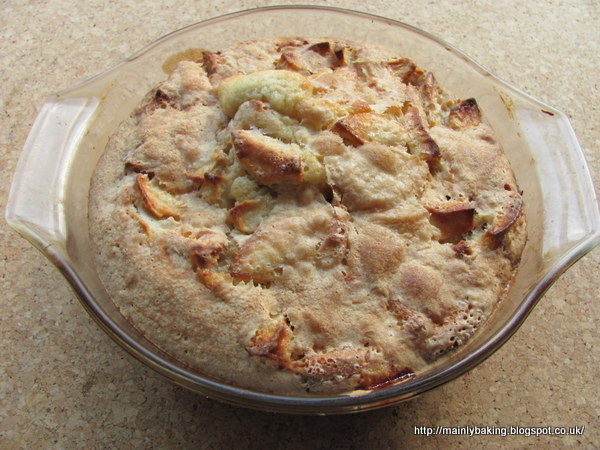
For dessert, I followed this recipe for Sharlotka, which baked the batter in a pudding dish. This wasn't entirely successful, as the depth of my baking dish meant that the dish took over an hour to cook properly. With the benefit of hindsight, it would have been better to use a larger, shallower cake tin, and serve the Sharlotka as a cake. Considering that the batter ingredients were just plain flour, sugar and eggs (with a 1/4 teaspoon baking powder, as suggested by some other recipes I looked at), I had no idea what the texture of the cake was going to be like. A sponge? a clafouti? a pancake? In fact, it was most like a dense sponge in texture, quite sweet but very plain and a good carrier for the sharp eating apples used in the recipe. When first baked, it had a crisp sugary crust, but this softened with time. I served the cooled cake with vanilla yogurt.

Although both these dishes are quite high in carbohydrates, neither of them seemed very heavy, so it didn't seem too much to serve them both as part of the same meal. The leftovers from the Kartoshnik were eaten with a chilli the following day, and suited that quite well too.


Sunday, 23 August 2015

Ham and Courgette Slice

This savoury bake is ideal for summer, especially when the forecast is for weather so hot that you wouldn't want the oven on, and you have enough warning and time to bake ahead. It's also good for when the courgettes are producing fruit faster than you can harvest them, or there's a glut on the market. We're not quite at the over-production stage, but I'm determined not to allow things to get out of hand this year - I don't want any marrows!

My inspiration comes from this recipe on Fig Jam and Lime Cordial, which I've written about before. This time I used two thick slices of smoked ham instead of the bacon, and added a sliced chilli and some shredded sage leaves for extra flavour.

This is what I used, but it seems a very versatile recipe, so a little more or less of any of the flavouring ingredients probably won't make a lot of difference, as long as you keep the batter the same (the eggs, flour and oil). I guess it would also be OK to add things like leftover cooked vegetables to the mixture too, as part of the total weight of vegetables.

300g coarsely grated vegetables (I used roughly 220g courgettes with 80g carrots for colour contrast)
1 large onion, finely chopped
1 red chilli, de-seeded and finely sliced
about a dozen sage leaves, finely shredded
100g grated cheese (I used 60g strong cheddar and 40g parmesan)
100-150g smoked ham, cut into small strips
5 large eggs
125mls light olive oil
130g SR flour
salt and pepper to taste

Just mix everything together, pour into a parchment-lined baking dish (I used a 23cm (9") cast iron pan) and bake in a pre-heated oven at 175C (fan) for around 50 minutes until firm and golden brown. The baking time depends on the depth of mixture which is determined by the size of the dish you use. A 20 x 20cm (8 x 8") square dish would be a similar size - anything smaller will give a deeper mixture which takes longer to cook.

This is best eaten warm or at room temperature. It's probably OK hot too, but I haven't tried that - I'd still let it rest for about 15 minutes after coming out of the oven.

Although this is very similar to a quiche filling, or a frittata, the SR flour makes it a little sturdier, whilst still keeping it light because of the raising agent, and the oil keeps the texture moist. The added bonus over a quiche (besides not making pastry, thus avoiding a soggy bottom) is that the onion doesn't need pre-cooking - any moisture given out during cooking is absorbed by the batter, which doesn't happen with a quiche filling.

I'm sending this to Belleau Kitchen's Simply Eggcellent bloggers' link-up. Dom is allowing us free reign this month saying that 'anything goes'! This dish makes a quick and easy main course, could easily be made vegetarian  and is robust enough to hold up in a lunch box or picnic basket, making it a useful recipe during the holiday season.

Saturday, 16 May 2015

Cheddar and Jalapeno Cornbread,

made with Quark.

I love the AlphaBakes challenge, where we are asked to cook something using a randomly chosen letter of the alphabet, as either the starting letter of a principle ingredient (eg B for bacon), or as part of the name of the dish (eg B for Battenburg Cake). Admittedly, some letters of the alphabet prove more difficult than others, but that's all part of the fun.

Last time the letter Q came around I made a cake using quinoa, which had a fairly unpleasant texture and didn't go on my list of things worth making again; this time I intended to play it safer with a quiche. Except every time I suggested quiche for dinner, my husband vetoed the idea, so I had to think again. Quark seemed the next best idea, and while searching for recipes I came across this cornbread recipe from The Fabulous Baker Brothers.

This is a luxury version of cornbread, compared to recipes I've tried before. It contains lots of cheese, sweetcorn kernels, onion and jalapeno peppers for flavour, and uses quark instead of the sour cream or buttermilk more usually found in cornbread recipes.

This was a straightforward recipe to follow, but my batter was very dry and I needed to add a few tablespoons of milk to give a stiff dropping consistency. The cooked cornbread was quite dry and crumbly, so it wouldn't have hurt to make the batter a little sloppier. The cornbread also took a lot longer to cook than the 40 minutes the recipe suggested - I think mine was in the oven for a touch over an hour!

We both really liked this - it was very cheesey, and well spiced with the jalapenos, which I had chopped quite finely. Most cornbread recipes contain a proportion of wheat flour, which I think lightens the sponge texture; this one was all cornmeal, and also contained coarsely puréed sweetcorn kernels, so it was quite dense. It definitely needed more liquid in the batter though, to reduce the crumbliness a little.

We ate the cornbread, still warm, with a spicy ratatouille. The following night we ate it with a pork and bean chilli, but after two meals I'd only used half the cornbread, so I had to freeze the rest. I hope it doesn't become even more crumbly in the freezer.

This cornbread also fits the brief for Dom's Simply Eggcellent challenge over at Belleau Kitchen. This month he wanted our savoury recipes using eggs. While eggs are not the principle ingredient of a cornbread, it's almost impossible to make any sort of cake without eggs, so I think it's OK to submit this recipe.


AlphaBakes is co-hosted by Ros, at The More Than Occasional Baker and Caroline, at Caroline Makes. This month's challenge, using the letter Q, is hosted by Ros, who will be posting a round-up of entries at the end of the month.

Thursday, 14 May 2015

Cauliflower Cake (Yotam Ottolenghi's recipe)

I noticed that there is a bloggers' celebration of cauliflower taking place, co-hosted by Karen at Lavender and Lovage and Choclette at Tin and Thyme.

I love cauliflower as it's extremely versatile and always tasty, however it's cooked. One of my favourite ways to eat it is gently fried with whole spice seeds, such as nigella, black mustard and cumin, and a few flakes of dried chilli. It then makes a delicious accompaniment, alongside rice or bread, to a curry.

Then there's cauliflower cheese, to which I often add pasta, to make a cross between cauliflower and macaroni cheese. And along with numerous others, I'm a fan of cauliflower 'rice' to reduce carbohydrate intake, although I do prefer to mix it with some Basmati rice, so that it will still absorb sauces.

The Cool Cauliflower Recipe Collection: Linky Party and Blog HopHowever, the recipe I want to add to this collection of cauliflower recipes is Yotam Ottolenghi's recipe for Cauliflower Cake. This is a delicious, well flavoured cake which is like a frittata. The addition of flour makes it lighter, yet sturdier, than a traditional frittata. The cake is flavoured with cheese, rosemary, onion, basil and sesame and kalonji seeds and can be eaten both hot and cold, which makes it ideal for picnics and parties.

I made and wrote about it back in September 2014, but rather than edit that post for the cauliflower link-up party, I thought it better to write a new post.


Thursday, 11 September 2014

Yotam Ottolenghi's Cauliflower Cake

Yotam Ottolenghi is a chef I admire greatly; his recipes often have Mediterranean or middle Eastern influences and he's perhaps best known for recipes based on vegetables - perhaps not 100% vegetarian, but where vegetables take the starring role.

This cauliflower recipe, which comes from his new book 'Plenty More'; is called a cake, but the texture is more like a frittata; flour and baking powder are added to a lot of eggs to give a lighter, but somehow also sturdier, texture than the traditional frittata.

The picture of the cake, which was published in the Guardian Weekend magazine, along with a few others from the book, instantly attracted both of us. My husband liked the pattern of onion rings on the top and I liked the description of something more appealing than a cauliflower cheese! I followed the recipe exactly, although I was slightly short of basil - the plant on the patio didn't really recover from the last harvesting; I suspect it hasn't had enough sun this year. The tin I used was slightly larger than the tin specified - I had the choice of using either a larger tin or a smaller one, and went with the larger one - but the cake still needed the full cooking time to get enough colour on top.

There are lots of big flavours in this cake - cheese, rosemary, onion, basil, sesame and kalonji seeds - and they do rather overwhelm the cauliflower, but nevertheless this is a really delicious and unusual way to use the vegetable. This makes a good dish to eat at room temperature, with a salad or hot vegetables, but is also something suitable for a picnic or buffet table. It's sturdy enough to withstand transportation, especially if it's left in the tin until required, and can be eaten as a finger food.


I can't resist adding this last photo - just to prove that this recipe turned out looking as it should!

Tuesday, 26 August 2014

Goat's Cheese, Apricot and Walnut Savoury Cake

Now that sugar has been recognised as a bigger threat to health than saturated fats, I'm wondering what implications this will have on the recent surge in home baking. Will we all switch to savoury baking? Make bread, quiches and meat pasties instead of sugar-heavy brownies and cookies? I doubt that sweet baking will be abandoned entirely though - at least with home baking, as with all types of cooking, it's easier to control the amount of sugar that you add. Perhaps the way forward is to re-run our favourite recipes and see how much the sugar can be reduced without spoiling the finished product.

Something I like once in a while are savoury cakes, although they will never replace sweet cakes entirely. There are times when a slice of savoury cake goes down well - early evening, with a glass of wine or with a lunchtime salad, but what you need with your mid-morning cup of tea or evening coffee is normal sweet cake.

I chose this versatile recipe from Hugh Fearnley-Whittingstall (second recipe down), and following his suggestions, changed the raisins and hazelnuts for dried apricots and walnuts, as that was what I had in stock. I also used parmesan instead of hard goat's cheese.

This was a pleasant savoury cake, but I think I would have preferred it to be totally savoury. The dried fruit in this recipe was sweet enough to overwhelm the savoury elements, even the parmesan cheese, resulting in something which didn't fall satisfactorily into either the sweet or savoury camp. In this respect, the other two recipes on the link look more interesting - the ham and olive one in particular, although another recent TV programme has warned of the dangers of processed meats!

Thursday, 7 August 2014

Double Cheese and Onion Soufflé Tart

This soufflé tart filling was a revelation! Good-bye soggy bottoms, farewell rubbery egg custard! I know that it is possible to make perfect pastry, blind bake to the exact point needed, get the custard into the case without spilling any, not have any cracks in the pastry for the custard to leak through, get the dish into the oven without any custard overflowing and get the exact set needed for the filling to be creamy rather than rubbery (and not soak into the pastry to give the dreaded soggy bottom) - but how often do they all come together to produce the perfect quiche?

I found the recipe on the Good Food website, and even though I've never made a soufflé, I found the idea of a soufflé filling for a savoury tart quite intriguing. In practice it was even better than I imagined - because the filling was quite solid (like a stiff meringue mix rather than cream), there was no liquid to soak into the pastry, or find the smallest crack to leak through. The pastry case could be filled to the brim without fear of overflow and the filling baked to a light springy texture, rather like a good baked cheesecake. The pastry case also released off the base  of the tin like a dream - something that has never happened when I make a quiche - and it stayed crisp for the three days it took to finish eating the tart.

Although I followed the recipe for the filling exactly, I made my own shortcrust cheese pastry, using 250g SR flour, 125g butter, 50g parmesan cheese and a little cold water. I used the pastry to line a deep 22cm loose-bottomed flan tin, and baked blind following the times and temperature in the recipe. The filling rose above the pastry during baking, and here was the only problem I encountered during making this tart - it was difficult to judge the end point of cooking. To be sure the soufflé was properly cooked, I turned off the oven after the time stated and left the tart in the cooling oven. This worked very well - the filling was cooked all the way through but still moist and creamy in texture. Once cooled, like all soufflés, it fell back to it's original level, but thankfully didn't sink in the middle, which was what I was fearing if it was undercooked.

The flavours in this quiche all worked well together - the sweet yet piquant caramelised onion chutney offset the richness of the soufflé filling, and the crisp pastry was a good contrast to the soft filling. I had picked a mild goat cheese, yet it was still evident that it was goat cheese being used - the flavour wasn't overwhelmed by any of the other ingredients. I'm not sure if this method could be adapted to make tarts with more solid pieces in the filling, such as bacon or vegetables, but  for a straightforward cheese tart this is so much better than a traditional quiche, and not that much more complicated to make.

The tart case only used 2/3 of the pastry, so there was plenty remaining to make some pesto pinwheels with the leftovers - the pastry was rolled to a rectangle, spread with a couple of tablespoons of pesto, rolled up like a swiss roll, chilled, then cut into 2cm slices and baked alongside the pastry case at 200C for about 20 minutes. (See the photo above.)

I'm sending this tart to Tea Time Treats (rules here), a baking challenge hosted jointly by Lavender and Lovage and The Hedge Combers. This month, Karen at Lavender and Lovage has asked us to produce something suitable for a picnic tea, and this tart certainly fits the bill - it would be easy to transport while still in the baking tin, and once cut is sturdy enough to be eaten by hand. It is also very tasty when eaten cold.

Monday, 28 July 2014

Courgette and Bacon Gratin


If there's one over-riding reason why I don't post many savoury recipes, it's because I don't often follow a recipe when I make something for dinner. Obviously there's a general template to follow to produce something like a lasagne, or a sausage pie, and I'm often inspired by recipes I've read, but I don't make things exactly the same every time, and I don't often take note of the quantities I use, particularly when I add things to adjust the flavour and seasoning as I go along. Generally, cooking of this sort is a lot more forgiving than baking cakes, where more precision is usually needed.

I did take a bit more notice while I was making this gratin, partly because Hubs has accused me of thwarting his efforts to lose weight by making too many cakes and desserts, so I might have less to post unless I write about my savoury cooking. As I say, I took a bit more notice, but it's still a fairly loose recipe - a little more or less of anything would probably have worked just as well, and it could easily be made a vegetarian recipe by leaving out the bacon and choosing a vegetarian-compatible cheese. I used this recipe by Ina Garten as inspiration.

Ingredients (to serve 2)
1 tablespoon sunflower oil
half an onion, finely chopped
100g smoked bacon or pancetta pieces
3 medium courgettes - around 500g - cut into 0.5cm slices
1 clove garlic, crushed
12 sage leaves, finely shredded
1 tablespoon plain flour
milk, as necessary - roughly 200mls
salt and pepper to taste
50g fresh white breadcrumbs
50g grated parmesan cheese
1 tablespoon pine nuts

Method
Heat the oil on a medium heat, in a large frying pan, and fry the bacon pieces and onion until the bacon is beginning to brown. Lower the heat a little and add the courgettes and garlic, and continue frying, turning occasionally, until the courgettes are beginning to soften.

Add the sage leaves, then stir in the flour and cook for 2 minutes. Add the milk gradually, allowing the sauce to thicken between additions. There will be more liquid coming out of the courgettes as the gratin bakes in the oven, so you want a very thick coating sauce at this stage, otherwise there will be too much thin sauce at the end of cooking. Season to taste - I didn't need any extra salt because of the bacon. Put this mixture into an ovenproof dish.

Mix together the breadcrumbs, parmesan cheese and pine nuts, and scatter in an even layer over the courgette mixture. Bake at 180C for 45 minutes, or until the topping is crisp and golden and the courgettes are really soft.

We  really enjoyed this accompanied by a mixture of runner beans and mange tout peas. Hubs doesn't really like completely vegetarian meals, so adding the bacon made it tastier for him. I was also trying to keep this meal relatively low in carbohydrates; for a more filling dish cooked pasta or potatoes could be added, but then I think the sauce would need to be a little thinner, as pasta goes on absorbing moisture during baking.

Looking at the photographs, I feel I ought to explain the idiosyncrasy of cutting mange tout peas in half. Hubs is basically lazy, so eats with just a fork where possible (although just a spoon is even better!). Mange tout peas sometimes have a long stringy bit along one side - if you haven't got a knife handy, this can make them unpleasant to eat whole, as well as difficult to fit into your mouth!

Monday, 17 February 2014

Cheese Scones with Za'atar

The AlphaBakes baking challenge has reached one of the more difficult letters of the alphabet this month - the letter Z! I could have gone the easy route, with a zebra cake, or used a zucchini, but I wanted something a bit more unusual. I often get inspiration from my spice cupboard, when looking for unusual flavour combinations, so was happy to come across a jar of Za'atar spice mix hiding at the back.

Za'ater is a variable mix of herbs, spices and sesame seeds (mine contains wild majoram, sumac and sesame seeds - some varieties use thyme and/or oregano) and is quite bitter, so isn't really suitable for sweet baking. After some experimentation, which is best forgotten, I finally decided on the savoury option of cheese scones filled with a swirl of the za'atar mix.

I made a standard scone mix of 50g of butter rubbed into 200g SR flour, to which I added 50g of grated cheese - a mixture of mature dry cheddar and parmesan. I mixed in half a teaspoon each of dry mustard powder, white pepper and cayenne powder for flavour, then added half a beaten egg and enough milk to make a soft dough. After a brief knead, I patted out the dough, on a floured board, to make a square about 1cm deep. I sprinkled about 2 tablespoons of za'atar over the dough, leaving a cm margin along one edge, which was wetted with milk. The dough was then rolled up tightly from the edge opposite the wet edge, so that the wet edge stuck and held the roll in place. The roll of dough was cut into pieces 2.5cm long and the pieces were placed on a baking tray with the swirl of za'atar facing upwards. The top of each scone was brushed with beaten egg and sprinkled with sesame seeds before baking at 220C for about 15 minutes, until risen and golden brown.

The bitter flavour of za'atar means it needs to be used with caution - I think these scones might have been better with a bit less za'atar mix, as the flavour quite overwhelmed that of the cheese and other spices used. I also think a scone might not be the best vehicle for the za'atar - small cocktail biscuits or puff pastry whirls which could be eaten in just a mouthful might have been more suitable. However it was an interesting way of getting to use the za'atar, which had been lingering unused in my cupboard for far too long.

AlphaBakes (rules here) is a challenge based on a randomly chosen letter of the alphabet. The dish made must feature something beginning with that letter as one of the main ingredients or part of the name. It is hosted jointly by Ros at The More Than Occasional Baker and Caroline at Caroline Makes. Caroline is this month's host, with the letter Z, and will feature a round-up of entries at the end of the month.

Thursday, 17 October 2013

Apple, Guinness and Cheese Soda Bread

How could I have been so stupid as to make this recipe, from Hugh Fearnley-Whittingstall without reading any of the comments attached to the published online recipe? On both the River Cottage site and the C4 site there are comments stating that there is too much liquid in the recipe as printed and that it should be 250mls of Guinness or buttermilk, not 250mls of each, and several bloggers who have also made it picked up on the published error.

Anyway - this idiot used both, and ended up with a sloppy batter which couldn't be shaped by hand. I scraped it into a large casserole dish lined with scrunched up baking parchment and got a decently shaped cob-like loaf out of it. However it didn't cook properly, even after more than an hour in a very hot oven, and the cut loaf showed both a dense, too moist texture and a line of under-baked dough at the bottom of the loaf.

The flavour combination of cheese and apple should have been great, but the loaf had a bitter after-taste which neither of us found pleasant to eat. Guinness is notorious for bitterness but I don't usually find it a problem, so I'm wondering if there was a weird interaction between the Guinness and the buttermilk.

There's a lot of potential in this soda bread so I really want to try it again, with just one of the suggested liquids, but can't really find an occasion to do so, as neither of us are eating bread at the moment, except for Saturday lunch, when I don't think Hubs would give up his crusty baguette.

I was going to enter this quick soda bread into this month's Tea Time Treats challenge, which is for breads, but as the recipe was a failure, and we didn't even like the flavour of the finished loaf, it hardly seems right to do so!

Saturday, 24 August 2013

Celia's friend Genie's Courgette Slice

Yet another attempt to use more courgettes, or, in this case, one monster that had been hiding underneath a leaf and had expanded quickly after a heavy rainfall. This recipe for Courgette(zucchini) Slice, found on Fig Jam and Lime Cordial, is a recipe give to Celia by her friend Genie, who passed away a few years ago. Celia writes very eloquently and often very movingly about her family life on her blog, and really values her friends and neighbours, and the recipes they share.

I followed the recipe closely - only adding a sliced red chilli for an extra zing. I was a bit worried as the slice cooked, as there seemed to be a lot of grease sizzling on top of the slice, but this was absorbed as it cooled, and the finished dish wasn't at all greasy.

This was more like a frittata or tortilla than a savoury bread, but the addition of flour makes it more sturdy and perfect for eating cold. I found it very useful as a protein-rich breakfast, and it was also very tasty as a lunch dish, with salad. The only thing I think I'd change is to grate the vegetables more coarsely next time, to give more texture.

Sunday, 7 April 2013

Mushroom, Sage and Mustard Quiche

This quiche made me realise what a difference it makes to use cream in the filling. Previously, I've always used eggs and milk, but there was a pot of double cream in the fridge, leftover from Easter, and I didn't want to use it in calorific desserts which we shouldn't be eating. Using it in the quiche made the custard part of the filling more full-bodied and richer in flavour.

I made a traditional shortcrust pastry mix, using half lard and half butter, but before adding the water I added in a heaped teaspoon of wholegrain mustard and 25g finely grated parmesan cheese. I baked the pastry case blind, and also brushed the inside of the case with beaten egg, which I dried out in the hot oven, but it still didn't stop a soggy bottom.

The filling was half a medium onion, finely diced, sauteed with 400g of sliced mushrooms and a crushed clove of garlic, until there was no excess water in the pan. I added half a dozen shredded sage leaves towards the end of cooking and seasoned the mixture with salt and pepper. The custard was 3 large eggs, 150mls double cream, 50mls semi-skimmed milk plus the egg left over from egg-washing the case (about half an egg). After the mushroom filling and the custard were in the case I sprinkled over about 25g finely grated mature cheddar and baked the quiche at 150C for about 40 minutes, turning up the temperature a little at the end, to make sure the filling browned a little.

The sage complimented the mushrooms better than I expected, and the cheese and mustard in the pastry added an extra savoury note - not overwhelming, but it was noticeable that something extra had been added. Apart from the soggy pastry bottom, this was a very succesful dish.

Wednesday, 19 September 2012

Cake Salé - Courgette and Feta Loaf

I've been interested in savoury cakes for a while now, but never seem to have the opportunity to make one. As I'm attempting to lose weight, following CT's departure (although not related to it, except that I don't need to bake as much now), the time has come to think about eating less sugar. FB has been worrying about eating too much sugary food at work too, so any new direction in baking will benefit her too, by making her lunch boxes healthier.

Cake Salé has been growing in popularity in France for a few years now, and although the classic combination of flavours is Ham and Olives, there are dozens of delicious sounding combinations around in recipes on the internet. Anything you have, as long as it's not too wet, can be baked into a savoury cake! A slice of Cake Salé served with a salad makes a light summer lunch, or serve alongside a robust soup with complimentary flavours as a more filling winter meal.  Hugh Fearnley-Whittingstall suggests thin slices as pre-dinner nibbles and it also seems an ideal transportable food to me, either to summer picnics or warmly spiced and served as you stand around the the bonfire, watching fireworks and celebrating the foiling of the Gunpowder Plot. If you like savoury food for breakfast, then these cakes should go down well then too as they are so versatile; I just had a small slice with my evening coffee!

My savoury cake was made primarily to help demolish the courgette mountain - because we let a few grow large while we were away, we can't seem to catch up and get back to the point where we can pick small courgettes. I based my recipe loosely on this one from The Kitchn, which in turn was adapted from an article and recipe in the NY Times. I made a few more adaptations to suit the ingredients I had in the store cupboard, and to give a fuller flavour. I also 'translated' the ingredients to metric weights:

225g coarsely grated courgette (skin on), salted with 1 teaspoon salt and left to drain while the batter is prepared.
225g plain flour
2 teaspoons baking powder
plenty of black pepper
1/2 teaspoon dried oregano
3 large eggs
80ml milk
80mls extra virgin olive oil
50g crumbled feta cheese
a few sprigs of fresh thyme, leaves picked
5 garlic-stuffed green olives, halved and sliced
about 50g pinenuts to scatter on top

After mixing the flour, baking powder, pepper and oregano in a large bowl, the eggs were beaten with the oil and milk until amalgamated. The wet ingredients were mixed into the dry, then the cheese, olives and thyme leaves were folded in. Lastly the drained courgette was stirred in, after pressing well to remove as much moisture as possible. The batter was transferred to a 2lb loaf tin lined with baking parchment, levelled and sprinkled with pinenuts. The loaf was baked at 180C for about 1 hr - the original recipe suggested 45 minutes, but my loaf tin is broad and deep so cooking took a bit longer!

I really enjoyed this savoury cake. The feta cheese gave a salty tang, but the over-riding flavour was from the garlicky olives and the very green and grassy extra virgin olive oil - one occasion when a good oil makes a huge contribution. As with the sweet courgette muffins I made recently, the flavour of the courgette was negligable, but they add moistness and contribute to the appearance with the green flecks from the skin. I'm looking forward to trying some more flavour combinations in the future! As Hugh F-W says in his Guardian article - stick to the same proportions of flour, eggs, fat and liquid, and play around as much as you like with the other additons!

Wednesday, 7 March 2012

Parsley Cheese Scones - a Tea Time Treat

I've nothing against a good scone, but they are not something that I bake regularly. For one thing, I like to bake things that can be eaten over several days, and most scones are best fresh out of the oven, or at the very least, eaten the same day. For another, a fresh plain scone is a delight, but only when smothered with butter or jam and clotted cream - not really everyday eating. Lastly, and even more important, even if jam and cream were liberally available every day, scones aren't really the sort of thing the rest of the family like to eat.

So when Karen at Lavender and Lovage set the challenge of producing sweet or savoury scones for this month's Tea Time Treats, I decided to look for something different. Savoury scones appealed to me, although I wasn't sure how well they would fit into a traditional afternoon tea. I also feel that the monthly baking events which I take part in should be a spur for me to make it a real challenge and try something different - a new flavour or technique - so after a lot of searching, I decided to try this recipe for Parsley Cheese Scones from Dan Lepard, not least because it started by making porridge!

Dan promises the recipe is lower in fat and bigger in flavour, fibre and moistness than standard recipes. I'm not sure about the fat, as there was more cheese than I've seen in most recipes, but he used some oil and buttermilk, rather than butter, to reduce the fat a little, and the recipe lived up to the other promises. One of the good things about them was that they kept fresh for at least three days!

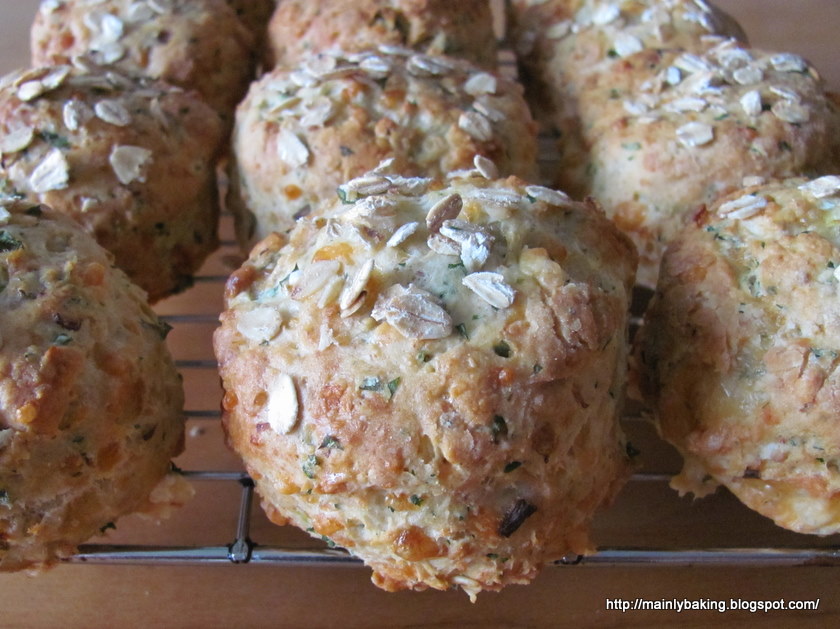
Unusually for one of Dan's recipes, I found that by the time I got to the last stage of mixing, I still had a bowlful of cheesey crumbs. Something wrong, somewhere! I had to add 6 tablespoons of milk to bring the ingredients together into a soft dough, which is quite a lot of liquid missing from the original recipe! I think I overdid the milk a little, because the dough was slightly too soft to cut well - the cutter left the scones slightly domed on top which meant they didn't bake to a good shape.

In the scheme of things, the shape didn't really matter as the great flavour more than made up for any shortcomings in the looks department. These scones were rich and moist with a strong flavour of the main ingredients - cheese and parsley. They were delicious still warm from the oven, lucious with melting butter, but they were also good eaten at room temperature. One way of eating them, which would be good at Tea Time, was with smoked salmon, but at other times of the day they would be good as an accompaniment to soup.

Tea Time Treats is a monthly baking challenge co-hosted by Karen at Lavender and Lovage, and Kate at What Kate Baked. The full rules can be found here, if you are interested in taking part.