Thursday, 17 October 2013

Apple, Guinness and Cheese Soda Bread

How could I have been so stupid as to make this recipe, from Hugh Fearnley-Whittingstall without reading any of the comments attached to the published online recipe? On both the River Cottage site and the C4 site there are comments stating that there is too much liquid in the recipe as printed and that it should be 250mls of Guinness or buttermilk, not 250mls of each, and several bloggers who have also made it picked up on the published error.

Anyway - this idiot used both, and ended up with a sloppy batter which couldn't be shaped by hand. I scraped it into a large casserole dish lined with scrunched up baking parchment and got a decently shaped cob-like loaf out of it. However it didn't cook properly, even after more than an hour in a very hot oven, and the cut loaf showed both a dense, too moist texture and a line of under-baked dough at the bottom of the loaf.

The flavour combination of cheese and apple should have been great, but the loaf had a bitter after-taste which neither of us found pleasant to eat. Guinness is notorious for bitterness but I don't usually find it a problem, so I'm wondering if there was a weird interaction between the Guinness and the buttermilk.

There's a lot of potential in this soda bread so I really want to try it again, with just one of the suggested liquids, but can't really find an occasion to do so, as neither of us are eating bread at the moment, except for Saturday lunch, when I don't think Hubs would give up his crusty baguette.

I was going to enter this quick soda bread into this month's Tea Time Treats challenge, which is for breads, but as the recipe was a failure, and we didn't even like the flavour of the finished loaf, it hardly seems right to do so!

Tuesday, 15 October 2013

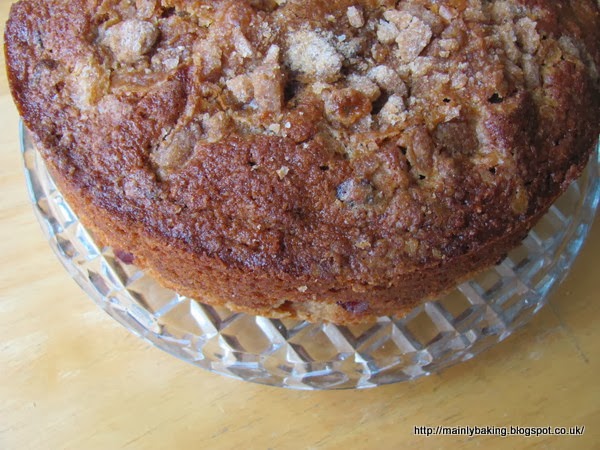
Wholemeal Apple, Marmalade and Cranberry cake

This gorgeous cake is a slight adaptation of a Nigel Slater recipe, taken from his book Tender (Volume 2 - Fruit), but also published here, in his Observer column. I have quite a few tart apples, from my own tree, stored for baking and wanted a cake with autumnal flavours.

I almost made the cake with white flour and sugar, as I didn't want another heavy cake, after the previous bake, but in the end I stuck to the recipe and went with light muscovado sugar and wholemeal flour, and the cake was still really light and tender.

The changes I did make were a) use dried cranberries instead of golden raisins b) leave out the orange zest and c) use orange marmalade flavoured with whisky, which probably made up for having no orange zest. I also sprinkled the cake with crushed raw sugar cubes rather than Demerara, which gave a better finish, as Demerara often dissolves into the surface. This way, there were still small lumps of sugar left on the surface, as well as a crisp crust where some of the sugar had dissolved.

The cake was cut while still warm, and the first slices were rather crumbly, but the cake firmed up as it finished cooling. Both the orange (with whisky) and cinnamon  flavours were quite subtle, bringing out the apple and cranberry flavours, rather than masking them. Although it was a light cake, it was still moist, and the tart fruits stopped the cake from being too sweet with the added marmalade.

Definitely a cake to make again; I'd like to try it with ginger preserves and pears, with perhaps a few nuts thrown in. And, as usual, apologies for rough photos of brown cake!

Friday, 11 October 2013

Sweet Potato and White Chocolate Cake

 I don't know if Jibber Jabber, the host of this month's We Should Cocoa challenge had a premonition of what was to come on Week 8 of The Great British Bake Off, but after a week of magnificent 3-D vegetable cakes which were also non-dairy, I'm sure that anything containing vegetables that I can bake will be an anti-climax. Fortunately I don't have to make a non-dairy cake or turn it into a novelty cake, and even more fortunately, I must include chocolate in some form to take part in We Should Cocoa. I've gone for substance over style (unlike Ruth) but this cake really was a little too substantial. I could be like Christine, and claim that the 'bread-pudding like' texture was intentional, but I really don't think that's how it should have been.

I scoured the internet for recipes which went beyond the usual carrots, courgettes or beetroot and in the end decided to use sweet potato. I also decided to use white chocolate, as most dark chocolate vegetable cakes I've tried lose the vegetables under the intensity of the chocolate flavour. I really wanted to get the full effect from the sweet potato. I used this recipe from The Good Food Channel, adding the zest of an orange, as suggested in the 'Tips' part of the recipe.

I know I've said in the past that I was never again going to make a recipe which melted white chocolate, but here the chocolate was melted with the oil, so what could go wrong? It didn't go drastically wrong, but the white chocolate still didn't melt easily and I really had to work hard to amalgamate it with the oil. The only other change I made was to finely grate the sweet potato, as I don't have a food processor which would reduce raw vegetables to a purée

The cake rose well in the oven and I tested it with a heat sensitive probe at the end of cooking time, and it appeared cooked. However, once out of the oven it collapsed quite a bit, to the extent that the sides of the cake collapsed inwards too. I'm not sure if it was undercooked or if there was too much liquid or raising agent, or whether it was just the addition of the chocolate, but the collapse made the cooled cake quite dense and pudding-y. Luckily, the flavour was excellent, although very sweet for our taste, so after the first taste I added a drizzle of 85% chocolate over the top of the cake. The flavour was predominantly of the orange zest; as usual the white chocolate added vanilla notes and the sweet potato seemed to add colour and texture rather than much flavour.

I'm quite disappointed that the vegetable cakes I've made recently have been heavy. I use a carrot cake recipe which always produces a light cake, so perhaps I should just vary the vegetables in that, rather than trying to find different recipes.

We Should Cocoa was started by Chele from Chocolate Teapot and Choclette from Chocolate Log Blog, and the rules can be found here. This month, the theme of pairing chocolate with vegetables was chosen by guest host, Jibber Jabber, who is accepting entries by Linky this month, and will do the usual round up at the end of the month.

Monday, 7 October 2013

Apple, Pear and Maple Crumble

Producing a fruit crumble is nothing to boast about, but I just wanted to keep a note of the flavour combination, as it worked so well. 

I  briefly sizzled the chopped fruit, a mixture of three apples and three small conference pears (still very hard), in 30g of butter. When the fruit showed signs of softening I added a heaped tablespoon of cornflour and 3 tablespoons of maple syrup. I left the fruit to cool while I made the crumble.

I reduced the sugar in the crumble, and added two tablespoons of maple syrup after rubbing in the butter; this made the crumble a little lumpy, but that's a good thing - several recipes I've seen lately advocate adding a little liquid to improve the texture! The crumble recipe was 100g plain flour, 70g light muscovado sugar, 100g rolled oats, 100g butter, 50g chopped walnuts, 2 tablespoons maple syrup. Sprinkle the crumble over the fruit and bake for about 40 minutes at 180C, until golden and the fruit juices are bubbling.

I was aiming for a maple toffee flavour to the crumble and think it worked quite well. Using pecan nuts would have been better than walnuts, but I didn't have any.

Thursday, 3 October 2013

Green Tea, Apricot and Cocoa Nib Biscuits

I've wanted to bake with Matcha Powder for years, but have always been put off by the price, particularly when mail order 'post and package' costs are added, as I've never (knowingly) been anywhere near a shop selling it. However, I was lucky enough to spot some while wandering around the Public Market on Granville Island in Vancouver BC, Canada. $13.95 (Canadian) seemed a reasonable price to pay for 50g (a bit less than £10), and the small tin could be easily fitted into our suitcase. Fitting in two 500ml tins of maple syrup bought from another vendor was a bit trickier, but I always try to under-pack to keep a little of the weight allowance for souvenirs. Hopefully, I'll soon get round to using some of the maple syrup in a baking recipe.

I had the idea that biscuits would showcase the green tea flavour better than a cake, and I was looking for recipe ideas when the AlphaBakes October Challenge (to use an ingredient beginning with C) popped up. One of the things I was considering adding as a flavouring ingredient was cocoa nibs, so everything seemed to be falling into place. After reading this beautifully photographed blog post, I decided to add some finely chopped dried apricots too.

The recipe I used gives a similar result to shortbread recipes, but the addition of an egg yolk makes the dough easier to handle, and more suitable for cut-out biscuits, as the dough can be rolled out more easily and doesn't spread while baking.

Ingredients
300g plain flour
100g caster sugar
50g ground almonds
225g unsalted butter, cubed, a little above fridge temperature
1 egg yolk
2 tablespoons Matcha (green tea powder)
60g dried apricots, chopped finely
40g cocoa nibs

Method
Put the flour, sugar and butter into a bowl and rub in the butter as if making pastry. Stir in the green tea, apricots and cocoa nibs. Mix in the egg yolk with a table knife, then use hands to gather the dough into a ball and knead lightly until smooth. A food processor can be used to make the dough if preferred.

Roll out portions of the dough to about 0.5cm thick, cut into 2.5cm circles with a plain cookie cutter. Knead trimmings together and re-roll. Place the biscuits on baking sheets lined with parchment and bake at 180C for 12-15 minutes until just beginning to colour.

Cool on the baking tray for a few minutes, then transfer to a wire rack to finish cooling. I made 26 cookies from this amount of dough.

I considered decorating the biscuits with a drizzle of glacé icing, but we dived in to start eating them before I had the chance to do so, and the idea just went away somehow!

The biscuits were a little crumblier than those usually produced by this recipe, so perhaps the green tea powder absorbs a lot of liquid. The apricots and cocoa nibs added contrasting chewy and crunchy textures, but all the flavours were very subtle. A little more green tea would not have gone amiss, but was unsure of how strong the flavour would be, so used it cautiously this first time. I'm not sure a deeper green colour would have been very attractive, either!

AlphaBakes (rules here) is a challenge based on a randomly chosen letter of the alphabet. The dish made must feature something beginning with that letter as one of the main ingredients or part of the name. It is hosted jointly by Ros at The More Than Occasional Baker and Caroline at Caroline Makes. Ros is the host this month, with the letter C, and as usual will post a round-up of entries at the end of the month.

Monday, 23 September 2013

Quinoa and Hazelnut Cake

- for the September AlphaBakes challenge - the letter Q

 This month's randomly picked AlphaBake's letter - Q - is something of a challenge to most of us, I expect, although I don't think it's the worst letter of the alphabet to deal with.

A quince dessert would have been good, but it's a little too early in the year to find quince for sale. I could have made a quiche, or baked with Quark, but I began my hunt through the indices of my cookery books (my usual starting point) with Dan Lepard's 'Short and Sweet', and found this quinoa and hazelnut cake straight away.

There were several preparatory steps, such as toasting and then cooking the quinoa, which made producing this cake a long winded affair, but the cake itself was quite easy to make. It seems a miracle to me that the sloppy amalgamation of the whipped egg whites and cooked grain, which looked so strange when it went into the oven, produced something which looked like a regular cake. I was half expecting the grain to sink and cook in a separate layer.

I added a chocolate fudge frosting to the cake, because I didn't want to use fresh cream and fruit, as suggested in the recipe. Chocolate and hazelnuts are one of the family's favourite cake flavour combinations, so that change worked really well.

However, although the cake was light and fluffy and looked pretty normal, and tasted really good too, none of us liked the texture of the quinoa in the cake. It tasted like cake but felt like couscous - a most peculiar sensation! At this point, where we've each had a serving of the cake, I'm not even sure that I will be able to persuade the others to eat any more, even in the cause of not wasting food!

AlphaBakes (rules here) is a challenge based on a randomly chosen letter of the alphabet. The dish made must feature something beginning with that letter as one of the main ingredients or part of the name. It is hosted jointly by Ros at The More Than Occasional Baker and Caroline at Caroline Makes. Caroline is the host this month, with the letter Q, and as usual will post a round-up of entries at the end of the month.

Sunday, 22 September 2013

Oatmeal Brownie Bars with Cherries

 I've been back from a wonderful holiday in western Canada for a while, but haven't had time for any baking until now. We were plunged straight into helping FB with the move into her first home - trips to IKEA and DIY shops, assembling furniture etc. There's still lots to do before she has to leave here at the end of the month, but I did want to take part in some of my regular baking challenges, so made time for a baking session.

These oatmeal brownie bars were a great success the first time I tried them, but didn't turn out quite as well this time. Despite extra time in the oven the brownie layer didn't set fully; this didn't affect the flavour, but made them very difficult to eat! This time I added 100g of chopped dried cherries to the topping portion of the oatmeal mix - this added a delicious sour and fruity note to the bars.

I am entering these into the Tea Time Treats challenge for September. This month the challenge for 'flapjacks, oats and tray bakes' has been set by Karen, at Lavender and Lovage, who alternates hosting duties with Kate at What Kate Baked.